



























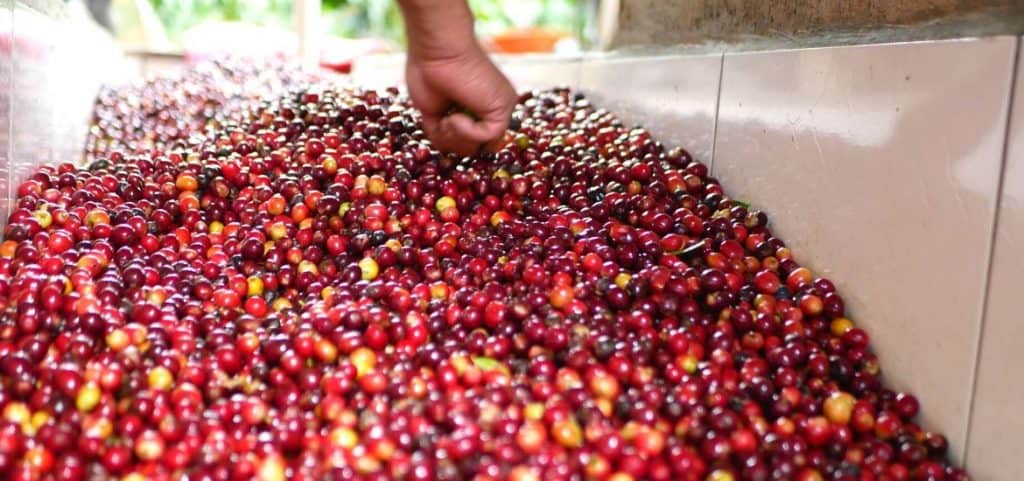
Coffees taste increasingly complex. Experimental fermentation practices are creating new flavors that we haven't found in coffee before. We humans are intervening and adding something to coffee that wouldn't otherwise be there. Where is this journey heading for producers, roasters, and consumers?
Part 1: Challenges
Sensory: How do we evaluate these coffees?
Developments on the coffee production side are sometimes rapid. We hear about Anaerobic Fermentations and Double Barrel Fermentations and Carbonic Macerations. What all sounds interesting are names that are heavily inspired by winemaking. Sometimes these names also sound very artistic. This seems to offer a chance for producers to make a name for themselves with an original name. What fermentation in coffee actually is, we clarify in this detailed article.
This whole development is certainly very interesting from a sensory perspective – suddenly we find flavors of cherry liqueur, violet; these are heavy, schnapps-like coffees, heavily fermented, without drifting into the vinegary part. These are new flavor fields that are just starting to emerge. A few years ago I tasted a coffee where the official cupping score sheet simply didn't seem appropriate to me anymore.
The coffee offered much more than I could have expressed through an evaluation sheet. The aromas were so diverse, I had never encountered such a coffee before. It was a multi-dimensional coffee that I couldn't match against anything in my sensory repertoire.

I rated it at 93 points. But here I clearly distinguish between a professional and a subjective rating – I rated it highly according to my best knowledge and conscience and my cupping experience.
My subjective rating, however, was quite different – did I like the coffee? No. I don't want to drink it again. There was simply too much flavor in too little space. But I am convinced that there is a market for these coffees. Only I think they're hardly found in Europe.
Roasting: how do we roast these coffees?
Now coffee roasters are increasingly coming into contact with these coffees. Us too. On our own farm in Nicaragua, we conduct numerous fermentation experiments and accompany them scientifically. The flavor notes we can create this way are sometimes genuinely absurd. In a positive way.
But we also notice that we need to roast these coffees a bit differently. These are sometimes coffees that are bursting with aroma. It would be a shame to drown these in a more developed, darker roast. We almost always opt for filter coffees with this type of green coffee.
Roasting these coffees requires a lot of finesse to find the right roasting profile. The aroma is intense, it should be retained, but the acidity is often very intense too, so it needs a bit more balance without jeopardizing the aromas. I'd like to encourage all other roasters to try something new here too, perhaps even to leave the familiar roasting path and try something different.
The progress on the production and fermentation side is enormous. I don't see that as strongly on the roasting side yet. I also wonder if our way of roasting is the right one to do justice to such coffees at all?
Enjoying. Are these coffees a pleasure or an expansion of horizons?
I have the feeling that I'm becoming – forgive me – a bit old-fashioned. I notice how these coffees interest me technically and challenge me sensorily, but leave me rather cold gustatorily.
Recently a friend, who at his age is surely already a bit old-fashioned, said that it seemed to him like the Chardonnays from the USA in the 90s.
Lots of texture, lots of aroma, lots of everything, but little inherent flavor.
a somewhat old-fashioned coffee enthusiast
He finds it difficult to enjoy them. He goes for lean wines, elegant, distinctive. I understand him. That's how I understand coffee. Personally, I like elegant coffees, often tea-like, with limited complexity but high clarity. These are coffees I can truly enjoy. The "new-fangled coffees" (oh my, I really am getting old) challenge me anew each time. I can't enjoy them yet, maybe that will come.
2. Opportunities
Anyone who has tasted such coffees must show a little openness, because they taste different. You can simply turn up your nose and enjoy the coffee that tastes more familiar. You can dismiss this as "tinkering," as "newfangled stuff" or as "trend" – I've heard all that in recent months. Or we show a bit more openness and take a closer look at who is making these coffees.
A post from a renowned cupper from Costa Rica irritated me somewhat recently. He turned up his nose, as described above, about these
"trendy cinnamon fruit bombs," that's no longer coffee. He preferred the crystal-clear, juicy and naturally fruity coffees from Tarrazú – which is one of the highest growing regions in Costa Rica.
Cupper from Costa Rica
And that's where the problem lies. Not all producers have a finca at nearly 2000 meters above sea level. The majority don't. The majority is far below that and produces coffee for a market that often cannot cover production costs. A different market channel could help. One that seeks extreme flavors.

With extreme fermentations, we create extreme flavors – and this also at 800 meters above sea level. Of course, not just any raw material can be used; only carefully sorted, ideally very ripe cherries result in great green coffee in the end. But the altitude at which coffee is grown could suddenly be put into perspective.
And that is a huge opportunity for all producers who haven't drawn the big prize of a finca in the highlands, but rather, like most coffee farmers, still hover in the sensory middle ground.
3. Risks
"For they know not what they do"
Heavily fermented and delicious coffees don't just happen. They are not a random product, but the result of a precise, controlled, and intentional post-harvest process.
We often hear about "over-fermentation" when something tastes heavily fermented. We disagree with that. Either something is fermented in a controlled manner, or it isn't. Lucia Solis recently made a comparison in a podcast to a pregnant woman – either a woman is pregnant or not. But she is not a little bit pregnant, or too pregnant. Either she is or she isn't. Just like coffee that has been fermented or not.
"Over-fermented" carries a clear subjective note and historically stems from the fact that uncontrolledly fermented coffees were often referred to as such. Coffees that smell and taste like vinegar, leather, rotten fruit, etc. Those are defects. And those are the product of uncontrolled fermentation, not over-fermentation.
These "modern" flavor profiles tend toward strong, lush fruit notes, often with heavy floral aromas. They remind me of old ladies' perfume.

Creating such a profile requires a lot of knowledge. The know-how must be there, otherwise it doesn't turn out well and the coffee ferments uncontrolledly. Producers who know what they're doing always go to extremes and create even more intense flavor profiles.
Producers who have heard about it and now want to try something are taking quite a high risk of doing many things not quite correctly. This can lead to uncontrolled fermentations.
The pH value, the temperature, the available sugar, the presence of air, the headspace in a closed container, the agitation, the development of temperature, etc. – all these are factors that must be considered during such fermentation. Otherwise it quickly becomes leathery, vinegary, and stinking.
Copy-paste. Will all coffees soon taste the same?
We're lucky that we get to taste a really wide variety of coffees. If we don't order samples ourselves, we get them sent to us. Often these intensive fermentation coffees too. That expands our sensory horizons.
The problem here, however, is that I remember a general flavor profile much more than unique, characteristic qualities.

A coffee from Flores, Indonesia, recently stood on the table next to a coffee from Colombia, and both tasted suspiciously similar. The post-harvest process was such that the cherries first spent 6 days in a barrel without air before being dried as natural for more than 25 days.
This intensive process created such similar notes in both coffees that I almost mixed them up. The Colombian tasted like the Indonesian.
"Is that now tragic?" some might ask. Maybe that's just the way of things. Others, in turn, see here the "loss of retention" and may be nostalgic for profiles that were standard 20 years ago but are increasingly giving way today due to socio-economic, botanical, and climatic conditions.
I am neither a terroirist, someone who seeks "retention" in coffee. Anyone who knows me a bit better knows how much I'm at odds with this term. Nor am I one who blindly follows new phenomena. In this discussion, I see myself as a bystander, because:
Is it up to us roasters to decide what coffee producers should produce and ferment?
Would anyone dictate to a winemaker which profile to expand and which to keep?
I don't think so.
I rather believe that here, for once, the "free market" of sensory preferences will decide. What catches on is decided by coffee drinkers, and those are roasters and coffee drinkers equally. We should simply refrain from writing off these new developments as a "trend" – that would probably be too shortsighted.
Are these coffees health-safe?
Intensive fermentation notes stem from intensive fermentation. Countless microbes and yeasts degrade sugar, raise acidity, and lower pH. Yeasts eventually retreat and bacteria take over. In some cases, mold envelops the half-dried cherry before it is dried in the shade for over 30 days.
It's a collection of life.

I am not a biologist and not a health expert. And precisely for that reason I must ask this question – are these coffees health-safe? If so, are there studies on this?
Harmful bacteria in coffee are killed during roasting. However, if coffees are affected by mold, the risk increases – aflatoxins, mycotoxins found in mold, cannot be completely eliminated through roasting and remain potentially carcinogenic.
Who can help here? Who knows someone who knows whether intensely fermented coffees can pose a potential health risk?
Conclusion
For me, it's far too early for a conclusion. We're just at the beginning of this new era, where coffees from Colombia taste like Flores, where coffees smell of heavy old ladies' perfume in their aroma, where we must realign our sensory standards once more.
What are your experiences with these coffees? We're curious about your feedback and open to learning much more.

