

















Coffee is a direct product of its colonial past. Colonialism is over, but historically grown role distributions persist to this day. The coffee industry does well to repeatedly ask itself which relics of the past stubbornly persist today. This requires engaging critically with history, accepting things, not trivializing anything, and improving communication.
I'm taken aback every time I walk past a shop and read "Colonial Goods" in large letters. What considerations led someone to still communicate with such a loaded term today?
It's quite possible that it's about carrying the company's own origins and history outward. It's also quite possible that it's about the products a shop still offers today and by "Colonial Goods" they mean what traditionally comes from far away, such as teas, spices, cocoa, and of course coffee. It would also be a variant that nostalgia is being indulged in in an awkward and poorly reflected manner.
I stumble over the terminology because I lack the historical context, specifically as it applies now.
From a reading of the past, the term is commonplace - colonial goods historically referred primarily to foodstuffs that did not come from Europe, i.e., from "overseas." It should be noted that these were sometimes countries that were no longer colonies, but sovereign states.
A reading from the present would probably require an explanation as to why the term is still used. If this explanation is missing, you can quickly find yourself in a corner where you must justify what is sometimes a romantic, innocent, and trivializing approach. The coffee trade, coffee production, and the spread of coffee is a direct product of four centuries of colonialism and must be viewed with a watchful eye.
And here we've arrived at a key moment when we want to talk about coffee and its colonial past. We must always read terms, decisions, and actions in the context of their time.

Costa Rica. Machinery used for husking and polishing coffee, UC Davis Library Digital Collections
Switzerland's Role - A Non-Maritime Nation
Switzerland, for example, was not directly involved in the slave trade in the 17th century, the "foundation of Caribbean plantation economies" (p.37, Jürgen Osterhammel), but did provide ships to seafaring powers like Portugal and Spain in the so-called triangular trade.
These, in turn, used them to ship enslaved people from West Africa to the Caribbean and South America to produce goods for the European market on plantations, which were then exported on the same ships. Overall, between the 15th and 19th centuries, more than 12 million people were forcibly taken from Africa to the Americas - according to Jürgen Osterhammel, 1.5 million of them died on the notorious passage. (p.38)

Switzerland was not a nation of seafarers, so most people were likely unaware that Switzerland was involved in triangular trade. Today we know what Switzerland's role was in colonialism (Zangger), so we can no longer hide behind ignorance. (More on this in the podcast with Dominik Flammer)
"Reading from the context of the time" means today: we know what happened in world history between roughly 1500 and 1975, but we no longer have any influence over it. But we do have great influence over how we look back at this time, how we place it in context, talk about it, draw conclusions from it, and more or less reflectively deal with the legacy.
Even more - it is our responsibility to engage critically with what happened and to repeatedly ask ourselves whether we might even be perpetuating colonial structures in what we do?
We work with coffee - and coffee is a broad term for us. When I say "coffee," I mean many things, not necessarily exclusively a cup of espresso or a roasted bean, but the entire commodity chain. The production, the trade, the processing, the serving, the way we talk about it.
Coffee is diverse. It contains various stories from different regions of the world. This diversity also shows how much coffee challenges us. The story of coffee in Brazil with a focus on the colonialist past is different from that in Mexico or Haiti.
If we want to communicate precisely and respectfully about the product and its history, we must understand the individual story of a coffee region. This way we can identify any colonial structures, understand them, translate them into the present, and question them.
On the topic: the podcast conversation with Christian Cwik, historian at the University of Graz, about coffee, slavery, and colonialism
Colonial Structures Today
The largest coffee trading houses are based in Switzerland. As a rule, green coffee and unroasted coffee are exported from a coffee-producing country and only "refined" in the destination country. Many large plantations in India and Brazil are still owned today by descendants of former colonial rulers. In regions like Chiapas in southern Mexico, with the recent history of the Zapatista uprising, it is clear that the fault lines of colonialism run along indigenous borders to this day.
And when we look at the issue of poverty, it is producers who typically cannot afford to produce coffee, and coffee brands in the northern hemisphere who make great profits from the sale of roasted coffee. There are reasons for these facts, and they don't come out of nowhere.
The "coffee system" is based per se on colonial structures.
Many of these have been softened or disrupted over decades. Fundamental, structural characteristics of the coffee industry, however, are thoroughly colonial. In my research for this blog, I was repeatedly astonished at how quickly one could fall into a colonial trap of thinking. Thought patterns had become too established and I questioned them too little.

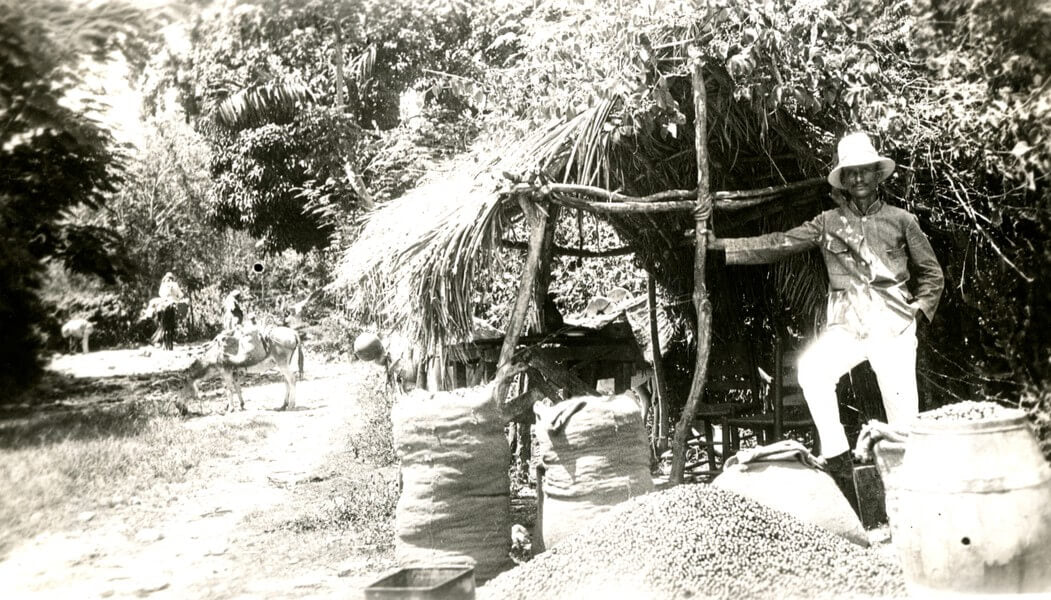
Costa Rica, Thomas Forsyth Hunt, UC Davis Library Digital Collections
When we drink coffee, we're not just drinking a warm, brown beverage. Anyone who has ever been on a coffee farm knows the effect when they drink a cup of coffee at home for the first time - the images in their head from the experience just flood in and the cup gets more colorful. The same can happen to us when we delve into the colonial history of coffee.
It doesn't help yourself, the past, or the interpretation of the present to feel bad about it. On the contrary - it helps to bring conscious awareness into focus and give even more appreciation to the people behind the coffee. At the same time, it sharpens our view of what seems normal, such as "Colonial Goods." We don't need to demonize the word, but it should trouble us - then we've all taken a step further in how we can think about coffee.
Coffee as an Export Product of Colonial Powers
Many products from subtropical agriculture were imported to Europe - spices, sugar, tobacco, indigo, cocoa, but coffee, since its arrival in the first urban coffeehouses, had this mix of promise and the forbidden, which made it so attractive to many.
Coffee is now produced in more than 60 countries. In all of these countries, except present-day Ethiopia and South Sudan, coffee was originally not a native plant but was brought by colonial powers. Administrators and missionaries were often the ones who planted coffee seeds in the subtropics.
In 1893, French missionaries planted coffee in the Taita Hills in Kenya for probably the first time. Their Bourbon variety coffee seeds were likely brought from Reunion.
The first producers in Kenya who consequently planted the coffee and called it "French Mission" were all settlers to whom the colonial power Great Britain had granted land rights. (worldcoffeeresearch.org)
This example makes it clear: coffee didn't simply spread - which gives the whole discussion a passive role. Travelers, scientists, and merchants who belonged to a colonial power actively spread coffee by transporting seeds and plants by sea freight to other continents.
The goals were both economic exploitation and botanical exploration of a previously unknown plant. It was primarily scientists from Holland, France, and Great Britain who undertook scientific examination of coffee, with a long focus on botanical typology.
Coffee Rust as a Direct Product of Colonial Expansion
However, the first coffee research facilities emerged much later: 1870 on Java, 1887 in Brazil, and 1896 in the Dutch East Indies. Until then, it apparently wasn't necessary to fundamentally investigate coffee's behavior and diseases, because coffee producers - all colonizers or appointed officials - could repeatedly increase production volume through deforestation and the use of cheap labor.
"as land remained cheap and plentiful, the simple but wasteful method of opening up new estates as soon as the old ones begin to be exhausted, seemed always preferable to an intricate and laborious study of the best means preserving land already under cultivation" (Stuart McCook, p. 31)
With the first documented coffee rust outbreak in 1869 in Ceylon, this changed abruptly. Coffee rust was previously unknown, occurring neither in present-day Ethiopia, the origin region for Arabica coffee, nor in Yemen, from which the Dutch, French, and British embarked on their voyages to Southeast Asia.

According to Stuart McCook, the coffee rust must have developed in Ceylon and multiplied rapidly because the large estates were planted in monoculture and not separated by trees. The first massive rust wave was a direct product of European expansionist policy.
Land Dispossession and Enslavement
The cultivation of coffee in the new colonies usually required the violent appropriation of land along with forced labor on plantations. As Osterhammel writes about colonial economics:
In many parts of the overseas world, conquerors initially sought ways to make the indigenous rural population work for them. Complete enslavement of the native population rarely lasted for long, but other forms of unfree labor were nearly universal. Characteristic of 16th-century Spanish America was the assignment of indigenous labor to private individuals by the crown, which was not less coercive and brutal than slavery. (p.81, Osterhammel)
Especially in more recent colonial history, Osterhammel continues, enslavement and forced labor were replaced by loss of access to land, which almost inevitably caused irreversible impoverishment. Land dispossession was directly supported by the colonial state; settlers - such as the French missionaries mentioned - occupied land and soil.
"The most valuable soils fell into foreign hands,"
Osterhammel continues, which drove the territorial expansion of large-scale haciendas into the early 20th century. The private, sprawling estates grew ever larger, extending into the land of village communities and smallholders, which led to a "marginalization of agricultural workers" (Osterhammel). When land takeover didn't occur, customs, traditions, and loose agreements were replaced by cadastres, land surveys, and new ownership titles that imposed new property rights.
Specific Colonial Stories
"Colonialism" is more present today than ever, especially when it comes to understanding one's own role in the world and in the context of climate justice. The legacy of the past permeates the present in recurring discourses about norms, terminology, or the structures underlying the coffee industry.
Osterhammel on this again:
As a focal point for contemporary self-understanding, colonialism usually appears either in the form of concrete historical events or as a quasi-dehistoricized term for foreign domination, racism, white supremacy, and illegitimate appropriations.
On the one hand, there is the macro level, the view from far above, of how colonialism and coffee interact. I want to draw attention to these patterns, manifestations, and historical derivations here. On the other hand, there are countless micro levels, nourished by specific stories and growing into a dense, large whole.
Coffee and Colonialism in Historical Examples - from Jonathan Morris, Decolonizing the History of Coffee
Slave Ships
There are stories of slave ships, such as that of the Leusden, a ship of the Dutch West India Company, which sank on the way to Suriname. On board were 680 women, men, and children from West Africa who were to work on coffee plantations. The sinking of the Leusden is the largest documented massacre during the transatlantic slave trade. Primarily people from West Africa were enslaved and used on plantations in South America. Suriname was responsible for half of the coffee drunk in Europe in the 1760s.
Haiti
Haiti was also one of the largest coffee producers before a war sparked by Napoleon and his subsequent defeat in 1804 led to the declaration of independence. Haiti could never again match its former times as a large coffee producer - the infrastructure was destroyed after the war, but according to Morris, another reason was that European buyers did not want to do business with a "Black Republic" that stood against Napoleon.

Haiti. Hand pulping machine for coffee, Thomas Forsyth UC Davis Library, Digital Collections
Brazil
Brazil replaced Suriname and Haiti as the largest coffee producer. Settlers in Brazil and other Latin American countries produced increasingly more coffee in the 19th century, which brought new forms of exploitation, land appropriation, and forced labor. Previously uncultivated land was planted with coffee, settlers were encouraged to privatize this land and expel the former inhabitants.
Mexico
In Chiapas, Mexico, the "Law of Colonization" came into force in 1883 and divided public land into private units, primarily sold to European and North American settlers. Indigenous people were often "hired" as workers on the farms - they were paid for their travel and provisions to the hacienda, but once there, they were indebted to the owners and had to work off this debt on the farm.
El Salvador
In El Salvador, there are good sources for own currencies of haciendas in the 19th century. The farm currency system, fichas de finca, became widespread in Latin America as a payment system for pickers. Workers lived on the hacienda, worked there, and were paid in the hacienda's own currency, which they could then use to shop in the stores on the hacienda itself. This closed system thus kept workers on the hacienda economically trapped, as they could not use their coins anywhere else.

What Now With This Legacy?
Stories about colonialism and coffee must always be told specifically for better contextualization. We can get a feel for an era of several hundred years, but individual stories help us better contextualize the past and present.
We can read colonial history just as well through a coffee lens. In this post, we cannot condense 400 years of colonialism, but we can point out that we should also examine history from a coffee perspective.
Because there are still structural characteristics in the coffee world today that are closely intertwined with the colonial history of coffee. We've become so accustomed to some of them that we hardly question what is given.
The Coffee Exchange
- The prices for green coffee are still largely set, as before, where no coffee grows: at the commodity exchanges in New York and London
- exchange prices do not reflect production costs, but instead show supply and demand
- actual production costs are not reflected in the current system. Efforts to establish regional minimum prices are slowly progressing, e.g., the discussion about regional FOB prices through Fairtrade
Large Farms, Land Ownership, and Labor
- Farms that are large today were already large in the past, or were able to grow because they had better starting conditions. For example, land rights that were granted to mostly colonial owners were denied to indigenous people
- often, large so-called estates in Brazil, Central America, and into the 19th century in the Caribbean, were characterized by owners who themselves belonged to the colonial power or these settlers were promised land from their country of origin
Good Green Coffee is Exported, Inferior Green Coffee Stays in the Coffee-Producing Country
- even in coffee-producing countries, the need for good coffee among clients is growing, so increasingly more good green coffee remains in the producing country
- but the lion's share of good green coffee leaves the country. "Every coffee has a home" one often hears, and so it has ironically become almost self-perpetuating that inferior coffee has become standard in the exporting country
Coffee is "Refined" in the Receiving Country
- as a rule, roasteries buy green coffee and roast it where it is consumed
- today, however, all technical prerequisites are fulfilled to roast coffee well, reliably, and with quality in the producing country
- shipping times can also be kept short
- thus, the argument that coffee must be roasted in the target market itself to guarantee freshness is outdated
- arguments such as time-to-market, quick response to unforeseen circumstances as well as shipping costs and emissions, however, argue against it
- concepts such as Moyee, Coffee Annan, or Desarrolladores de Café etc. show, however, how efficiently and effectively roasting can be done at the origin of coffee
Cheap Coffee requires primarily two things: cheap labor and maximum efficiency.
- Roasted coffee in Central Europe has become only marginally more expensive over the past 30 years, taking inflation into account, while production costs in all coffee-producing countries have multiplied.
- Where maximum efficiency brings prices down (Brazil), labor is more expensive than, for example, in Nicaragua, where labor is much cheaper. However, a trend is increasingly evident in Central America: workers who previously worked seasonally on coffee farms are leaving their homes and migrating northward.
- In northern Guatemala, for example, pickers are leaving their homeland to pick in Mexico. They earn minimally more, as they lose wages when exchanging currency upon return. Why do they do it anyway? Because they get to eat on the farms, while they would go hungry in Guatemala. On my last trip to Mexico in October 2022, I learned a lot about this from Ensambles Café
The Problem With Logos
Even in recent times, brands have had to revise their logos and bring them up to date. Julius Meinl, for example, only changed its well-known logo in 2004, in which a small "Moor" was colored red

Source: Citybee
As recently as spring 2021, I saw this logo in Florence, which had apparently persisted for years and the operators saw no reason to change it.

And Now? What Should We Do?
Keep calm.
Don't demonize anything.
But become more sensitive, look at your own history and that of coffee companies again and again, and ask yourself these two simple questions for the colonialism quick check:
Is the action and/or inaction of a practice timely?
Does it need correction? If so, for whom, and what does it matter?
We must regularly examine our own history and always keep in mind whether our thinking is shaped by old patterns. Coffee would likely have developed differently without European expansionist policy. Now it's up to us to shape the future of coffee with an honest look at the past.
A Selection of Literature Used
Coffee & Colonialism, Erika Koss
Decolonizing Coffee, Jonathan Morris
Colonialism, Jürgen Osterhammel
Stuart McCook, Coffee is not forever
All photos in black and white: https://digital.ucdavis.edu/search/forsyth/%5B%5D//10/