












Every coffee beverage consists of at least 90% water. A filter coffee even consists of more than 98% water. Less than 2% are dissolved coffee particles (TDS). These figures illustrate how important water is for coffee brewing. Coffee water should be flavorless and free of chlorine or other taste-affecting contaminants.
But even if the water from your tap tastes good, it isn't necessarily the best coffee water. The amount of minerals in your water has a decisive impact on the taste of your coffee as well as the longevity of your coffee or espresso machine.
In our coffee water guide, we recommend the right water hardness for filter coffee and espresso. You'll learn how to determine the hardness of your water. We work out which filtration method will bring your water into the target range. Water from some regions is not well suited for brewing delicious coffee even after filtration. A "mineral water calculator" helps you decode any mineral water label and find suitable coffee mineral water to purchase. Another formula calculates the mixing ratios between two waters to achieve target water.
The foundations for this article were developed by Michel Aeschbacher. Many thanks for the support from Otto Wyss of BWT and Dr. Marco Wellinger from ZHAW in Wädenswil.
More articles about filtering coffee:
- Filtering with water filter pads
- Filtering with water filter cartridges
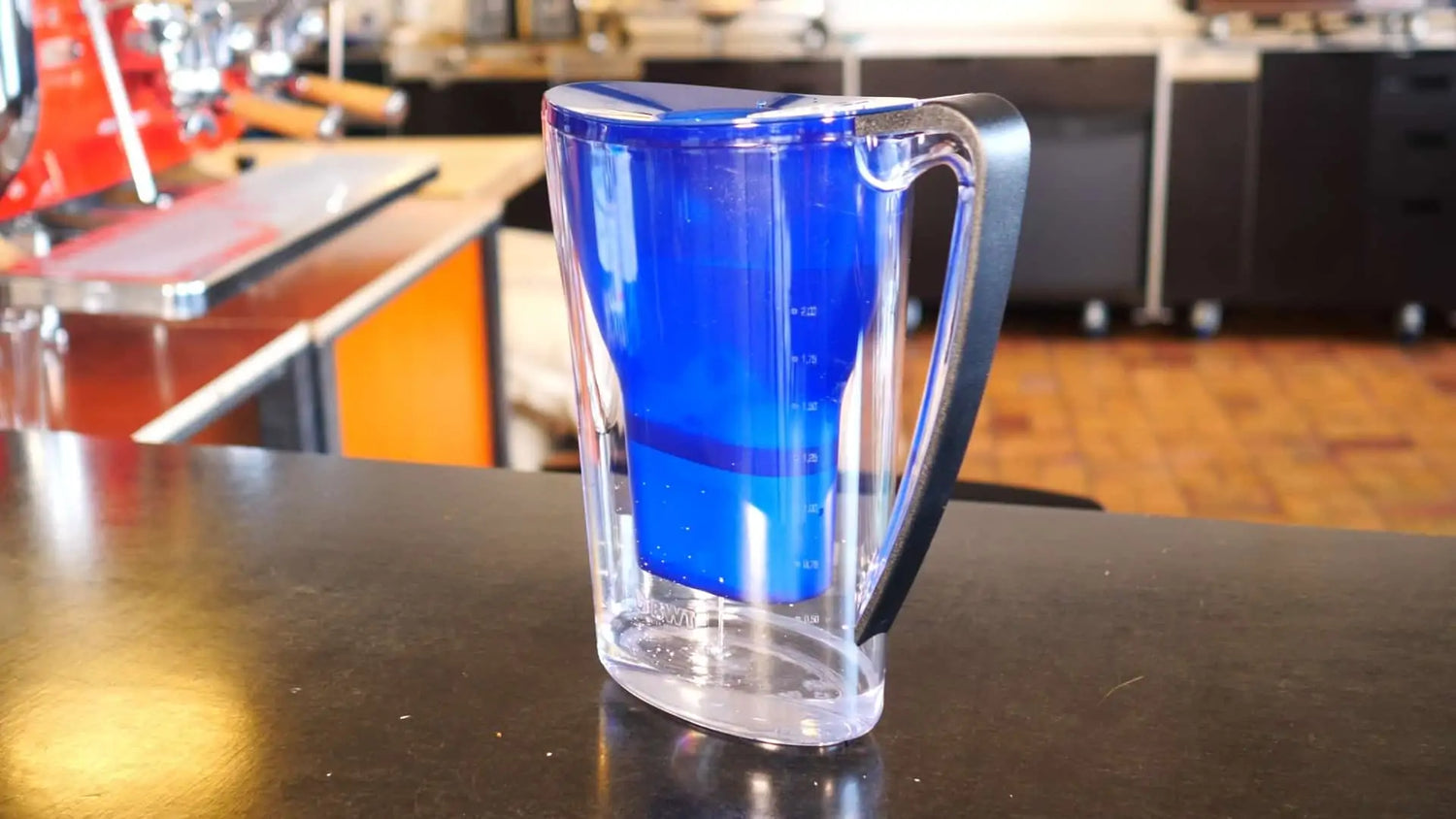
- Filtering with countertop water filters
- Total hardness = Magnesium Mg+2 and Calcium Ca2+
- Alkalinity = Hydrogen carbonate = Bicarbonate = HCO3-
- Total hardness: 2 – 3 °dH
- Alkalinity: 1 – 2 °dH
- Total hardness: 3 – 6 °dH
- Alkalinity: 2 – 4 °dH
- For calcium, it's 40mg/L versus 100mg/L hydrogen carbonate. Thus the factor is 2.5.
- For magnesium, it's 24mg/L, and accordingly the factor is 4.1.
- For hydrogen carbonate, the factor is 0.82
- That means: calcium in mg/L divided by 7.1 plus magnesium in mg/L divided by 4.35 equals total hardness.
- The hydrogen carbonate value in mg/L is divided by 21.8 to calculate alkalinity in dH.
- Cations = Positive equal to or larger than total hardness (sodium, potassium)
- Anions = Negative equal to or larger than alkalinity (sulfate chloride)
- Total mineralization in mg/L is all minerals in the water as well as salts.
- Conductivity is also all minerals in the water measured in micro siemens μ S/cm.
- Often all values are also given in ppm (parts per million)
- The pH value is also measured, which in most water hovers around the neutral value of 7. Rainwater, for example, is already acidic due to the carbon dioxide it contains, with a pH of about 5.5
- First use sodium exchange to reduce total hardness to about 14° dH.
- Then use a classical decarbonizer to reduce both to 4° dH GH and 2° dH alkalinity.
What is good coffee water?
Good water for coffee preparation is very soft. Soft water has absorbed a small amount of dissolved and broken down minerals.
"Soft" refers to "hardness." For coffee preparation, we're mainly interested in two measurements: total hardness and alkalinity.
At this point, a water chemist would launch into a lecture. For now, only the essentials matter.
Total hardness and alkalinity are specified in different units of measurement. We recommend good coffee water in German hardness degrees here and explain below how you can convert all other units.
Perfect water for filter coffee:
Perfect water for espresso:
Alkalinity vs. Carbonate hardness: Test kits for measuring water hardness and other sources refer to carbonate hardness instead of alkalinity. We address this further below and use the more precise term alkalinity here in the text.
Do you need to know more to brew good coffee? Not necessarily. If you have this water available. Then enjoy your coffee. If not, keep reading.
What water do I have at home? Let's measure together
The easiest way is if perfect coffee water comes from your tap. In some regions, it does. A few years ago, Benjamin traveled through Switzerland tasting and measuring water from springs, brewing coffee according to the same protocol each time. In many regions of Valais, perfect water flows from the tap.
Water hardness can be measured with different equipment. A conductivity meter can provide information just as well as a ppm meter. The simplest and cheapest way to measure is a drop test (titration test). This allows you to easily measure total hardness and alkalinity.
10 ml is placed in a clean plastic test tube. Then the test drops are added one by one. Each drop represents one degree of hardness. When you reach the hardness degree of your water, there's a color change of the mixture in the test tube. This indicates the effective hardness of your home water.

How and what does the countertop water filter filter?
A countertop water filter does its job. It's available from well-known brands like BWT or Brita and other smaller brands. The countertop water filter only decarbonates half of the water with each filtration. The other half only passes through an activated carbon filter. In 50% of the water, total hardness and alkalinity are unaffected, while the other 50% of the water is fully decarbonated.
Let's calculate an example. We go through another example in our water video.
From our tap, we measured water with a hardness of 16° dH total hardness and 12 °dH alkalinity. This is our starting point. From 50% of the water, we remove all the alkalinity and exactly the same amount of total hardness, since we can only remove pairs of total hardness and alkalinity.
From 12 °dH, 6 °dH alkalinity remains. We also reduce total hardness by 6 °dH because it's removed as a pair. The result after the first filtration is 10 °dH GH and 6° dH alkalinity.
Now we can halve the alkalinity again with the second filtration, but the difference of 4°dH to the GH remains. Thus, after the second filtration, we reach a value of 7° dH GH and 3°dH alkalinity. With this, we're almost in the target range of desired coffee water hardness. Another filtration brings us into the perfect target range for espresso with 5.5 °dH GH and 1.5° dH alkalinity.
Admittedly, it's a complex procedure. But one that works in many cases.
The water filter with fixed water connection

Water filters connected to fixed water supply have significantly higher filter effectiveness through water pressure. Here, larger quantities of water can be filtered in a single pass to the target range and beyond.
If the water becomes too soft, it can be adjusted to a desired target level by mixing it with tap water. With the filter cartridge, the difference between total hardness and alkalinity also remains.
During decarbonation, an ion exchange occurs where magnesium and calcium are replaced by hydrogen ions bound to hydrogen carbonate. This reduces total hardness and alkalinity equally. The pH value increases the more we filter.
For whom is a fixed water connection the right solution?
If you drink a lot of coffee and have hard water, then a permanently installed filter system is an excellent solution. It's very convenient and guarantees the longevity of your high-quality equipment. Relative to the acquisition costs of an espresso machine and grinder, the installation costs of a filter system are manageable. Over 90% of all machine defects are due to water that's too hard.

Installation at your home water line should be carried out by professionals, especially in rental apartments. Ultimately, however, it's not complicated. The fixed water filter can be connected to the cold water line of your kitchen via a T-fitting. If, in rental apartments, no additional hole can be drilled in the worktop, we recommend simply converting the cold water tap into a "filter water tap." To do this, you don't insert a T-fitting in the line; instead, all cold water is completely run through the filter and drawn from the tap.
The hot water remains "normal" water and can be used without accelerating the consumption of the filter cartridge.
Mineral water as coffee water
Who doesn't know this? You're on vacation and want to brew yourself delicious coffee. Your hand grinder and your favorite beans are ready. But the tap water tastes like chlorine or smells unpleasant, and your coffee doesn't taste good.
Mineral water from the supermarket can be the solution. But the information on the bottle is overwhelming. What do sulfate and chloride have to do with my total hardness? How do I find the total hardness to find the right coffee water?
Our mineral water calculator can help you. Basically, you only need three values: calcium, magnesium, and hydrogen carbonate.
Mineral water bottles usually indicate total mineralization in mg/L. With this, we can calculate German hardness. Calcium is heavier than magnesium but lighter than hydrogen carbonate.
Read the mg/L values from your water bottle for calcium, magnesium, and hydrogen carbonate and enter them into the formula. Below, for those interested, is the derivation.
Example Volvic:
| Mineral | Value | Calculation |
|---|---|---|
| Calcium | 12 mg/L | ÷ 7.1 = 1.69° d |
| Magnesium | 8 mg/L | ÷ 4.35 = 1.84° d |
| Total hardness | 3.53° d GH | |
| Hydrogen carbonate | 74 mg/L | ÷ 21.8 = 3.39 |
| Total alkalinity | 3.39° d Alk | |
The calculation is based on the amount of calcium or magnesium we need relative to hydrogen carbonate so that limestone forms.
When we apply these, we get a value in parts per million calcium carbonate, which gives us the effective amount of particles. Since this must then be divided by 17.85 to achieve German hardness, we take the direct path without an intermediate step.
Ignore all other values on the bottle for now.
Mixing mineral water and tap water
Mixing can work too. A harder water and a very soft water together can create perfect water. A higher tap water portion reduces water costs for buying mineral water.
The following calculation helps you mix two waters to create your target water. Have fun mixing.
Desalination systems are a coffee water problem!
Desalination systems supply entire houses with water. Here too, ions are exchanged, namely calcium and magnesium for sodium. This greatly reduces the total hardness of the water. Alkalinity, however, remains.
Alkalinity can also be described as acid-neutralizing capacity. In nature, this is a good effect because it "reverses" acidic water. For coffee, this is problematic. Coffee — like many complex delicacies — lives from acids that balance and stabilize the coffee's flavor. When these acids are buffered by high alkalinity, the coffee becomes bland and dull as a result. The finest coffees in the world taste like standard coffee and lose their character. Therefore, while desalination systems are advantageous for reducing scale formation, they're problematic for preparing coffee water.
In houses with desalination systems, usually the only option is to go to the garden. As a rule, garden hoses are not connected to the desalination system. Here the process of measuring and filtering via decarbonation or resorting to mineral water begins again.
Desalination systems are not suitable for preparing good coffee water!
Basics about water
Minerals are basically uncharged. Dissolved in water, they break down into charged fragments called ions.
We call carbonate hardness the equality between alkalinity and mostly calcium, since limestone can form from these. Example: 20° dH total hardness and 12 °dH alkalinity equals 12° carbonate hardness
We measure with different methods:
| Unit | ppm CaCO₃ | °d | °f | Ca²⁺ + Mg²⁺ (mmol/L) | HCO₃⁻ (mmol/L) | Ca²⁺ (mg/L) | Mg²⁺ (mg/L) | HCO₃⁻ (mg/L) |
|---|---|---|---|---|---|---|---|---|
| 1 ppm CaCO₃ = | 1 | 0.05603 | 0.1 | 0.009991 | 0.01998 | 0.4004 | 0.2428 | 1.219 |
| 1 °dH = | 17.85 | 1 | 1.785 | 0.1783 | 0.3566 | 7.147 | 4.334 | 21.76 |
| 1 °fH = | 10.00 | 0.5603 | 1 | 0.09991 | 0.1998 | 4.004 | 2.428 | 12.19 |
| 1 mmol/L (Ca²⁺+Mg²⁺) = | 100.1 | 5.608 | 10.01 | 1 | – | 40.08 | 24.30 | – |
| 1 mmol/L (HCO₃⁻) = | 50.04 | 2.804 | 5.004 | – | 1 | – | – | 61.02 |
| 1 mg/L (Ca²⁺) = | 2.497 | 0.1399 | 0.2497 | 0.02495 | – | 1 | – | – |
| 1 mg/L (Mg²⁺) = | 4.118 | 0.2307 | 0.4118 | 0.04114 | – | – | 1 | – |
| 1 mg/L (HCO₃⁻) = | 0.8202 | 0.04595 | 0.08202 | – | 0.01639 | – | – | 1 |
Where does the difference between total hardness and alkalinity come from?
In principle, water consists of equal parts of total hardness (magnesium and calcium) and alkalinity (hydrogen carbonate). But this is very often not the case because another mineral is added: gypsum. Gypsum consists of calcium (positive) and sulfate (negative). This is usually the difference between GH and alkalinity and cannot be reduced with normal filters. Thus, the difference between GH and alkalinity remains the same despite filtration.
Only desalination would help, which should then be adjustable so that not the entire amount of magnesium and calcium is exchanged.
Practical example: raw water with 20° dH GH and only 12° dH alkalinity.
Alternatively, reverse osmosis can also exchange all mineralization and then be re-enriched with magnesium and calcium.
Danger zones for scale formation and corrosion


Source: https://www.bmlrt.gv.at/wasser/wasserqualitaet/grundwasser/karte_haerte_GW2017.html

Source: Water hardness map Germany: People, Water, Sun, Heat & Environment, Issue 1997, Environmental Brochure of the Tegernseer-Fach-Gruppe e. V.
Soft water is one of six variables. The other five — amount, grind size, distribution, time, and temperature — are covered in preparing espresso.