



























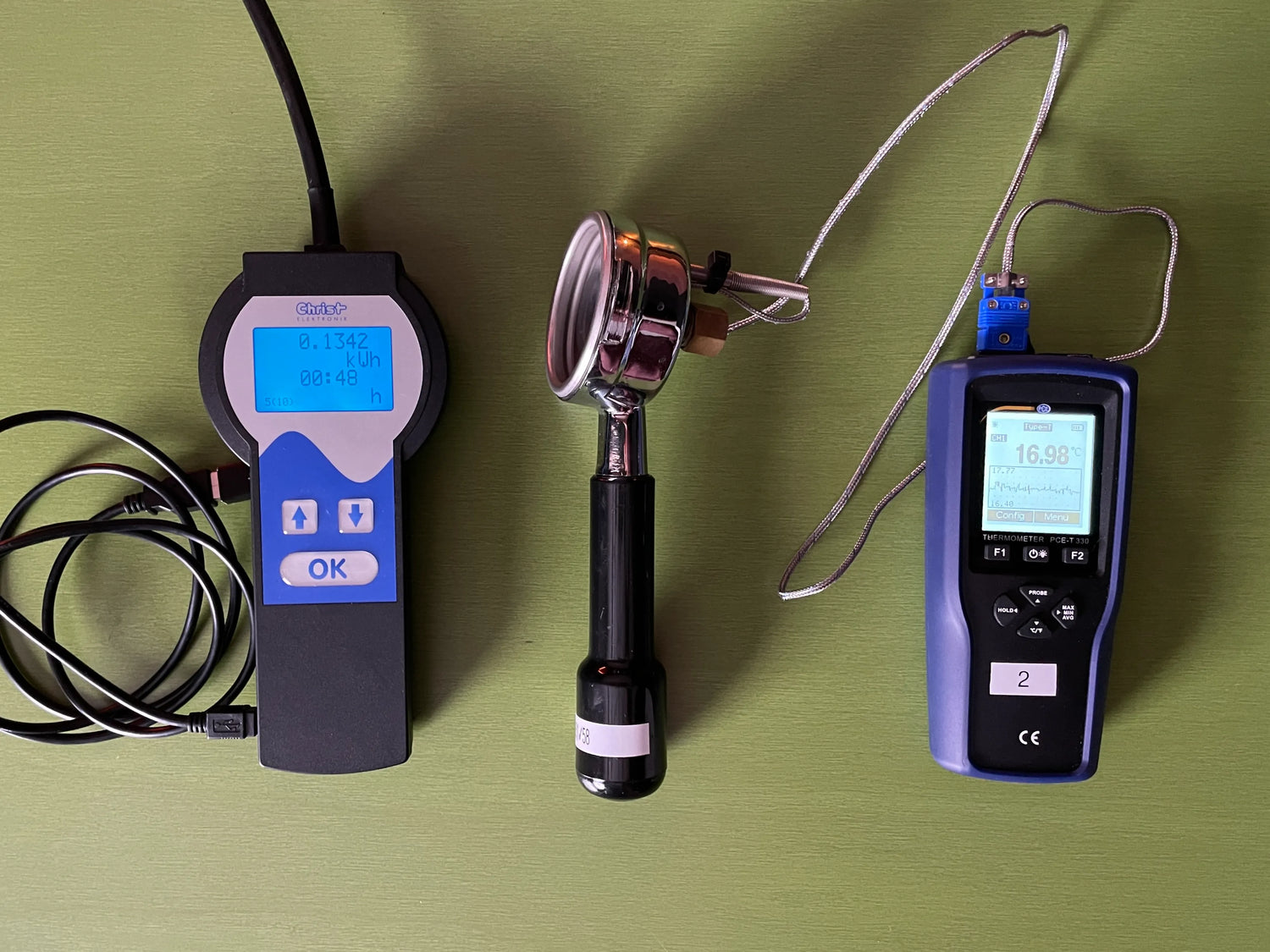
We have revised our power measurement protocol to ensure better comparability and create transparency. To do this, we took a closer look at how energy labels are measured and critically examined our own measurements.
It was important to us to develop values that represent everyday use and can make it more efficient.
The article explains how we measure, how the results come about, and presents our equipment. We now measure espresso machines with all technologies. If a machine does not have a steam function, the corresponding measurement is omitted. If a dual boiler has no option to shut off the steam boiler, we continue without this measurement in the protocol.
Otherwise, we perform the measurement once with and once without the steam function.
Measuring instruments
Power measurement
To obtain precise and reliable values, appropriate measuring instruments are a prerequisite. For this reason, we have acquired three Christ CLM1000 Professional (Plus) devices. The Christ CLM1000 Professional (Plus) provides second-by-second measured values for power consumption and energy consumption at a resolution of one tenth of a watt-hour. This corresponds to 0.0 Wh or 0.0000 kWh.
The measuring device transmits the measured values via USB and we can save and evaluate them as CSV.
Measurement setup
Preparation
In our first power comparison protocol, we set a heating time to achieve high comparability. However, this does not correspond to actual use and penalizes machines that heat up faster and are brew-ready. Why should you wait 25 minutes at home when the machine is ready after 10 minutes?
Therefore, we try to empirically and in consultation with manufacturers determine when the machine is really at brewing temperature. The exchange with the manufacturer gives us a target value that we verify with our measurements (see temperature measurement protocol).
When is an espresso machine considered temperature-ready?
A machine is considered ready when the target temperature of 92 °C in the portafilter is reached on the first extraction (extraction shot). A preceding 5-second flush with the portafilter locked in is performed to accelerate heating of the portafilter (flush shot).
Depending on the machine and function, we determine the starting temperature with and without the steam boiler.
The heating time is taken into account in the power measurement. After heating, the extraction power measurement begins.
Performing the power measurement

We perform the power measurement in parallel with a temperature measurement. For both measurements, the test machine must be "cold". For this, a rest time since last use of at least 6 hours is defined. The water tank is filled with water at room temperature (20 - 24 °C) to maximum volume. The machine is unplugged and, once the measuring devices are ready, is plugged in and switched on.
Once the machine is ready after the predetermined time, 5 extractions of 26 s ± 1 s are made (the procedure for temperature measurement is covered in the temperature measurement section). Before the first extraction, a 5 s flush is performed once with the portafilter locked in (part of the warm-up phase) and one minute is waited between extractions. Subsequently, a 2 s flush is performed before each extraction and then extraction is made. The two-second flush is also called "flushing" and simulates cleaning of the shower screen.
Then we extract 5 x 70 g ±5 g of hot water from the hot water dispenser to simulate an Americano. We also wait one minute after each extraction. If the machine has the ability to adjust steam power, the steam extraction is always measured at maximum power.
In a final phase, energy consumption in "idle" mode is measured. For this purpose, we leave the machine on for at least 20 minutes.
One test machine, one test series
Data collection is performed on one test machine and in one test series. There can be slight control-related variations from machine to machine.
Evaluation of power measurement
For the evaluation, we always take the timestamp and energy value from the CSV file and enter it in the measurement data table.
Typically, the data is read as follows:
- End heating = Espresso extraction start,
- Espresso extraction end = Americano start,
- End Americano = Milk steaming start
- Milk steaming end = Keep warm start
However, if pauses occurred during the measurement, these are taken into account during evaluation. Data points always consist of two values: timestamp t and consumption E at that point in time. tAA = 11:12:12 = Time point heating start and EAA = 0 = Heating start
Heating
We take the first data point from the measurement and the data point that can be obtained after the previously specified time. Here a check is still performed to see if the first extraction then also starts.
Calculation: EA = EAE - EAA
Example: 0.1000 kWh = 0.1000 kWh - 0
Espresso extraction consumption
Calculation: EE5 = EEE - EEA
Example: 0.0077 kWh = 0.1200 kWh - 0.1023 kWh
Calculation: EE1 = EE5 / 5
Example: 0.00154 kWh = 0.0077 kWh / 5

Hot water consumption
Calculation: EA1 = EHE - EHA
Example: 0.0050 kWh = 0.1250 kWh - 0.1200 kWh

Steam / milk steaming consumption
We also note the value we have set for the steam extractions. For example: tD = 25 s
Calculation: ED5 = EDE - EDA
Example: 0.0100 kWh = 0.1250 kWh - 0.1200 kWh
Calculation: ED1 = ED5 / 5
Example: 0.0020 kWh = 0.0100 kWh / 5

Keep warm consumption
By keep warm, we mean "ready for immediate use", i.e., neither standby nor power-saving mode.
Calculation: EW = EWE - EWA
Example: 0.0150 kWh = 0.1450 kWh - 0.1250 kWh
Calculation: EW60 = EW / (tWE - tWA) * 3600 s
Example: 0.1800 kWh = 0.0150 kWh / (14:10:00 - 14:05:00) * 3600 s
Espresso, Americano and Cappuccino consumption
For the calculation of an espresso, as well as for the calculation of a cappuccino, we included the heating time. We conducted a survey in our community with 2,700 participants. This examined typical usage behavior. One finding related to regular heating and extraction of coffee: in most cases, heating is done and then one or two extractions are performed.
Therefore, we include the heating time in the consumption calculation for one extraction.
Espresso calculation: EE = EA + EE1
Cappuccino calculation: EC = EA + EE1 + ED1
Coffee maker protocol consumption (EKM)
In older videos, our consumption specifications always refer to a heating time of 25 minutes and 5 extractions with 1 minute pauses between extractions. So that we also have comparability to the old videos, we also provide this value as EKM.
Note here, however, that the older values can appear comparatively too high for machines with faster heating time.
Coffee maker protocol calculation: EKM = EA + EE5

Feedback and measurement standard
This measurement protocol has been tested multiple times in practice and has evolved through feedback from espresso machine manufacturers. Thanks for the differentiated feedback to Holger Dreißig from Xenia Espresso as well as Julian Thomas and Patrick Lieser from Profitec.
Xenia uses the power measurement protocol to optimize and develop comparison values with other espresso machines. Profitec and ECM also use the measurement protocol in development and to obtain comparison values.
Do you have questions about our measurements? Have you already measured your own machines? We look forward to your feedback and comments.
If you want to learn more about energy optimization or other sustainability articles in the coffee field, sign up here for our corresponding newsletter.


