




The Q-Grader program of the Coffee Quality Institute (CQI) is the world's most renowned coffee sensory training. Q-Graders go through a demanding training and examination program. In 20 exams, they demonstrate their skill in sensorily evaluating coffee and identifying and assessing defects in green coffee (unroasted).

Q-Graders analyze the quality of coffee using a standardized cupping and evaluation protocol. They are calibrated to provide objective assessments. They rate the quality and intensity of acidity, body, flavor and aroma of a coffee on a scale between six and ten. Coffees rated above 80 points are considered specialty coffee.
A Q-Grader in Singapore evaluates coffees on the same basis as a grader in Korea or Mexico. A Q-Grader's license is valid for three years. After that, a Q-Grader must undergo calibration and license renewal.
The Q-Grader program was created for rating Arabicas. In the meantime, there is also a protocol for rating Robustas, the so-called R-Grader program.
Swiss, German and Austrian Q-Graders
Currently, the following Q-Graders are active in Switzerland (follow the link and search for "Switzerland"). Around 50 Q-Arabica Graders are now certified in Switzerland. This is quite a lot when you compare it to, for example, Germany, where 31 Q-Arabica Graders are certified. The high density also reflects the fact that Switzerland is an important location for coffee trade and quality assessment. Austria has 6 Q-Graders, Great Britain has 9.
Q-Grader Exams
All 20 exams must be passed. Failed exams can be retaken 2 times within 18 months.
General Coffee Knowledge
100 questions on coffee cultivation, processing, brewing, roasting and the coffee market. Knowledge of SCAA manuals is required (Water Quality, Coffee Cuppers, Coffee Brewing, Coffee Processing, etc.).
3 x Sensory Skills Test
Three tests must be completed. They all revolve around identifying and rating salt, acidity, and sweetness in solutions.
- 1 – 2: Identification and ranking of three solutions each
- 3: Mixed samples in which, for example, sweetness of intensity I is paired with salt of intensity II must be identified.
4 x Cupping Skills Test
6 coffees from each of the following four categories must be correctly evaluated in their own coffee.
- Washed Milds (Central America)
- African coffees
- Asian coffees
- Natural processed coffees
Olfactory Skills Test (4 Tests in 2 Parts)
The various aromas of le Nez du Cafe must be identified and classified.
Triangulation Tests
For each of the four groups of cupping tests, a triangulation is performed. The participant must discriminate one different cup from six sets of three cups each.
Organic Acids Matching Pairs
Four of the acids found in coffee must be identified: acetic, malic, phosphoric, and citric acid
Arabica Green Coffee Grading
350 g of green coffee must be sorted and rated. Defects must be noted, counted and rated, and the coffee must be graded.
Arabica Roasted Coffee Grading
Roasting defects must be identified in a 100 g batch.
Roasted Sample Identification
From four brewed coffees, you must identify which coffee is "underdeveloped," "over-roasted," "baked," or "perfectly" roasted.
More information about Q-Graders can be found here directly from the Coffee Quality Institute.
Starting in October 2025, a new assessment form, the Coffee Value Assessment, will be introduced. Here we have discussed and analyzed this in detail.
The Q-Grader Profession
Q-Graders work as professional coffee tasters in export and import. They serve a relay function as they provide feedback on coffee quality to coffee producers and also inform potential buyers. The Q-Grader's assessment is crucial in determining the selling price of green coffee.
Moreover, many larger companies in development and quality control have filled positions with Q-Graders. Increasingly, smaller roasteries also employ a Q-Grader, thus gaining access to a specialized vocabulary.
Part of the Q-Grader training involves developing linguistic expressions that match sensory impressions. You learn to describe coffee as precisely as possible according to a framework. Once you speak this language, it's much easier to navigate the trade.
In the country of origin, both Philipp and I experienced that Q-Grader training made conversations with local tasters much easier. On one hand, there's unity in the fact of having passed a really difficult exam. On the other hand, you don't have to spend a lot of time figuring out what everyone understands by quality. Communication becomes much easier when you verbalize what you're looking for.
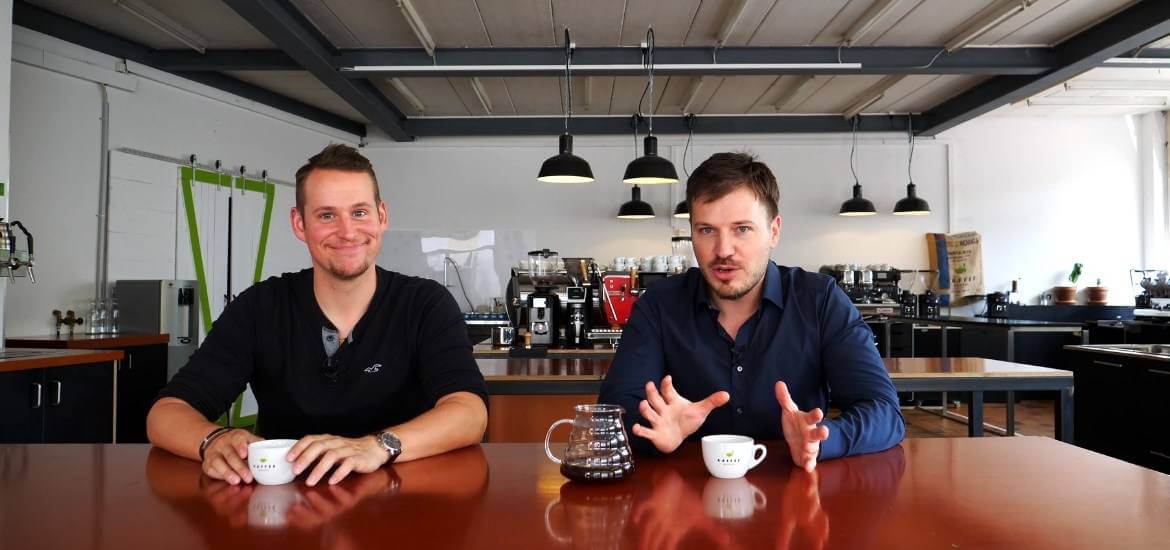
Our Q-Graders![]()

Nadja Schwarz is now the fourth Q-Grader in our team. She learned the precise analysis and description of green coffee during her time as a lab manager and confirmed this with the Arabica and Robusta Q-Grader qualifications. Her affinity for wine (WESET 3) and interest in the influence of environment on the sensory development of food gives her multifaceted insight into flavor complexity. She is also our sensory course instructor.
Michel Indelicato is our third Q-Grader. As a trio, we can now theoretically form a complete panel, as the evaluation of three Q-Graders is needed to finally rate a coffee. From our perspective, it makes sense if at least one external Q-Grader contributes to an evaluation, because we are very well calibrated with each other through our daily work. There's also a risk that we could collectively drift away from global calibration.
Philipp Schallberger has been a Q-Grader for several years. He completed this training as an employee of research and development at Delica AG. Through his years of service as a judge at national and international coffee championships, he is an experienced judge. Philipp taught our sensory courses for a long time because he has an unmatched ability to articulate flavor descriptions precisely. This is helped by the fact that he is also well-trained as a wine connoisseur and can draw numerous parallels.
Benjamin Hohlmann is an Arabica and Robusta Q-Grader. He has also successfully completed a sensory license in the field of coffee at ZHAW Wädenswil. The German Cup Tasting Master and regular finalist in the Swiss Cup Tasting Master competition has developed deep expertise in coffee sensory science, especially through his own championship participation. A major breakthrough was his participation in the Brewers Cup and World Cup Tasting Championship. Months of training and concentrated tasting sustainably expand the limits of one's own taste perception.
Sensory training is possible through private coaching, courses and continuous practice in everyday work. Our sensory courses can help with this.