




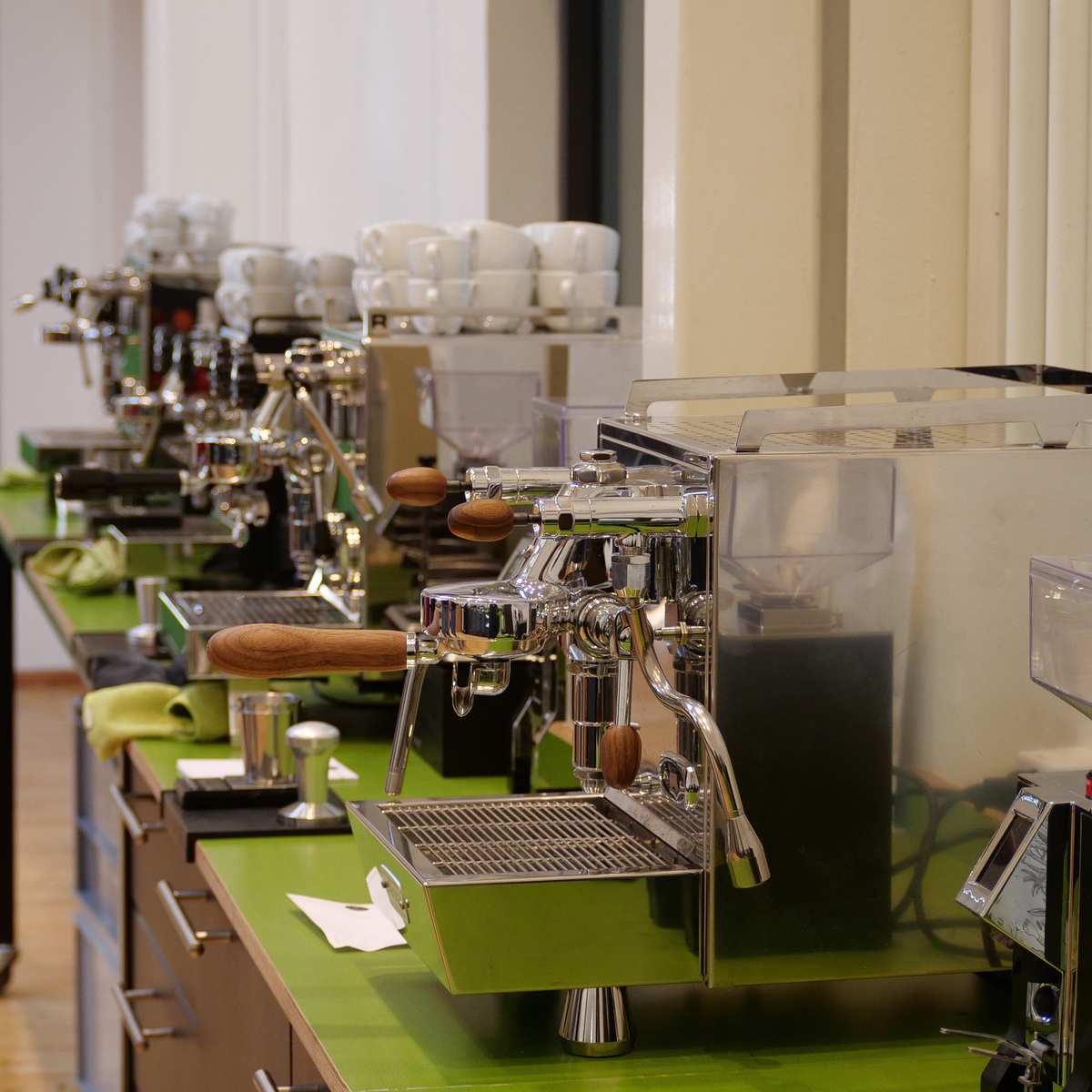
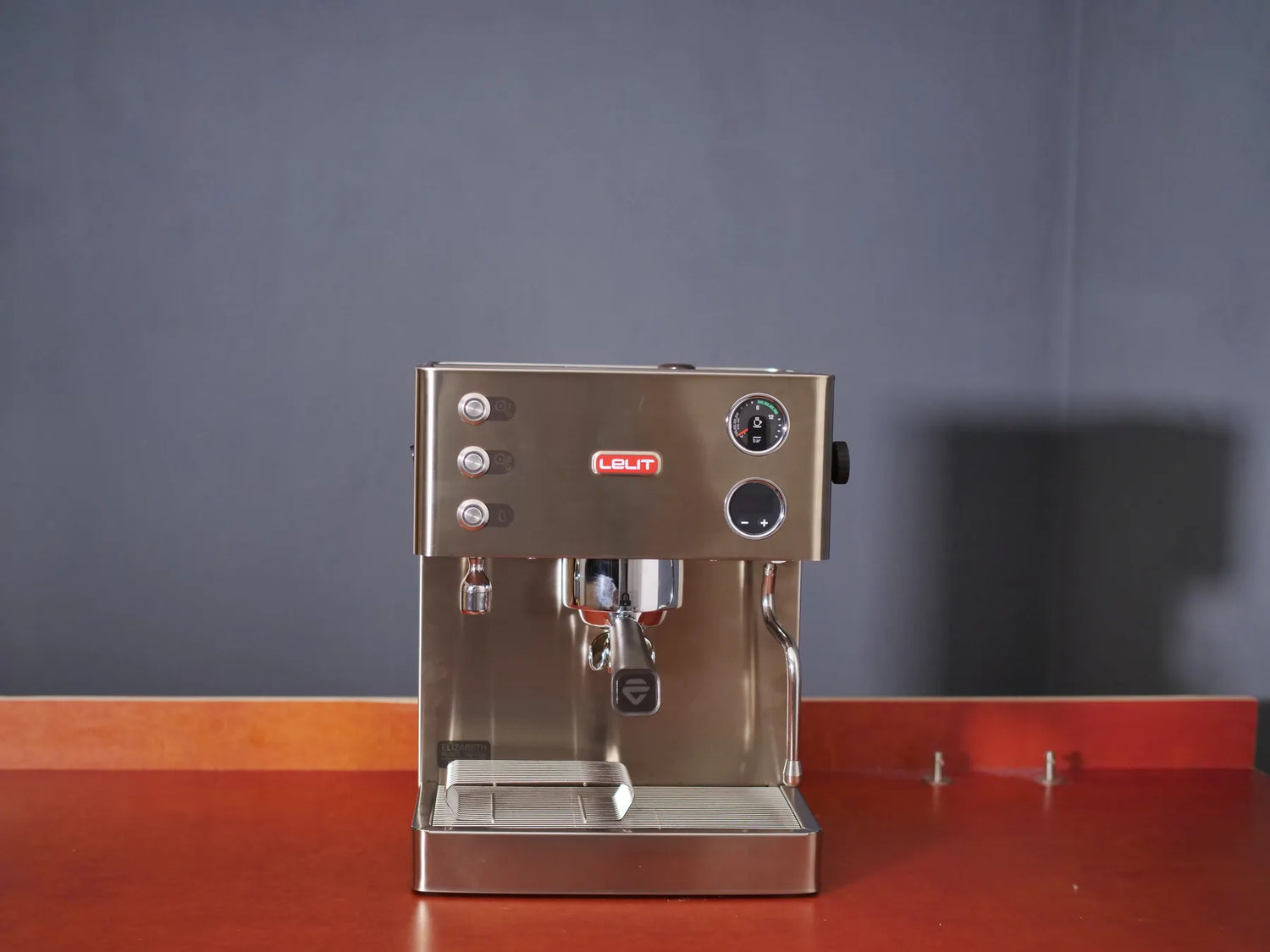

The Lelit Elizabeth PL92T is applying for the title "Best dual boiler espresso machine for beginners" with strong test performance. We are positively surprised and feel confirmed. Because Lelit goes the extra mile with the Elizabeth even with dual boiler espresso machines and gets many things right. That's why our view of the Lelit Elizabeth is similarly positive as our review of the dual circuit Lelit Mara X at the time.
The Lelit Elizabeth is one of many dual boiler espresso machines we have tested and will continue to test. Go here for an overview.
With our current protocol, the test is stricter than in 2022. The Elizabeth needs 25 to 30 minutes instead of 20 in our measurements to really reach temperature, and within a shot the temperature rises significantly. We measured the same machine that has now been in our test operation for well over three years. A new machine might behave differently. An intermediate test in May 2025 was much closer to our results from back then.
Lelit Elizabeth Dual Boiler Classification
The Lelit Elizabeth is one of the cheapest dual boilers on the market. At the time of testing in 2022, prices in Switzerland ranged between 1,100 francs at major online platforms and 1,600 francs at local retailers. In Germany, the Lelit Elizabeth was available from 1,050 euros. Today you can get it for around 1,000 euros. That's really cheap!
Many dual boilers start in the price range of more than 1,800 francs or euros, which makes the price of the Lelit Elizabeth all the more competitive. Pointing out that these prices are achieved due to high volumes and especially via online retail doesn't change anything: The Lelit Elizabeth is very inexpensive for a dual boiler!
At the same time, it comes with a backpack of functions and refinements that much more expensive models don't have in their baggage. Various pre-infusion modes, a shot timer, and thoughtful controls make the Lelit Elizabeth a compelling espresso machine for entering the dual boiler class!

Lelit Elizabeth Quick Check
Don't want to read the whole article? Then you'll find the most important strengths and weaknesses of the Lelit Elizabeth summarized here.
Facts
- Dual boiler with PID temperature controller and vibration pump as well as pump gauge.
- The Elizabeth weighs 12 kilograms, is 32.2 cm wide (with lance), 38.2 cm high, and the body is 26 cm deep. If you include the portafilter and the protruding power cable, the Lelit Elizabeth reaches a depth of 43 cm.
- The drip tray holds 1.4 liters.
- The water tank has a capacity of 2.5 liters. The machine cannot be connected to mains water.
- Steam boiler volume: 0.6 liters (can be switched off)
- Brew boiler volume: 0.3 liters
- The machine's housing is brushed stainless steel.
- Lelit is an Italian manufacturer and belongs to the Breville Group.
Strengths of the Lelit Elizabeth
- The Lelit Elizabeth combines the strengths of a dual boiler espresso machine with a comparatively affordable price. The separate boilers allow precise adjustment of the espresso machine for its two main purposes: making espresso and steaming milk.
- The temperature of the Lelit Elizabeth is consistent from shot to shot when the machine is properly heated. According to our 2026 retest, this is the case after 25 to 30 minutes, not after 20 as indicated in 2022.
- The Lelit Elizabeth PL92T has low power consumption. For heating and one espresso, we measure 0.171 kWh with steam boiler today; without steam boiler it was 0.082 kWh.
- The steaming performance of the Lelit Elizabeth is good. It rolls powerfully but heats slowly, allowing for a long rolling phase and thus silky milk foam. The boiler can be regulated up to 145 degrees Celsius.
- Practical shot timer to see the shot length in seconds.
- Two different pre-infusion modes that offer plenty of room for timing to extract the perfect result from every espresso.
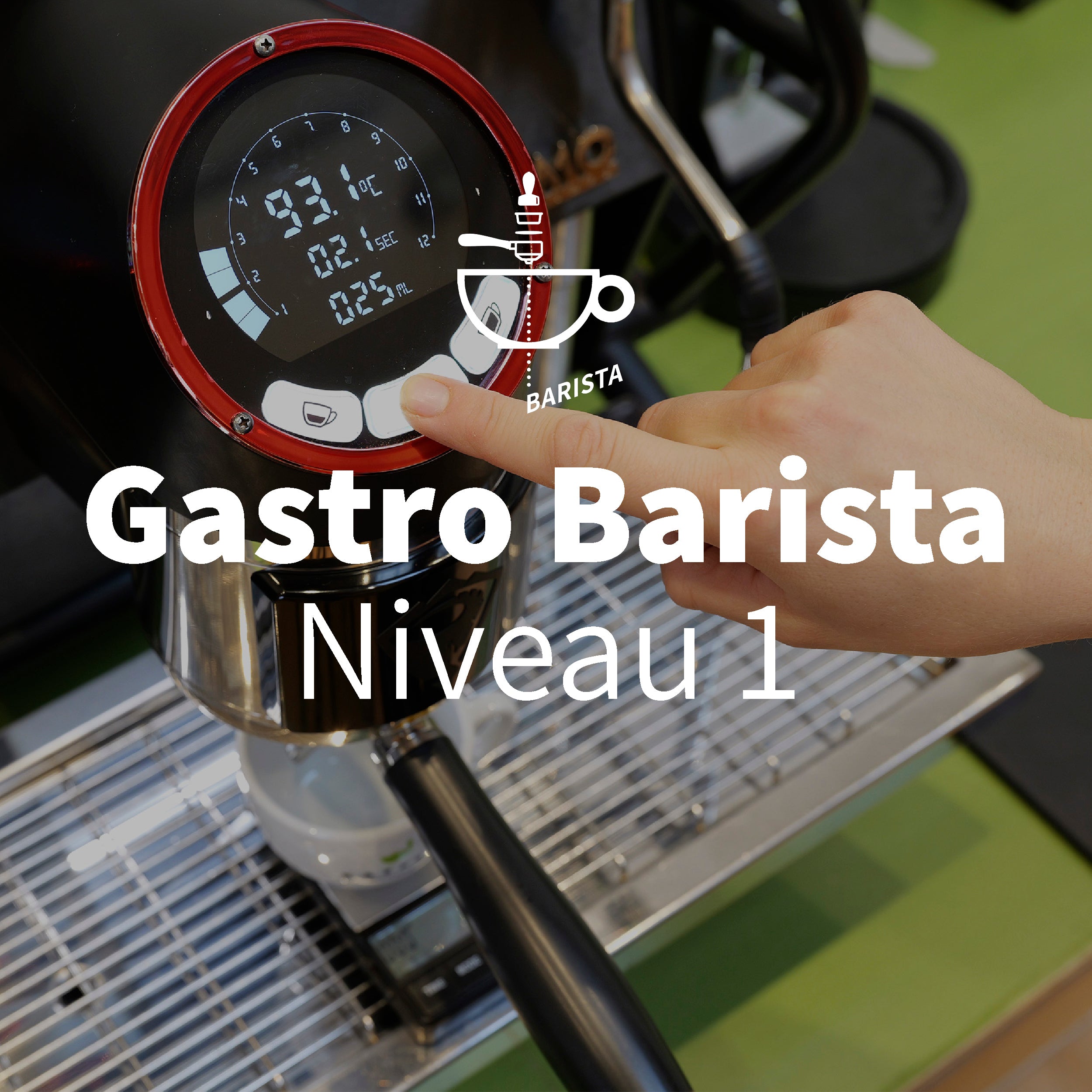
- Clear LCC (Lelit Control Center) for controlling the machine as well as displaying the shot timer. Additional functions for controlling and programming the machine in expert mode.
- Good basket with 18-gram capacity included in the package.
- Programmable buttons that can also be used for automated flushing and cleaning programs.

The Lelit Elizabeth PL92T allows control on multiple levels. On the surface, you can program temperature and, for example, shot times. Pre-infusion settings are also possible. Through the advanced control, many PID details can be adjusted. Hardly any manufacturers allow access to this level of detail.
Weaknesses of the Lelit Elizabeth
- The build quality of the machine could be more premium. The stainless steel body feels thin compared to other dual boilers.
- The portafilter is functionally good but not balanced. The plastic grip looks cheap.
- It comes with a plastic tamper that isn't actually suitable as a tamper.
- The plastic steam knob feels like a temporary solution and radiates the lower quality of the portafilter grip.
- At various points, the Lelit Elizabeth has relatively sharp edges that can cause nasty cuts even during everyday use.
- The machine gets quite loud when the water level in the water tank is too low. The pump itself is fairly quiet.
- The water tank looks like a relic from an earlier era. Unlike the Lelit Mara X, water isn't drawn from below but through tubes that need to be re-threaded each time after refilling.
- The heating time is 25 to 30 minutes for the machine to really reach temperature. In 2022, we measured 20 minutes. The machine itself indicates readiness earlier, which doesn't match our measurements.
- Temperature optimum is achieved when the machine has been running longer. Therefore, it's important to know your own machine and to check and adjust it with a local dealer to the actual current temperature.
- The buttons sometimes don't respond sensitively.
Low Power Consumption Without Steam Boiler

Compared to other dual boilers, the Lelit Elizabeth with the steam boiler switched off has relatively low power consumption. Note, however, that power is measured here at a protocol of only 15 minutes. At that time, the machine hadn't yet reached full temperature. So the actual power consumption will be slightly higher, though still relatively low. It's not comparable to some thermoblocks that achieve consumption of only 0.1 kWh. Yet approximately 0.13 to 0.15 kWh is still a good result.
With steam boiler, we measure 0.24 kWh, which corresponds to the result of the Rancilio Silvia Pro X. With many dual boilers, we get high values of more than 0.35 kWh in comparative measurements.
We now measure according to our revised power measurement: heating and one espresso, because most of you switch on the machine and then make one or two shots. With steam boiler and 25 minutes heating time, the Elizabeth achieves 0.171 kWh in the retest; without steam boiler, it was 0.082 kWh in our 2023 measurement. Standby with steam boiler costs 0.084 kWh per hour. Interesting is the power curve: like the Elizabeth 3, the machine only heats at full power for about seven minutes, after which the PID only maintains with short pulses. The 2022 values (0.13 and 0.24 kWh for heating plus five shots) cannot be directly compared with today's measurements.
Heating Time of the Lelit Elizabeth PL92T
We've read a lot about the Elizabeth's short heating time. We don't agree. At 10 and 15 minutes, the PL92T hasn't yet reached its target temperature. We recommend warming up the machine for at least 20 minutes.

Today, 20 minutes is no longer enough for us. In the retest, the first shot after 20 minutes was only 84.8°C, with 94°C set. After 25 minutes it was 90.7°C, still a good three degrees below the following shots. From the second shot onwards, the Elizabeth stays stable minute by minute between 92.5 and 94.0°C. In the May 2025 intermediate test, it was at temperature after 30 minutes. We therefore recommend 25 to 30 minutes today. The Elizabeth 3 is somewhat faster at 20 minutes.
The Lelit Elizabeth truly hits its comfort zone when it's been on longer. Our measurement with the WBC protocol shows this as well. We have the impression that the machine was optimized for the "running for 1 hour" scenario. That seems only partially suitable for everyday use at home. Because at least we really enjoy an espresso when the machine has just reached temperature. In everyday life, we typically switch the machine off after the shot and turn it back on a few hours later for the next espresso.
To be precise: the Lelit is also in the temperature corridor earlier. However, it only becomes truly stable with the factory default programming when it's been running longer. This might be possible to adjust through the advanced settings of the LCC.
Within the first 30 minutes, we'd rather set the machine about two degrees higher than the displayed target temperature.

In the video, we said in 2022 that small boilers wouldn't buckle even in the WBC protocol. In the retest, the Elizabeth maintains the first eleven of 14 shots between 92.8 and 94.6°C and then drops to 89.5°C. In May 2025, all 14 shots still stayed within one degree. Within individual shots, temperature now rises four to five degrees. In our temperature rating, that gives 2.7 out of 10 points. The Elizabeth 3 loses temperature earlier in the WBC test but keeps it more stable within the shot.
The measurements in 2022 were taken with the Lelit Elizabeth's factory default settings. These were: KPc 2.0; KIc 0.04; KDc 1.0; BC 30; KPs 2.0; KIs 0.00; KDs 20.0; BS 30; Ec 10; Es 0; F01 1; Tr 0.
These settings can be controlled in the Lelit's advanced settings via the LCC. Lelit provides everything here to adjust many details in PID behavior and control. You can also adjust the length of the pump phase in pre-infusion. A good explanation is provided by Dave Corbey in a blog post.
Pre-infusion and Espresso Quality
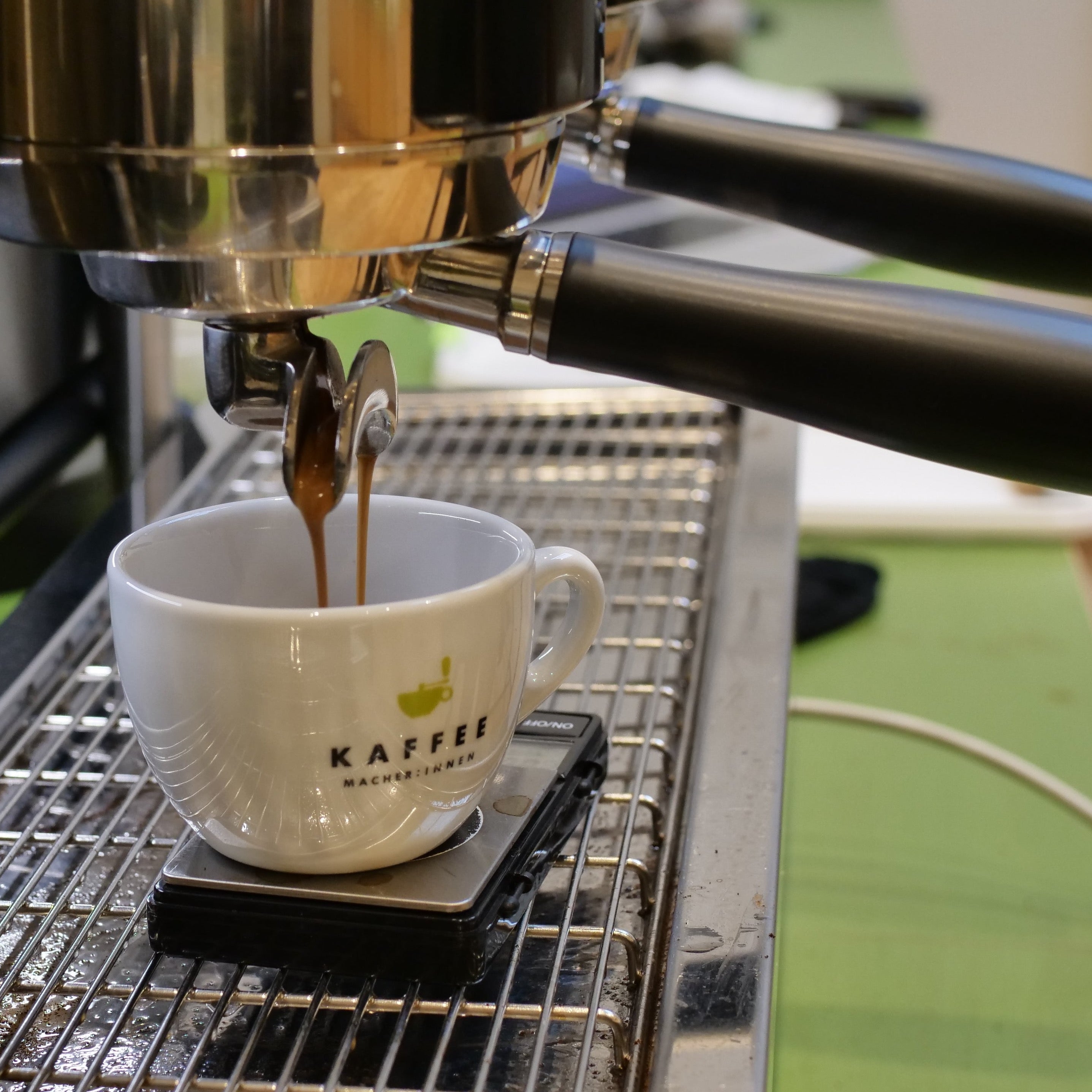
Even in standard mode, the Lelit Elizabeth allows us to brew good espresso. When the machine is well heated, we get good results. However, we set the machine two degrees higher if we want espresso 20 minutes after turning it on!
Additionally, the espresso machine allows the use of two different pre-infusion modes. On the one hand, with the steam boiler switched on, we can use the steam to gently apply pressure to the coffee puck after stopping the pump for 3 seconds up to 20 seconds.
On the other hand, a sort of blooming pre-infusion can be run. For this, the steam boiler must not be running. Now the pump stops after 6 seconds of operation and then enters a definable pause phase.

Advanced Pre-infusion Settings
The pump stop phase can be defined for both modes in the advanced settings. Here's how to access the menu:
BLS1 stands for Button 1 and BLS2 stands for Button 2. The following number defines the activated pump phase before the steam pressure pre-infusion. In the example above, we chose 3 seconds, which seems like a reasonable value to us.
BLP1 sets Button 1 for blooming pre-infusion and BLP2 sets Button 2. In the example above, we chose 6 seconds before the pump stops.
In both modes, the activated pump time is subtracted from the total pre-infusion time set. So if we choose a 10-second pre-infusion in the menu, it will be 7 or 4 seconds, since the pump pressure time counts as part of the pre-infusion.
Effects of Pre-infusion on Different Espressos
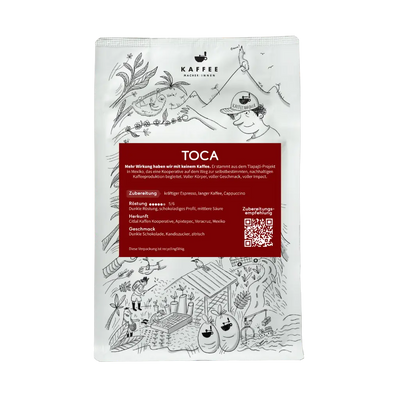
We've experimented extensively with pre-infusion and tried the modes with different espresso roasts and times. The possibilities are enormous here. We achieved better results with steam pressure pre-infusion. Lighter roasted specialty coffee espressos in particular became sweeter and more balanced. In the video test, for example, we taste Toca from our bio project partner in Mexico.
With a darker roasted Robusta espresso, the difference was small—it worked well without pre-infusion too. The Lelit Elizabeth offers with its adjustment options a playground for curious coffee aficionados. But it also carries the risk of getting lost. In that case, a step back to the standard profile makes sense.
Regarding pre-infusion, the Elizabeth 3 takes a big step forward. Instead of the second values in BLS1 and BLP2, you can store a pressure profile with up to five stages on each of two buttons and additionally control the flow manually with the Pagaia lever. In terms of espresso potential, the PL92T scores 5.0 points in our current protocol, the Elizabeth 3 scores 6.5. The difference comes from both profiling and temperature.
Steaming Behavior
The base pressure of the steam boiler is rather low. However, the temperature can be increased to 145 degrees Celsius, and then the Lelit Elizabeth becomes really fun to steam with. It rolls powerfully without heating up too quickly. This allows for a long rolling phase and is the prerequisite for very good milk foam.
Especially for those just beginning to steam milk, the Lelit is also an interesting choice steamwise. The long rolling phase helps break down any large bubbles created by inexperienced steaming.
Only the steam knob frustrates a bit every time we start steaming again. We've received tips from the community that there are nice custom wooden versions, turned in small series.

We'll provide measurements according to our current steaming protocol later. It's already clear: the Elizabeth 3 steams with an equally large steam boiler significantly faster and brings 300 milliliters of milk to 60°C in 30 seconds. With the PL92T, it takes noticeably longer, which explains the long rolling phase we praised so much in 2022. The steam knob on the Elizabeth 3 is made of wood, by the way.
Elizabeth PL92T or Elizabeth 3?
With the Elizabeth 3, Lelit has tackled much of what we criticized in 2022: portafilter grip, steam knob, Pagaia, and tamper are made of wood, the water tank lid sits in a guide, and pre-infusion becomes saveable pressure profiles. In return, the brew boiler is smaller and the price is around 1,650 euros—significantly higher.
| Retest 2026 | Elizabeth PL92T | Elizabeth 3 |
|---|---|---|
| Price | approx. 1,000 euros | approx. 1,650 euros |
| Brew/Steam boiler | 0.3 l / 0.6 l | 0.2 l / 0.6 l |
| Profiling | 2 pre-infusion modes, time adjustable | 2 buttons with 5 pressure stages each, Pagaia lever |
| Heating time | 25–30 minutes | 20 minutes |
| Shot 1 after 20 minutes | 84.8°C | 93.6°C |
| 5 shots at one-minute intervals | stable from shot 2 (after 25 min) | drops by 2°C, stable with 2-min pause |
| Power heating + espresso, with steam | 0.171 kWh | 0.154 kWh |
| Controls | Plastic | Wood |
| Tamper | Plastic, not suitable | 58.55 mm, wood grip, flush |
| Weight | 12 kg | 15 kg |
If you primarily drink espresso, are looking for a dual boiler with a budget around 1,000 euros, and can live with plastic parts, the PL92T still gives you a lot of machine for your money. If you want to save pressure profiles, prefer faster heating, and value more premium controls, you should check out the Elizabeth 3. We explain how Pagaia works in the overview of the Lelit Pagaia.
KM Rating (Retest 2026)
0 – 100
Two categories are still missing: steaming quality and noise. We'll add both and then update the overall score. Based on current findings, the Elizabeth PL92T lands in the "Compromise" to "Good / Standard" range. This is more sober than our 2022 conclusion, mainly due to temperature and heating time. A newer or freshly descaled unit might score better here.
Conclusion and Further Tips
What an exciting espresso machine. Not only in terms of value for money does the Lelit Elizabeth set a real exclamation point. The various pre-infusion modes, the overall good performance, and Lelit's opening to allow deep access to machine control in an advanced mode enable a steep learning curve.
The Lelit Elizabeth is a very compelling entry-level dual boiler espresso machine with the potential to outperform many more expensive machines in terms of performance. Right out of the box, in fact. With the many tips and tricks from the Lelit community, and if you invest time in getting to know the machine, the Elizabeth opens realms that are distant future-talk for espresso machines with classical E61 brew groups.
2026 Classification: With our current protocol and a three-year-old unit, the rating is stricter. The Elizabeth needs 25 to 30 minutes, plastic parts remain its weak point, and temperature shows more variation in the retest than in 2022. At around 1,000 euros, it remains a serious entry into the dual boiler class, especially for those who like to tinker with settings. Those wanting more comfort and pressure profiles will find the more modern successor in the Elizabeth 3. We've summarized which machine type generally suits you in our espresso machine buying guide.
Warm regards, your Benjamin
Technical Specifications at a Glance
| Feature | Lelit Elizabeth PL92T |
|---|---|
| Price | approx. 1,000 euros (as of October 2026) |
| Type | Dual boiler with PID |
| Boiler | Brew boiler 0.3 l, steam boiler 0.6 l (switchable) |
| Pump | Vibration pump with adjustable OPV |
| Profiling | Steam pressure pre-infusion (up to 20 s) and blooming pre-infusion |
| Volumetric Control | Time control, shot timer |
| Heating Time | 25–30 minutes (retest 2026) |
| Brew Temperature | after 25 min: shot 1 90.7°C, then 92.5–94.0°C (set to 94°C) |
| Power Consumption | 0.171 kWh heating + espresso with steam (2026), 0.082 kWh without steam (2023); standby 0.084 kWh/h |
| Noise Level | Measurement coming |
| Water Tank | 2.5 l |
| Drip Tray | 1.4 l |
| Dimensions (W × H × D) | 32.2 × 38.2 × 26 cm (43 cm with portafilter) |
| Weight | 12 kg |
And what are your experiences with the Lelit Elizabeth? Feel free to share in the comments.
By the way, this applies to this machine too: we bought it, we conduct our tests independently, and we test to the best of our knowledge and belief.