







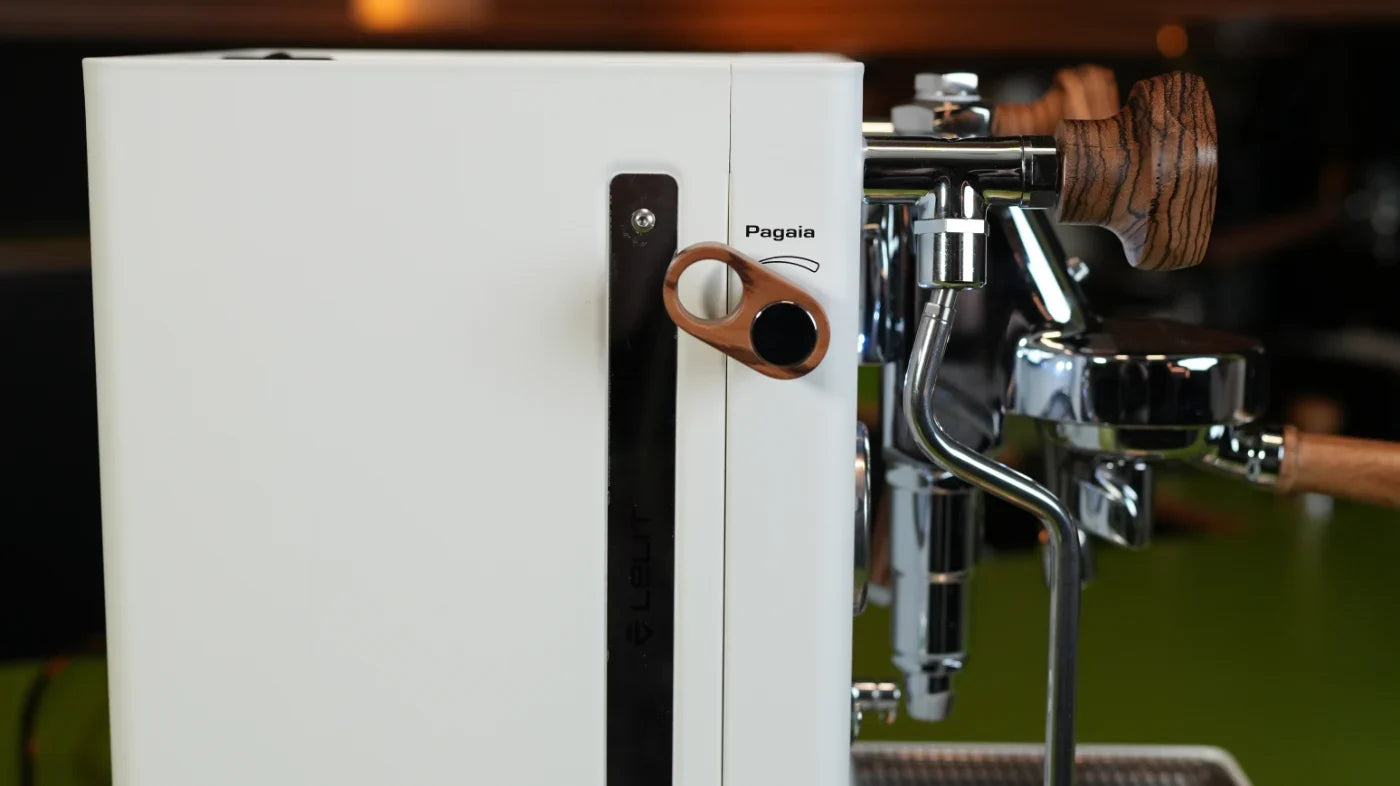

Pagaia is Italian for paddle. Lelit calls it the lever with which the flow rate during espresso extraction can be controlled since the Mara X3. The Mara X3 was the first machine with this control. At the World of Coffee in Brussels, Lelit has upped the ante: the Elizabeth and the Victoria now also come with Pagaia, and they have even more to offer.
On this page we compile everything we know about Pagaia: how the control works technically, which lever angle means which flow, and how the feature sets differ between machines.
How Pagaia works technically
Classic flow control on an E61 brew group works mechanically: a needle valve narrows the water path, the pump continues running at full power, the rest is throttled. That's how Lelit does it on the Bianca. Pagaia does it differently. The lever controls the pump's power itself, electronically and in real time via pulse width modulation. So instead of braking, less water is delivered from the start.
This has two practical consequences. First, you can hear the control: at reduced flow, the vibration pump on the Mara X3 drops below 50 dB. Nice mechanical feedback that tells you more during brewing than any gauge. Second, pressure in Pagaia is not a setpoint but a result. You control the flow, the pressure adjusts as a result of the resistance in the coffee cake. Those coming from pressure profiling need to rethink here.
Which angle means which flow
That's the question we get asked most often. On the Mara X3 we measured it:

The Pagaia lever sits on the left side of the machine. It doesn't control valve position, but pump power.
The 10 o'clock position is a sensible starting position for pre-wetting the coffee cake because the puck is saturated evenly there without you immediately tearing channels.
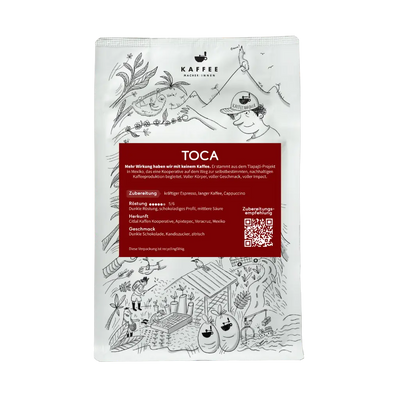
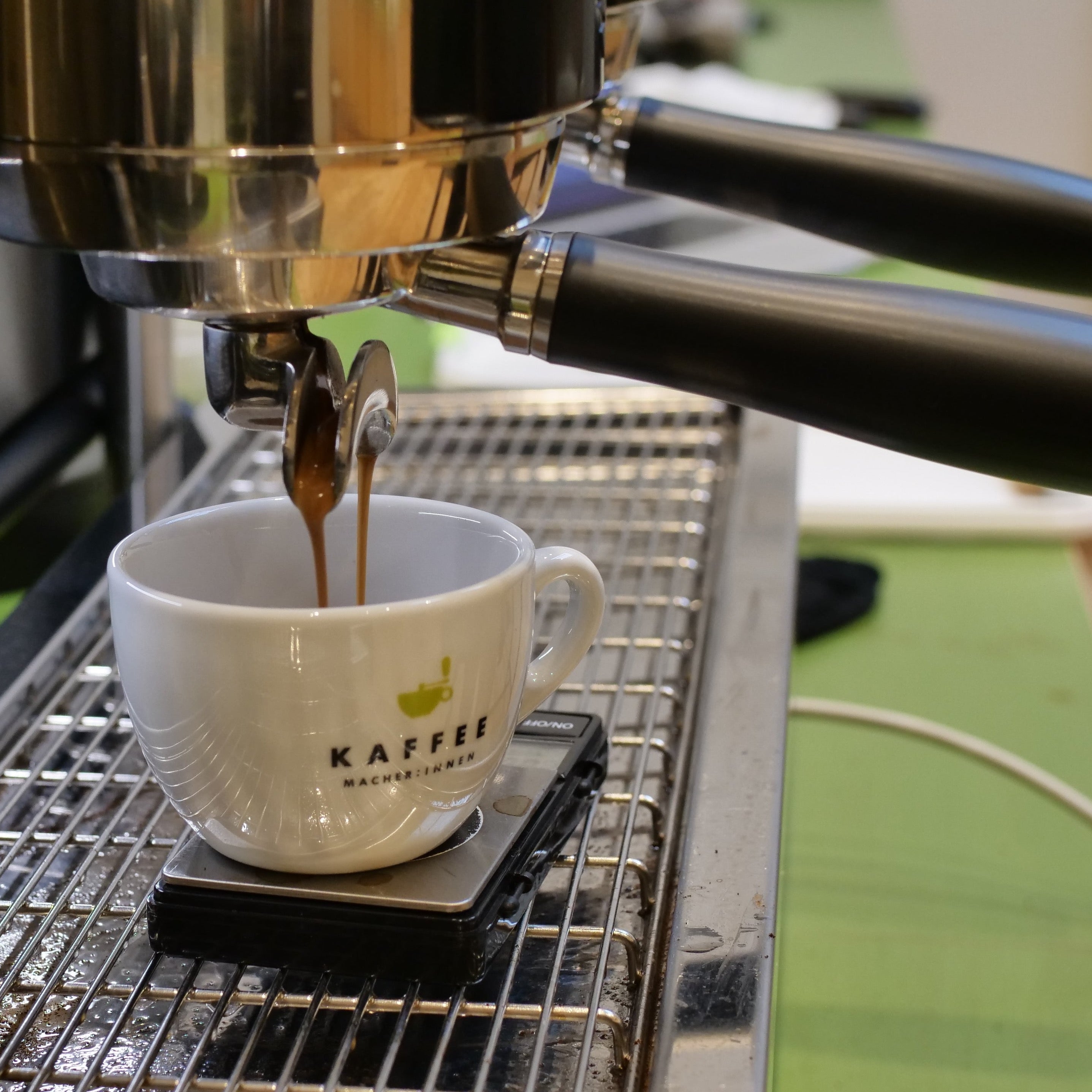
Start with the lever at 10 o'clock, wait until the first drops appear at the outlet, then turn it all the way up. That's how we brewed our Toca espresso from Mexico: around 40 grams in just under 30 seconds. The result was caramel-like and creamy, with a long finish.
And if you're not in the mood for the game: set the lever to full flow and brew classically. Pagaia doesn't force you to do anything.
What Pagaia can't do on the Mara X3
Reproducibility. You brew manually, you have to develop a feel for when the puck is saturated and when to turn it up. That's fun if you're into it. If you want the same espresso reliably every morning without thinking, this isn't for you. The Mara X3 doesn't have volumetrics either, and there's no shot timer.
That's exactly where the second generation gets interesting.
Elizabeth 3 and Victoria 3: Pagaia plus programmable stages
Lelit calls the new versions Elizabeth 3 and Victoria 3. Both have the Pagaia lever, but they also have a pressure sensor whose reading is displayed on the screen. And they have two buttons on which you can save a profile each.
A profile consists of several stages. You can, for example, start with a gentle pre-infusion at low pressure, then switch to a second stage, then to a third. Because Pagaia controls pump power, you can really control it and not just approach it from the valve side. The pressure is measured in the process and follows the programmed phases.
That's the difference that interested us most in Brussels: on the Mara X3, flow profiling is manual work, on the Elizabeth 3 and Victoria 3 it becomes storable, and the machine executes the profile automatically. There's still no volumetrics and no time control. Pressure modulation at this price point is a major statement though!
Which Lelit has which Pagaia feature set
| Machine | Type | Lever | Pressure sensor with display | Programmable profiles |
|---|---|---|---|---|
| Mara X3 (PL62X3) | Dual boiler | yes | no | no |
| Elizabeth 3 | Dual boiler | yes | yes, according to Lelit | 2 buttons, multiple stages |
| Victoria 3 | Single boiler | yes | yes, according to Lelit | 2 buttons, multiple stages |
None of the three machines has volumetrics. We have only tested the Mara X3 so far, with 50.2 out of 100 points. The information about the Elizabeth 3 and Victoria 3 comes from the presentation at the World of Coffee in Brussels and is not measured by us.
What does Pagaia cost
Lelit sells Pagaia on the Elizabeth and Victoria as an upcharge option. In Brussels we were told of a surcharge of 300 euros each compared to the version without the lever. Prices for Switzerland are not yet set. On the Mara X3, however, Pagaia is built in as standard, with a price of 1,699 francs, around 500 francs more than its predecessor.
Lelit equipment prices have been heavily discounted in recent years by major international retailers. Machines were sometimes 200 to 400 francs below the recommended retail price. We'll see where Pagaia-equipped machines settle.
Why Lelit can do this now
Lelit has been part of the Breville group since 2022, which is the company that operates as Sage in Europe. We were told in Brussels that there's a large patent portfolio there that Lelit can draw from. After years where we at trade shows joked about new paint jobs as innovation, technologies are visibly coming together here for the first time.
Conclusion
Pagaia is not a gimmick. On the Mara X3 we got true flow profiling in a classic dual boiler, and it was a joy. What Lelit is announcing for the Elizabeth 3 and Victoria 3 goes beyond that: programmable stages in a price range where it didn't exist before.
Whether that holds up in everyday use, we'll only know after our measurements. On the Mara X3, the control was strong, but temperature stability was weak. Especially with the Victoria as a single boiler with a small tank, it will be interesting to see whether a gentle pre-infusion can even take place within a stable temperature window. Both machines are on our list, we'll look at the temperature and examine the whole thing in detail.
Further reading: our test of the Lelit Mara X3 with all measured values for Pagaia, our test of the Lelit Elizabeth, and our test of the Lelit Victoria. How we measure is explained in our test protocol v2.3.