







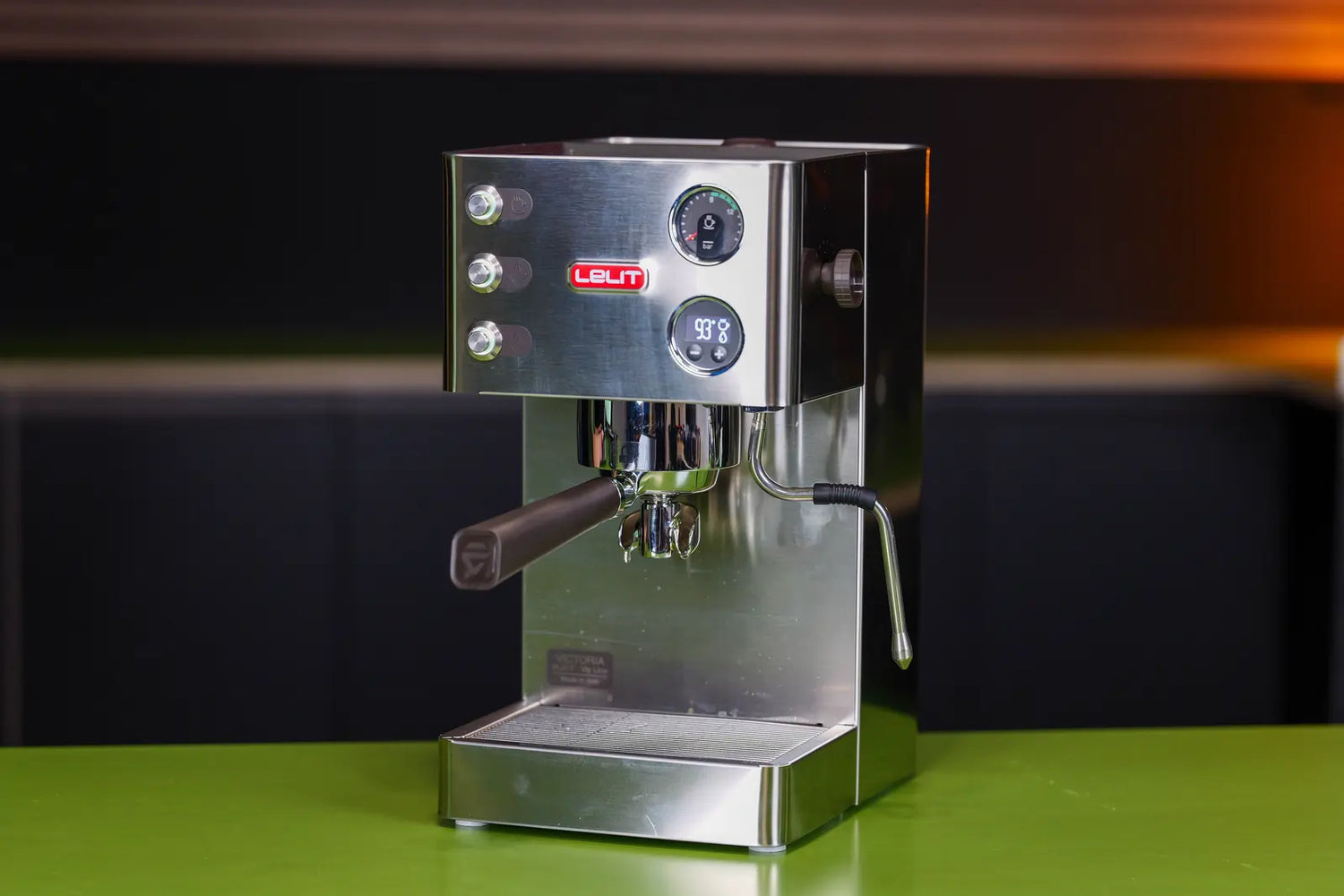

The Lelit Victoria performed decently in our test. With our tips, we improved the machine's performance. For us, the Lelit Victoria is a good entry-level espresso machine for many applications. This single boiler from Lelit provides everything needed to prepare a good espresso.
Fast Heat Instead of Waiting Time
Let's get to the point and start with our most important finding: without any additional measures, the Lelit Victoria heats up in 23 minutes. That's slow and can be annoying. Who wants to wait when the urge for espresso is NOW!
To shorten the 23 minutes, we applied a method that is increasingly becoming standard in other espresso machines. Generally speaking, the boiler temperature is raised above the target temperature to heat the portafilter holder and the rest of the machine more quickly. The temperature is then deliberately lowered back to the desired target temperature.
For the Lelit Victoria, the fast heat-up works like this:

The machine is not yet stable in temperature after this procedure. An espresso can be pulled well at this time. To achieve stable brew temperature long-term, you should wait longer.
Design and Features
The Lelit Victoria is a compact machine that is 38 cm tall, 27.8 cm deep (32.8 cm with plug), and 23.5 cm wide including the steam wand. The machine weighs 10.9 kg. The water tank holds 2.35 liters and the drip tray has a volume of 0.9 liters.
The brass boiler has a capacity of 300 ml and is, typical for single boilers, designed for both espresso preparation and steam generation. The boiler temperature can be controlled via the Lelit Control Center (LCC) and PID.
The ring group takes 58 mm portafilters. The included portafilter is made of chrome-plated brass. The Lelit Victoria is similar in its narrower design and craftsmanship to the Lelit Elizabeth. Lelit stays true to its line, with sharp edges well covered with rubber gaskets or blunted by bending the edges.
The Victoria also has a steam wand, which is designed primarily for functionality and otherwise simply.
Temperature Stability
For a single boiler with a small boiler, the Lelit Victoria shows solid temperature performance. Our espresso shots were correspondingly stable. Even with higher frequency, the machine did not deviate significantly from the target temperature. Using the WBC protocol, we recorded a standard deviation of 1.28 degrees over 14 shots. This puts it in a similar range as its dual boiler sister, the Elizabeth. For comparison, a Lelit Bianca V3 achieved a standard deviation of 0.7.

New: Lelit Victoria 3 with Pagaia
In Brussels, Lelit showed the Victoria in a new version, the Victoria 3. It gets the Pagaia, the little lever for controlling flow rate, which first appeared in the Lelit Mara X3. Pagaia doesn't throttle mechanically, but electronically regulates pump power. Flow is controlled, and pressure follows from that.
The fact that this technology lands in a single boiler is the real news. Flow control has been a topic for machines starting at 1,700 Swiss francs for years. And the Victoria 3 doesn't stop at the lever: according to Lelit, it also has a pressure sensor with display plus two buttons that can each be programmed with a profile with multiple stages. This would make a gentle preinfusion not only possible but also repeatable. Volumetric and time control are still missing.
It's interesting to look at the preinfusion function, which we list below as a disadvantage for the PL91T: it drains the preinfusion water and is not ideal for good extractions. This is precisely the problem that true flow control would solve. If Lelit can pull this off, it would be the most relevant improvement for the Victoria since the PID.
Lelit has stated the premium for Pagaia at 300 euros.
Recommended Specialist Dealers
- Die Röster, Switzerland
- Bohnendealer, Austria
- Stoll Espresso, Germany
We search for specialist partners we know provide good work and service. We maintain close contact with these dealers. These are affiliate links. If you order through this link, it won't cost you more, but we receive a small commission that we put towards new test equipment.
Steaming Milk with a Single Boiler
After pulling the espresso shot, switch to milk mode to steam. It takes 90 seconds for the machine to reach the target range. Then it provides sufficient steam power for steaming. With a 0.6-liter pitcher, the small machine struggles a bit. We heat hot water in the 0.6-liter pitcher in 65 seconds.
But it's not that it doesn't work. Anyone who gets used to their Lelit Victoria will achieve satisfactory results. For the occasional cappuccino and similar drinks, that's plenty. If milk drinks are the main focus, then it's worth questioning whether the Lelit Victoria is the right machine for you.
Advantages of the Lelit Victoria PL91T
- PID Control: enables precise control of brew temperature, which is crucial for preparing a perfect espresso. Not standard in this price range.
- Compact Design: ideal for smaller kitchens or spaces without having to sacrifice functionality.
- User-Friendliness: despite some adjustment options, the machine remains user-friendly, even for beginners.
- Fast Heat-Up Time: with tricks, the heat-up time can be significantly reduced, ideal for your morning espresso.
- Solid Build Quality: robust design and high-quality materials compared to many other machines in this price range.
- Value for Money: offers many features and good quality at a fair price, especially compared to other machines in the same segment.
Disadvantages of the Lelit Victoria PL91T
- Single Boiler System: limits flexibility, as espresso and milk drinks can only be made sequentially. After pulling an espresso shot, you must wait about 90 seconds for the small boiler to switch from espresso to steam quality.
- Learning Curve: some degree of familiarization and practice is required for optimal results.
- Preinfusion Function: the preinfusion function as used here drains the preinfusion water and is not ideal for good extractions.
- Steam Power: steam power is rather limited, but typical for a single boiler and even quite good in this segment.
- Energy Consumption: while the turbo heat-up mode is practical, it consumes more energy than slow heat-up. In fact, energy consumption is identical for both fast and slow heating of the machine.
- Button Operation: the buttons are stiff.
Summary and Impressions of the Lelit Victoria
The Lelit Victoria can be had for around 800 Swiss francs or euros and is a very interesting espresso machine in this price range. Yes, a single boiler means compromises have to be made. However, in its segment, the Victoria performs well and stands for tasty results.
The temperature consistency is nothing to be shy about, and with our tips, you'll reach temperature quickly enough. If you're looking for a small espresso machine and primarily drink espresso, the Victoria is certainly a good choice for you.
The materials also suggest that the machine is likely durable, compared to other plastic "monstrosities" in the same price range.
Backup Material Lelit Victoria

Energy consumption. More about this and how we measure it here.