





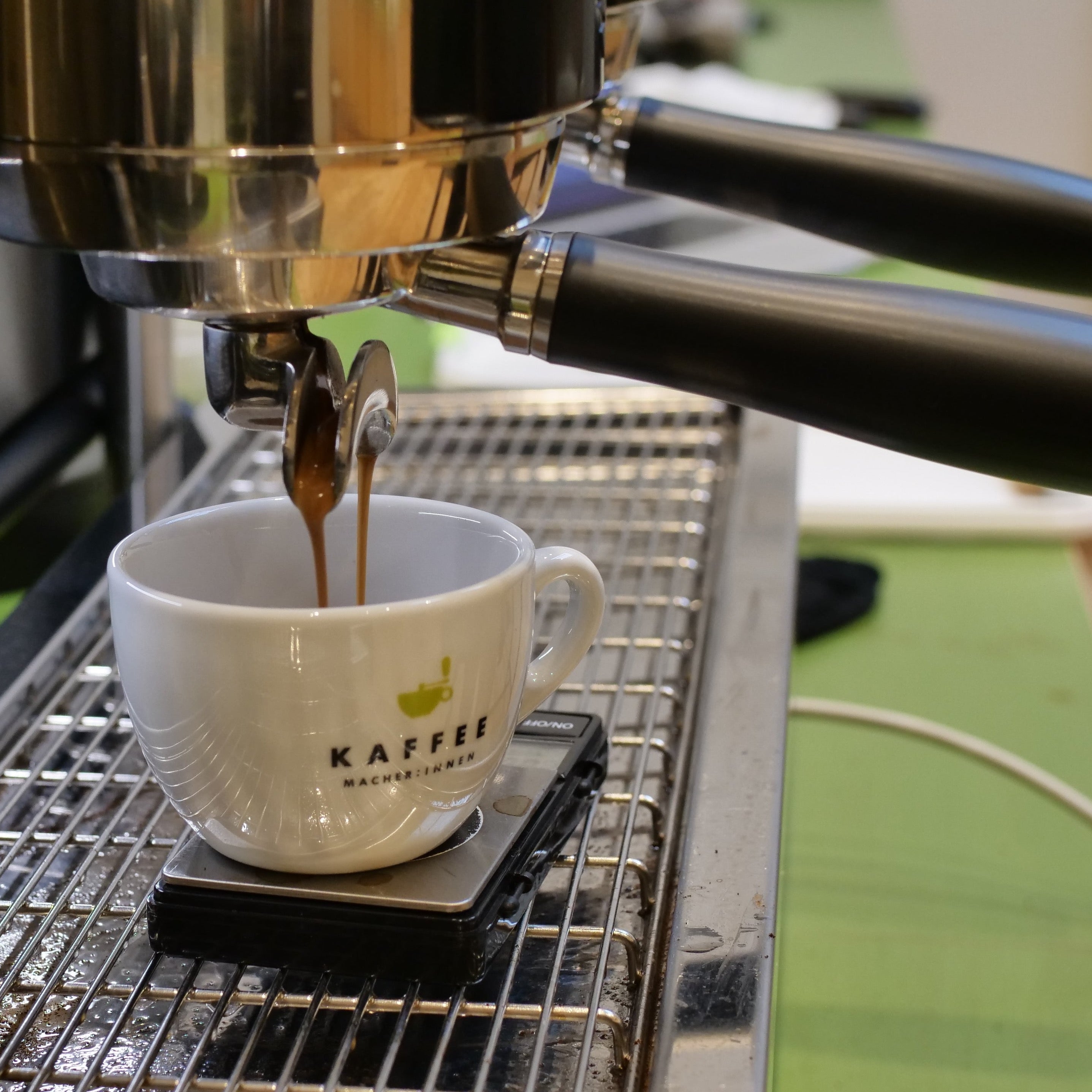


Brew time, extraction time, pull time — three words for the same principle. And yet there's confusion about when you should actually start counting. At the button press? At the first drop? We'll clear this up. (Looking for a complete guide to espresso preparation? You'll find it in our Espresso Preparation Guide.)
Brew time is contact time
Whether you call it brew time, extraction time, or pull time: it always means the contact time between water and coffee. Nothing more, nothing less.
Extraction begins the moment hot water hits your coffee puck. Not when the first drop falls into the cup. And it ends when the pump stops working and no more water is pushed through the coffee.
That sounds simple, but in practice it regularly leads to misunderstandings. Because between the moment you start the pull and the moment water actually reaches the coffee, one to four seconds can pass depending on the machine.
When to start counting?
The short answer: When your machine dispenses water.
With most machines, this happens practically immediately when you press the button or pull the lever. Then the button press is your start signal. With some machines there's a small delay of one or two seconds — you can easily test this by running it once without the portafilter and seeing when the water comes. You simply subtract this latency.
Why not count from the first drop? Because several seconds of extraction already take place between water contact and the first drop in the cup. The water must first penetrate the entire coffee puck before anything comes out the bottom. If you only start counting from the first drop, you're missing several seconds of contact time — and your recipe no longer works.
And the first seconds of contact between water and coffee have a massive impact on the entire extraction time. This is where it becomes clear whether the grind size was chosen correctly or not.

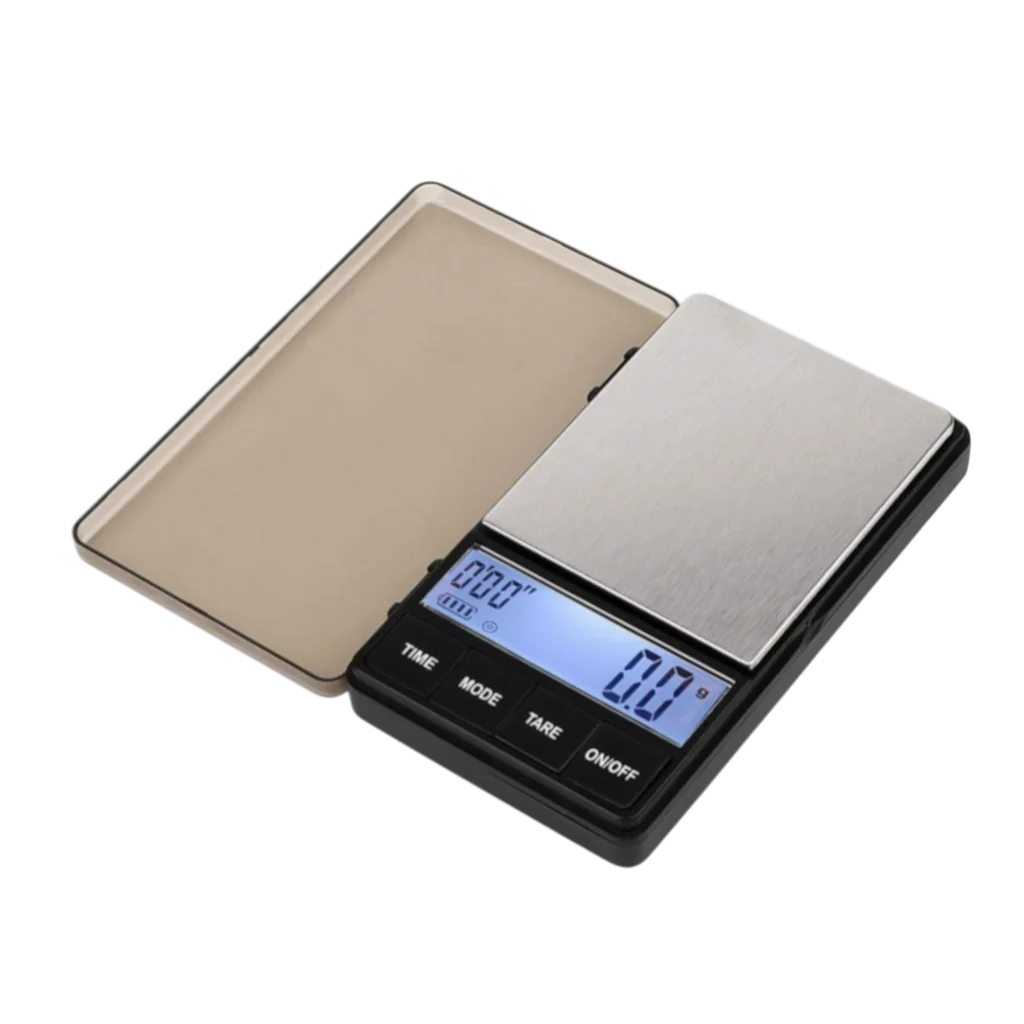
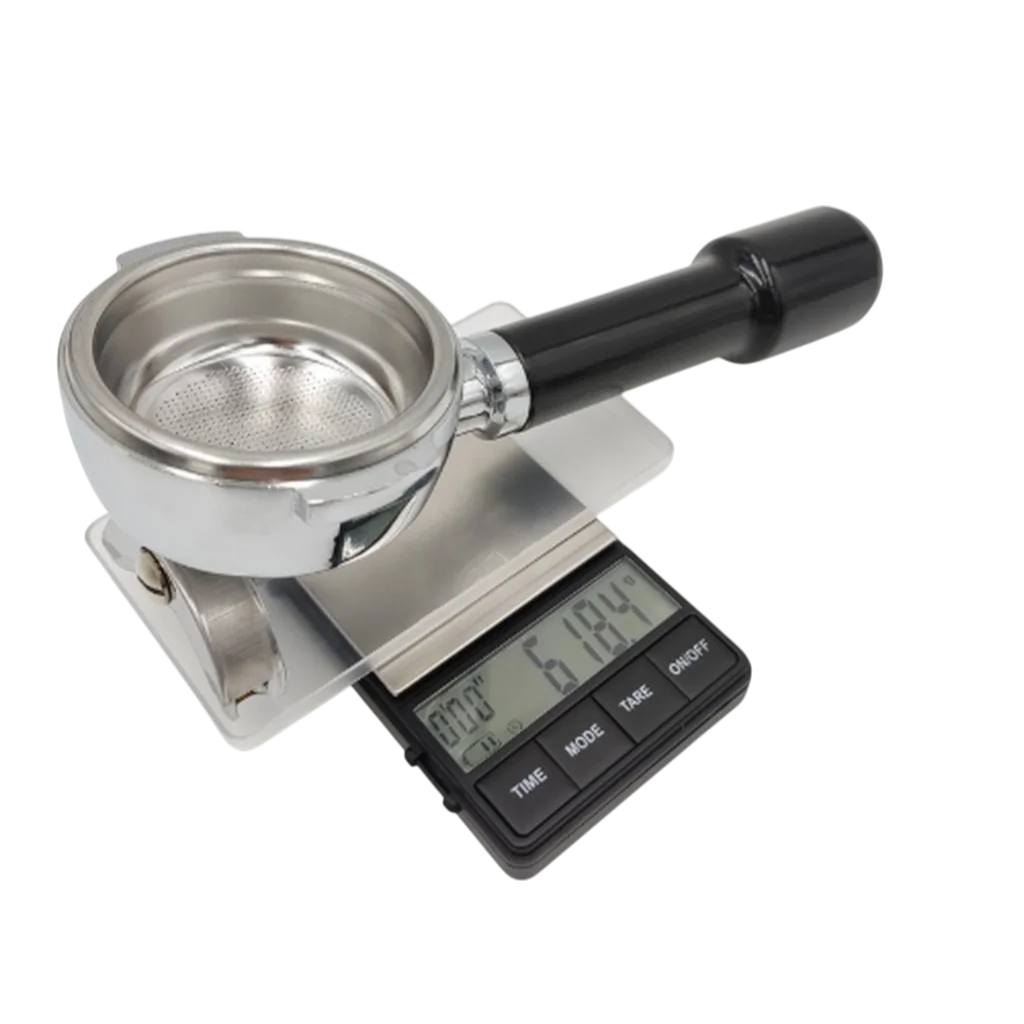
What scales with drop detection can do (and what they can't)
Some scales automatically start the timer as soon as the first drop lands on the scale. This isn't useful as a measurement for brew time, because it doesn't represent the beginning of extraction.
Still, the function isn't worthless. It can tell you something about your coffee: If the first drop arrives after three seconds, you're probably grinding too coarse. If nothing comes for ten seconds, your grind size is probably too fine — or your puck has a problem. As a diagnostic tool, drop detection is useful. As a stopwatch for brew time, it isn't.

We've included our favorite scales in our shop. There's something for every price range.
Vibration pump vs. rotary pump: The difference that changes your recipes
This is where it gets practically relevant, because your pump determines how you need to interpret recipes.
A rotary pump builds pressure almost immediately. Within seconds, the full brew pressure is on the coffee. The brew chamber fills, the water hits the puck, and you're off. With a rotary pump, the button press and extraction start are practically the same thing.
A vibration pump works differently. It takes much longer to build pressure — the flow starts slowly and increases over several seconds. This means: the contact time is running, but the first phase is far from as intense as with a rotary pump. The coffee is essentially pre-wetted gently before the full pressure arrives.
This has consequences for your recipes.

The +3-second rule
Most recipes you get from roasters — "18g in, 36g out, 25 seconds" — are made with rotary pumps. That's because many roasters use professional commercial machines, and those almost always have rotary pumps.
If you have a vibration pump at home (and this applies to the vast majority of home machines), you need about three seconds more with such recipes. So: 25 seconds recipe specification → roughly 28 seconds on your machine. This isn't an exact law, but a good rule of thumb to get in the right ballpark.
At Kaffeemacher, we generally provide our recipes for both vibration and rotary pumps and label them accordingly. If you're unsure about a roaster, ask which machine the recipe was made with. That gives you a better reference point than any rule of thumb.
Extraction time for single and double espresso
A question that often comes up: Does a double espresso need to run longer than a single?
Not necessarily. If you use double the amount of coffee in the larger basket for a double espresso and let double the amount of water through, the contact time often remains similar. The resistance of the coffee puck and the flow rate scale together. What changes is the brew ratio — and that should remain constant. A 1:2 ratio (18g coffee → 36g espresso) applies to the double just as much as a 1:2 ratio (9g → 18g) applies to the single. Although single espressos always have their own unique dynamics. A small amount of coffee powder doesn't build resistance as evenly as the coffee powder in a double espresso. One reason we tend to recommend doing double extractions instead.
Extraction time is your control tool: if the time doesn't match with the same brew ratio, the grind size probably isn't right.
Brew time as guidance, not law
25 seconds is not a magic number. We provide recipes as time windows, not as second-precise specifications. The reason: every machine behaves slightly differently, every coffee reacts slightly differently, and a couple of seconds more or less makes little difference in taste with a well-adjusted recipe.
Use brew time as a guide value. If you end up at 22 seconds with 18g coffee and 36g espresso, you're probably grinding a bit too coarse. At 35 seconds, too fine. But whether 26 or 28 seconds — try it and decide by taste.
In the end, what matters is what's in the cup. Brew time helps you get there. But it doesn't replace your tongue.
Want to know how pre-brewing and pre-infusion affect extraction time? We explain that in the article Pre-infusion in espresso: Is it really worth it? — including why 3 seconds of pre-infusion is almost always too little.
This article is also available as a video on our YouTube channel.