




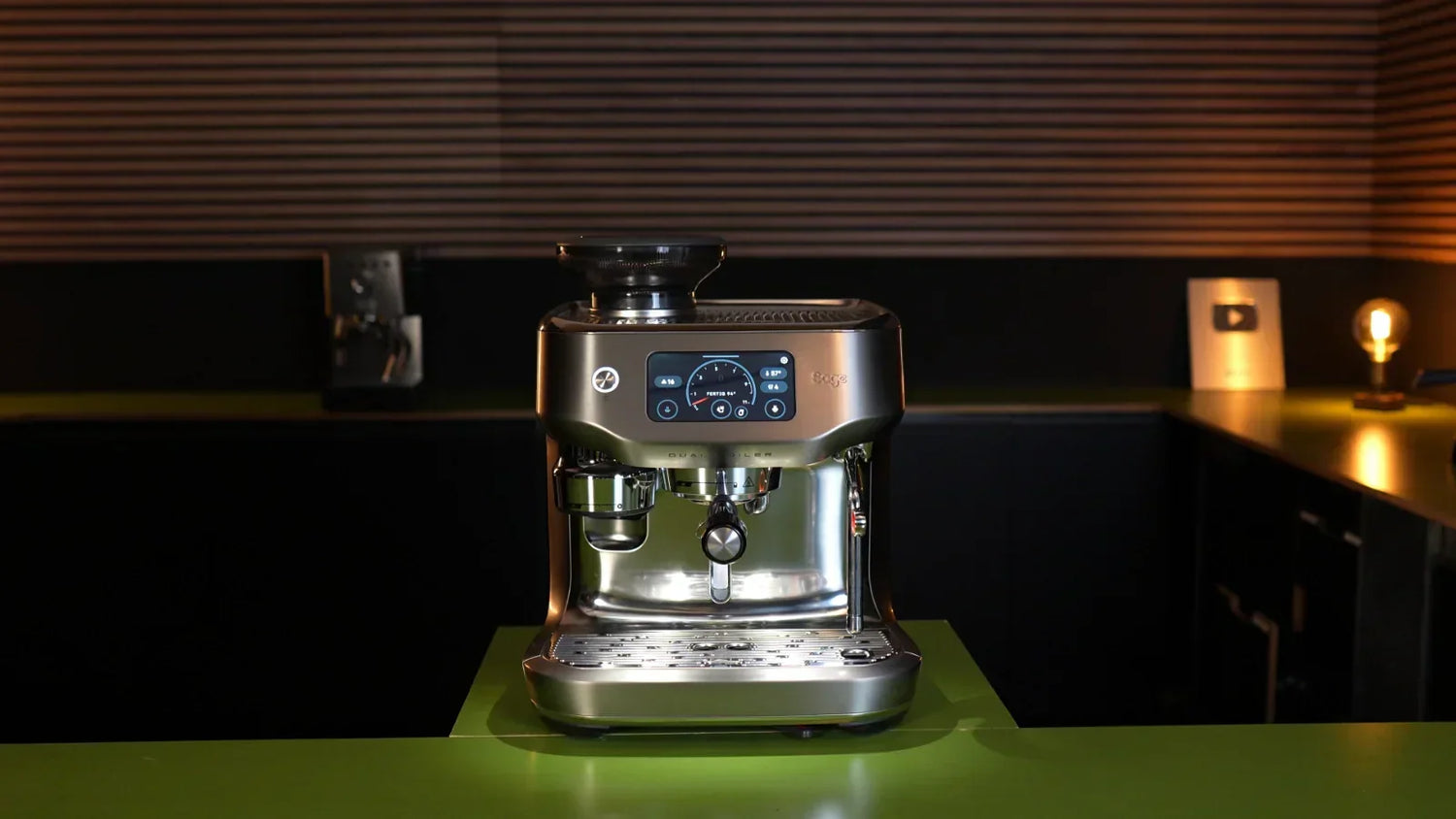

The Sage Oracle Dual Boiler is an all-in-one dual boiler espresso machine in the high-end segment that automates nearly every step from grinding to milk frothing. It targets comfort-loving espresso enthusiasts and switchers from fully automatic machines who are willing to invest €2,600 (CHF ~2,600). Its strengths lie in rapid readiness for operation (~4 min heat-up time) and well-regulated temperature management (temperature deviation <±2 °C even after 15 shots). The volumetric shot control and automatic milk frothing also work impressively reliably. However, the Oracle Dual Boiler shows weaknesses with the integrated grinder: its dosing accuracy fluctuates noticeably, which limits the reproducibility of espresso quality. Moreover, the machine is constantly accompanied by an audible fan whirring.
Overall score: 86/120, Price-to-performance: 8/10 – a successful comfort package with deductions for inconsistencies and the high price.
For the test of the smaller Sage Dual Boiler, click here.
Classification & Test Setup
To test independently, we buy all test devices, even though manufacturers constantly ask us if we'd like to test their devices for free. If you'd like to support our work and the purchase of additional test machines, feel free to try our coffees or order the Sage Oracle Dual Boiler through our partner link, e.g., at Amazon. It won't cost you more, but we receive a small commission.
The Oracle Dual Boiler is Sage's most advanced portafilter model and positions itself as a bridge between the classic portafilter machine and fully automatic machine. With dual boiler technology, built-in grinder, automatic tamping function, and independent milk frothing, it aims to make the path into the espresso world easier for beginners without overwhelming them with manual work steps. At the same time, it should offer ambitious home baristas enough control to influence shots themselves through simple recipe settings. In short: Sage promises "espresso making on easy mode" in professional quality with this machine – and that at a premium price.
We tested the Oracle Dual Boiler independently and thoroughly as always. Our test took place in a controlled environment (room temperature ~21 °C), using soft water and fresh Apas beans. The machine was first put into operation, used in everyday life for a few days, and then transferred to the test scenario.
Then our usual comprehensive measurement protocol followed: This included temperature measurements with a Scace sensor in the portafilter, pump volumetric tests, precision weighings of the dispensed coffee grounds amount and particle distribution, as well as noise measurements during operation. We also simulated practical scenarios – from a single morning espresso to the WBC protocol with 14 consecutive shots – to explore the performance limits of the Oracle Dual Boiler. Power consumption was also determined in various operating states (see Energy & Efficiency). In short: we thoroughly tested the machine and checked both with data and sensory evaluation where it shines and where it doesn't.

Design, Workmanship & Accessories
Externally, the Oracle Dual Boiler immediately appears as a typical Sage product. Materiality and workmanship are strongly reminiscent of cheaper Sage models – both positively and negatively. The machine consists mainly of brushed stainless steel sheet, feels solid, and weighs a respectable ~17 kg on the scale (good for stability). However, there's no great leap in appearance compared to a €1,000 Sage. The gaps are clean, but the material thickness (e.g., of the drip tray) could be higher for the budget requested. At least: inside, there are two stainless steel boilers and even a heated brew group – the latter a clever feature that brings the portafilter quickly up to temperature. The downside of this tech offensive is a constant-running fan that needs to provide cooling and leads to permanent whirring. This fan noise is somewhat reminiscent of a PC fan. You can literally hear that there's a small computer on board here.
Accessories & Delivery Contents
Sage equips the Oracle Dual Boiler very generously. In the box, you'll find, among other things, a stainless steel milk jug, a knock box for spent grounds, cleaning utensils, and of course the portafilter with inserts (single and double basket). A water filter for the 2.3 L water tank is also included. This is typical of Sage – a useful addition that we recommend changing regularly.
The 58 mm portafilter itself is made of solid stainless steel and sits well in the hand. It clicks flat into the brew group; the seal ring grips firmly, though the lever needs to turn a bit further to the right than on E61 machines. The wide, removable drip tray (approx. 1.3 L capacity) covered with a stainless steel grill is striking. Under the grill, Sage uses plastic elements. This is functionally okay but not quite as premium optically and tactilely. Plus point: In the drip tray compartment there's a practical storage compartment for accessories (e.g., blind basket, cleaning tool) and a rolling mechanism to move the heavy machine forward and backward on the work surface more easily.
Overall, the workmanship convinces in everyday use: Nothing rattles, the operating elements (dials, levers) feel robust. Nevertheless, the impression remains that Sage relies more on the inside than external luxury here – other dual boilers in the €2,500 league (e.g., Profitec, ECM) look much more purist and elegant, but sacrifice all the built-in technology.

Operation & Workflow
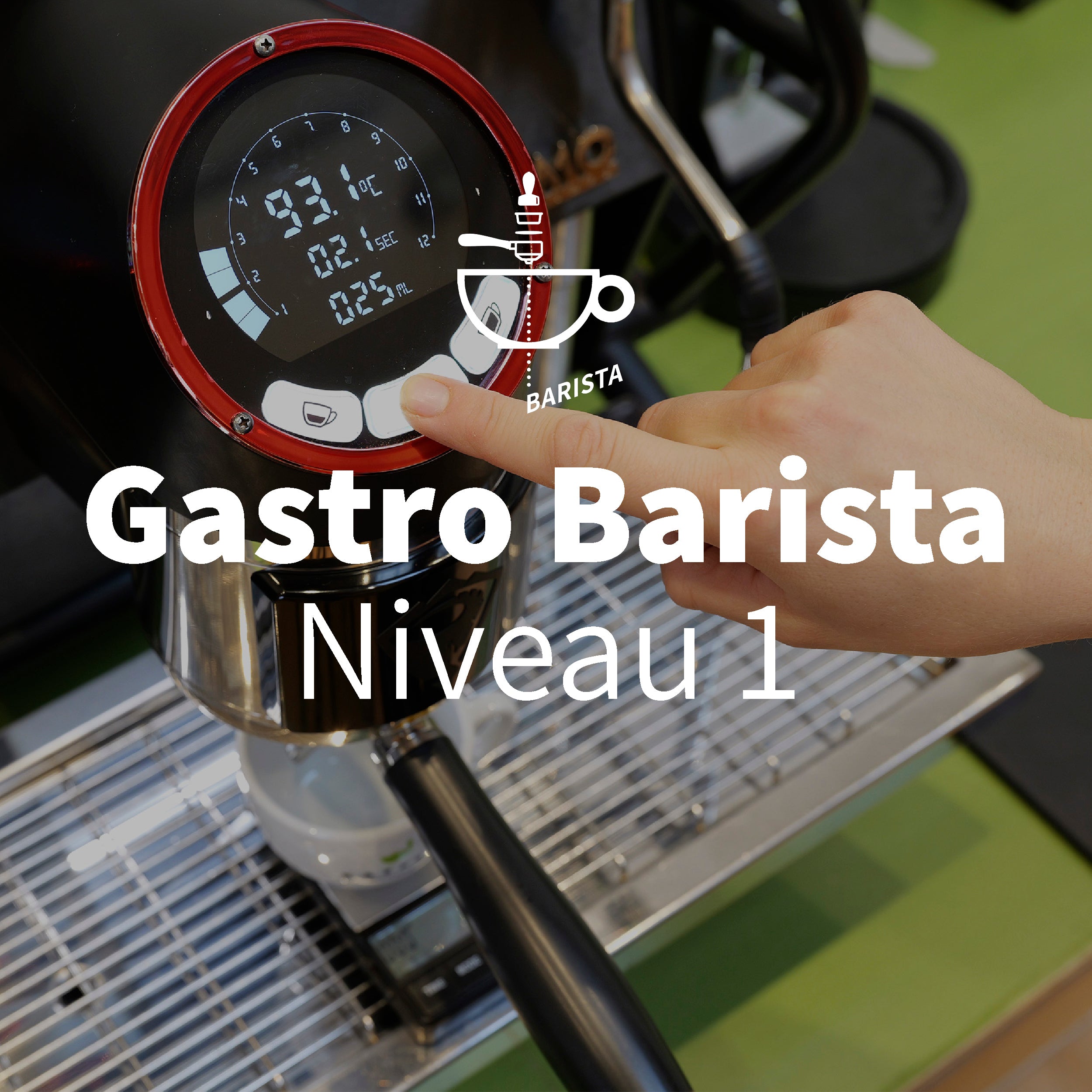
The Oracle Dual Boiler presents itself as extremely user-friendly in handling. It's operated via a combination of menu display, dial, and some buttons. The central display (not a touchscreen, but an informative LCD) guides you through settings and shows parameters like temperature, shot time, or selection menus. Even the first startup is announced by the machine with a friendly start jingle ("Ding-Dong"). Fortunately, you can reduce or disable it in settings.
After switching on, the Oracle heats up lightning fast (details in the Heat-up Time section). Once ready, it essentially guides the user step by step to espresso: Grinding & tamping happen automatically at the push of a button. You fix the portafilter in the grinding dock and the machine grinds the preset amount and compresses the coffee using an internal tamper mechanism automatically. This integrated tamper has an adjustable pressure level; in our test, it achieved ~10-15 kg of pressure, resulting in an evenly firm puck – at least when the dose is correct (more on that in the Volumetrics chapter). After the tamp cycle, the machine releases the portafilter and you insert it into the brew group as usual.
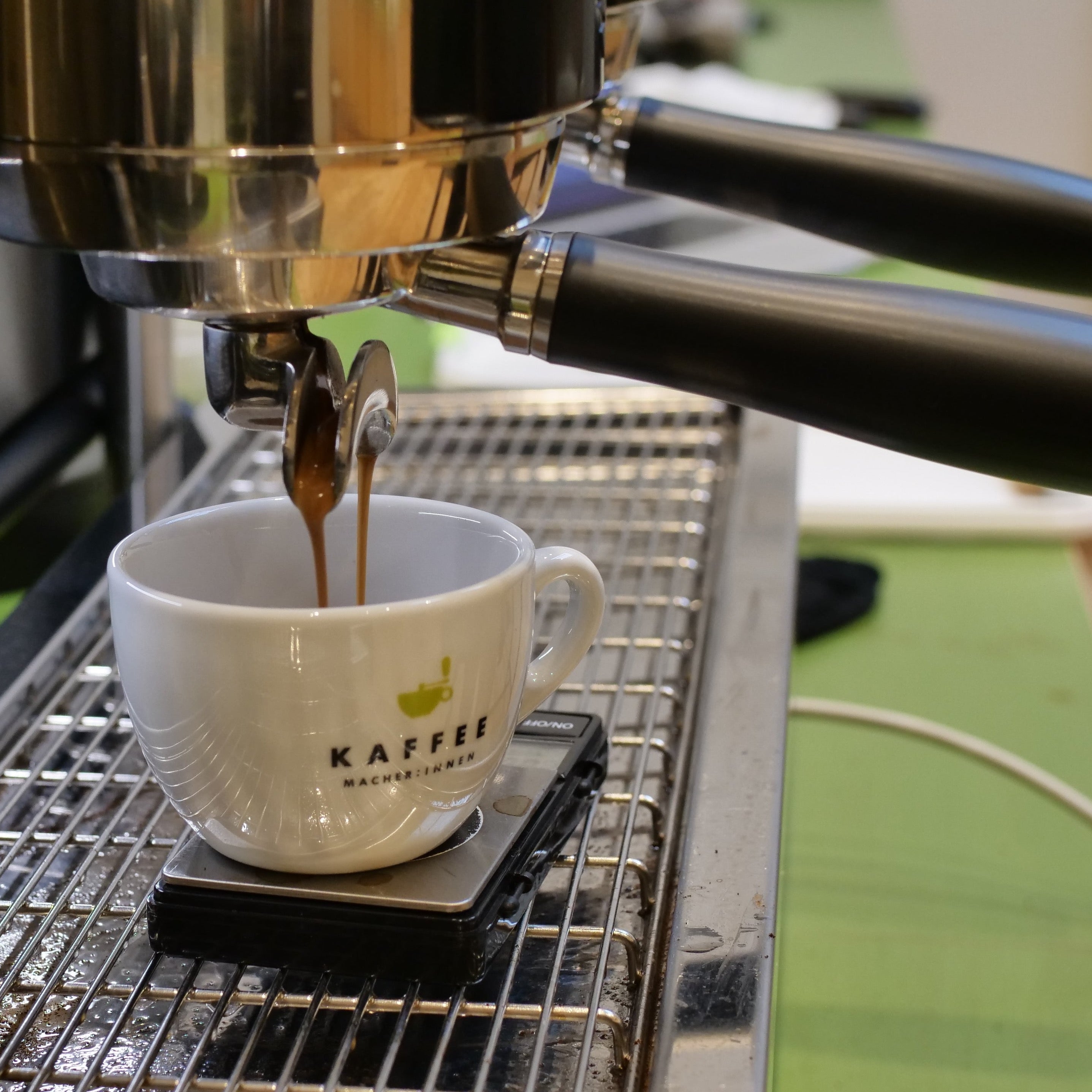
Start extraction: With the push of a button, the espresso extraction starts, controlled volumetrically by default. This means the Oracle automatically stops the shot at the preset liquid amount (e.g., ~50 ml for a double) – and it does this remarkably precisely and reproducibly. The integrated flowmeter works flawlessly; shots measured in series deviated by a maximum of 1–2 ml from each other, which is excellent. This saves you from having to manually stop using a timer.

Daily Routines
The entire user interface of the Oracle is designed to make the workflow as simple as possible. A smartphone app makes it possible to turn the machine on and off via timer or remote control – handy for preheating from bed in the morning or turning off the machine if you've forgotten. Thanks to the short heat-up time, however, this feature is only somewhat necessary.
Cleaning and maintenance are well thought out: After extraction, a solenoid valve relieves brew pressure (dry-puck function), so the spent grounds land dry in the basket. The steam wand purges itself after frothing with hot steam (automatic blast-out). Additionally, you can activate a cleaning burst by double-tapping the hot water button. This is ideal for rinsing the brew group and basket in between.
The stainless steel surfaces are relatively resistant and easy to wipe down; fingerprints are less noticeable than on polished chrome. Thanks to the extendable rollers, you can easily pull the machine forward alone to clean behind it or remove the tank. Overall, we found little cleaning effort in the test: daily emptying of the drip tray (the fill level is signaled by a red float), wiping the steam wand (cool-touch, nothing burns), and occasional backflushing with blind basket and cleaning tablets – done.
Grinder Automation – Potential Collides with Reality
Where there's planing, there are shavings – and where a machine does so much automatically, there are also automation pitfalls. A major criticism point is the grinder automation (see Volumetrics): The Oracle grinds on its own but doesn't precisely measure the coffee grounds amount; instead, it likely works via fill level/pressure. This results in the dispensed coffee dose varying somewhat depending on the beans and settings, and sometimes seemingly arbitrarily, without the machine raising an alarm. For the entire adjustment system of the grinder to work, however, precise coffee amount dispensing is a prerequisite.
Yes, Sage is the first company to roll out synchronized and automated grinder adjustment on a large scale for home espresso machines. If an extraction time falls significantly short or exceeds the target, the Oracle automatically adjusts the grind for the next shot. The concept sounds brilliant, but it only partially worked in testing. The tolerance bandwidth at which the automation kicks in is relatively large – "way too large," as Michel from the team notes.
This means the machine ignores minor deviations, and only when a shot really goes wrong (more than 5 seconds above or below target) does it adjust.
Unfortunately, this control algorithm currently can't be manually fine-tuned. Two main problems cause additional fluctuations and challenges for the system. The imprecise amount output itself causes brewing to sometimes run shorter or longer. No wonder – the coffee amount strongly controls the resistance of the puck, not just the grind!
When someone manually adjusts a grinder, they always grind some coffee from the grinder to empty the so-called retention. This is important because otherwise, some grams of the "old grind setting" will negatively affect the shot. We measure around 3 grams of retention; it's worth grinding out.
In practice, the Grind-by-Sync function is accurate enough to keep shots reasonably on target. However, it's far from delivering precise shot-after-shot results. Manual coffee preparation is way ahead here, at least for now.

Heat-up Time & Temperature Management
Dual boiler machines were long considered a "morning patience test," but the Sage Oracle Dual Boiler impressively disproves this prejudice. It heats to operating temperature in about 4 minutes – an outstanding value in this device class. In testing, we could pull our first espresso after just under 4:00 min without temperature drops. This is possible thanks to the combination of two relatively small boilers, powerful heating elements (2,300 W maximum power consumption), and the heated brew group. The latter ensures the portafilter gets hot quickly even without a long wait.
Sage has clearly done good work on thermal management here. Already after 4–5 minutes, we reach stable temperatures – that's top tier and comparable to the fastest thermoblock devices. For context: Many classic dual boilers (without brew group heating) need 15–20 minutes of lead time to be similarly stable. With the Oracle Dual Boiler, you can therefore safely give the instruction: Turn off when not in use, but be fully ready to go again in a few minutes when needed – that saves energy.

Temperature Stability
Once heated, the Oracle maintains consistent brew water temperature. In our standard protocol (brew temperature 94 °C, extraction time ~25 s), the temperature during a single espresso stayed within ±0.5 °C of the target value – a very good result. Over multiple shots, it remains impressively stable: we pulled five double espressos in a row and detected only minimal drift.
Even in a stress test to WBC specifications (14 shots in direct succession, with increasingly shorter pauses between shots), the machine stayed in the green zone. Here, the brew temperature increased very gradually, so by the end, approximately +1.5 to 2 °C above the starting temperature was reached. This curve is typical – continuous load further heats the brew group – but in this case very flat and controlled. +2 °C after 14 shots is absolutely uncritical, especially since hardly anyone adjusts this at home.
Important: For all normal scenarios (1 to ~5 shots in a row), the Oracle Dual Boiler stays within ±1 °C of the target temperature. This builds confidence in reproducibility. In everyday use, we could also taste this: the second, third espresso tasted just as extracted as the first.
According to our measurement data, there's a slight offset of one degree from the factory. If you set 94 °C, for example, you'll also come very close to 94 °C in the water stream at the portafilter – any deviations (<1 °C) are within measurement tolerance. The machine also allows you to program an individual offset if desired. This wasn't necessary in our test. Even after longer breaks (>1 h) and restart, there was no first cold shot: thanks to intelligent heat-up logic (the Oracle heats the boiler and group in coordination so both are ready together), the first shot was immediately in the correct temperature window.
Temperature Management in Detail
The Oracle has PID controls for both boilers. What was striking in testing was the active cooling system: the mentioned internal fan also kicks in during longer shot series to cool the electronics and possibly the boilers. Sage thus prevents the temperature from rising uncontrollably – clever, but acoustically present.
At rest, the boilers maintain temperature quite precisely, with the steam boiler automatically throttled slightly when not in use to save energy (we observed that the machine reduces heating cycles in idle mode).
For the typical home user, this means: With the Oracle, you get a very consistent brew temperature without much effort – an important foundation for consistent espresso quality.

Volumetrics
The Oracle Dual Boiler combines two volumetric systems: coffee dosing and water dosing. We examined both closely in testing – with mixed results.
Water Amount / Espresso Volume
The Oracle's volumetric espresso output is excellent. Via the menu, you can program a water amount for 1- and 2-cup shots (factory default about 30 ml for single and 60 ml for double). During operation, the machine stops the shot precisely upon reaching this amount. Our test series showed deviations of maximum ±2 ml between consecutive shots – practically nothing.
In everyday use, you notice this: when we set 40 ml for a single espresso, for example, we get this volume in the cup very consistently each time. This takes a huge load off because you don't have to manually stop or use a scale. Even if the grind is slightly off and the shot flows faster or slower, the amount is right. Sage has well-coordinated the combination of flowmeter and control.
Coffee Amount / Grinder Dosing
As discussed, it looks less rosy with the integrated grinder. Instead of an integrated scale (as some newer grinders on the market), Sage relies here on a time- and fill-level-based dosing concept. The Oracle "thinks" it knows when enough coffee grounds are in the basket, but doesn't measure it precisely. In testing, this led to noticeable fluctuations: typically, our double dosing amounts were between approximately 21.0 g and 21.5 g, even though 21.0 g was targeted. Individual outliers were even +0.5 g or -0.8 g. This may not sound like much, but it can noticeably alter the espresso output (extraction time and brew rate).
In the cup and during extraction, this sometimes expresses itself quite clearly: once the espresso tasted somewhat thinner and more acidic, the next shot then stronger again – even though we hadn't changed anything. This is where you notice that the Oracle does everything "at the push of a button" like a fully automatic, but (not yet) with the precision of a dedicated grinder with a scale.
Why does the dose fluctuate? Our suspicion: The machine stops grinding once the internal tamper feels a certain back-pressure or reaches a certain height in the basket. That's simply not a precise principle. In one case, the machine also simply stopped grinding too early – the puck was visibly under-filled, yet the display reported "Dose OK". The result was insufficient resistance in the portafilter and too little coffee. Then the entire automation system doesn't work at all. The grinder adjusts, the brewing ratio no longer fits. Such coffee can't taste good.
Consistency vs. Comfort
The discrepancy between excellent water dosing and mediocre coffee dosing is probably the Oracle Dual Boiler's biggest weakness. You always get the same espresso volume dispensed at the push of a button, but not always with the same strength because the coffee amount varies.
For anyone wanting high reproducibility with the Oracle, we recommend at least checking the coffee amount on critical shots. The most reliable way is to weigh the portafilter briefly before and after grinding with and without coffee. Anyone who gets used to this knows why the shot works afterward, or why it doesn't.
Alternatively, you can also operate the grinder in manual mode – then it grinds as long as you press the button (or until abort), and you can manually stop the amount. Of course, this isn't the idea behind such a machine, but it shows: the real bottleneck here is really the grinder.
For Statistics Enthusiasts
In a series of 10 double shots, the standard deviation of the dispensed coffee grounds amount was around 0.3 g (relatively high), while the standard deviation of the liquid amount was under 1 ml (extremely low). This illustrates the discrepancy. On the positive side, we should note that the particle distribution of the ground coffee is very neat. We had the coffee grounds examined by ZHAW in Wädenswil.

A main peak of 284 microns and a fine peak of 28.5% – these are values well-suited for preparing primarily medium and darker roasts effectively. The potential for good extractions is there – it's just not fully utilized when the amount varies.
Espresso Potential
Let's get to the most important thing – the espresso in the cup. What can the Oracle Dual Boiler deliver here and how do we assess the taste potential?
When all parameters are correct, the Oracle Dual Boiler brews excellent espresso shots. Temperature and pressure are stable, pre-infusion can happen gently, and the brew system (shower screen, brew group) distributes water evenly over the puck. In our best shots, we achieved balanced espressos with very good quality.
Particularly practical is the ability to manually control pre-infusion: you can, for example, pre-brew for 5 s at low pressure and then transition to main extraction with a button press. This semi-manual profiling allows you to vary recipes somewhat. The machine saves such sequences as programs if you wish.
We played with this in testing and, for example, pulled a shot with very long pre-infusion and a total time of 35 seconds. This could be reproduced at the push of a button – but only provided the coffee amount was correct. Here we're back to the point: the best recipes aren't worth much if the grinder doesn't deliver the same amount each time. We had a shot designed for 27 s that suddenly only took 23 s due to 0.5 g under-dosing and tasted accordingly different. This diminishes reproducibility. In our view, the grinder therefore limits the espresso potential of the Oracle. Purely in terms of brew technology, it could score even higher.

Sensory & Shot Quality
The good news: Even with slight inconsistency, the Oracle overall delivers very solid espressos in the cup. Over several days, we tasted various beans on it (from light fruity roasts to classic Italian roasts like the Compadre) and consistently achieved drinkable to excellent results. In blind tastings, you would have barely detected a difference from a manually extracted espresso (with separate grinder) if the parameters were right.
When the Oracle messes up a shot, it's usually due to a gross deviation (extremely short or long extraction). This happens, as described, mainly when the dosing is significantly off.
Espresso Score
In our evaluation, the Oracle Dual Boiler achieves 10 out of 15 points in the espresso potential criterion. That's a good rating. Because the potential is there! The machine can do everything a good shot needs. You just need to override the comfort functions and work a bit yourself (weigh the coffee after grinding).
If you use the machine and grinder without checking, the potential is severely limited and you'll repeatedly end up with shots that you could have brewed with a €350 setup.
For everyday taste, 10/15 means: Good. Most users will be very happy drawing finely aromatic espresso – especially without much effort. However, if you want to experiment ambitiously (various doses, ratios, fine-tuning), you might sometimes feel constrained by the Oracle or work with workarounds (manual weighing).
Overall, the Oracle Dual Boiler delivers exactly what it promises: espresso as simple as possible, without taste compromises. It's impressive how quickly and without great prior knowledge you can achieve drinkable results with this machine. That's its major strength – and perhaps you'll forgive it for narrowly missing the absolute taste olympus.
Milk Steam & Frothing
A highlight of the Oracle Dual Boiler is the milk frothing function. Sage has integrated a fully automatic steam wand that froths milk at the push of a button – including temperature and foam level control. In testing, this feature impressed us again: the Autosteam delivers good microfoam, with which latte art pouring is easily possible.
You simply place the milk pitcher under the wand, select the desired milk temperature via menu (e.g., 60 °C) and foam level (from little to lots of foam in a few steps) – the machine does the rest. It froths to the target temperature and then stops automatically. Result: fine-pored foam, evenly integrated, no large bubbles.
For someone with no experience frothing milk, that's a blessing: the Oracle conjures milk foam that's better than in many average cafés. The team was surprised at how well the system works. Sage has experience with earlier models (Oracle Jet), and it shows.
Speed & Performance
In our measurements, it took approximately 68 seconds to bring 300 ml of milk to 60 °C. That's a slow value. Many household espresso machines need 60–90 s for 300 ml, so the Oracle is in the middle range. Classic espresso machines and especially dual boilers often get 25 to 45 seconds – in the same price range.
Manual Frothing
Anyone preferring to swing the pitcher themselves also gets their money's worth. The steam wand can be switched to manual mode anytime by taking it in hand and operating the steam lever like on any classic machine. The manual frothing performance is also convincing. The wand is long enough and movable, the two-hole steam head creates a nice swirl in the pitcher.
This makes the Oracle suitable for those wanting to learn. You can first use the automatic to get a feel for good milk foam, and later practice yourself. The machine doesn't limit you here. On the contrary, Michel joked: "until you're so confident that you can really do it by hand that well, by then Sage will definitely deliver good milk foam automatically for you."
Wand Cleaning
An important point: the steam wand has an auto-purge function. After each frothing, it briefly spits steam/water to remove milk residue from the nozzle. Additionally, the tip is removable and can be cleaned.
In our test, the wand stayed relatively cool outside thanks to cool-touch insulation, so milk doesn't burn on immediately. A quick wipe with a damp cloth was enough to keep it clean. You should do this briefly after each froth.
Foam Quality Rating
The Oracle Dual Boiler achieves 7 out of 10 points in the milk foam category. That's a good result. Deductions in our rating were mainly for speed – faster dual boilers or pro machines deliver more steam power, but that's rarely needed at home.
In practice, 7/10 means: fully sufficient for home needs, even for multiple drinks in a row. By the way: thanks to dual boiler, you can simultaneously pull espresso and froth milk, significantly reducing prep time for cappuccino & co. In testing, we often worked in parallel – e.g., running espresso while the automatic frothed. Result: cappuccino ready in 1–2 minutes, no stress. Machines without dual boilers (or without parallel capability) need much longer here or you have to do it sequentially.
The Oracle leverages this advantage super well in everyday use. In summary: milk enthusiasts will get their money's worth with the Oracle. Whether latte macchiato, flat white, or cappuccino – the machine delivers the milk foam essentially at barista level, optionally on autopilot or to your own taste manually. That's really fun and encourages coffee creation experiments. Anyone drinking lots of milk-based drinks will love the Oracle.
Noise Level
The Oracle Dual Boiler operates at a divided noise level. On one hand, it works surprisingly quietly during brewing operation, but on the other hand, it has a constant noise source built into its design that you can't overlook: the fan.
Noise Level During Espresso Extraction
During coffee extraction, the Oracle is pleasantly quiet. The vibration pump is well-damped in the housing, and you only hear a muted hum when pressure builds. We measured ~60 dB at 1 m distance (without background noise). That's about normal conversation volume – excellent for an espresso machine. Many machines exceed 70 dB, especially when cups clatter on the drip tray. The Oracle has rubber pads that dampen vibrations.
In our worst-case measurement with intentionally clattering cups, a peak value of ~69 dB resulted. That's still far from, e.g., a vacuum cleaner (80–90 dB). Overall, we'd rate the pump/brewing noise level as low – in everyday life, we found the machine hardly disturbing during extraction. Normal conversation next to it is no problem.
Grinding Noise
The integrated conical burr grinder produces typical grinding noise. Since it's built into the housing, sound is somewhat dampened, but it's certainly not completely quiet. We measure 73.8 decibels at the grinder.
Fan Noise
Here's the catch. As soon as the Oracle switches on, an internal fan runs to cool components. This continuous whirring isn't particularly loud, but it's always there. In a server room, the Sage Dual Boiler wouldn't stand out, perhaps in a kitchen or living room though.
Other dual boilers without fans are completely silent at idle but often emit a loud click (relay) and pump vibration when extraction starts. The Oracle pretty much reverses this – it's a little audible all the time, but very civil during extraction. Which variant you find more pleasant is a matter of taste. If you turn on the machine in the morning and let it run in the background until needed, you have permanent ventilation in the room.

Energy & Efficiency
The Sage Oracle Dual Boiler sets accents not just technically but also energetically – though with mixed results. On one hand, it scores with rapid heat-up time, allowing it to run only when needed. On the other hand, it consumes electricity continuously as a dual boiler in standby to keep both boilers at temperature. Let's look at some figures from our power measurement protocol:
Heat-up cycle: The initial heat-up to operating temperature (94 °C brew boiler, ~135 °C steam boiler) took ~4 min 30 s and consumed about 0.11 kWh of electricity. That's very efficient for a dual boiler machine. For comparison: machines with longer heat-up times may draw less peak power, but often add up to 0.2 kWh or more over the duration. Sage heats quickly and then shuts off the heating elements.
Single shot (espresso): An espresso double shot of ~25 s draws negligible power. In our protocol, a single shot (after heating) came to 0.016 kWh. That's about 1–2 tea kettle fills for a cup of tea – hardly worth mentioning. Including heat-up (if you only run the machine for one espresso), this adds up to about 0.127 kWh. That's still a very good value. In household terms: at 30 cents/kWh, that's about 3.8 cents per espresso (incl. warm-up).
Cappuccino (espresso + milk): For a cappuccino, milk must additionally be heated. Our measurement for 1 cappuccino from cold start showed ~0.153 kWh. This includes heating, espresso brewing, and milk frothing. This is also moderate – other machines are sometimes higher here, especially if they have longer idle times.
5 shots in a row: It got interesting in the multiple-drink scenario. We heated the machine and then pulled 5 double espressos in a row (total ~7:30 min operating time). Result: 0.19 kWh total. This nicely shows the advantage of short heat-up time: the first ~0.11 kWh goes into heating, but additional shots cost barely more. Each additional espresso added only ~0.016 kWh. In other words, if you make multiple drinks in a row, you use the energy very efficiently.
Keeping warm/standby: This is the weakness of many dual boilers – including the Oracle. If you leave the machine on and ready, it consumes about 0.11 kWh per hour (corresponds to ~110 W continuous power). In 30 minutes it was ~0.055 kWh, in 60 minutes about 0.11 kWh. That's quite noticeable. A morning (4 h) without use takes ~0.44 kWh just for standby. However, there's relief: the Oracle has an adjustable auto-off function. From the factory, it goes to standby after 1 hour of inactivity (boilers shut down). You can also set the timer differently. In standby, consumption drops practically to zero. However, reheating from completely cold then takes ~4 min again. Sage offers smart home integration (app timer) for this to reheat from standby at fixed times, e.g.
Hot water and steam use: Dispensing hot water (e.g., for an Americano, ~70 g) cost us about 0.008 kWh – hardly worth mentioning. Frothing milk, by contrast, consumes noticeable power because the steam boiler must reheat. 5 rounds of milk frothing (5× 300 ml in succession) consumed about 0.127 kWh. That means roughly 0.025 kWh per portion (e.g., cappuccino milk).
Overall, the energy efficiency of the Oracle Dual Boiler is good for its device size, but not groundbreaking. It achieves 6.5 out of 10 points in our rating. Why not a top score? Because there are now machines using thermoblock technology or better insulation that use significantly less standby power. The Oracle is somewhat more energy-hungry through its two boilers when left running.
Positively, however, thanks to fast heat-up time, you don't have to do that: if you only pull espressos morning and evening, you can leave the machine off between times and save lots of electricity. In a realistic scenario (2 espressos in the morning, 2 in the evening, off in between), we measured daily consumption of ~0.25 kWh – that's completely okay. If you leave it on for 8 hours continuously (e.g., in an office), standby alone takes ~0.9 kWh.
Energy Conclusion
The Oracle Dual Boiler is not a power hog but rewards planned use. If you discipline yourself to turn it off (or control it via app), you can benefit from the great heat-up time and save energy.
Volume Potential
How does the Oracle Dual Boiler fare when things get hectic? Many drinks in a row, guests, or even a small coffee stand? Here you see that while it's above average capable for a household machine, it obviously doesn't replace a full-fledged commercial machine.
In terms of performance, the Sage Oracle Dual Boiler actually delivers a lot to make good espresso and cappuccino even under load. However, there are some technical bottlenecks. Even if the temperature is perfect and the frothing power is sufficient: without direct water connection and waste hose, any real undertaking in terms of mass production remains limited.
Although the Oracle Dual Boiler can practically be refilled with fresh water from various sides, you still have to do it yourself. And while the drip tray holds quite a bit of water – 1.3 liters still fills up quickly.
Everything works… it's just not practical. And so we come to our rating of the volume potential.
Overall Rating & Price-to-Performance
Before we reach the final conclusion, here's the overall assessment of the Sage Oracle Dual Boiler in the categories we tested. This is composed of weighted individual ratings we assigned during testing:

You can see that the Oracle Dual Boiler performs strong to very strong in many categories: usability, heat-up time, noise level, accessories – it gets almost full marks here. There are slight deductions for foam quality and espresso performance, mainly due to the grinder issue. Larger deductions were given for build quality (pricier machines can show higher material quality), power consumption (typical dual boiler not super efficient), and volume/catering (not a commercial device).
The total score is 86 out of 120 possible points, which equals ~72%. With this, the Oracle Dual Boiler ranks in the upper middle range of our previously tested machines in this class. Given the price, it positions itself well – not outstanding, but good. Especially the price-to-performance rating of 8/10 shows we consider what's offered appropriate despite the high absolute price. You get a comprehensively equipped machine that impresses in many respects and only falters in some aspects (dosing accuracy, continuous operation).
Scale: On our price-to-performance scale (1 = poor PLV, 10 = excellent PLV), 8/10 means the Oracle Dual Boiler is largely worth its money. It's expensive, yes – but it also delivers something unique for that. Machines with scores 9 or 10 are usually real bargains; the Oracle doesn't fall into this category. But you're not paying for nothing either: the technology inside justifies the price to a large extent.
Conclusion & Who It's Suitable For
Our conclusion: The Sage Oracle Dual Boiler is a fascinating espresso machine that wants to bring tech enthusiasm and coffee enjoyment together. It combines high-quality dual boiler espresso with the comfort of a fully automatic machine. In many areas – from heat-up time to temperature maintenance to milk foam – it impressed us positively in testing. Sage demonstrates here what's possible in the home espresso sector when you're willing to employ technology.
Of course, the package also has weaknesses: the integrated grinder falls short of its potential and causes inconsistencies, the constantly running fan constantly reminds you that you have a small "computer" in your kitchen, and the price of around €2,600 makes you think twice.
Nevertheless: the Oracle Dual Boiler delivers on its promises. It greatly simplifies the daily espresso bar routine without taking the soul from the core – a good espresso. You can experiment with it just as much as with a manual machine, or you can just lean back and let the automation do the work.
Who is this machine right for?
If you've previously had a fully automatic machine and now want to upgrade to portafilter quality but don't want to sacrifice comfort, the Sage Oracle Dual Boiler is made for you. It takes grinding, dosing, tamping, and milk frothing largely off your plate but delivers authentic barista feel taste-wise. Ideal for enthusiasts with tech affinity who like it convenient but don't want taste compromises on the result.
If you live in a household with multiple coffee drinkers who want their drinks quickly and in succession in the morning, you'll benefit from the dual boiler and the Oracle's speed. Cappuccino for everyone in a short time – no problem. The machine also works well for office groups or small teams, as long as someone keeps an eye on water and beans.
If you like to entertain guests and make 6–8 drinks at a stretch, you'll appreciate the Oracle's performance reserves. It easily handles small coffee parties without you sweating as host.
But if you're a perfectionist who wants to control every shot down to the last detail, the Oracle might frustrate you a bit. The automation (especially the grinder) won't always let you have full control. In that case, you'd probably be happier with a classic portafilter machine plus separate high-end grinder – there you can determine and optimize every variable yourself.
If your budget is limited and you're willing to work manually for good espresso, the Oracle is probably overkill. You can get combinations for less money that are taste-wise on par. You sacrifice comfort but save €1,000 - €2,000.
If you're noise-sensitive and expect absolute quiet in the kitchen, be warned: the Oracle hums a little all the time. There are quieter options (e.g., machines without fans). However, those are often louder during operation – you need to weigh which noise bothers you more.
Profile recommendation: The Sage Oracle Dual Boiler is perfect for someone who wants "the best of both worlds" – quality and convenience. We from the coffee makers had a lot of fun with it, especially because it does many things right and occasionally gives reason for nerdy discussion. It's a machine for enthusiasts with a playful spirit and ambition who are willing to pay for innovation. If you see yourself in this description, you'll have a great time with the Oracle Dual Boiler: espresso, cappuccino, flat white – everything works, and with an ease that brings joy.
In conclusion, we can say: Sage created a complex device with the Oracle Dual Boiler that delivers good coffee surprisingly uncomplicated. We happily forgive small weaknesses given the overall package. For us, it's a game changer in its niche – and a clear recommendation for anyone who wants to "rise to the big league of home barista at the push of a button."
Enjoy brewing coffee!
Those leaving automatic mode need figures. Standard recipe, grind and error table at Preparing espresso.