Sage Barista Touch Test: Good milk foam, espresso too hot
 Benjamin Hohlmann
The Sage Barista Touch is a combination machine. It combines a grinder and an espresso machine. This is convenient and has several advantages, such as its compact size. On the other hand, it's difficult to upgrade.
We tested the grinder and machine thoroughly and reveal in the following test report how the Barista Touch performed.
Semi-automatic with fully automatic appeal
This machine attempts a balancing act between a classic portafilter machine and a fully automatic machine. Almost all settings are operated via the display, except for the grind size. This is adjusted with a dial.
In the menu, you can then select many different coffee drinks, such as Flat White, Cappuccino, or Americano. But on closer inspection, you'll quickly notice that most drinks are made with the same settings. This is simply because espresso is used as the base for most mixed drinks.
The amount of coffee ground on the Barista Touch can only be adjusted in one-second increments. This is a real shame. The Smart Grinder Pro grinder from the same manufacturer can do this to a tenth of a second, and the Barista Pro, also a combination machine, to half a second. One second, as with the Barista Touch here, makes a world of difference. If you want 18 grams of coffee, one second too little might only give you 17.5 grams, but one second more then gives you 18.5 grams. That's frustrating.
During the brewing process, the Sage Barista Touch assists the user with tips on the display. However, some of these tips are simply wrong. The ideal extraction time for an espresso is stated as around 10-12 seconds, but you should really aim for around 25 seconds. With the suggested 10 seconds, the espresso tastes as sour as hot lemon.
The machine suggests 10 to 12 seconds of extraction time. Instead, aim for around 25 seconds – only then is the espresso no longer under-extracted and sour. How to get there is explained in our article on extraction time for espresso and on the right grind size.

A touchscreen display and little else
Some settings on the Barista Touch are very helpful. For example, you can adjust the milk temperature and milk foam level. The milk frothing performance is excellent. However, the display, which is actually the core of this machine, isn't really necessary for the machine's function. Moreover, it responds rather poorly compared to a smartphone display.
Unfortunately, the Barista Touch feels a bit like it's a patchwork of the Sage Barista Pro and the Oracle Touch. But it doesn't come across as particularly convincing.
Temperature excess – how far above 100 does it go?
The Barista Touch works with a thin-film heater, which Sage markets under the name ThermoJet. So there's no thermoblock inside. This is supposed to be a further development of the flow-through heater. The advantage is that the machine is hot after just 3 seconds. The energy transfer is enormous and the machine's power consumption is extremely low.
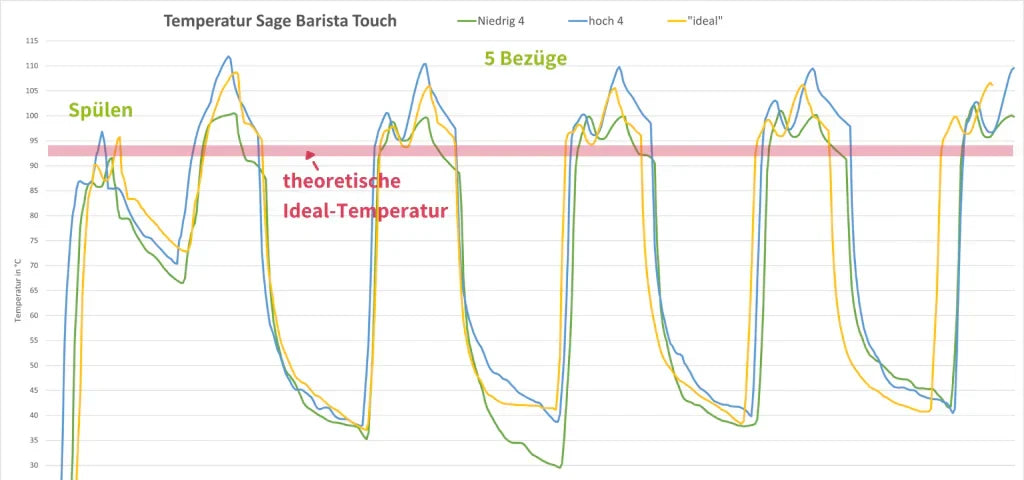
Heat is transferred to the brewing water via a heating plate. This is faster than with a thermoblock, whose intermediate aluminum block is sluggish at heating. It would even be possible with the thin-film heater to run different temperature profiles. However, the Barista Touch unfortunately doesn't have a precise temperature control unit. There are a total of 8 adjustable temperature levels, but even the lowest setting reaches 98 degrees Celsius and is far too hot. We aimed for a temperature of 93 degrees, but we couldn't reach it with any setting.
But what does the too-hot temperature do to the espresso? An espresso brewed too hot tastes very bitter, dry, and harsh. That's just not enjoyable. So you really can't brew a delicious espresso with the Barista Touch.
Milk foam of dual boiler quality
Another aspect is the milk frothing performance. You can froth milk automatically or manually. The steam wand is ready for frothing immediately after pulling the espresso, almost like a dual boiler. Simultaneous frothing during extraction is not possible. With the automatic function, the temperature of the pitcher is measured via a sensor near the drip tray. The milk temperature can be adjusted and runs very accurately. The automatic function works well and you can also manually produce excellent milk foam. However, we recommend switching to the manual method to produce truly fine-pored Latte Art foam.
Included accessories, size, and upgradability
The package includes two single-wall baskets and one double-wall basket. Also included are a milk pitcher and a tamper. The included Sage Razor is supposed to allow you to remove coffee grounds from the portafilter if too much has been ground. With a properly adjusted grinder, this shouldn't be necessary.
The Sage Barista Touch is 34 cm wide, 41 cm deep, and 40.6 cm high. The two-liter water tank can be easily removed and the machine's finish, with its brushed stainless steel, looks high-quality.
| Feature | Sage Barista Touch |
|---|---|
| Type | Combination machine with integrated grinder |
| Heating system | Thin-film heater (ThermoJet), ready to operate after 3 seconds |
| Temperature settings | 8 levels, lowest at 98 °C |
| Water dosing | Time control, no volumetric |
| Grind dosing | Only in full-second increments |
| Milk foam | Automatic and manual, temperature adjustable |
| Dimensions (W × D × H) | 34 × 41 × 40.6 cm |
| Water tank | 2 liters, removable |
| Included accessories | 2 single-wall baskets, 1 double-wall basket, milk pitcher, tamper, Sage Razor |
"Volumetric control" for espresso
Although the Sage website states that the Touch has volumetric control, we can't confirm this. The water quantity is dosed not via volumetric control, but via time control.
Volumetric control always dispenses the same amount of water through the coffee puck. For example, if you set it to 45 grams of water, it will always deliver that amount. The resistance of the coffee doesn't matter at all. The flow time will increase or decrease depending on how fine the coffee grounds are, but you'll always end up with 45 grams of water.
With the Barista Touch, you can adjust the brewing time. If the coffee grounds are too fine, you might only get a few milliliters in the cup; with too coarse a grind, the cup almost overflows.
For beginners, volumetric control makes much more sense. The brewing recipe (e.g., 1 part coffee to 2.5 parts water) doesn't change. You only adjust the flow speed through the grind size. With time control, on the other hand, you have to adjust your brewing ratio every time you change the water amount. That's more complicated and makes using a scale essential. That's not beginner-friendly.
Conclusion on the Sage Barista Touch
As a pure milk frother, the Barista Touch would really be great. It froths well and reliably and is fun for any barista.
But unfortunately, the pulled espressos don't taste good. The brewing temperature is inconsistent and much too hot.
So you should seriously consider whether the extra cost for the Barista Touch makes sense. Other Sage models, such as the Bambino Plus or the Barista Pro, are hardly any different from the Barista Touch. Whether you're willing to spend the extra money for the Barista Touch just for the automatic milk frothing function is your decision.
But in this price range there are also alternatives from other manufacturers that you should consider, such as the Quick Mill Orione 3000 or the Gaggia New Classic. Some dual boiler machines are also available at this price.