




























Grind size is the variable that influences your espresso most strongly — more than brewing temperature, more than tamping pressure, more than the machine. Yet "how fine do I need to grind?" is a question with no universal answer. We explain why that is, how you find your grind size, and what you can do if it doesn't taste right. (You'll find the basics of espresso preparation in our brewing guide.)
Why there's no magic number
"Set your grinder to 12" is a sentence you constantly read in forums. The problem: setting 12 on your grinder produces a completely different particle size than setting 12 on a grinder of the same type. Even two identical grinders from the same factory can grind differently at the same setting. The burrs sit slightly differently, the calibration varies, and usage has worn the burrs unevenly.
Grind size is therefore not a numerical value you can transfer. It's a setting you have to find yourself for your grinder, your coffee, and your machine. The good news: it's less complicated than it sounds.
The method: Finding the right grind size through timing
You need three things: a scale, a stopwatch (or a scale with timer), and a recipe as a starting point. Let's take the standard recipe: 18 g coffee, 36 g espresso in the cup, time window 25–30 seconds.
Dose 18 g of coffee, tamp, brew, and watch two things: how many grams land in the cup and how long it takes. The extraction time tells you whether the grind size is correct.
If the espresso runs through too quickly (e.g., 36 g in 18 seconds), the grind size is too coarse. The water meets too little resistance and rushes through the puck. The espresso typically tastes sour, thin, and watery.
If it runs too slowly (e.g., 36 g only after 40 seconds), the grind size is too fine. The water barely gets through, the coffee is over-extracted. The espresso tastes bitter, astringent.
If you land in the time window (25–30 seconds for 36 g), you're in the right range. From here on, your taste decides.

Adjusting grind size: How much should you turn?
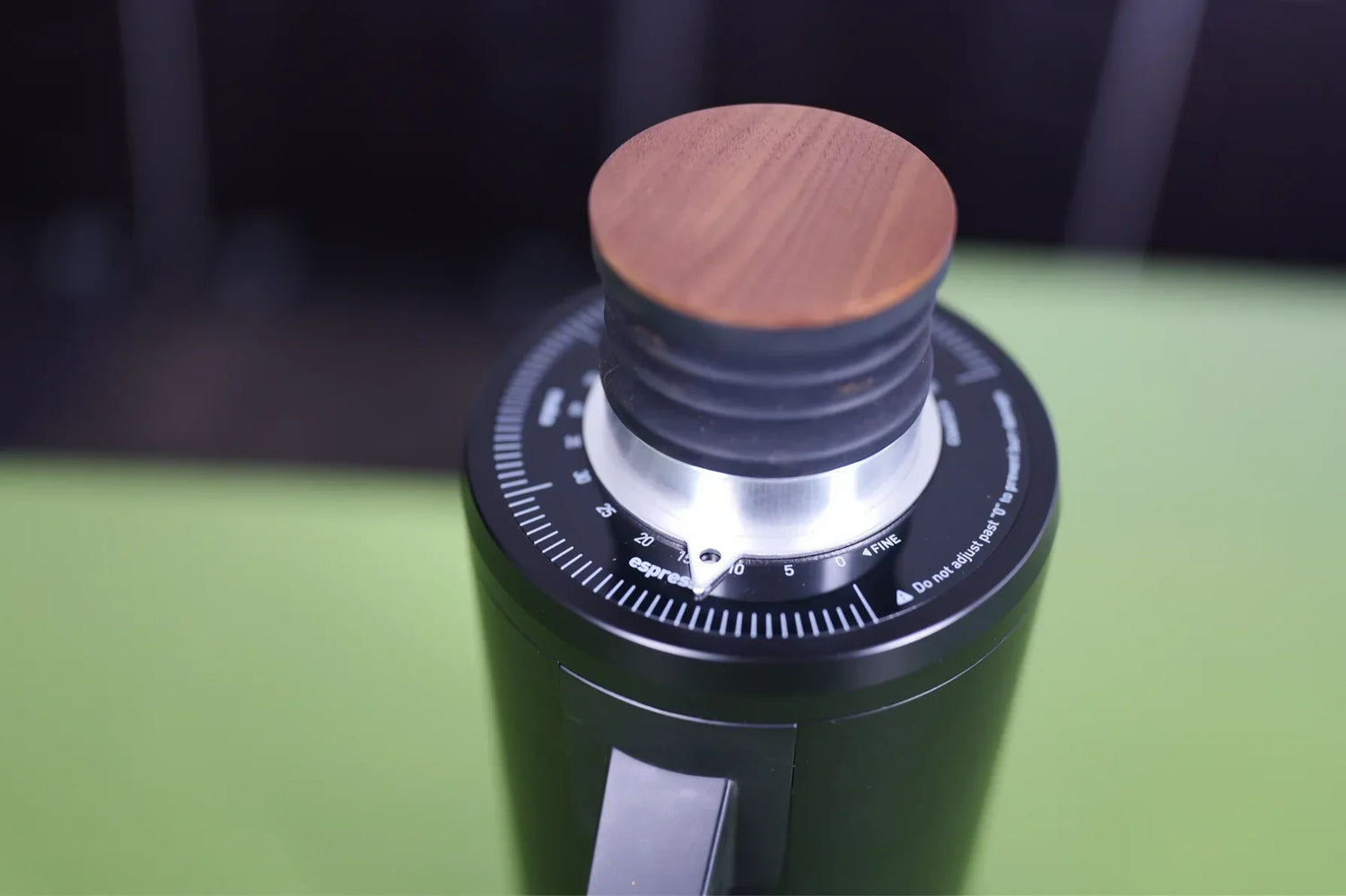
Here's the rule: less than you think. With most espresso grinders, small adjustments make a noticeably significant difference. With some grinders with fine gradations (e.g., the Eureka Mignon or Niche Zero), it's just one or two clicks or notches. How finely the grind size can be adjusted is itself a purchase criterion when you're thinking about which grinder you need.
The rule of thumb: Adjust grind size in small steps and do a shot after each change. Don't jump from "way too coarse" straight to "extremely fine" — you almost always overshoot, and especially if you adjust significantly finer, the grinder can even clog. A good rhythm: one small adjustment, one shot, taste, correct. After three to four shots, you're usually in the right range.
Important: After adjusting, discard the first small amount of ground coffee (2–6 g is usually enough). There's still powder from the previous grind size in the grinding mechanism. If that gets into your portafilter, it distorts the result. We call this coffee residue retention and it varies in amount from grinder to grinder.
When you need to adjust grind size
Grind size is not a set-and-forget setting. Several factors change how the coffee behaves at the same grind size:
New coffee: Every coffee has a different density, cell structure, and roast. When you open a new bag — even of the same coffee — the grind size can be slightly off. With a completely different coffee (e.g., from light to dark roasted), you often have to adjust several settings.
Coffee age: Freshly roasted coffee releases CO₂. In the first days after roasting, it resists the water more strongly, and the shot runs slower. At the same time, it's still degassing and doesn't taste great yet. We recommend waiting a good two weeks after roasting before starting to brew espresso. The longer the coffee sits, the finer you'll need to grind it over time.
Humidity: In high humidity, ground coffee expands slightly and creates more resistance. On hot, humid summer days, the espresso can suddenly run slower even though you haven't changed anything. One setting coarser usually solves it.
If your espresso tastes sour — despite fine grind size
A common problem: the espresso tastes sour, so you grind finer. And finer. And eventually the shot runs for 40 seconds and still tastes sour. What's going on?
Usually channeling. If the grind size is very fine but the coffee puck wasn't distributed evenly, pressure builds up unevenly. Water finds a channel through the puck and extracts everything there (bitter), while the rest of the puck gets hardly any water (sour). The result is an espresso that tastes both sour and bitter, no matter how fine you grind.
The solution then lies not in the grind size, but in the puck preparation. Distribute the coffee in the portafilter evenly (WDT with a needle works well), then tamp evenly. You'll find more on this in our brewing guide. A pre-wet can also help with channeling because it saturates the puck more evenly before full pressure comes.
If all that doesn't help and the espresso still tastes sour at the right time and right ratio, brewing temperature can play a role. Temperature that's too low extracts fewer acid-binding compounds. A couple degrees more can make the difference. But try grind size and puck preparation first — that solves 90% of the problems.

Espresso grind size vs. filter coffee grind size
Espresso requires the finest grind size of all brewing methods. For comparison: filter coffee is ground roughly like fine sand, French press like coarse sea salt. Espresso is somewhere between powdered sugar and fine sand — noticeably finer than anything else.
This has a simple reason: contact time with espresso is only 25–30 seconds. For water to extract enough flavor from the coffee in this short time, the surface area of the coffee particles must be as large as possible. Finer grind = more surface area = more extraction per second.
This is why you need a grinder for espresso that can grind fine enough and deliver uniform particle size. Not every coffee grinder can do that. A decent espresso grinder costs around 200 euros and up. Cheaper grinders can grind fine, but unevenly — with many coarse and many too-fine particles at the same time. This leads to under- and over-extraction in the same shot. Our large espresso grinder test shows which grinders achieve this. You'll find a curated selection of recommended grinders in the espresso grinder selection. Hand grinders in the budget range under 100 euros are often the best choice.
Setting grind size: Results in five shots
If you have a new grinder or want to open a new coffee, this method gets you to your goal quickly. Define the recipe or use our recipe. We provide a recipe for each espresso in our shop.
Shot 1: Start with a setting that seems roughly right to you. Dose 18 g, brew to 36 g, and time it. If the shot takes under 20 seconds: set noticeably finer. Over 35 seconds: set noticeably coarser.
Shots 2–3: Correct in the right direction, each time in small steps. You should now land in the range of 22–32 seconds.
Shots 4–5: Fine-tuning. Small corrections, taste, try. If the espresso is in the time window and you like it: done. If it's in the time window but doesn't taste right: continue reading at Espresso too sour or adjust the brewing ratio (slightly more or less water).
Yes, that costs you five shots of coffee. Consider it an investment — afterward you'll know where your grinder stands, and you'll only need to make minimal adjustments.
More on brew time and why it's your most important diagnostic tool: Espresso extraction time: When does the brew time really start?
Your espresso tastes sour? Then check out our detailed troubleshooting article: Espresso too sour — what to do?

