






Coffee is a semi-fresh product. If it's too fresh, it doesn't taste good. If it's too old, it loses intensity. In between lies the age that promises the most aroma and the best balance. But when and how are signs of aging noticeable? We tested this with our coffees: Leica, Henrique, and Dreispitz put to the test.
Since 2019, we recommend on our coffee packages that the coffee should be consumed between two weeks and two months after roasting. This is a recommendation because we think the coffee tastes best within this time span. At the same time, we know that our customers drink the coffee rather quickly and don't hoard it. So we believe that a majority of our customers drink our coffees between one and three weeks.
But: Why doesn't fresher coffee taste even better? Does the coffee remain stable between 2 weeks and 2 months after roasting? And is it undrinkable after that?
We checked our recommendations on three coffees from our range – with the Leica, the Dreispitz and the Henrique. The coffees reacted differently to aging. Let me first explain why coffee ages.
Why does coffee age?
Coffee ages because it's still alive. More precisely, because even in dried green coffee there is still moisture present (often between 9 – 12%). The embryo in the green coffee is dormant, but still capable of germinating. Green coffee is theoretically still long-lasting, but once it's roasted, the clock starts ticking rapidly.
We always talk about aging, or signs of aging, but never about spoiled coffee. The fact that coffee becomes undrinkable for health reasons would be due to extreme storage – high humidity and eventually mold – which is naturally not recommended. Hardly anyone would eat moldy bread. But old coffee doesn't endanger health; rather, it fails to meet expectations of what we actually understand coffee to be.
Analyzing coffee sensorially and chemically poses special challenges because coffee is always a moving target (Beeman et. al, 2011). Coffee is inherently not stable; it changes rapidly, especially after roasting. Thus, sensorial and chemical analyses are always time-consuming because the object of investigation is constantly changing – coffee lives, even after roasting.
Various physical and chemical reactions during roasting change the structure of the coffee bean and are partly responsible for the aging of coffee. Roasting makes the bean more porous and causes volatile compounds (mostly aromas) to be lost faster. Maillard reactions during roasting create compounds that are susceptible to fatty acid oxidation.
We know these fatty acid oxidations as rancid coffee. Many of us have already opened a pre-ground coffee package that was hidden somewhere in a cupboard. Out comes a rancid smell. Grinding massively accelerates the aging process because grinding potentially enlarges the surface area of the coffee.
What factors cause coffee to age?
There are mainly two reasons that cause roasted coffee to age faster or slower. They are packaging and storage temperature.
Coffee packaging
Coffee packages are becoming increasingly colorful, creative, and thus more memorable, but the main task remains the same: keeping roasted coffee fresh. Basically, coffee can be packed in a paper bag if it is consumed very quickly. If the goal is accelerated aging, then roasted coffee can be stored openly.
However, if roasted coffee is to be stored, it needs an oxygen barrier. These are usually polyethylene layers (PE) on paper, or aluminum packaging. Aluminum has shown the best properties so far for keeping coffee fresh for a long time – however, aluminum is something we decided against for ecological reasons. We chose PE-coated paper. While this keeps the coffee fresh for less time than aluminum, since we don't sell it on supermarket shelves, the time from roasting to consumption is much shorter.
In supermarkets, you'll find almost exclusively aluminum pouches, even those flushed with nitrogen. These coffees must not show too obvious signs of aging for several months. The aluminum-nitrogen combination currently does this job best. Transparent coffee packages are optically interesting, but they allow UV light to enter and accelerate the aging process.
Storage temperature
We know that higher temperatures accelerate chemical and physical reactions – and vice versa. Since roasted coffee is also still an ever-changing product, the external factor of high temperature can cause the coffee to age faster.
Aroma compounds are driven out of the packaging faster by high storage temperatures, as is the CO2 that was created during roasting and is still present, which keeps the coffee fresher in the package. While this smells good at the moment, it tastes less good in the cup.
The opposite is also true – coffee doesn't have to be stored too cold. If coffee is stored in the refrigerator and then brought back to room temperature for use, the condensation that forms leads to faster aging, but above all to uneven grinding distribution.
Michel discussed this in a short video:
Yeretzian and Blank examine these factors in detail in their publicly accessible paper: Protecting the Flavors – Freshness as a Key to Quality. We also made a video with Chahan Yeretzian about how long coffee can actually stay fresh.
Why doesn't fresh coffee taste good?
In a coffee that was roasted only a few days before, the amount of CO2 is still very high. While this produces a nice crema, a visual feature that many coffee aficionados seek, we have described what the crema myths are all about in detail here.
However, this CO2 in high concentration prevents a high extraction rate. Put simply: the CO2 behaves in the coffee like an impregnating spray for shoes. It repels water – but under heavy stress, the shoe also gets wet inside.
Coffee that still has a lot of CO2 is enveloped by it. The water can extract less from the coffee during extraction because it "beads off" the CO2. We still owe you a detailed examination of this.
During extraction, the brew water first dissolves acids from the roasted coffee. Backyard Coffee illustrated this nicely in this video. So shorter extractions are always acidic because the contact time was very short. Now, if we think of our "impregnated" coffee, which carries this CO2 shell, the following happens: the water penetrates less intensively into the interior of the coffee bean, so what is most easily soluble is extracted: the acid.
Fresh coffee thus always has an intense, full crema, but tends to be sour and has less texture, since this (sugars and fibers) can only be extracted through longer extractions, or once the CO2 is mostly no longer present.
How does old coffee taste?
Of course, this has to do with individual taste preferences, but rancid coffees are a thorn in many people's sides. I was once invited to a sensory panel at Nespresso where we tasted capsule coffees up to five years old. I was amazed at how sensitive the Nespresso staff were to detecting the slightest signs of old coffee that I wouldn't have considered old yet. The Nespresso sensory experts are extremely well trained in rancid coffee.
"Rancid," as mentioned above, is often a description for old coffee. We know this from oils that have gone stale. Describing rancidity is not quite easy – we often use loan words like: stalky, horse stable, flat, woody, pungent – what else can you think of? Feel free to share your descriptions in the comments.
In our experience, old coffee generally has the property that:
- the aroma is overpowered by off-notes (such as rancid, stalky, woody, tallow-like)
- the flavor notes are no longer intense, and if they are, not as originally perceived (fruity, floral)
- the texture can be less round
- the acidity stands alone, perhaps because the degenerating sweetness can no longer support it
- the balance is no longer there; acidity and bitterness often dominate
- the aftertaste can seem woody
- Yannick Schilli from the sensory group on FB speaks of "coffee without tension"
More on freshness and other criteria in coffee is discussed here.
When do our coffees taste best?
With this knowledge, we wanted to examine three of our espressos more closely. We tasted the coffees over 12 weeks at two-week intervals.
The experiment setting was as follows:
- Tasting after 2w, 4w, 6w, 8w, 10w, 12w
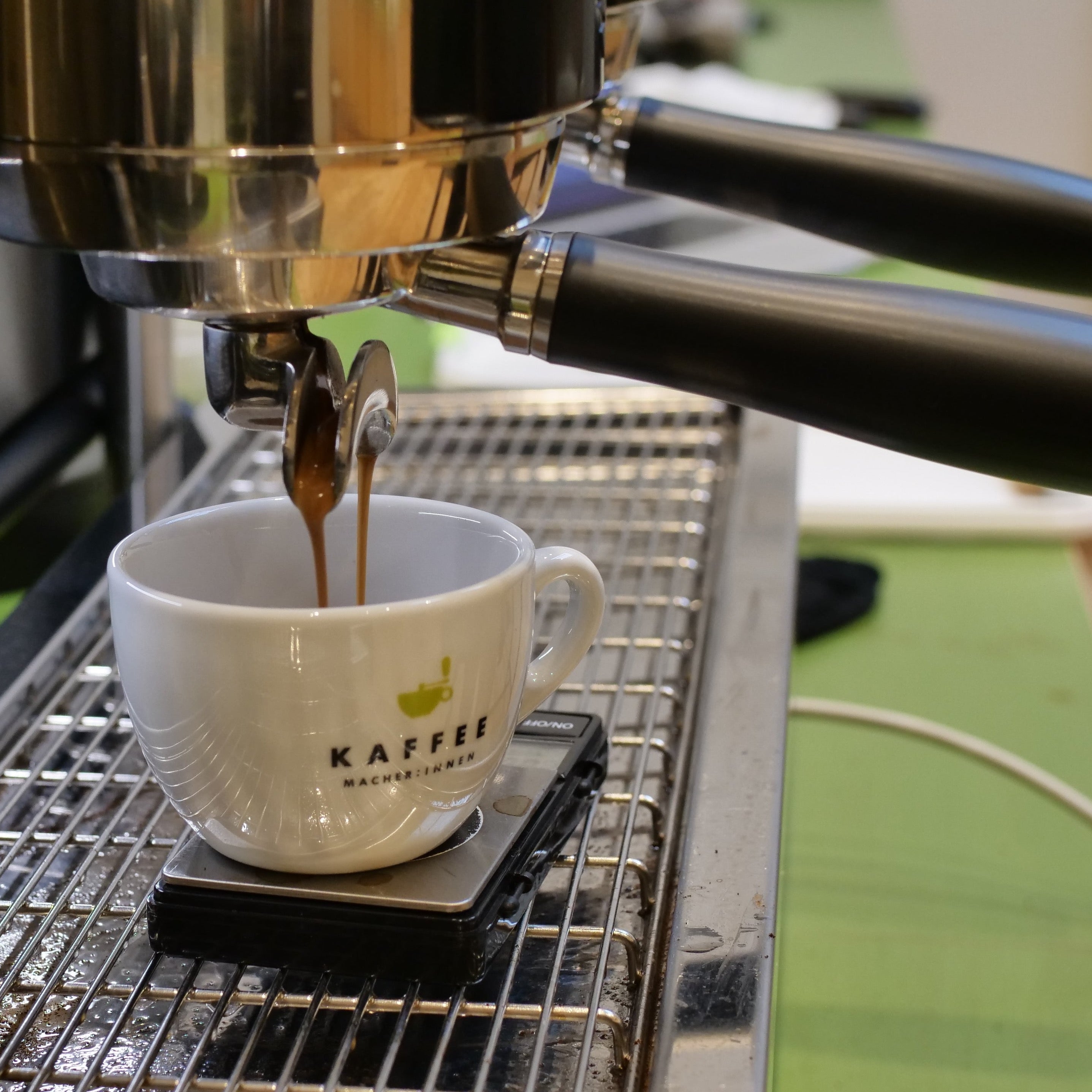
- Extraction: 19g coffee powder, 47.5g extraction amount (1:2.5) brew ratio
- Target time: 27 to 30 seconds
- three extractions per coffee at each tasting
- consistent tasters
Leica Espresso
A honey espresso from Finca Santa Rita in Nicaragua. A special coffee for us because it was our first specialty espresso from our own farm, and we've managed to develop a standard process by now. We try to produce a bit more Leica each year. Fruity like cherries, lots of sweetness, and a soft texture characterize this coffee.
| Time after roasting | Comments |
| 2 weeks | Notes of lime, medium weight, zesty acidity, limited sweetness, limited balance |
| 4 weeks | very round, well-balanced, concentrated, syrupy sweetness, creamy |
| 6 weeks | Aroma limited, texture pleasantly soft and creamy, dense, dominant acidity, bitter aftertaste |
| 10 weeks | little intensive flavor notes, coating on the palate, good texture, pleasant, somewhat simple acidity |
| 12 weeks | Amarena cherries, no roast notes whatsoever, silky, thin texture, slight saltiness, bitter aftertaste, qualitatively pleasant acidity, not further specifiable |
Comments on the Leica tasting
The coffee after four weeks was our favorite. After three weeks it's already at its peak, which then holds for about ten days. If the coffee is very fresh, acidity dominates. With about three weeks after roasting, the balance is there, the fruity cherry notes are present, and the sweetness is significantly more intense.
The aroma then fades faster after six weeks, before it – interestingly – reappears after 12 weeks, in high clarity. In return, the three-month-old coffee lacks the soft, dense texture that makes espresso what it is for us.
Leica drinking recommendation: at its peak after 20 days
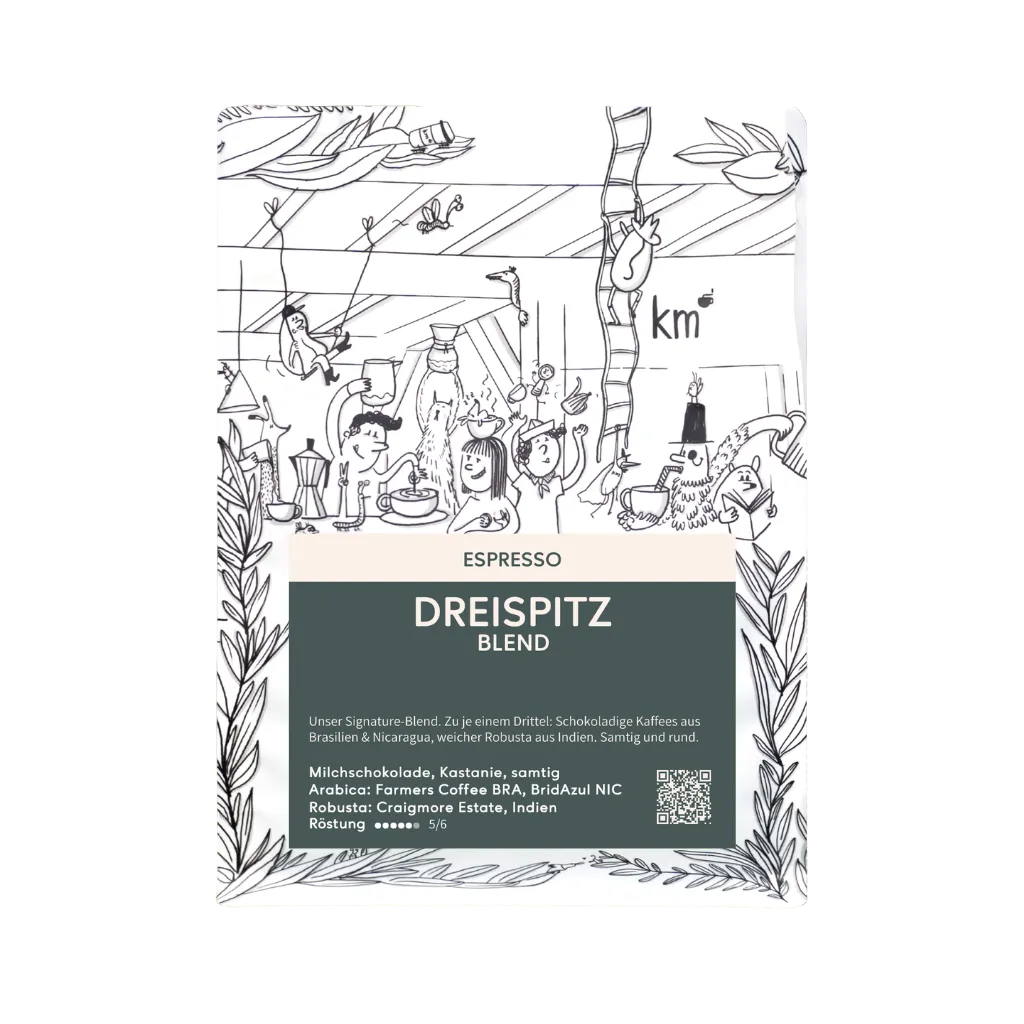
Dreispitz Espresso
Our signature blend for all espresso lovers. Balanced and uncomplicated for all common brewing methods. A full-bodied, chocolatey espresso, supported by a creamy body and a fine acidity.
| Time after roasting | Comments |
| 2 weeks | dark chocolate, limey acidity, pleasant Robusta note, very round, pleasant aftertaste, full body |
| 4 weeks | medium texture, somewhat watery, subtle acidity well integrated (simple but clean), clean Robusta aftertaste |
| 6 weeks | intensive Robusta notes, long Robusta aftertaste, robust, well-integrated acidity, simple but clean; creamy-heavy body |
| 10 weeks | Milder aged espresso where the acidity becomes more prominent. Somewhat broken into parts, rather light, Robusta notes reintegrated, balanced, becomes more intense as it cools. |
| 12 weeks | Little aroma, scent light like natural Robusta, texture present, sweetness missing, Robusta winery. Lacks intensity and balance of attributes. Like a marathon runner who takes off and falls. |
Comments on the Dreispitz tasting
The coffee after two weeks was our favorite. It then holds up well for about a week before the texture decreases somewhat. Anyone who likes the Robusta notes stronger would be well served after six weeks. The taste changes in such a way that the coffee from Nicaragua recedes somewhat into the background and the Robusta takes over. An interesting play that we really perceived intensively for the first time.
Dreispitz drinking recommendation:
1st peak: after 12 days
2nd peak: after six weeks
Henrique Espresso
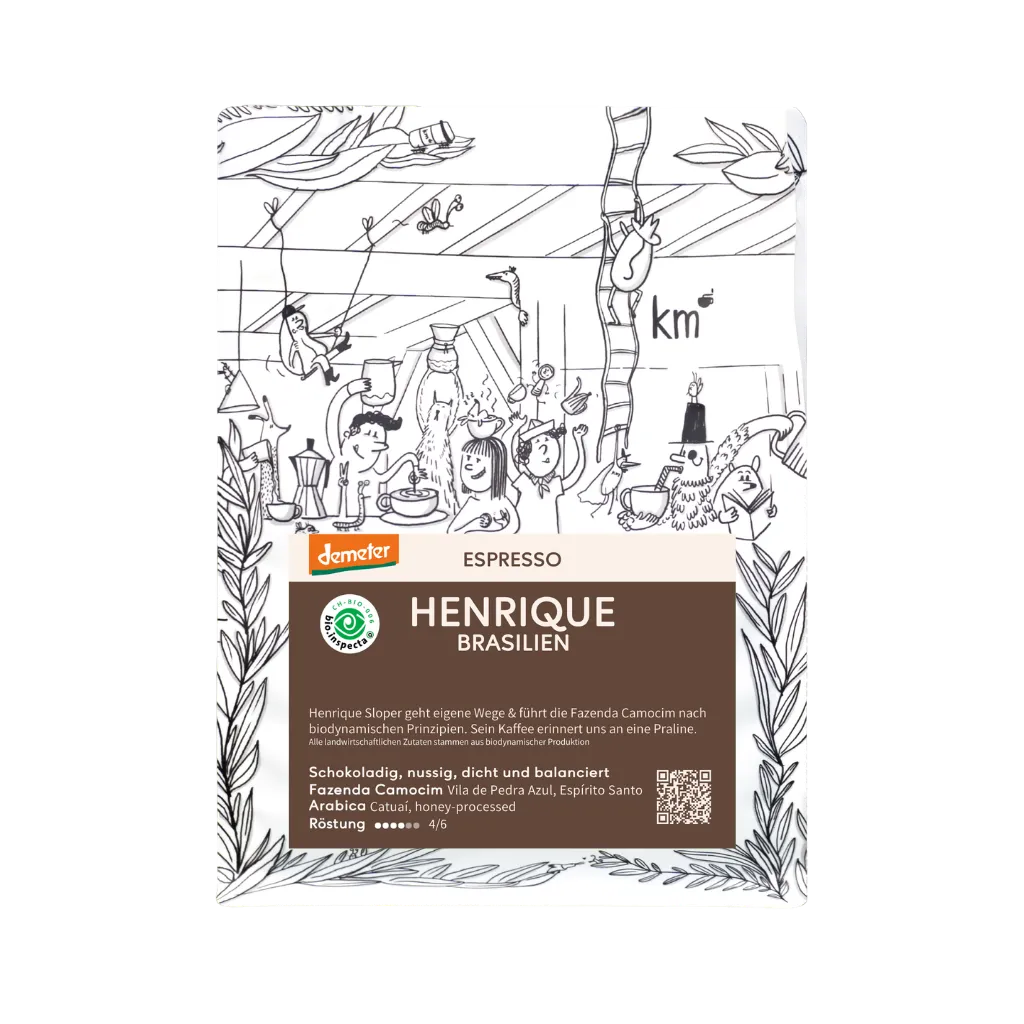
Henrique from Brazil is the chocolatey-nutty espresso with full body and long aftertaste. As an espresso a praline, with milk a dessert. It's got what it takes, this Henrique. And has power.
| Time after roasting | Comments |
| 2 weeks | very dark hazelnut, medium texture, roast notes noticeable, little acidity |
| 4 weeks |
very harmonious, well-balanced, defined, mild acidity (delicate), very dark chocolate, almond notes |
| 6 weeks |
very dark chocolate, bright acidity, more intense roast note, aging is becoming somewhat noticeable |
| 10 weeks | somewhat broken into parts, medium weight. Notes of licorice to classically dark chocolatey, slightly roasty in the aftertaste |
| 12 weeks | no longer coherent in itself. Faster extraction: 19g in 40 out in 24 sec Loss of density, clarity, sweetness, A shorter extraction does old coffees good |
Comments on the Henrique tasting
The Henrique is one of our darkest espressos, which is reflected in the taste. The roast notes are present, especially after two weeks. After three to four weeks, the coffee is at its peak – it's balanced, the roast notes are gone and give precedence to the chocolatey notes. After ten weeks, you can feel the age in the coffee somewhat; the balance is not as high as it was at the beginning.
Henrique drinking recommendation: at its peak after 20 days
What is the optimal age for roasted coffee?
We like it this way:
Filter coffee:
at least 7 days after roasting, 10 days is better, for naturals and other intense fermentations, wait rather 12 days
Espresso:
at least 10 days after roasting, for light roasts about 14 days, for naturals rather wait 21 days
When is coffee too old?
Counter question: what is too old? We recommend consuming our coffees between two weeks and two months after roasting. That's our idea of how the coffees should taste. Anyone who ventures outside this time window isn't making a mistake; they're just following their own preferences.
In our long-term test, it became clear that our coffees in non-aluminum packaging show the first signs of aging after about 10 weeks, thus beyond our two-month recommendation. But there are also always surprises, such as the Dreispitz, which after an initial high and subsequent decline recovered and reached its second peak after six weeks.
Can coffee get too old? Yes, if it no longer makes sense sensorially. Old coffee, however, has no negative impact on health. The rancid, stalky, tallow-like notes can take over; the lighter, especially floral notes fade. But we're not talking about a defect here; we're talking about a normal aging process.
Coffee, unlike wine, has a very small window of enjoyment. Wines, on the other hand, can gain with age. Coffee is thus something like Snapchat, just for taste. Wine is more like the YouTube video that becomes more important with age.