




«You'll never read a sentence like this from me: 'This coffee is right for you and tastes the best.' That's because taste is individual. Maybe we even enjoy different coffee drinks.
This article is designed to help you figure out which coffees and coffee beans are right for YOU.
With the 9 decision tips in these articles, you can discover your taste preferences and make the right choice when standing in front of the coffee shelf.
Unfortunately, you only find out in the cup whether you really like a coffee. But if you follow these tips, you'll always get closer to your favorite coffees.
1. Your coffee type: Espresso, Moka, or Filter?
If you're absolutely sure that you're an espresso person or a filter coffee drinker, you can jump directly to the section "Which coffee for espresso?" But it might also be interesting for you to find out why your guests always want to drink espresso or filter coffee when they're with you. Because that might have something to do with you.
Every coffee drink can be good! The question is: when do you want to drink the coffee and what should it achieve?
The short espresso is enjoyed at the end of a meal or al volo, meaning on the fly. The perfect quick pleasure with concentrated caffeine and flavor. One sip and you're done! Espresso is many things, but not a good socializer. The time it stays in your cup is simply too short.
When you're sitting at an afternoon café date with your dream partner and they order an espresso, you can get nervous. If the order is filter coffee or Latte Macchiato, then that's quite promising. Both are the longest drinks in the coffee world and the perfect conversation companions.
Remember: Do you want to drink coffee long and comfortably?
Then filter coffees, café crema, or espresso-milk blends like Latte Macchiato or Cappuccino are suitable. Espresso is the perfect quick drink.
The amount of the drink stands in contrast to the strength. The smaller a drink, the higher the concentration. All drinks have roughly the same amount of caffeine and the same other flavors that make coffee what it is. The determining factor is the amount of coffee used and not so much the concentration of coffee particles. From 9 g of coffee beans, you always extract roughly the same amount—whether the drink is 25 ml of espresso or 150 ml of filter coffee.
The concentration of coffee particles is especially important for mouthfeel. The stronger a coffee is concentrated, the thicker the drink. A strong espresso feels heavy and creamy in the mouth.
At the same time, you experience a flavor explosion because the full power of the coffee powder used is diluted with only about 25 ml of water. It consists of about 7-10% dissolved coffee particles and correspondingly 90-93% water.
Filter coffee is at the other end of the scale. It has only 1.0-1.5% dissolved coffee particles and 98.5-99% is water. It's tea-like in consistency and feels soft and light in the mouth. Compared to espresso, the flavor is rather "spread out" and not so explosive. This gives you more time to discover different flavor notes in filter coffee.

Important: Just because of the concentration: Filter coffee is more forgiving! If you brew a bitter or sour coffee as an espresso, you'll taste it 10 times stronger in the espresso. Because it's up to 10 times more concentrated.
Are you more of an espresso person or more of a filter coffee person? Or are you in the middle, with café crème or Americano? Remember where you fit in. Because that's crucial for choosing your coffee beans.
2. Light, medium, or dark roasted?
Before choosing beans, it's worth determining whether lighter or darker roasts suit you better. Depending on that, the taste won't be quite as important in choosing the coffee beans.
Basically, it's like this: the lighter a roaster roasts their coffees, the more you taste the coffee bean itself. The darker coffee is roasted, the more the flavor notes become similar. Dark roasted coffees taste more and more roasted with longer roasting times. Light roasted coffees remind you that coffee itself is a fruit.
The higher quality a coffee is, the more complex it is, and this shows more clearly in the light roasted state. But even the most complex flavor notes reduce when a roast becomes very dark. Roasting is a process that first chemically transforms coffee and then "burns" more and more substance. In the end, ashy and burnt notes remain.
The spectrum of coffee flavor ranges from fruity—sweet—chocolatey—to roasted. If you're interested in fruity notes, you should try lighter roasts. If you prefer roasted notes, go for darker coffee instead. The area between the two extremes is recommended for experimental coffee drinkers from both sides.
Light roasting is just as much a master discipline for roasters as precise dark roasting to the point. Roasts that are too light are "underdeveloped," taste grassy and grainy. Dark roasts produce significantly more smoke. But the coffee shouldn't taste much like that. Bread-like flavor notes develop when insufficient energy is given to the roaster during longer roasts. This phenomenon, called "baking," counts as a roasting defect.
The art is to master the extremes of roasts in the light or darker range, or to combine both in medium roasts.

Remember: the darker roasted, the less you taste the diverse flavor notes of high-quality green coffees. The lighter roasted, the more clearly you can determine that the green coffee isn't good and maybe even has off-flavors. Roasteries that buy lower quality coffee will never roast it light but will "hide" it behind the roast.
The roasting topic is very complex and is presented here in brief form.
3. Coffee beans for your happiness: Arabica or Robusta
Coffea Arabica is the more widely distributed and naturally higher quality coffee species. Coffea Canephora is the counterpart to Arabica and is commonly referred to as Robusta. Both species consist of many subspecies in turn and also come as crosses. The two siblings of the Coffea family couldn't be more different. They have fundamentally different flavor profiles and their caffeine content differs.
Because they belong to the same family, the unequal pair is regularly viewed from one perspective. However, this perspective doesn't do justice to both, and it especially blocked Robusta's quality development for a long time.
The flavor profile of Canephora is strong, earthy, and full-bodied. Due to higher chlorogenic acid and double the amount of caffeine, Canephora is more bitter. Due to the more pronounced perceived bitterness, the acidity and sweetness of Canephoras come into their own less, leading to limited flavor complexity in the cup. And here the cat bites its tail. Due to this basic condition, cultivation of Canephora was sometimes considerably less careful over decades. This strengthened the earthy-bitter flavor profile through off-notes and irregularities, which also led to a generally lower price for Canephoras at the coffee exchange. Historically, Canephora has taken a role in coffee blends as a strong, potent component. With compact crema, Canephora became the standard for many cheap espresso blends. Particularly in southern Italian espresso blends, but also in many instant coffees, a lot of Robusta is used.
Arabica has diverse aromatics, relatively little perceived bitterness, and more pronounced fine acidity. When Arabica is cultivated in high altitudes and processed cleanly, enormous complexity develops. This fundamental flavor characteristic of Arabica varieties led to Arabica being further refined for quality. A evaluation profile matched to Arabica supported this development. The term "specialty coffee" today exclusively targets Arabica coffees.
Wanting to compare Arabica and Canephora is like putting a pear next to an apple. You don't do justice to either. So it's all the more pleasing that more and more producers and producing countries are focusing on producing high-quality Canephoras. A pioneer in this is Uganda, which led the development of an evaluation form tailored to Canephora. This so-called "fine cup standard" will play an increasingly important role in the future. Not only because it's getting better, but also because the changing climate will reduce Arabica growing areas and increase Robusta growing areas.
When does Robusta make sense?
Robusta is perfect for anyone who likes really strong coffees. With lots of punch, caffeine, and thick crema. Robusta is standard in strong Italian blends. If you like coffee-milk drinks like Cappuccino or Latte Macchiato, you have a strong option in Robusta. Robusta's own flavor is strong enough not to be overpowered by the milk.
When does Arabica make sense?
With its complexity and naturally present acidity, many Arabicas are excellent filter coffees. Especially varieties grown at high altitudes, harvested when mature, and processed precisely, are flavorful and exciting to discover. The flavor diversity of Arabicas is enormous, so you can find an Arabica variety or processing method for every drink and every taste. Arabicas can equally be used for espresso roasts and blends. They come as single origins or blends. There are no limits to experimentation here.
4. Which coffee for filter coffee and French press?
The French press fits into the range of different filter and brewing methods. Flavor-wise, the same coffee that suits the French press, also called a plunger pot, is suitable as for classic filter methods like the Melitta filter, the Hario V60 filter, or other hand filters.
Filter coffee is less strong coffee compared to espresso. It has a concentration of dissolved coffee particles of approximately 1.2 to 1.5%. At this concentration, almost all flavor directions are "moderated." Rather bitter coffees are just as little concentrated and thus only slightly bitter as coffees that have more pronounced fruity acidity.
In this sense, anything is possible in the range of filter coffee and is left to your own taste. Personally, I recommend lighter roasted coffees for filter coffees, where roasting notes are in the background. Filter coffee is excellent for exploring the different flavor notes of various coffee regions. Depending on the region in Kenya or Ethiopia, the flavor of the coffee already differs significantly within one country. The difference to coffees from Central America or Papua New Guinea is even much greater.

Coffees brewed as filters are perfect for exploring coffee diversity. That's why I recommend: give it a try.
Here are some taste pointers:
- Kenyan coffees often taste like red berries and are my favorite coffees for cold brew.
- Ethiopian, naturally processed coffees are often floral and have notes of blueberries.
- Coffees from Dipilto in Nicaragua taste strongly of chocolate.
- The Blue Batak from Sumatra has notes of licorice.
- Brazilian coffees often have nougat-chocolate notes.
A coffee's flavor depends largely on the region, the variety, and the way the harvest and processing is done. Therefore, these mentioned flavor directions are very general. There are also Brazilian coffees from individual farms that taste completely different.
Filter coffees from very good roasteries
So many roasteries roast good filter coffees that any list falls short. And as described above, it also very much depends on which roasting philosophy you prefer. I myself drink filter coffees most in the spectrum light to medium roasted. To discover outstanding filter coffees on the German-speaking market, I founded the coffee panel with sensory world champion Gloria Pedroza. We taste filter coffees and crown the test winners. You can find our own filter coffees here.

5. Which coffee for espresso?
Espresso is, besides Turkish coffee, the strongest drink in the coffee universe. In numbers: about 7-10% concentrated coffee particles in relation to 90-93% water. What comes together in 20 to 30 milliliters is the full coffee charge. That's precisely why the inner balance of the coffee before and after brewing plays such a big role. At this concentration, everything unpleasant is potentiated and not tasty. Conveniently, the reverse is also true. What's delicious is very delicious!
That's why selecting the coffee requires just as much care as with filter coffee. And especially "acidity" should be enjoyed with caution. Important: Acidity is crucial for complexity in every high-quality product. A wine without acidity or chocolate without acidity tastes flat and boring. Coffee is similar. The challenge is to balance this acidity with the other attributes, meaning in balance with sweetness, bitterness, and mouthfeel.
The roast plays an important role in this, as does the extraction. Because with coffee, unlike wine, it's not enough to just buy a good product. It must be prepared first. If you succeed in bringing pronounced acidity into balance, then the espresso is pretty much certain to be fantastic. Preparation isn't difficult and is easy to learn, but it does require some care.
That's why I recommend choosing longer developed, meaning darker roasted coffees for espresso. It's then easier to extract them properly during brewing.
If you feel confident, you can try things wildly. Often a coffee package says: "for espresso" or "crema beans." This refers to the way the coffee is roasted. There are no "crema beans" or "espresso beans." It depends solely on how a coffee is roasted and whether it suits a drink with that roast. The roaster's roasting philosophy also plays a role. For example, I use the "filter coffee" from rather dark-roasting roasters as espresso because it still seems balanced to me as an espresso.
Which espresso type are you?
Do you swear by "Italian roasts"? Then the Robusta portion probably plays a big role and you like the bitterness of the darker roast. These roasts are roasted the same way by roasters in Germany, Austria, or Switzerland. You don't have to buy an Italian package with a brand name for that. Many local roasters provide you with "Italian profiles." Again: the key points are "dark," "strong," and often "Robusta content."
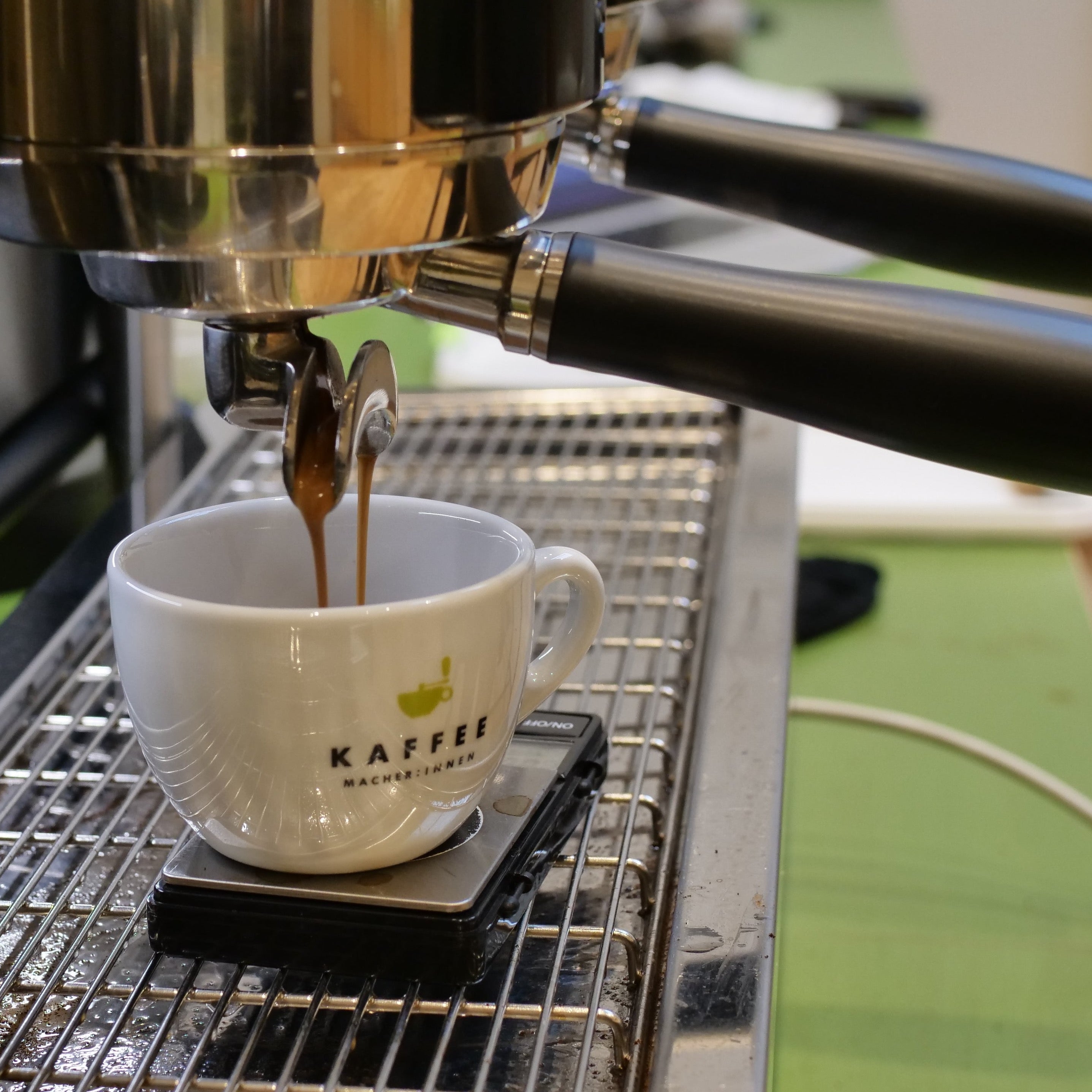
If the espresso still doesn't taste like it does in Italy or doesn't give off the atmosphere of the Italian barista, then it's either the preparation method, the drink length, or your lack of vacation mood. I claim the espresso toward Italy tastes so good because we're on the way to vacation AND because the shots are much shorter and snappier. In Italy, we typically drink 15-18 ml of espresso. If 7-8 grams of coffee are used for that, then it's really strong and especially thick. If there's also a Robusta content, the spoon almost stands in the crema.
When we drink 40 ml espressos from automatic machines in Switzerland, it's more similar to a café crème than this concentrated dark espresso. Apropos, southern Italy and northern Italy also differ significantly. The further south, the higher the Robusta content.
The opposite of the Italian espresso, which convinces through strength and bitterness, is the somewhat longer, more balanced espresso. Besides choosing the coffee, the brew ratio plays a big role. How many grams of coffee are dosed into the portafilter and how much is brewed into the cup?
I personally like to brew with a ratio of 1:2.5, so for example 9 grams into the portafilter and 22.5 grams into the cup. With some coffees I also like a ratio of 1:3, meaning 9 grams into the portafilter and 27 grams into the cup.
How capsule coffee changed espresso drinkers
If you prepare espresso with a ratio of 1:2 or 1:2.5 and your guests think it's "too strong," then you're probably dealing with capsule coffee drinkers. It's remarkable how much capsule coffee consumption has already changed our beverage and coffee habits.
Regardless of the manufacturer, a capsule typically contains only about 5 to 5.5 grams of coffee. However, the conventional capsule machine delivers a "typical drink amount" into the cup, so 25 ml and more. Many capsule machines brew 35 milliliters of "espresso" by default. The brew ratio is then effectively 1:6 and the strength of the coffee differs significantly from a "classic" espresso. This has about 7-10% dissolved coffee particles. The capsule espresso only reaches 3-5% of dissolved coffee particles.
So it resembles an Americano or café crème more than a real espresso. If you frequently drink such "espresso," you get used to this flavor profile and then initially feel overwhelmed by an espresso from a portafilter machine with a ratio of 1:2.5.
Espresso from very good roasteries
Some very fine espressos have recently been in my grinder. Coffees from Adrianos (CH), Röstbar (DE), Stoll Kaffee (CH), Wildkaffee (DE), Rösterei Vier (DE), Flying Roasters (DE), Felix Kaffee (AT) have particularly pleased me. This isn't an exhaustive list but a loose list of very good roasteries from which I've recently been able to taste coffees. You can find our own espresso roasts here. You can find an excellent overview with a comparison of different coffee beans in the blog article by Coffeeness.
6. Reading coffee labels correctly and what you shouldn't buy
The imaginative stringing together of hollow phrases reaches its peak on coffee packaging. Very often, the praised refined crowning with gentle artisanal long-term roasting is an artful circumlocution for cheap commodity coffee without origin information.
When reading labels, I recommend a radical approach. Look for precision, especially in the supermarket. If you don't find it, that's already a hint of the likely quality. It follows: the more on a package, the more the roaster knows about the coffee themselves or is willing to share this information, and the higher the probability that it's better quality.
When looking at coffee labels, the analogy to wine is helpful. When a wine says "red wine," we know we've arrived at the cheapest and qualitatively lowest assortment shelf. In this category fall coffees that are labeled "Robusta" or "Arabica."
If you find information about the country of origin on the bottle, we're slowly approaching better qualities. But seriously—who buys a wine with the blanket designation "from France" wants to create an elegant taste experience? No, they want to get drunk and consciously accept the programmed headache the next day.
What's on the packaging of high-quality coffee?
Recommended minimum standard:
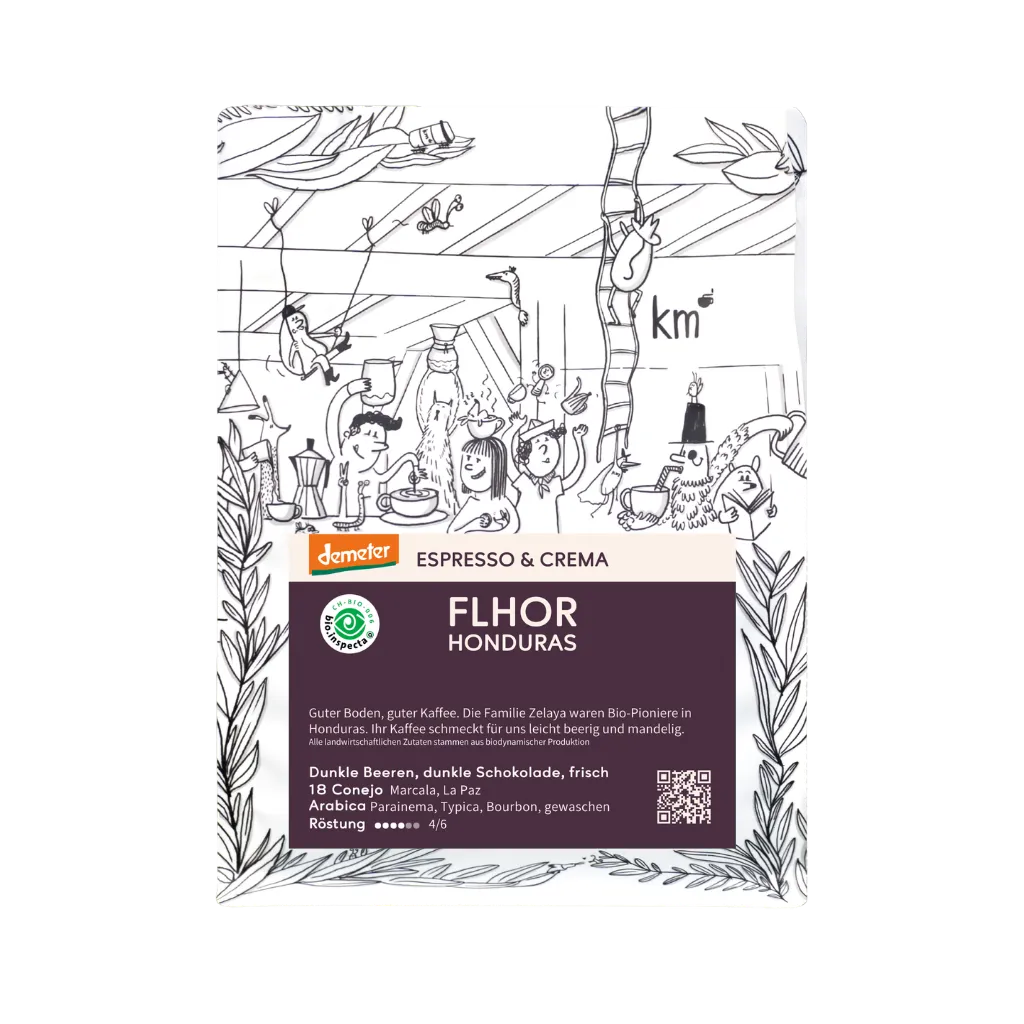
The roast date: the date when the coffee was roasted. Only when the roast date is known can you judge whether the coffee is fresh or old. After two months, whole bean coffees show a noticeable reduction in flavor quality.
Origin information: country, region, producer/cooperative/processing facility. For some regions, DOC certifications are available, meaning verified origin seals.
Composition: whether it's a single-origin coffee or a blend. In the case of a blend, the blend ratio of Arabica/Robusta should be stated and the origin information adjusted accordingly.
Exemplary label text on a coffee bag:
Processing information: whether the coffees were washed or naturally processed or experimentally processed.
Varieties: which varieties or cultivars of Arabica/Canephora are involved.
Refinement of origin information: not necessary, but interesting are lot number/name and altitude information.
Further information: some roasteries state the purchase price of the green coffee or also information about the roast. This is exemplary and stands for a new type of communication with the consumer. More information on this in our article on transparency.
Fairtrade and organic seals say nothing in themselves about a coffee's quality. However, they're an indication that premiums and a minimum price were paid for these coffees.
So which coffees should you buy?
I recommend radicality at this point. If the minimum information isn't provided, I wouldn't buy and try a coffee. The probability of missing out on something good is very low. Likely, many bargains won't be in your selection either. But these usually convince more with price than quality.
The minimum information isn't difficult for a roaster to find and state if they buy high-quality coffees. The excuse that no "trade secrets" or "special blends" should be revealed is humbug. Roasteries that win major international roasting competitions reveal their roasting curves and blends.
Secrecy is misplaced at this point. Industrial roasteries buy the same standard coffees and mix them back together in very similar proportions. Hiding behind secret recipes for blends or origins is a fig leaf in front of inferior coffee quality.
If I have the minimum info, will the coffee taste good?
Unfortunately, it's not guaranteed that you'll like a coffee that states the minimum information on the packaging. You have to try and test it each time. With each coffee bag, however, you'll notice whether the direction and roasting philosophy of a roaster suits you. Try to describe as precisely as possible whether coffees are too bitter or sour, too smoky or mild for you.
Bitterness and acidity are often confused sensory-wise. Train yourself by biting into a lemon as a reference for acidity and remember well how the acidity feels in your mouth. An example of bitterness is gentian root or artichoke. Store these references internally and test the coffee.
If you can rule out that bitterness or acidity comes from extraction, tell the roaster about your taste experience. Maybe they have a suggestion for you that tastes less unpleasant to you. If you can't find common ground with this roaster, try another one.
Taste and sample coffee
Coffee tastings are an excellent way to try different coffees side by side. If these are prepared by roasters or coffee professionals, you can also rule out that you're doing something wrong yourself.
So take advantage of every coffee tasting in your region as an opportunity to learn more about coffee and fill your own flavor database. Many roasteries conduct regular tastings. Coffee festivals are also a good opportunity to taste coffees from different regions directly side by side.
This is also possible in guided sensory courses. We ourselves conduct sensory courses at our academy, but we also come to you or taste at team and company events.
7. Which coffee is healthy and easy on the stomach?
Coffee is neither explicitly healthy nor unhealthy. It has both health-promoting effects and problematic impacts, especially when consumed in large quantities. "5 cups of about 150 ml each" is often cited as a reference. The truth is actually somewhat more complicated and depends on many factors—not least on your own physical condition.
We spoke with Professor Chahan Yeretzian about the topic of coffee and health effects.
At the same time, there are potentially cancer-causing substances in coffee that, while not proven to cause cancer in coffee, are known to be carcinogenic. We've made a video in English language about furan and acrylamides and will write another article on this here.
Digestibility of coffee
How well a coffee is tolerated depends closely on its quality and processing. It shouldn't be forgotten that coffee is the core of a fruit. With other fruits too, there are unpleasant side effects if they're eaten underripe or overripe. It's similar with coffee.
High-quality coffee is harvested selectively. For this, the picker typically has to walk through the bushes three times within a few weeks and harvest the deep red or dark yellow cherries. Coffee cherries don't ripen together per plant. This type of harvest is very labor-intensive and correspondingly costly. That's why it's skipped in the production of cheap coffees. Instead of picking cherries individually, the coffee is stripped by hand or even harvested mechanically.
Such unequal ripening stages of coffee cherries cause some follow-up problems. They ferment differently—if they're fermented at all. These beans dry differently and behave differently during roasting too. The roasting level is therefore not uniform, the flavor differs, and digestibility is changed. Very often, such beans are the decisive digestibility problem.
The speed and duration of roasting also affects digestibility, by the way. But that's again its own big topic, which again involves furan and acrylamides. You're doing well with coffees that are roasted neither too quickly nor too light and also not too dark and too long. We'll address this topic in our article series on roasting, which is at the top of our to-do list.

8. The best coffee is freshly ground
Even with the best coffee and the roast that's right for you, the last step to perfect coffee hasn't been taken yet. Fresh grinding is missing. And by fresh, I mean shortly before you brew. As long as coffee isn't ground, it protects itself through its own protective layer. It's then not easy for oxygen to penetrate into the coffee's interior. But as soon as the coffee is ground, its surface increases many times over. One bean becomes thousands of particles that, on one hand, release aroma compounds into the air and, on the other hand, spread oxygen access.
At this moment, an accelerated aging process begins. Within 20 minutes, even untrained palates can taste the difference between freshly ground coffee and coffee ground 20 minutes ago.
What we now lose isn't the basic flavor of the coffee. The coffee still tastes like coffee. But it no longer tastes complex, surprising, lively—just like coffee, period. If you extend the waiting time, coffee soon tastes rancid because the fats begin to oxidize. By now at the latest, it's no longer tasty.
Grinding fresh and yourself is also highly recommended for another reason. Only this way can the grind size be adapted to your own needs and brewing method. The grind size determines the resistance of the coffee in the cake. This constantly needs to be adjusted, from day to day and coffee to coffee.
So: if you want to improve coffee quality with simple means, switch from pre-ground to fresh and self-ground first. This is also possible "cheaply." We've tested 14 hand mills that are suitable for filter coffee and partially for espresso.
And for the record: anyone who buys pre-ground has no control over the visual quality of the coffee beans. Therefore, ground coffee industrially bagged often uses lower green coffee quality than the same coffee or brand in whole beans.
9. The best coffee in the world
And what about that cat coffee? What's it called again? Oh yes, Kopi Luwak. And Jamaica Blue Mountain? And Monsooned Malabar?
These three coffees have something in common. Good stories and successful marketing. They've been successfully positioned on the world market and are particularly good for telling stories about.
They can all taste good, but they're not the best coffees in the world, just expensive and marketing-hyped. With Monsooned Malabar, this is less problematic and this coffee also serves a common flavor profile. It tastes nutty, somewhat earthy-robusta-like, but is an Arabica. For many, an accessible espresso.
There are good Jamaica Blue Mountains. The special thing about these coffees is the limited quantity and exclusive marketing. Here's something that one wishes for all coffee regions. A positioning as a region on the world market. With Jamaica Blue Mountain comes a small wooden barrel for transport.
The Kopi Luwak with all its variants is, on the other hand, a highly problematic development. The Indonesian palm civet naturally eats certain amounts of coffee cherries. The gastrointestinal tract separates cherry flesh and bean. After defecation, the bean can be collected, dried, and marketed. The story is so absurd that it sells because of its sheer oddity. So much so that palm civets in cage farming are stuffed with cherries to increase the amount of coffee production. Humans are clever when it comes to profit maximization. So larger animals are also stuffed with cherries and used as fermentation channels. The coffee that ultimately results is not of particular quality. The story, however, is perfect for being picked up by media and people. We're very clear at this point and finally the language fits. What's marketed here as coffee is shit.
All these coffees aren't the best coffees in the world. In fact, in sensory comparison with high-quality coffees, they score very low points. Really exceptional coffees like a Panama Geisha are rated at over 90 points. Monsooned Malabar and Kopi Luwak struggle to get over 75 points.
If you're looking for a country's best coffees, you'll find them at Cup of Excellence. In this competition, in the first round sometimes over 100 producers per country compete to have a national and international jury find the best coffee in the country.