












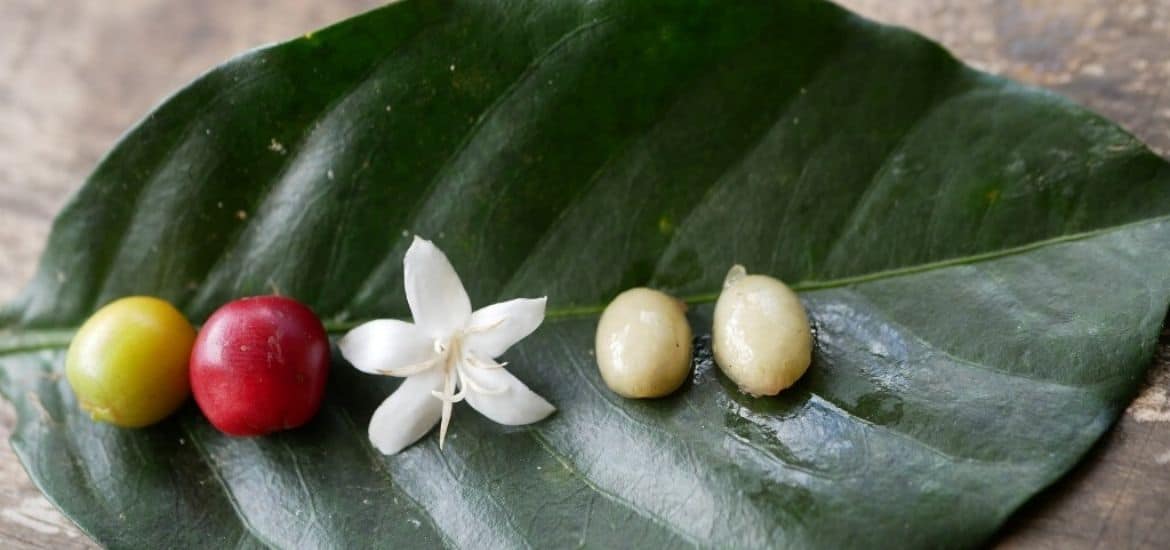

Can Robusta even be specialty coffee? Coffee expert Constantin Hoppenz advocates for a clear yes, provides compelling arguments for it, and challenges coffee roasters.
Is Robusta the inferior Arabica? This suspicion persists, we hear it in almost every beginner course. Our longtime friend, Constantin Hoppenz, has given this some careful thought.

Robusta, a specialty?
When people hear Robusta, they usually don't think of anything good. Associations range from dark, Italian coffee blends with significant bad breath potential to mass production in Vietnam for instant coffee and other cheap products.
The current image is clear: Arabica as a must for anyone who wants quality in their cup; Robusta for those who want it cheap and simple.
Accordingly, most in the specialty coffee world are clearly negative about Robusta. Understandable. Taste a standard quality Robusta once, and it doesn't exactly bring a smile to your face.
But why exactly? Is Robusta really as bad as its reputation? What role does Robusta play in coffee's future? And is there such a thing as Specialty Robusta Coffee?
Why we should engage more with Robusta. An argument in its favor.
Facts for coffee beginners
The botanical name of Robusta is coffea canephora, which, unlike Arabica (coffea arabica), is not commonly used in its botanical name. Robusta production has increased significantly over the past decades. Currently, 40% of global coffee production comes from Robusta cultivation. (39 million bags) In 1990 it was only 19 million bags, less than half. The largest producing countries are Vietnam (40%), Brazil (25%), Indonesia (15%), India (6%), and Uganda (4.5%). Robusta grows best in tropical regions below 1000 meters altitude (Arabica grows better at higher elevations).
Climate change and economic viability
Coffee, like any agricultural product, is affected by weather and other natural influences. Coffea arabica is particularly susceptible to temperature and precipitation fluctuations and also suffers from disease such as leaf rust.
Around 2014, "la roya" (coffee rust) struck all of Central America and destroyed up to 50% of the harvest. Anyone who thinks this is irrelevant to specialty coffee, which grows protected from leaf rust at high altitudes, is mistaken. Coffee production is closely interconnected. There is only enough high-quality coffee if producing countries and their coffee farms are in good condition. The vast majority of coffee farmers producing specialty coffee live from selling average qualities at world market prices.
For producing countries like Nicaragua, coffee is one of the most important export goods. Therefore, preserving this sector is of great importance for these countries. They see an increasingly growing world market for coffee and want to participate in this growth.
Rising demand for coffee
By 2050, global demand is expected to rise to up to 300,000 million bags. (Currently approx. 160,000 million). Although such figures should be taken with great caution, the trend is clear. By the same time, however, the agricultural land suitable for Arabica production will be cut in half due to climate change.
The clearing of forests to gain new agricultural land for Arabica would be the consequence. Here it would be an option to instead supplement or replace the Arabica stock with Robusta plants at lower cultivation altitudes (below approximately 1000 meters). The increase in usable coffee would be exponential, since Robusta yields up to four times greater production. In addition, Robusta is much easier to handle and more stable in cultivation.
Sustainability must also be thought about from the producers' economic perspective, because coffee will only be grown if it is financially worthwhile. Currently, world market prices at only 120 US cents per pound for Arabica are below its production costs. Add to this the aforementioned impact of disease and poor weather conditions, which lead to lower yields. It is therefore not surprising that Robusta is increasingly being considered a serious alternative. Colombia's agricultural ministry recently began collaborating with Nestlé to test over 3000 Robusta seedlings for cultivation. Costa Rica has also recently lifted a ban on the production of non-Arabica varieties.
Robusta in research
At the same time, intensive research is creating new Arabica varieties that are significantly more resistant than their predecessors. The CATIE research center (Centro Agronómico Tropical de Investigación y Enseñanza) in Costa Rica alone examines over 1000 new varieties. The genetic diversity of coffea canephora (Robusta) is of great importance here. It is considered the evolutionary mother of coffea arabica. (coffea canephora + coffea eugenoides = coffea arabica) whose genetic material is crucial for developing resistant Arabicas.
In an article published at the beginning of the year titled "High extinction risk for wild coffee species and implications for coffee sector sustainability," it states:
"Robusta coffee has therefore been responsible for overcoming most of the key issues for coffee sector sustainability, either by direct replacement or through use in breeding new cultivars, rendering the development and use of other coffee species unnecessary."
The contribution in Science Advances Magazine points to the threat to naturally occurring coffee species, whose protection is essential for the continuation of coffee as a crop.
These aspects are therefore directly related to specialty coffee, as they affect almost all regions and producers that produce exceptional coffee. Once again: specialty coffee is not separate from the ecological challenges and economic hardships of the producers, for whom specialty coffee often represents only a fraction of their yield.
A sensory enrichment
From a taste perspective too, Coffea Canephora should not be a no-go. Anyone who has already had the pleasure of a good Robusta knows that it does not automatically have a bitter, bland taste resembling the smell of car tires. A Fine Robusta, considered a specialty according to CQI, is clean and balanced just like a Specialty Arabica.
Flavor notes vary depending on terroir and processing. They are often in the nutty-chocolatey range, but can also be fruit-forward. Particularly characteristic of Robusta is a full body, which makes many Arabicas seem like thin soup. Additionally, coffea canephora has lower perceptible acidity and higher saltiness, which can be attributed to a higher amount of potassium in the bean. (Think of the flavor profile salty-caramel).
Higher bitterness is also typical and is caused, among other things, by higher caffeine content. Up to more than twice as much caffeine as in Arabica (2–4% vs. 1.5%) is normal. Anyone who doesn't get going in the morning even after a double Arabica espresso will be pleased about this. While preferences regarding bitterness, like chocolate, vary widely, when balanced correctly, it is sensorily enriching and stimulating.
Where are the Specialty Robustas?
If coffea canephora can taste so good, why is there virtually no high-quality Robusta to drink in the cafés of this world? That coffee in general can be a complex beverage like wine is something we've only known for a while. It wasn't until 1974 that the term Specialty Coffee came into circulation through a contribution by Erna Knutsen. Since then, an ever-growing number of people have been concerned with this unique product. Then as now, it takes driving forces to advance coffee and bring about a change in thinking. Until now, there have not been enough actors willing to consider Robusta from a quality perspective in order to sustainably change its reputation for the better. However, first initiatives were made several years ago. In 2009, the first seminars were held under the direction of the Coffee Quality Institute to evaluate Robusta. The goal was to establish a quality standard similar to Arabica. A newer version of this protocol was recently published during the World of Coffee in Berlin. According to this protocol, a Fine Grade Robusta is present if it achieves at least 80 points and has fewer than 8 defects in a 350g sample.
Some noteworthy farms already consistently producing Fine Robusta include the Sethuraman Estate in India or the Jhai Cooperative in Laos.
When people taste Specialty Robusta for the first time, they often don't even know it's Robusta. While this is nice, you should know that Robusta requires a different approach.
Often Robusta loses when compared to Arabica because the rules of the game were made for Arabica.
Constantin Hoppenz
We often view high-quality coffee only in terms of potential. What can this coffee offer under the best possible conditions? That's unrealistic.
The conditions for a good cup of coffee are only rarely optimal. If we orient the question of which coffee is good and which is less good based on how many satisfactory cups of coffee it ultimately enables, then the average rather than the extreme is what matters.
Robusta is much more forgiving than Arabica when prepared as an espresso. Coffee in most cafés is rather underextracted, which makes an Arabica with high acidity far more unpleasant than a Robusta.
Moreover, the majority is still prepared as a milk beverage. With strong caramel flavors and plenty of body, Robusta hits the taste of most coffee drinkers. Mario Fernandez, Technical Director ICO, described the difference between the two varieties in a very amusing yet accurate way:
If they were both animals, Arabica would be the horse and Robusta the donkey. Robusta is a real workhorse while Arabica shines more in show performances. Showing off a donkey in dressage is just as misguided as having a horse climb steep mountainsides as a pack animal.
Specialty Coffee is more than just taste
For most coffee enthusiasts, it all started with the first special cup of coffee. This experience with the first fruity natural coffee from Ethiopia remains in many people's memory. But specialty coffee is much more than what's in the cup. Specialty coffee stands for a change in thinking. It stands for respect for products that have become all too taken for granted. Good coffee also means good action.
Requirements such as traceability and transparency, fair prices, and appreciation of hard work are an expression of values that make the specialty coffee world unique. For me, they are the reason I work in this industry.
Constantin Hoppenz
If you advocate these values with conviction, it is only logical to hold Robusta to the same standard.
If a roastery brands itself as "Specialty" and stands for sustainability, it cannot at the same time rail against Robusta. Or is it unthinkable that a Robusta producer wants to produce the best possible quality, practices sustainable cultivation, and wants to work directly with roasteries?
It is not a compromise in terms of quality if we, as a coffee industry, pay more attention to Robusta production. Because the pursuit of ever-better coffees in the simple sense eventually reaches its limits. Let's think about coffee in context. If we develop quality broadly instead of always pushing further upward, we can ultimately inspire more people with coffee—whether Arabica or Robusta.
Constantin Hoppenz
Berlin, September 2019
How do you taste Robusta "properly"? A report on the R-Grader course
How does fine Robusta taste as an espresso? Taste our Robusta espresso from Java.