













The first version of this text on what we understand by sustainability dates back to 2019. It was time to revise it. And this second version won't stand here forever either. We are constantly learning and letting that knowledge flow into our actions, so that today we have developed an increasingly multifaceted picture of the topics that shape our thinking.
Sustainability and fairness are processes and not finite states.
Over the coming years, we will continue to refine our approaches, repeatedly reflect on our actions, and thus remain in the process.
Good coffee for everyone
Many follow us on social media and read our blogs. Others enjoy coffee with us at Café frühling or at Kaffeemacher Cafe at Basel Station, attend courses in Basel or Dinslaken, or order our coffee to their homes — we create different touchpoints, but work from the same fundamental motivation that drives our company forward:
We want to make good coffee accessible to everyone, share our knowledge about the coffee world, and provide new impulses to advance the industry.
Below, we address various topics on how we understand, live, and cultivate sustainability at Kaffeemacher.
Sustainable Entrepreneurship
Our work and our standards are fundamentally sustainable in nature. Because we understand our work as long-term, social at its core, and have enshrined this standard and goal in the articles of association of the GmbH and even in the commercial register.
We have committed ourselves to cooperative and collaborative activity along the coffee chain. From cultivation to cup, we promote knowledge exchange, transparency, and balance throughout the coffee value chain.
We make challenges visible, seek solutions for the industry, and contribute to socio-ecological transformation.
In doing so, we understand ourselves as a learning company that shares the knowledge it gains with the market. Concrete examples are our training courses for restaurateurs, roasteries, and baristas, as well as our articles and videos. We run a coffee farm, cafés, and a roastery, and are thus confronted with the real challenges of the coffee industry. Our perspective is therefore informed by practical experience and serves as the engine for our work and the experiential foundation for our action decisions and recommendations.
Purpose-Driven
We are a purpose-driven company. This means that for us, a goal stands at the center of our activities, not profit generation. We understand profit as a prerequisite for achieving our company objectives. For this reason, profits in our company are not withdrawn; they remain in the business and are reinvested in the purpose-driven operation. Purpose is not a buzzword for us—it reflects the fundamental motivation and guiding principle of our founding.
The Team as the Engine
Employees shape and develop Kaffeemacher from within through their ideas and visions. Our philosophy appeals to and attracts like-minded people. We support team members in unlocking their potential and implementing their ideas. Our corporate philosophy allows for mistakes and sees them as opportunities for growth. Our collaboration is based on trust and enables each person to find their own path and continue developing within it.
Customers and Business Partners as Part of the Community
Our customers are not just buyers of our products but also part of our coffee community. Primarily through our presence on various social media platforms and our sharing of knowledge about coffee, we have been able to continuously increase our visibility. We inform through live discussions about current developments in the coffee market, provide contributions on coffee-specific topics, and invite our customers to live question-and-answer sessions.
Business partners are often partners and are valued as such. Whether it's purchasing raw coffee or supporting and promoting coffee farmers when it comes to new equipment—together we are stronger and can achieve more. Our goal is to find synergies and be able to build on a network.
Social Responsibility
As we grow in size and visibility, our social responsibility also grows beyond the coffee supply chain. We are aware of this, and as a young company, we see development opportunities in this regard and want to forge alliances beyond coffee in the future.
Regarding the ecological impact of our company and its products, we are in the process of generating figures and facts. We are already continuously launching projects on waste reduction and recycling, investing in research in this area, and constantly seeking more sustainable alternatives in packaging and accessories.

In Mexico at Rancho San Felipe, our partners who produce the decaffeinated coffee for us.
Sustainable Raw Coffee Sourcing
As a coffee company with our own roastery, we are aware of our function as a hinge along the coffee chain. We have the choice from millions of raw coffees but only purchase about 25 different raw coffees per year.
We see this selection as a responsibility—since we have far more choice in different raw coffees than our customers have in roasted coffee, we are in the position of a door-opener and our decisions have a great influence on the realities in coffee-producing countries. This is a beautiful task that motivates us.
Within this responsibility lie countless possibilities to make the coffee chain progressively more sustainable. With our shift toward the origin, where coffee comes from, in dialogue with producers, and through regular travels to coffee-producing countries, we became aware of how significant the leverage is that we now have through raw coffee purchasing. We purchase raw coffee with care. Because including certain producers means excluding others. Therefore, in our raw coffee sourcing, we work with partners who share our philosophies.
Fair Price for Coffee Producers
Since we started as a roastery and began purchasing raw coffee, we wanted to understand what a fair price for coffee producers is. This began our intense learning years. We held conversations, wrote articles, and made podcasts about production costs, FOB, ex-farmgate prices, Fairtrade, and direct trade. Each of these concepts helped us sharpen our focus while simultaneously asking the question: what if we don't set the price at all?
How can we naturally place price-setting in the hands of producers?
They are independent entrepreneurs on equal footing—so why shouldn't those responsible for a product be the ones setting its prices?
To arrive at this naturally obvious way of doing business requires transparency in the supply chain, direct contacts, and partners who all pull in the same direction. Today we work exclusively with raw coffee suppliers who share our ideals and embody transparent practices.
The prices of our raw coffees are either set by producers themselves, or we offer prices with our import partners that are significantly above local market rates and include premiums for efforts in ecologically sustainable production.
There is no single fair and just coffee price—these differ by context and season. Dependent on weather patterns, foreign exchange rates, inflation, and economic shocks with global effects, we renegotiate prices year after year with our partners. The fluctuations are generally not very large but reflect reality. Two examples:
Apas, Brazil
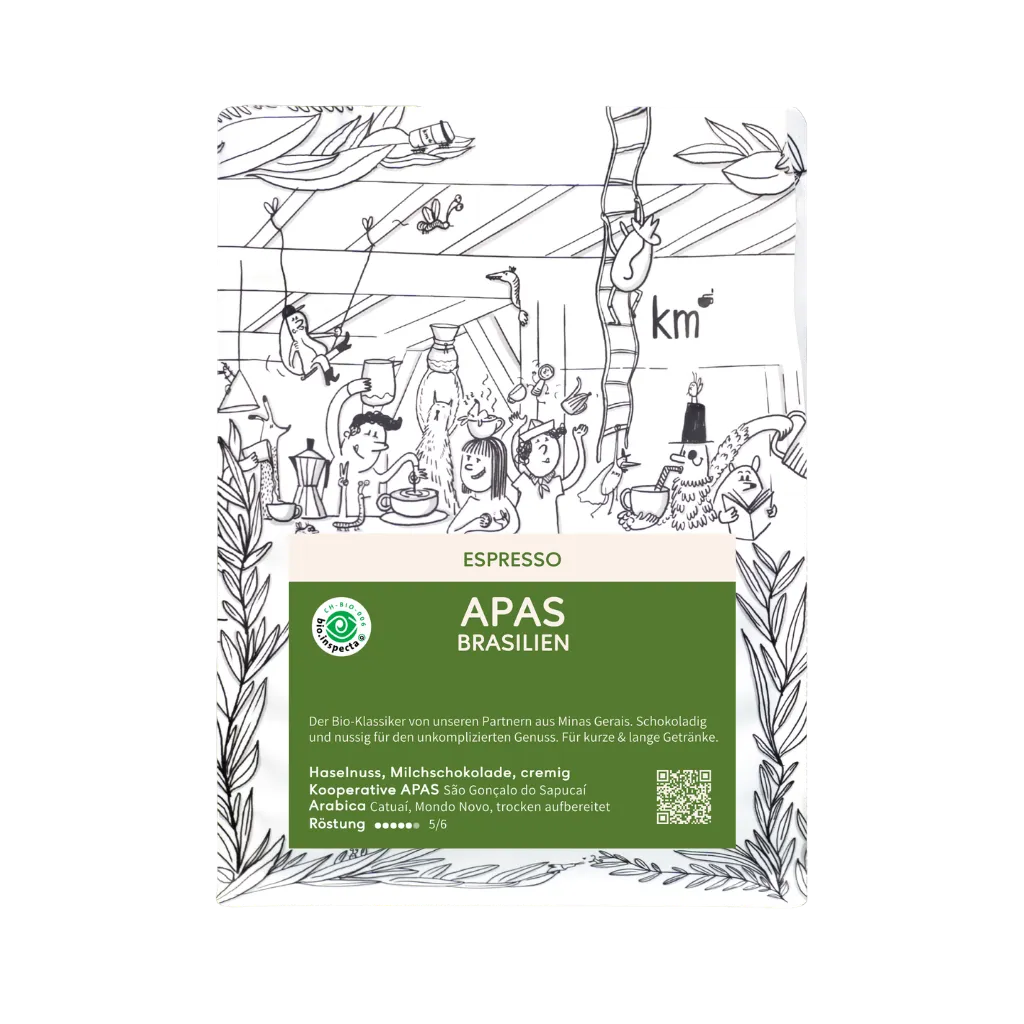
The Apas Cooperative orients itself toward the stock exchange price for coffee, the so-called C-Price. This fluctuates strongly by season. Apas applies a differential of $3.30/kg to their organically produced coffee.
So if the coffee price on the exchange is $5/kg, Apas would charge $8.30/kg. This is the strategy chosen by Apas itself.
Toca, Mexico
In the Toca project, we work with Ensambles as our export partner. The coffee price paid covers project costs, field staff, payments to coffee producers, and premiums to promote the transition to biologically regenerative principles.
Ensambles observes the local market price, the so-called plaza, and makes a higher offer based on that, which is worthwhile for producers.
In the year 22/23 we pay significantly above plaza, import twice as much as the previous year, guarantee premiums, and thus slowly build trust with producers to commit long-term to the project.
Being a Partner, Providing Impulses, and Initiating Change
As a coffee company that purchases raw coffee and sells roasted coffee, we perform a major balancing act: on one hand, we are deeply rooted in small-scale, subtropical agriculture; on the other, we focus on the precise positioning of roasted coffees in the end-consumer market. At these endpoints and at all stages in between, we can provide impulses and bring about change.
- With the Apas Cooperative in Brazil, we transitioned to organic coffee production in 2022 and now purchase almost their entire organic harvest.
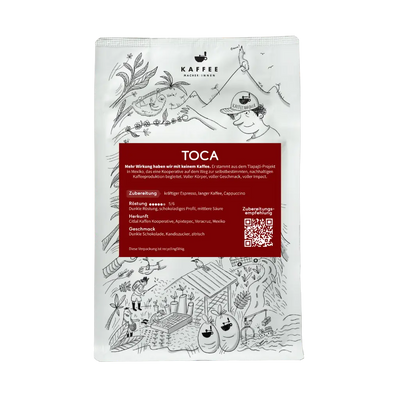
- In the Toca project in Mexico, we are guiding an indigenous community toward organic coffee production and providing direct market access to a heavily marginalized region.
- Also in Mexico, we have set up what is probably the most local decaffeinated coffee with Rancho San Felipe—within an 80 km radius, the coffee is grown, processed, decaffeinated without chemicals, and shipped.
- With Macenta Beans in Guinea, we found partners who turn Robusta into specialty coffee while protecting the rainforest.
- And on our farm in Nicaragua, we are experimenting with various post-harvest processes, varieties, and shade trees to be able to produce coffee as independently as possible from external influences.

Juan Boillat, roaster and barista. In the background: our Reicat catalyst, with which we clean the exhaust air.
More Ecological Agriculture
An important pillar in this way of working is a clear focus on soil health. The better the soil, the more resilient the coffee plant. We support agricultural approaches that work regeneratively and understand coffee production holistically. This also includes the production of fertilizer on-site, which makes producers more independent from market fluctuations.
Small-scale producers in particular need a broad range of tools to respond to constant challenges in coffee growing. Whether organic, biodynamic, regenerative, or a mix of different approaches—anything that strengthens coffee producers and gives them agency, we support.
We learn when we talk with the FiBL about soil erosion and fertilizer, when agricultural consultants explain different types of compost to us, when scientists recommend agroforestry systems to us, and when sustainability consultants from major companies describe their strategies for adapting coffee farms to climate change.
The solution approaches are complex and contextually different. Neither a single label nor a single form of agriculture can prevail in a climate that is changing unpredictably and rapidly. Hybrid approaches and flexibility are required; this demands openness and curiosity, and to these two virtues we wish to commit ourselves.
Ecological Footprint and Environmental Impact Points
Coffee companies are by definition globally active along the coffee chain. It's in the nature of things, because coffee is grown in the southern hemisphere, shipped here, roasted, and shipped out again. The coffee bean not only connects distant worlds in terms of content but also covers remarkable distances along the way.
The ecological footprint of coffee is not uncontroversial—depending on cultivation method, logistics efficiency, roasting method, preparation method, and not least the decision of whether, how much, and what type of milk goes into a coffee, coffee can range from climate-neutral to climate-harmful. Worlds lie between, and analyzing, calculating, understanding, and deriving action measures requires patience and energy that should flow into this analysis.
Since 2022, we have been working on calculators to determine our ecological footprint—on the coffee farm, in the roastery, and in our gastronomy. We work with consulting firms that verify our calculations and thus give us confidence that we are calculating correctly.
We do not aim to calculate individual products, business units, or the entire company and then offset our emissions. We calculate so that we understand where we can implement reduction pathways, where we need to activate which levers so that we not only emit less but also bring about positive change and, ideally, achieve a reduction effect.
With the transition from conventional to organic coffee production at the Apas Cooperative, we likely changed Apas's CO2 emissions in the single-digit percentage range (figures under review). In our internal calculations, it's even in the higher double-digit range.
Through setting up the new decaf supply chain in the smallest radius in Mexico, we were able to save more than 18,000 nautical miles of logistics compared to our previous decaffeinated coffee.
Through precise energy consumption measurements on espresso machines, we can provide increasingly better recommendations on which machines perform in the most climate-friendly way and which anachronistically chase purely the focus on 1960s espresso machine aesthetics.

Measure, measure, measure. We generate knowledge about the efficiency and ecological footprint of machines and report on our findings in our tests.
New Tasks Through Our Own Monitoring
Through the self-imposed and increasingly thorough review of our work along the entire coffee chain, we not only constantly discover new blind spots but also give ourselves new tasks on how we can improve existing practices.
How do we arrive at the most ecological coffee packaging?
Which wood makes our tamper CO2-positive?
Which barista cloths protect water from microplastics?
What type of milk has the shortest supply route and the smallest footprint?
We experience this self-review not as a burden but gain renewed motivation to continue developing our company, see new opportunities, seize them, and thus help shape our collective future.
We cannot tackle these new tasks alone, so we will increasingly rely on partnerships and alliances to tackle complex projects and achieve overarching goals.
Sustainability in Gastronomy
As Kaffeemacher, we operate two cafés in Basel. Our goal is to create places and spaces that convey our love for coffee and invite relaxed lingering. Our two concepts—Café frühling in Kleinbasel and the Café on the Passerelle at SBB Basel Station—are both places where we can convey our standards for coffee and food.
From the beginning, we have had a trusted relationship with our suppliers, pay attention to regionality, organic products, and preferentially source products from small businesses or producers. Our baked goods come from Vital Speisehaus organic bakery from Dornach, and cow milk from the Marchmatt organic farm in Reigoldswil. The two cafés are among the largest buyers of our own roastery.
We co-founded the Swiss organic oat drink Gutsch, are part of the cooperative, and act as a distribution center for other gastronomic projects.