







Four methods, one goal: the caffeine must come out of the bean, everything else should stay in. How well this works determines the taste, the price, and whether measurable solvent residues end up in the cup. We spoke with the decaffeinator CR3 in Bremen, researched patents and limits, and found an error that appears in almost every article on the subject.

Decaffeination always happens to raw coffee, never to roasted coffee. Four extraction agents are in use: dichloromethane, ethyl acetate, water, and CO₂. The difference between them lies in selectivity, not in the marketing name. And decaffeinated does not mean caffeine-free: a decaffeinated espresso contains 3 to 15.8 milligrams of caffeine.
What all methods have in common during production
Decaffeination always happens to raw coffee, the green bean before roasting. There is no industrial process that decaffeinates roasted coffee.
Meike Holtmann works at ANKA, the research and innovation subsidiary of CR3, on exactly these processes. She describes four steps that are the same for all methods:
The difference between the methods lies in the second step, and there in three variables: temperature, pressure, and time. Holtmann calls it "the operating mode of the entire process".
Selectivity means: how specifically an extraction agent targets caffeine and leaves everything else alone. A less selective agent also removes fats, acids, and aroma compounds. This is the real reason why some decafs taste flat.
Dichloromethane: nine hours and the best price-to-performance ratio
Dichloromethane, short DCM or methylene chloride, is the most common method worldwide. The reason is simple: it works better than anything else. Holtmann calls DCM "the most efficient extraction agent for caffeine".
Pressure, temperature, and target value according to the original patent by Procter & Gamble from 1971. There the beans are premoistened to 41 to 50 percent by weight water, the solvent-to-bean ratio is 3:1 to 5:1.
Short process time means low energy consumption, and that directly impacts the price. Holtmann: "The price-to-performance ratio is right."
What many find surprising: DCM is not the most aggressive, but rather a gentler agent.
"It is relatively selective for caffeine as well. Not so many co-extracts come out with it."
If you start with good raw coffee quality, you preserve a lot of aroma. But we haven't tasted any specialty coffee from the DCM method yet. That probably also has to do with it being a chemical process and market acceptance being limited.
In the indirect DCM method, the solvent never touches the bean. The coffee is soaked in hot water, the caffeine goes into the water, and only this water is treated with DCM. After that, the aroma compounds return to the bean with the water. We found no documented figures for temperatures and times for this variant.
How much dichloromethane remains in the coffee? 34 products tested
A working group measured 34 commercial decaffeinated roasted coffees from EU trade in 2024 using headspace-GC-MS. The results:
| Measurement | Value |
|---|---|
| Range in roasted coffee | 5.7 to 816.6 µg/kg |
| Mean value | 127 µg/kg (0.127 mg/kg) |
| Median | 59.5 µg/kg (0.060 mg/kg) |
| Legal maximum Switzerland and EU | 2 mg/kg (2,000 µg/kg) |
| Legal maximum USA | 10 mg/kg (10 ppm) |
| Transfer into beverage, filtered coffee | Median 26.8 percent |
| Transfer into beverage, French press | Median 43.1 percent |
Fabian, Süße-Herrmann, McGaffin & Hielscher (2024), Proceedings 109(1), 33. Limits: Swiss VTVV Annex 1, EU Directive 2009/32/EG Annex Part II, 21 CFR 173.255.
Three things are now clear. First: DCM is detectable in finished coffee; the statement "nothing is left after roasting" is too sweeping. Second: the highest measured individual value is around 41 percent of the limit, the median is about three percent. Third: a quarter to just over two-fifths of the residue ends up in the cup, and French press transfers significantly more than paper filter.
Holtmann says about the residues: "The prescribed maximum levels are undershot by a hundredfold." The study's median is by a factor of about 34, the mean by about 16. The order of magnitude fits, but individual values scatter considerably.

Pure caffeine at Descamex, Córdoba, Mexico
Why the issue is moving again, once more
The International Agency for Research on Cancer (IARC) has listed dichloromethane in Group 2A since 2017, as "probably carcinogenic to humans". In the USA, a petition by multiple environmental and health organizations has been pending since November 2023 to remove methylene chloride from food approval. The FDA reopened the comment period on May 28, 2026, and closed it on June 29, 2026; a decision has not been reached to date. We found no comparable initiative in the EU; nor in Switzerland.
Ethyl acetate, the sugarcane process
Ethyl acetate goes by two names. The technical one is ethyl acetate, the prettier one is Sugarcane Process. Both mean the same molecule.
"Industrially it is used in synthetic form. But it is also naturally present in traces in sugarcane, in sugar beets, or in fruit, and can also be produced from natural components. And that's why it also carries this name Sugarcane Processing."
Technically, ethyl acetate behaves similarly to DCM, with one difference: "It is not quite as selective for caffeine as dichloromethane. So the process times are slightly longer." At Descafecol in Manizales, the decaffeination facility in Colombia, the solvent cycles run for about eight hours according to the process diagram, after a half-hour steaming.
Cycles and steaming time according to the process diagram from Descafecol, Manizales. The residue specification of 20 ppm is a voluntary statement by Descafecol; Cafe Imports states a maximum of 10 ppm in its process diagram.
The legal situation is the real difference. Unlike dichloromethane, there is no numerical maximum value for ethyl acetate. It is listed in Part I of the Annex to Directive 2009/32/EG, among the solvents permitted for all purposes under good manufacturing practice. Swiss VTVV follows this system.
The most interesting set of numbers for this process comes from a 1999 review and shows what decaffeination costs:
| Condition | Duration | Caffeine removed | Loss of soluble solids |
|---|---|---|---|
| Room temperature, 27 degrees | 8 h | 37 to 39 % | 9 to 10 % |
| Room temperature, 27 degrees | 14 h | 42 to 44 % | 14 to 15 % |
| with hot water circulation | 8 h | 62 to 64 % | 34 to 36 % |
| with hot water circulation | 16 h | 78 to 80 % | 40 to 42 % |
Ramalakshmi & Raghavan (1999), Critical Reviews in Food Science and Nutrition 39(5), Table 5. Laboratory conditions, not industrial parameters.
Water processes: why water alone doesn't work
The most obvious idea is also the most wrong. If you put coffee beans in hot water, caffeine dissolves, but so does everything else. You get a cup of coffee and a flavorless bean.
The water processes solve this with a trick. Holtmann: "The coffee bean is extracted with hot water or with hot caffeine-free green coffee extract." This extract is saturated with all soluble coffee components, just without caffeine. So essentially only caffeine can leave the bean, everything else stays in because the solution is already full of it.
The caffeine-loaded extract then runs over adsorber filters. "A caffeine-free but aroma-rich extract comes out of these adsorber filters again." The cycle begins anew.
"We found that the filters we use also have a lower affinity for co-extracts, which has a very positive effect on the aroma of the decaffeinated coffee, because we have fewer losses there."
Two suppliers carry water processes in their name. Swiss Water in Delta, British Columbia, works with green coffee extract and charcoal filters. Descamex in Córdoba, Veracruz, calls its process Mountain Water Process.
Values from a 1980 patent for the water process with adsorption. Swiss Water and Descamex do not publish their own process data.
"99.9% caffeine-free" - well, not quite
Neither Swiss Water nor Descamex publish temperatures, pressures, process times, or a decaffeination level. The common claim "99.9 percent caffeine-free" for the Swiss Water Process could not be traced to any primary source; it comes from a teaching material that itself refers to a blog. We therefore do not name it as a fact.
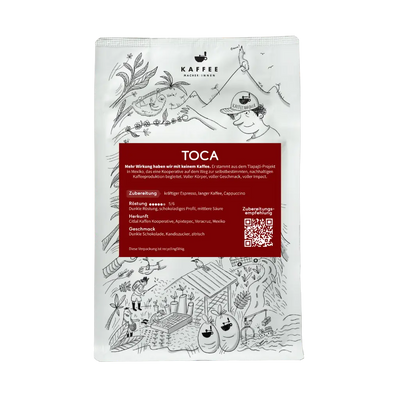
The coffee with which everything started here comes from such a process. Our Sueño from Mexico is decaffeinated with water at Descamex, the coffee comes from Rancho San Felipe.

Supercritical CO₂: from 31 degrees and 73.8 bar
Carbon dioxide is known as a gas and as dry ice. Above around 31 degrees and 73.8 bar it becomes something third: supercritical. It then has the density of a liquid and the diffusion behavior of a gas, and in this state it dissolves caffeine.
Kurt Zosel invented it in Oberhausen; the patent was filed on February 5, 1970. It specifies 40 to 80 degrees, 120 to 180 atmospheres, a water content of the beans of 15 to 30 percent, 5 to 15 hours of decaffeination, and residual caffeine below 0.01 percent. The heart of the patent is a subtlety: it is the moisture that makes supercritical CO₂ a medium that absorbs caffeine.
At today's industrial scale, the values are higher. Holtmann mentions "extremely high pressures, 250 to 300 bar, and high temperatures of 60 to 80 degrees". An environmental impact study from 2017 documents a facility with 250 bar and 90 degrees, five hours of steaming, then 11.5 hours of extraction for Arabica and 22 hours for Robusta, with 97 percent caffeine removal.
Worldwide, around 100,000 tons of raw coffee per year are processed using the supercritical method, according to the Max Planck Society. That's about one percent of global harvest.
Subcritical CO₂: liquid at 70 bar, seven days process time
If you lower the pressure and temperature below the critical point, you get liquid CO₂. This is slower and more expensive, and precisely for that reason interesting, especially sensorically.
CR3 calls this process Carbonic Natural. Holtmann describes it like this: "The CO₂ is in a liquid state and flows through the pretreated beans and is incredibly selective." After extraction, pressure is released, pressure drops from 70 bar to ambient pressure, and the caffeine precipitates from the CO₂. It is absorbed in a water stream, the CO₂ goes caffeine-free back into the next batch.
Pressure, temperature, and residual caffeine according to a documented factory visit by Belco. There, 97 to 99 percent of the caffeine goes into the liquid CO₂ phase.
Sebastian Gabriel, marketing and sales at CR3, once explained it to us like this: CO₂ is "a lazy solvent".
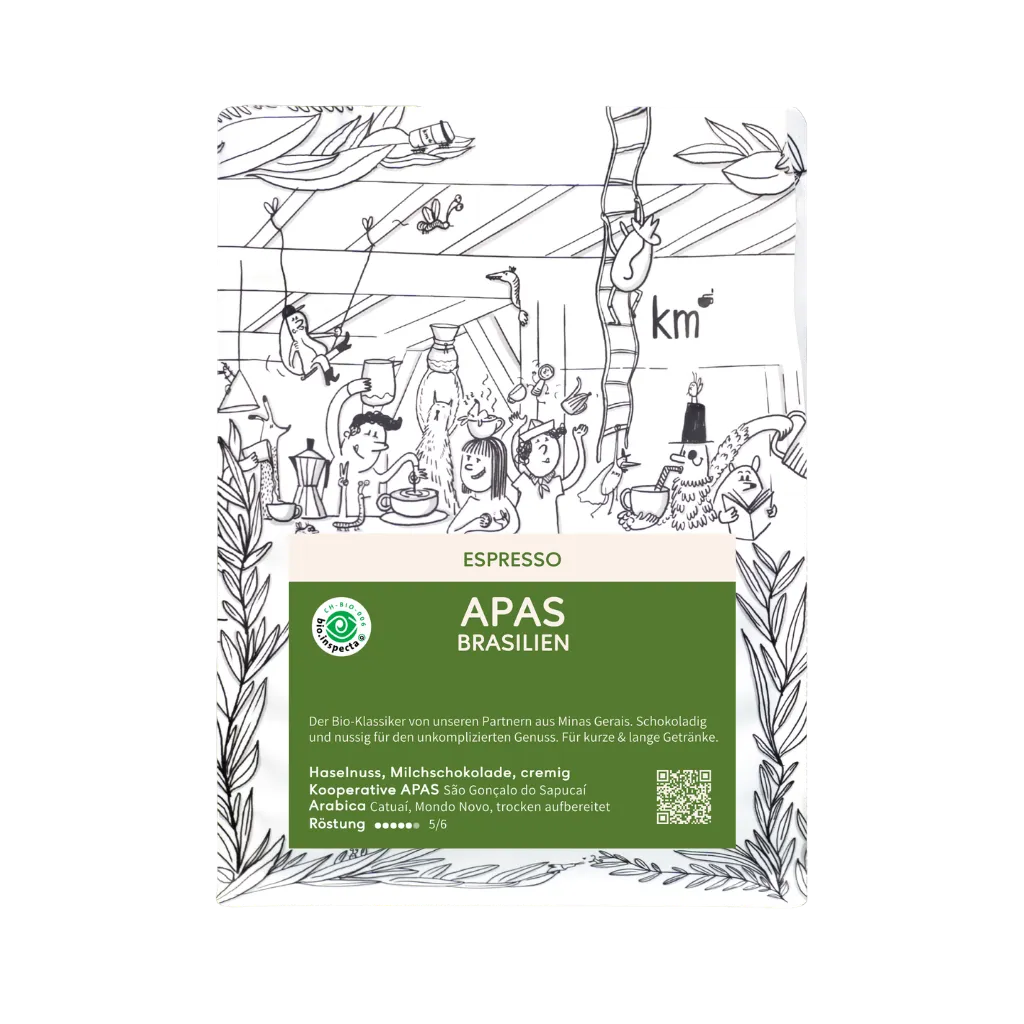
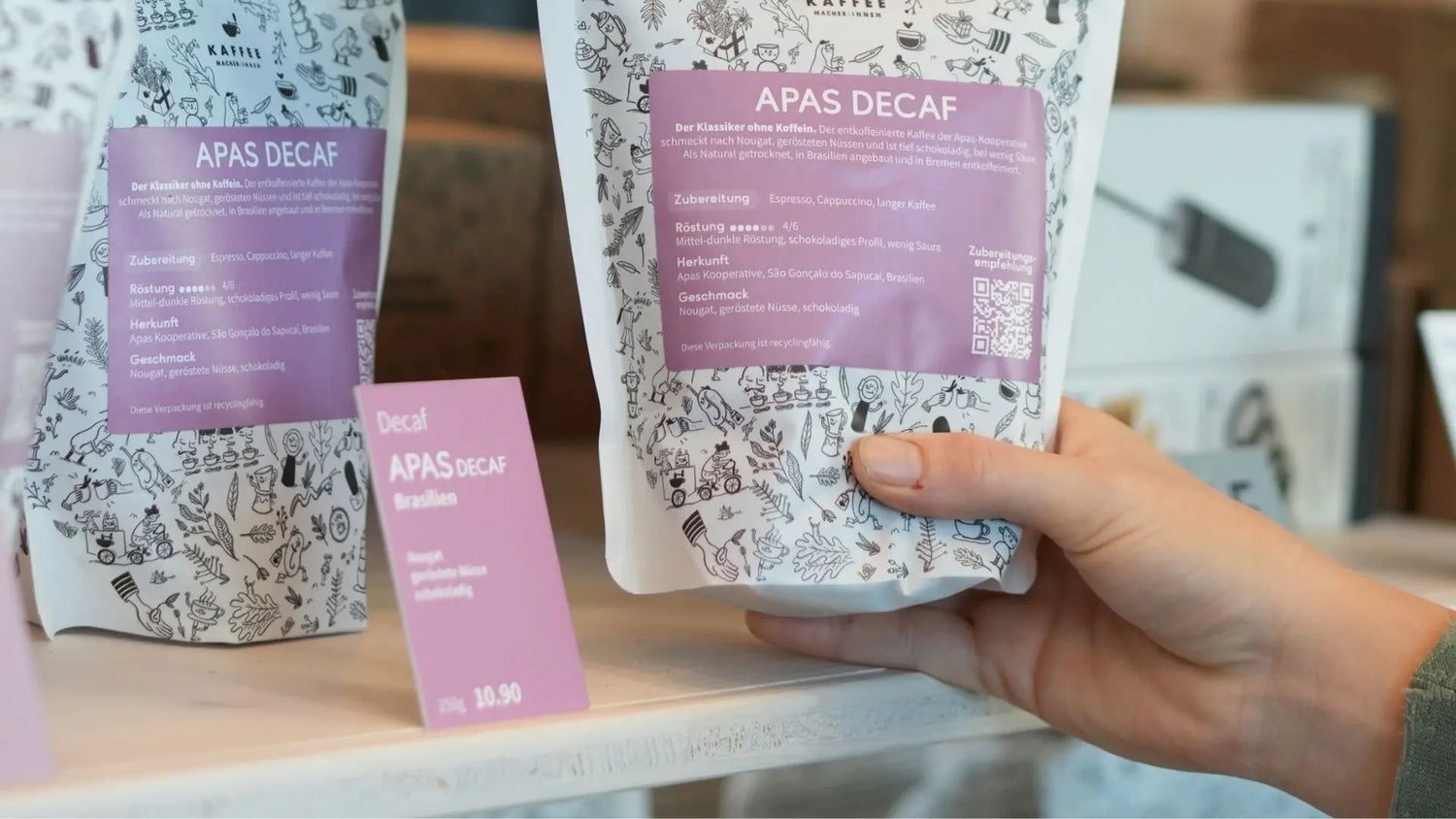
Two points that matter in everyday life. The CO₂ comes from natural spring carbonation, which is why the process is certifiable as organic. And: our Apas Decaf from Brazil is decaffeinated this way, as is our Dipilto Decaf from Nicaragua.

The triglyceride process: much claimed, little proven
Many articles mention a fifth process: the beans bathe in hot coffee oil, triglycerides in the oil pull the caffeine out.
We found no primary source for this. No patent, no peer-reviewed study, no manufacturer information specifies temperature, duration, oil-to-bean ratio, or decaffeination level. We checked and ruled out three relevant patents that are regularly cited in the literature for this and actually describe other methods.
The four processes in direct comparison
CO₂ appears twice in the table because it runs in two operating modes. The extraction agent remains the same.
| Process | Extraction agent | Duration | Pressure / Temperature | Selectivity | Cost |
|---|---|---|---|---|---|
| Dichloromethane (DCM) | Dichloromethane | approx. 9 h | 2–14 bar / 60–99 °C | high | low |
| Ethyl acetate (Sugarcane) | Ethyl acetate | approx. 8 h cycles | not published | medium | low to medium |
| Water (Swiss Water, Mountain Water) | Green coffee extract plus adsorber filter | not published | 50–100 °C (1980 patent) | high, filter-dependent | high |
| CO₂, supercritical | Supercritical CO₂ | 11.5–22 h | 250–300 bar / 60–90 °C | high | high |
| CO₂, subcritical (Carbonic Natural) | Liquid CO₂ | 6–7 days | 70–80 bar / 23 °C | very high | high |
"Not published" means: the value is not published by any manufacturer and is not in any primary source.
What "decaffeinated" legally means, and why "EU limit 0.1 percent for caffeine" is wrong
Precision is key: sentences like "in the EU, decaffeinated coffee may contain up to 0.1 percent caffeine" appear on every other page on the topic. They are not correct as stated.
The EU regulates only coffee extracts with Directive 1999/4/EG—that is, instant coffee. The limit there is 0.3 percent anhydrous caffeine relative to dry matter. For roasted coffee, we found no harmonized EU numerical value.
The 0.1 percent comes from national law:
| Jurisdiction | Roasted coffee | Instant coffee | Basis |
|---|---|---|---|
| Switzerland | max. 0.1 percent by weight, relative to dry matter | max. 0.3 percent by weight | EDI Ordinance on beverages |
| Germany | max. 1 g caffeine per kg coffee dry matter, i.e., 0.1% | max. 3 g/kg, i.e., 0.3% | Coffee Ordinance, § 2 para. 3 |
| EU | no harmonized value found | 0.3% | Directive 1999/4/EG |
Practically, this changes nothing for you as a drinker: in Switzerland and Germany the same value of 0.1 percent applies.
What ends up in your cup
The limit says nothing about how much caffeine you actually drink. Measurements of the beverage are needed for that.
The reference study for this is from 2006. Ten filtered decaf coffees from nine chains and local cafés ranged between 8.6 and 13.9 mg caffeine per 473 ml. Decaffeinated espresso came in at 3 to 15.8 mg per shot.
To start: raw coffee contains about one percent caffeine for Arabica and about two percent for Canephora, depending on the variety. A 2020 study cites ranges of 0.8 to 1.4 percent for Arabica and 1.7 to 4.0 percent for Robusta. Roasting changes this almost not at all, because caffeine is heat-stable.
What this residual caffeine does in the body is a separate question. How long caffeine works, how quickly it is broken down, and when it disturbs sleep, we have written up separately.
Bremen as the caffeine capital
"Decaffeination was invented in Bremen. Many people don't know that. And you can essentially say Bremen is still the world capital of decaffeination."
Both are true, with a clarification. The patent "Preparation of coffee" was filed on May 4, 1906, and issued on September 1, 1908. On it stand three names: Johann Friedrich Meyer Jr., Ludwig Roselius, and Karl Heinrich Wimmer. Roselius is listed almost everywhere as the sole inventor, but he is not.
And the solvent was indeed benzene, literally in the patent: "We have found that benzene (also called benzol) is eminently suitable for this purpose." Kaffee HAG was founded that same year, 1906. The widely circulated anecdote that a coffee shipment damaged by seawater gave Roselius the idea sounds adventurous, but perhaps a bit too adventurous. I have not yet found a reliable source for it.
As for the world capital: Bremen's Coffein Compagnie processes around 120,000 tons of raw coffee per year in five facilities, according to its own information, and calls itself the global market leader. CR3 is also based in Bremen. There is no independent global capacity ranking, because Descamex, Descafecol, Demus, and Swiss Water do not publish their capacities.
Which process makes the best coffee?
Stacey Linden from Swiss Water put it to me something like this in our conversation for the main article:
The decaffeination process leaves a sensory footprint, more or less depending on the method. What we find interesting is the question of whether this sensory change is a flaw, or whether it can add a new quality.
Fast and cheap processes like DCM, in our understanding, leave a soy-like character. Water processes can leave a malty taste in flatter coffees. Ethyl acetate can increase acidity, while the subcritical CO₂ process can slightly dampen the coffee.
If you know this as an importer or roaster, you look for the right raw coffee for the right process, and that's how you can create a new, sensorically interesting product.
Decaffeination as quality improvement of poor raw coffee?
We asked Meike Holtmann whether it is true that poor qualities were primarily decaffeinated in the past. Her answer: "I don't perceive that here in our company today. A large portion of the coffees we sell here as raw material have good, sometimes even very good sensory quality." The low qualities, called "affectionately bird seed or muesli coffees" in the company, are extremely rare.
Her observation on the effect is interesting: "With unclean qualities, we sometimes actually perceive it as an upgrade of the coffee." Less so with good qualities. So the process smooths things out, which helps poor raw coffee and costs good coffee something.
Anyone who wants to judge decaf must know both: the raw coffee quality and the method applied. For more on taste, faster aging, and why decaf extracts differently, see the main article on caffeine-free coffee.
For listening
Conclusion
Four processes, and none is categorically the best. Dichloromethane is fast, cheap, and more selective than its reputation suggests, but leaves measurable residues and is under regulatory scrutiny. Ethyl acetate is similarly fast, slightly less selective, and more loosely regulated. The water processes avoid solvents altogether but publish little process data. CO₂ in the subcritical mode is the slowest and most expensive process and, according to CR3, the most selective.
You'll find our decaffeinated coffees in the decaf collection, each with information on the process used.
Sources
Conversations
Meike Holtmann, Research and Innovation, ANKA (research and innovation subsidiary of CR3), Bremen.
Sebastian Gabriel, Marketing and Sales, CR3 Kaffee Veredelung, Bremen.
Stacey Linden, Swiss Water, Delta, British Columbia.
Studies and reviews
Fabian, Süße-Herrmann, McGaffin & Hielscher (2024): Residues of dichloromethane in decaffeinated roasted coffees, Proceedings 109(1), 33.
Ramalakshmi & Raghavan (1999): Critical Reviews in Food Science and Nutrition 39(5), Table 5.
2006 study on caffeine content in decaffeinated beverages. McCusker, Fuehrlein, Goldberger, Gold & Cone (2006): Caffeine Content of Decaffeinated Coffee, Journal of Analytical Toxicology 30(8)
2020 study on caffeine content in Arabica and Robusta. Gaibor, Morales & Carrillo (2020): Determination of Caffeine Content in Robusta Roasted Coffee (Coffea canephora) by RP-UHPLC-PDA, Asian Journal of Crop Science 12(2)
2017 environmental impact study on a supercritical CO₂ facility. De Marco, Riemma & Iannone (2017): Supercritical Carbon Dioxide Decaffeination Process, a Life Cycle Assessment Study, Chemical Engineering Transactions 57
Patents
Meyer Jr., Roselius & Wimmer: "Preparation of coffee", filed May 4, 1906, issued September 1, 1908.
Zosel: Process for decaffeination with supercritical CO₂, filed February 5, 1970.
Procter & Gamble: Decaffeination with dichloromethane, 1971.
Water process with adsorption, 1980.
Law
EDI Ordinance on Beverages (Switzerland).
Technical Regulations Ordinance for Food, VTVV, Annex 1 (Switzerland).
Directive 2009/32/EG on extraction solvents, Annex Part I and Part II.
Directive 1999/4/EG on coffee extracts.
Coffee Ordinance, § 2 para. 3 (Germany).
21 CFR 173.255 (USA).
Other information
IARC Monographs: Classification of dichloromethane in Group 2A, 2017.
FDA, procedure to remove methylene chloride from food approval, pending since November 2023.
Max Planck Society, statements on the supercritical CO₂ process.
Process diagrams Descafecol (Manizales) and Cafe Imports.
Documented factory visit by Belco to CR3.
Coffein Compagnie, Bremen, own information on processing volume.