


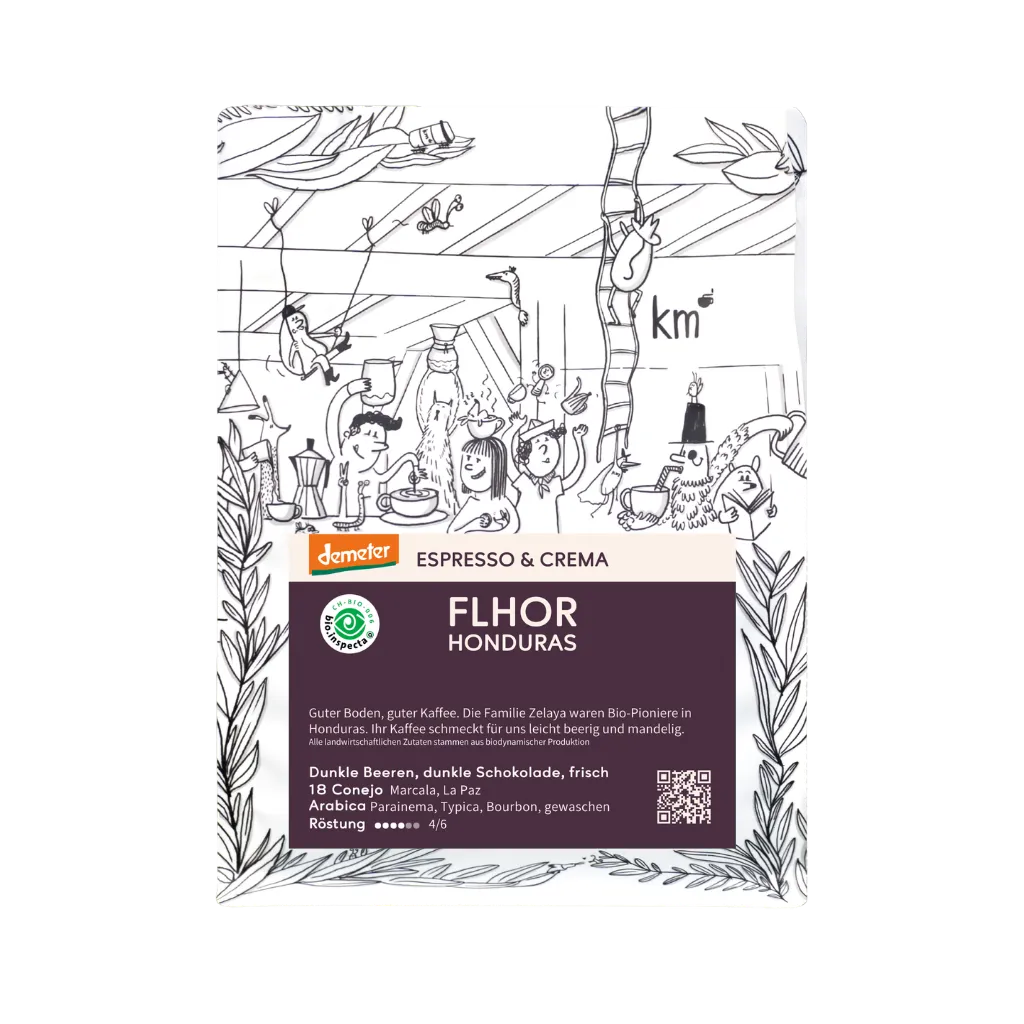





Decaffeinated coffee is coffee from which the caffeine has been removed before roasting. Technically speaking, it's called decaffeinated coffee, but the truth is: it's not really free of caffeine. In Switzerland, it may contain a maximum of 0.1 percent caffeine by mass, based on dry matter. In a cup, between 1.4 and 3.6 milligrams remain according to EFSA values, compared to 80 to 138 milligrams in filter coffee.
That's the short answer. The longer one is about the fact that decaf (decaffeinated) is its own universe, with its own taste rules, its own brewing behavior, and a market that belongs to only a few people. I spent a month drinking only decaffeinated coffee to understand this.
Until recently, I associated decaffeinated coffee with headaches. I drink coffee primarily because I like the taste, but I don't deny the effect caffeine has on me—its absence causes me headaches. This creates a somewhat complicated love triangle between a cup of coffee, caffeine, and me as a coffee drinker.
I wanted to test this situation and decided to drink only decaffeinated coffee for a month. I called it my Decaf December. To prepare, I spent a month beforehand replacing five percent of my weighed coffee beans with decaf beans in my filter coffee. After almost a month, I felt ready.
Or so I thought.
Decaffeinated, caffeine-free, decaf: what's what
Four terms, one thing, and a misunderstanding.
| Term | Meaning |
|---|---|
| Decaffeinated | The legally correct term. In the Swiss Beverages Regulation, it says "decaffeinated coffee (caffeine-free coffee)." The caffeine has been removed, but a residue remains. |
| Caffeine-free | The most common phrasing in Switzerland. Strictly speaking, it's incorrect because no commercially available coffee is truly free of caffeine. |
| Decaf | Short form of the English "decaffeinated." On Italian packages, it's called "decaffeinato." |
| Decaffeinated | A rare variant that means the same thing. |
In Switzerland, "caffeine-free" is the more common phrasing; in the specialty trade and in law, it's "decaffeinated." In this article, we usually use "decaffeinated" and "decaf" because both are precise. They always mean the same thing.
Welcome to a different world
Decaf is not just another type of coffee drink; it's its own universe. Decaffeinated coffee often tastes different from untreated coffee. It should be roasted and prepared differently. And the market behind the bean is concentrated in the hands of only a few players.
Interest in decaffeinated coffee has grown significantly in recent years. We feel that as a roastery—we roast more decaf every year. The reasons are individual, but we mainly hear two: avoiding caffeine and milder taste, with "milder" probably meaning less bitter.
I received many tips on social media about where to find good decaf. I received coffee samples and had great conversations. It felt like coffee enthusiasts were on a treasure hunt. I wondered why it had to be this way. Why doesn't it seem self-evident to come across really delicious decaf?

Coffee tasting at Descamex in Córdoba, Mexico. They decaffeinate our Sueño.
I spoke with some of the world's largest decaffeination companies that introduced me to the decaf universe: CR3, Swiss Water, Descamex. With Les Révélations from Paris, a roastery that roasts exclusively decafs, I discussed how understanding of decaffeinated coffee seems to be changing. And in my self-reflection, I realized that we simply misunderstand decaf.
How much caffeine is still in it?
This is the question we hear most often: Green coffee contains between 1 and 1.4 percent caffeine in Arabicas and between 1.8 and 3.5 percent in Canephoras (Wintgens, 2012). The roasting process has only marginal influence; the caffeine content remains almost identical between green and roasted coffee. This is why decaffeination happens to green coffee before roasting.
What's allowed afterward is regulated by national law, and Switzerland and Germany are aligned:
| Jurisdiction | Roasted coffee | Instant coffee |
|---|---|---|
| Switzerland | max. 0.1 percent by mass of dry matter | max. 0.3 percent |
| Germany | max. 1 g caffeine per kg dry matter, so 0.1% | max. 3 g/kg, so 0.3% |
| EU | no harmonized value | 0.3% |
Ordinance of the EDI on Beverages (SR 817.022.12); German Coffee Regulation § 2 Abs. 3; EU Directive 1999/4/EG. The EU only regulates extracts; the often-cited "EU limit of 0.1 percent" for roasted coffee does not exist as such.
And in the cup? A reference measurement from 2006 found between 8.6 and 13.9 milligrams of caffeine per 473 milliliters in ten decaf filter coffees from nine chains and cafés. Decaffeinated espresso ranged from 3 to 15.8 milligrams per shot. Only one product in the test contained no detectable caffeine. The authors' conclusion belongs on every package: "decaffeinated is not the same as caffeine-free."
A filter coffee contains 80 to 138 milligrams per cup (200 milliliters). In twenty cafés examined, espressos ranged from 51 to 322 milligrams per shot, with a median of 140. So the difference between decaf and regular coffee is much greater than the difference between two espressos from two different cafés.
Who should drink decaf
From conversations with our customers and from my own experiment, four groups emerged.
Those who are sensitive to caffeine. Nervousness, heart palpitations, and restlessness occur in some people even at small amounts. How strongly caffeine affects you is individual and sometimes genetically determined. There's more about this in the article on the effects of caffeine.
Those who want to drink coffee in the evening. That was my main benefit. A controlled 2025 study found that 100 milligrams of caffeine even four hours before bedtime had no measurable effect on sleep. With just a few milligrams in decaf, you don't need to worry about the time. More on this in the article about the effects of caffeine.
Those who seek the taste, not the effect. This is the group most underestimated in retail. Stacey Lynden from Swiss Water says: "Decaf drinkers are the most loyal of all customers."

Stacey Lynden from Swiss Water in Vancouver, Canada.
Those who should consume less caffeine for health reasons. Here we're cautious because we're roasters, not doctors. The EFSA names 200 milligrams of caffeine per day for pregnant and nursing women as an amount without safety concerns. What this means in individual cases should be discussed with a healthcare professional.
Our decaffeinated coffees
We roast decaf for a simple reason: because we want to drink it ourselves and enjoy it. For each one, we include the method because it affects the taste.
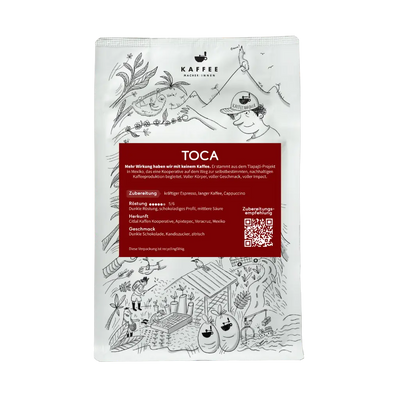
Sueño
Mexico, Rancho San Felipe. Water process at Descamex. Dark chocolate, maple syrup, malt. Roasted for espresso and for dark filter.
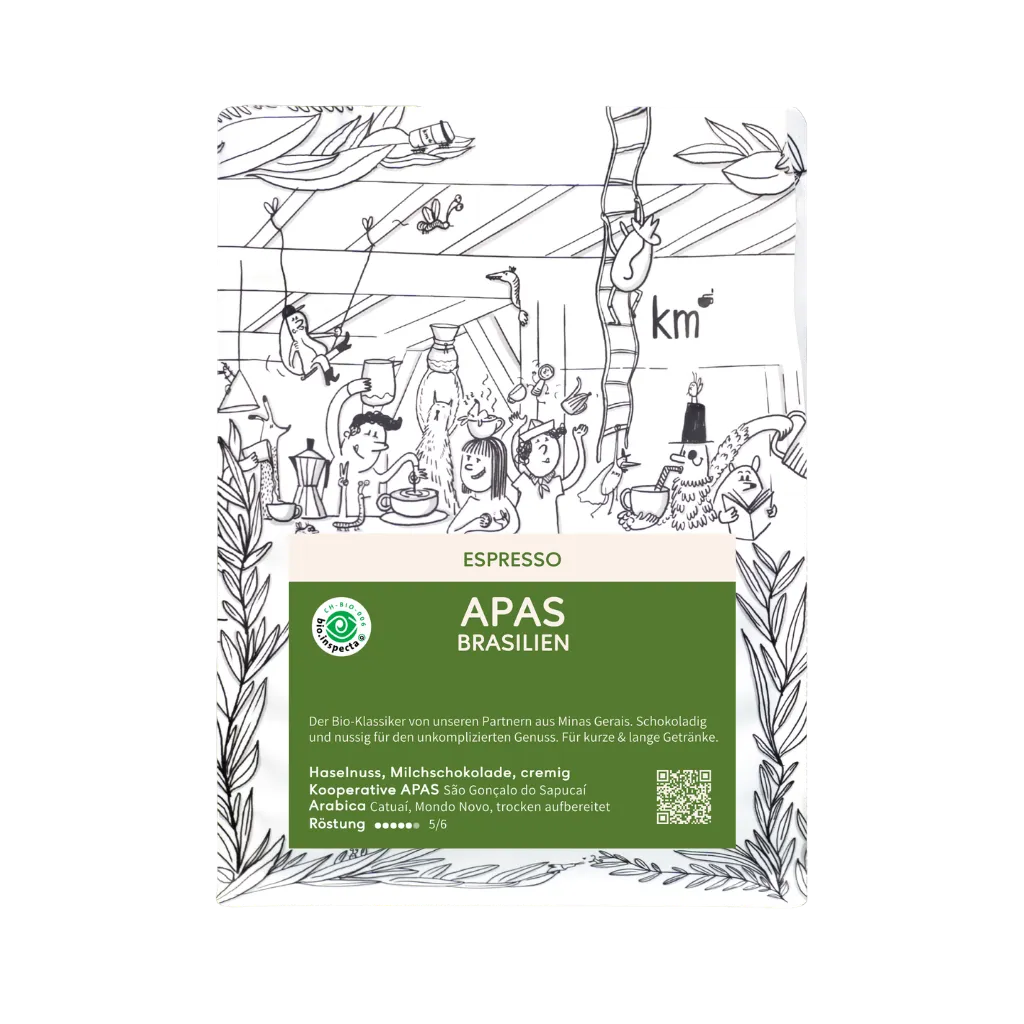
Apas Decaf
Brazil, São Gonçalo do Sapucaí. Subcritical CO2 at CR3 in Bremen. Nougat, roasted nuts, chocolatey.
Dipilto Decaf
Nicaragua, Finca Los Suyates and El Paraíso. Subcritical CO2 at CR3. Chocolatey with fine acidity, plus a light fruit from the carbonic maceration portion.
A fourth is coming: a Shakisso from Ethiopia, decaffeinated using the water process and organically produced. Once it arrives, it will be here and in the collection.
You'll find them all in the decaf collection.
How is coffee decaffeinated? The four processes
All industrial processes treat green coffee. All start with the bean being treated with water vapor, heat, and water until it swells to almost double its volume and the pores widen. Only then does the extraction solvent come into play.
Four extraction solvents are in use:
| Process | Duration | In short |
|---|---|---|
| Dichloromethane (DCM) | approx. 9 hours | The most common and cheapest process, more selective than its reputation suggests, but leaves measurable residues. |
| Ethyl acetate, also Sugarcane Process | approx. 8 hours cycles | A solvent that also occurs naturally in sugarcane. Somewhat less selective than DCM. |
| Water process | not published | Works with saturated green coffee extract and adsorber filters instead of solvents. This includes the Swiss water process, which Swiss Water operates as the Swiss Water Process, and the Mountain Water Process from Descamex. |
| CO2, supercritical and subcritical | 11 hours to 7 days | Carbon dioxide under high pressure. Subcritical, meaning liquid, is the slowest and according to CR3 the most selective process. |
The difference between processes lies in selectivity: how targeted the extraction solvent goes after the caffeine while leaving aromas, fats, and acids alone. A less selective agent removes much more, and this is exactly what you later taste as a thin body in the cup.
We spoke with the specialists at CR3 in Bremen about pressures, temperatures, process times, and residue measurements, and we looked up the legal situation. All of this with numbers and sources will get its own article.
The taste of decaffeinated coffee
How should decaffeinated coffee taste? Like coffee that hasn't been decaffeinated? If we agree on that, then decafs have it tough, because the process is usually noticeable.
Whether that's negative depends on which flavor reference we use for decaf. Is a decaf's reference an undecaffeinated coffee, or actually another decaf? Is the reference for non-alcoholic beer a beer with alcohol?

At Swiss Water, Stacey Lynden told me they have their own attribute in sensory analysis for how strong process notes taste.
The coffee world has managed to treat Robustas separately and discuss them sensorially in a different category, even though they're also a coffee. We also don't compare capsule coffee with espresso from a portafilter machine because we know there are differences.
As long as we think we should always penalize process notes in decaf, we stay stuck in a rut and miss what's behind the taste.
That said: there are process notes and there are process notes. The same green coffee, processed using different methods, will taste different. Some heavier, some lighter. Much more important is something else.
"Coffees with bigger personalities tend to stand out a lot more during the Decaf process."
The more characteristic the green coffee, the more characteristic the coffee afterward.
High quality coming in, high quality coming out
The best decaf filter coffee I had during my Decaf December was from Les Révélations in Paris. It was a natural from Panama by Creativa Coffee District. I brewed it several times and shared it with the team, got feedback like "oh, natural, where's that from?" And I simply said "Panama, roasted in Paris," without mentioning the decaf info.
We didn't taste process notes because the green coffee was very characteristic. It was a natural that fermented in closed containers before drying. As Stacey Lynden would say: "high quality coming in, high quality coming out."
Yes, the process adds a process note to the coffee. But if the base material is characteristic, you barely taste it in individual cases.
What does the decaf process do to the taste?
The process also takes something away—bitter compounds, alongside caffeine itself, which is already bitter.

Sebastian Gabriel from CR3, Bremen.
"The acidity is also homogenized," says Sebastian Gabriel from CR3, the world's largest decaffeinator using subcritical CO2. Often, roasteries had bought lower-quality green coffee and then had it decaffeinated because the process can somewhat mitigate quality issues. Or more simply put: "It can actually enhance poor green coffee quality tastewise, or flatter the green coffee."
But the process also always removes soluble compounds from the green coffee, such as fats, carbohydrates, acids, or melanoidins, which affect our perception of texture.
Swiss Water designed its own scorecard to document changes before and after the process. On a scale of 1 to 6, they assess how much the coffee has changed: flavor notes, acidity, and body, which they break down into texture and thickness.
Stacey Lynden says the body changes the most. This is related to the loss of soluble compounds. In a decaffeinated coffee, there are relatively more insoluble than soluble compounds. This affects brewing and taste.
Why a high decaffeination level isn't automatically good
A lab series on the ethyl acetate process shows the price of this loss in numbers: 37 to 39 percent caffeine removal costs 9 to 10 percent of soluble solids. 78 to 80 percent caffeine removal costs over 40 percent. The decaffeination level alone is therefore not a quality statement.
The color: darker, but not burnt
"The color change is primarily not related to oxidation," Sebastian Gabriel tells me. In their case, decaffeination with subcritical CO2, it's a combination of pressure, heat, rehydration, and re-drying.

Left: untreated green coffee, right: decaffeinated green coffee.
Stacey Lynden adds that in the water process, the green coffee extract deposits some of its color in the seed, making the coffee darker.
An interesting point: decaffeinated coffee can look darker even at low end temperature in the roasting drum. But once it's ground, it remains light. The difference between outer and inner color is relatively large. In non-decaffeinated coffees, this would indicate uneven bean development. In the decaf case, it's the process: the cell structure becomes more porous and coffee oils penetrate outward more easily.
Freshness: Decaf ages faster
Gabriel and Lynden both independently say: oxidation occurs more quickly in decaffeinated coffee because antioxidants are removed by the process. The coffee ages faster than green coffee and roasted coffee. Add to this the higher porosity, through which oxygen penetrates the bean more quickly.
For you, this means: Buy decaf in small quantities and drink it fresh. While we wait up to three weeks after roasting for dry-processed coffees, we drink decafs as early as one week after roasting.

Decaf looks darker after roasting—but only on the outside.
Preparing decaffeinated coffee
Even though decaffeinated coffee is still coffee, the process changes brewing behavior. In all my Decaf December tests, coffees decaffeinated with water, DCM, and ethyl acetate had longer extraction times in filter preparation than non-decaffeinated coffee. Coffees decaffeinated subcritically with CO2 behaved most similarly to untreated.
"The decaffeinated coffee bean is more porous, resulting in greater contact surface for water, so brewing takes longer."
Stacey Lynden therefore brews her decaf filter coffee with a coarser grind. Since the coffee has already broken down soluble compounds in the process, she measures less strength in the drink. Her three rules:
What this looks like concretely in the portafilter, in the automatic machine, and in the hand filter, with recipe parameters for our coffees, will get its own article.
The decaf market: undemocratic and consolidated
Back to our natural from Panama. The coffee was very good and recently roasted; I extracted it slightly over-dosed. It showed hardly any sensory signs of being decaf. Why isn't this the standard?
Because of volume. And focus. And risk. And price.
In short: because the decaf market is highly consolidated and these coffees are nano-stories in a non-transparent mass market.
Who determines which green coffee gets decaffeinated?
As a rule, it's buyers like exporters, importers, and trading houses who want a certain green coffee or already-mixed basket blends decaffeinated by a decaffeinator. Sebastian Gabriel told me that the decaffeinator is never the "owner of the goods, only the processor."
If it's not trading houses, it's roasteries. We did this with the Rancho San Felipe a few years ago: we made a purchase commitment for 50 percent of a lot, they had it decaffeinated at Descamex, and since then we've had the coffee as Sueño in our lineup.
Batch size is the bottleneck
For Descamex to decaffeinate the green coffee for Rancho San Felipe, 50 bags had to be delivered, so 2,500 kilograms. That's the minimum size there. At Swiss Water in Vancouver, it's now 4,560 kilograms; at CR3, around 3,000.

At Descamex production. The machines are huge; the process remains confidential.
This leads to three problems. First, a trading house or roastery needs customers for about 3,000 kilograms, and this volume should be sold quickly because decaf has shorter shelf life. Second, the process is flying blind: there's no way to decaffeinate a sample quickly and then decide if it's sensorially interesting. The 3,000 kilograms are the test batch. Third: if at least 3,000 kilograms are needed to run the facility, which coffees get processed? Rarely the microlots.
Few complex decafs, because the entry barrier is too high
I joked with Piroska Hunyadi from Révélations that we really need a 60-kilogram decaffeination machine to make it attractive to decaffeinate rare and sensorially complex coffees on a mini scale.
So the mentioned Panama lot was at least 3,000 kilograms large so Swiss Water could decaffeinate it. There are only very few producers who can make 3,000 kilograms at this level. The entry barrier for great coffees into the decaf market is thus far too high.
I would love to have a 300-kilogram lot from Peru decaffeinated because it's a coffee I'd also like to drink in the evening. But it's not possible because there isn't enough coffee. Sebastian Gabriel says: "Scaling makes much more economic sense. Decaffeination is capital-intensive and the safety and environmental regulations are very strict, which really only justifies scaled production."
So the decaf market isn't really democratic. As long as batch sizes are this large, and at Swiss Water even larger, smaller lots don't make it into the process. Coffee drinkers lose out sensorially because the selection remains limited.
A severe consolidation
We know the coffee market is highly consolidated: on the roasted coffee side, a handful of roasteries account for 50 percent of offered coffee, and on the green coffee side, the five largest countries produce over 80 percent.
The decaf market looks no different. The options for trading houses and roasteries to have coffee processed are highly limited. Rising price pressure and efficiency efforts mean batch sizes are getting larger, not smaller.
Closing thoughts and a wish
"Decaf drinkers are the most loyal of all customers. If we manage to offer high-quality decaf, we're doing a service to our best customers."
From a sensory perspective, she's right: decaf drinkers drink decaf for the taste and the feeling, not for the caffeine.
She sees great potential for even better decaf, as does Sebastian Gabriel. All statements have in common that they mean a process that should be as gentle as possible.
But looking at the coffee farm, it looks different. Very few producers can produce lots of 3,000 kilograms or more in top sensory quality. And even if they can, there's still the decision of the trading house or roastery whether this coffee should be decaffeinated.
These uncertainty factors lead me to believe that roasteries tend to be less bold in selecting decaf. But if roasteries work together and commit to a certain quantity, then sensorially top-tier coffees can also be decaffeinated.
My wish would therefore be a small decaffeination machine, one that could handle 60 to 120 kilograms. The market for it would be small roasteries that want to decaffeinate special coffees.
No headaches and much more coffee
After the first week of my Decaf December, the headaches disappeared. I woke up, drank a decaf filter coffee, and felt just as alert starting the day as usual.
I drank filter coffee like there was no tomorrow. Normally I stop mid-afternoon so caffeine doesn't affect my sleep. In Decaf December, I kept drinking coffee every evening because there were no side effects. My bean consumption rose by 80 percent, partly because I was trying different coffees.
Since then, consumption has declined, but I still regularly drink decafs in the evening as filter coffee. And something has stuck with me: I experience fewer or no headaches in the morning anymore. Maybe it has to do with the 30-day abstinence, maybe not. Either way, a new world has opened up to me that I don't want to miss anymore.
The research supports this
The headaches were no illusion. The reference study on caffeine retention lists headache in 50 percent of those affected, starting 12 to 24 hours after the last dose, peaking after 20 to 51 hours, lasting 2 to 9 days. And the threshold is 100 milligrams per day, roughly one cup. There's more on this in the article about the effects of caffeine.
Buying decaf
Our own decafs are listed above, with origin and process. You'll find them all in the decaf collection.
To listen to and watch
Episode 74, "Inside Decaf: Research, Processes and the New Trend," with Meike Holtmann from ANKA and Sebastian Gabriel from CR3.
And the video about Decaf December:
Frequently asked questions about decaffeinated coffee
Is decaffeinated coffee really caffeine-free?
No. In Germany and Switzerland, decaffeinated roasted coffee may contain up to 0.1 percent caffeine by dry matter mass. In finished drinks, 8.6 to 13.9 milligrams per 473 milliliters of filter coffee and 3 to 15.8 milligrams per espresso shot have been measured.
How much caffeine does decaffeinated coffee have?
According to EFSA values, 1.4 to 3.6 milligrams per 125 milliliters. A measurement series of finished drinks found 8.6 to 13.9 milligrams per 473 milliliters of filter coffee and 3 to 15.8 milligrams per espresso shot. For comparison: normal filter coffee contains 80 to 138 milligrams per 200 milliliters.
What does decaf mean?
Decaf is short for "decaffeinated." On Italian packages, it says "decaffeinato."
Does decaffeinated coffee taste different?
Usually yes, because the process removes soluble compounds as well. The body changes most noticeably. How much you taste it depends on the process and, above all, on the quality of the green coffee. In very characteristic coffees, it's barely noticeable.
Can you drink decaffeinated coffee in the evening?
Yes. A controlled 2025 study found 100 milligrams of caffeine even four hours before bedtime had no measurable effect on sleep. Decaf, with just a few milligrams, is far below that.
Is decaffeinated coffee healthy?
As a roastery, we don't make recommendations about this. What's documented is that a large 2017 review found no harmful associations for decaffeinated coffee with health outcomes. It's also documented that the acute blood pressure increase after coffee is not solely due to caffeine: decaffeinated espresso increased systolic blood pressure similarly in occasional drinkers.
Can you drink decaffeinated coffee during pregnancy?
The EFSA names 200 milligrams of caffeine per day for pregnant women as an amount without safety concerns. Decaf is far below that. What makes sense in individual cases should be discussed with a healthcare professional, not a roastery.
What decaffeination process is best?
The question is poorly framed. The green coffee comes first, then the process. A highly selective process won't make good decaf out of mediocre green coffee, but a less selective one can flatten very good green coffee.
Are there naturally caffeine-free coffee beans?
None that play a role in commerce. There are varieties with naturally lower caffeine content (e.g., Laurina), but they're produced in very small quantities. What you find on shelves is decaffeinated coffee.
Why is decaffeinated coffee more expensive?
Because an additional industrial process step is added, with transport in both directions. And because minimum batches are large: 2,500 to 4,560 kilograms, depending on the facility. Whoever wants small amounts pays a premium.
How long does decaffeinated coffee keep?
Shorter than untreated coffee. The process removes antioxidants and makes the bean more porous, allowing oxygen to penetrate faster. We drink decafs as early as one week after roasting; untreated coffees sometimes only after three weeks.
Conclusion
Decaffeinated coffee has gotten better, and it's still worse than it could be. The reason isn't chemistry; it's batch sizes: as long as 3,000 kilograms is the entry barrier, interesting microlots rarely make it into the process.
For you in the cup, that means three things. First: the process matters, but the green coffee matters more. Second: decaf ages faster; buy small quantities and drink them fresh. Third: grind coarser, dose higher, bloom shorter.
You'll find our decaffeinated coffees in the decaf collection, each with the process indicated.