




























The Crema. For many, it's the crown on the espresso. Many swear that good foam also promises good coffee, that the tiger stripes give the espresso the final kick and that no crema means a bad espresso. Well, it's unfortunately not that simple.
The foam (Ital. crema) on coffee is indispensable for many. There's hardly an image, hardly a coffee package, hardly a coffee advertisement where coffee isn't covered with foam. You almost get the feeling that foam has to come with coffee, otherwise something isn't right. Yes, that the foam is just as important as the drink itself.
I admit, the foam does look really good. We've gotten so used to it that we believe the crema simply has to be there, regardless of which drink.
Based on these observations, opinions and even theories form that become so strong that the preparation of the perfect espresso, the often-cited God Shot, seems unreachable. And an entire industry took advantage of this – the most beautiful foam suggests the best coffee.
One thing becomes clear: espresso is probably the drink with the most expression, the most myth, the highest appeal. And the crema is partly responsible for that.
What is Crema?
Crema is a foam that only forms when we work with high pressure and high temperatures. Hot water of more than 90° meets ground coffee with high pressure of approximately 7 bar. The water emulsifies the oils in the coffee powder, while the CO2 in the coffee is dissolved by these high temperatures and pressure. As soon as the coffee leaves the filter basket, the coffee emulsion goes from a high-pressure area to an area of atmospheric pressure. As the pressure on the emulsion decreases, the CO2 trapped in it expands and turns into foam.
The comparison to a shaken soda bottle is roughly similar. We all know it – if you shake a soda bottle vigorously and immediately open the cap, you'll be covered with a soda fountain: a liquid with CO2 in a high-pressure area enters an area of lower pressure, creating foam.
Crema is nothing more than a special type of foam. The foam consists of two phases: the continuous phase, which is the medium in which CO2 gas bubbles are present as a dispersion. This means they don't dissolve in the continuous phase.

It just looks really good.
The Short Lifespan of Crema
The crema's lifespan is up to 40 minutes. And within these 40 minutes, the structure changes considerably. From liquid, fine-pored foam, it eventually becomes dry, porous foam. However, this isn't really important for many consumers since espresso is usually drunk quickly.
The crema decreases because its molecular structure slowly changes. This happens to any foam when drainage occurs. The heavier oil particles settle because they're attracted by gravity. The crema structure changes, it becomes unstable and gradually dissolves.
Reading Tips and Other Videos
Here you'll find two scientific analyses on the topic that we can recommend:
Xiuju Wang, 2014:
Understanding the Formation of CO2 and Its Degassing
Behaviours in Coffee
Illy and Navarini, 2011:
Neglected Food Bubbles: The Espresso Coffee Foam
The video by James Hoffmann on this topic goes even deeper into the chemical composition of crema and connects to its historical origins.
5 Factors Influencing the Amount of Crema
From the first step, we know that crema is simply a type of foam. Here we discuss which factors determine the amount and quality of this foam.
Crema and CO2
The gas bubbles in the crema are dissolved CO2. But where does it come from and which coffees contain more CO2?
CO2 is produced as a byproduct during coffee roasting. The CO2 then deposits itself in the cell structure of the roasted coffee beans. For foam to eventually appear on the coffee, the CO2 must remain stored in the bean. This requires tight packaging, timely grinding, and a correctly adjusted grinder.
Roast Age
The fresher a coffee is, the more crema the coffee exhibits. The older it is, the less crema will be present because the CO2 has dissipated. The crema clock also starts ticking once a package has been opened.
Crema is therefore a good indicator to show the age of a roast. Espressos reach their best enjoyment time around two to three weeks after roasting. After around two to three months, the quality of the roast decreases. The crema indicator can certainly provide guidance here on whether a coffee is relatively fresh. From this, quality can be inferred based on freshness.
The Roast Level
Different roast levels produce different crema volumes. There is a high correlation between foaming capabilities and fractions that have a high molecular weight of complex sugars and proteins, all caused by Maillard reactions.
During roasting, coffee enters Maillard reactions at 140°, non-enzymatic browning reactions. This means the coffee now turns brown but doesn't really taste like coffee yet.
As temperature increases, Maillard reactions also increase. Reducing sugars combine with amino acids to form new compounds and begin to create the coffee's aromas.
Back to foaming capability, which is positively influenced by pronounced Maillard reactions. If a coffee roasts longer and thus spends more time in the Maillard phases, more crema is produced in the cup.
Water
An invisible factor that can influence crema is water. Perhaps you've noticed that the same coffee foams more in one place and less in another.
Hard water tends to produce a bit more foam, while soft water produces less foam. It's the same with soap as it is with coffee foam.
Machine Types
Although we speak of the crema, there are clear differences in consistency, porosity, and elasticity.
| Espresso from portafilter machine | generally produces a dense, elastic, shiny crema |
| Espresso with bottomless portafilter | produces a voluminous, rich crema because the coffee stream isn't redirected. The intact crema reaches the cup directly. |
| Espresso from automatic machine | produces a voluminous but less elastic crema. It's more porous because it traps more air. |
| Filter coffee | produces no crema because the pressure during extraction is too low |
| Capsule coffee | often produces very airy crema, less elastic but voluminous |
| Moka pot | produces little stable foam because the ratio of water to coffee is high. |
| Cezve/Ibrik | produces only little foam because it's prepared without pressure |

The crema from the automatic coffee machine is very voluminous but fluffier and somewhat drier than crema from the portafilter machine.
Focus: Crema from Coffee Capsules
Capsule coffee produces a lot of foam. Contrary to rumors that baking powder or some other agent is in there, there's a simple explanation.
- lots of gas in little space
- on average, approximately 5.5g of roasted coffee is pressed into a capsule. The coffee is usually ground and capsulated immediately after roasting. This allows CO2 to flow into the capsule and become trapped there. Often the coffee capsule is also filled with nitrogen, which displaces the remaining oxygen.
- In relation to the small amount of coffee, the coffee capsule contains a lot of gas that foams up during extraction
- larger holes without resistance
- when the capsule is punctured over the filter plate, the coffee shoots through relatively large exit holes without resistance from the capsule
- the fast flow isn't redirected (=slowed down) and lands directly in the cup
We received this information kindly from Patrizio Frigeri, coffee engineer, who has also reported extensively on capsules here.

For many, a reason to buy a capsule machine: the foolproof foam on the coffee.
More Robusta = More Foam
Often, for more classic espresso interpretations, intensive foam is desired – even a small amount of Robusta can help achieve the goal. 100% Robusta is extremely foamy; the spouts of the portafilter are almost overflowed with foam during extraction. However, the foam's consistency is different; it's more porous, somewhat drier, less shiny, and less elastic.
Why?
Robusta contains up to twice as much CO2 as Arabica coffees, especially in medium-dark roasts. And: Robusta contains only about half the fat in the form of oils compared to Arabica – and we know that oil doesn't foam. In other words: the oils in Arabica prevent more intensive foam formation.
Is Crema Overrated?
In one of the classics of coffee books, it states that for a "true espresso" at least 10% of the drink must be crema.
I struggle with such hard definitions for a drink that is enjoyed worldwide and interpreted with different coffee philosophies.
10% crema volume is primarily a visual reason – if there were only a thin layer of crema on the liquid, we might think the coffee is already old, or that it was poorly prepared.
If appearance seems so important, then we can also ask whether espresso is a multi-sensory drink? Does the cup, the spoon, and the glass of water belong to it as well? Probably yes, because espresso is always a brief moment of enjoyment.
 Tiger stripes espresso from our Facebook Community. Left by Marco Rödel, right by Olaf Sühr.
Tiger Stripes on Espresso – Are They Important?
Nevertheless: we are strongly influenced by the idea that crema should be quite present. And it should look nice – we keep hearing about tiger stripes, which are supposed to suggest a particularly well-executed extraction.
Tiger stripes are nothing more than fine coffee particles that dissolve during extraction. However, tiger stripes don't appear on all coffees – or don't appear at all.
- tiger stripes are especially visible on darker coffees, because darker coffees are more brittle due to high roasting temperatures.
- in the vast majority, tiger stripes appear with conical grinders that produce more fine particles. Daniel Hofstetter explains this clearly in this video.
Barista Championships and the Crema (R)evolution
The harsh visual assessment and the supposed influence on taste was overrated for a long time – including at the World Barista Championships. In the early days and well into the 2000s, crema accounted for 50% of the total score in the espresso category. Fifty percent. The other half was judged on taste – almost unimaginable from today's perspective.
"Back then" people looked for a long time, holding the cup at an angle, assessing the elasticity, judging the hopefully reddish-brown color, and the absence of bubbles.
 Felix Hohlmann at the Swiss Barista Championship 2017. At that point, it was only noted whether the crema was present or not.
Imagine that today – almost impossible. And that was standard until just over 12 years ago. And today crema – appearance accounts for less than 2%. Thank goodness.
We kindly received this information from Sonja Björk Grant and Gloria Pedroza, two long-standing judges at Barista World Championships.
And that brings us to – for us – the most important question: is crema actually tasty? And, does crema make espresso better?
- Crema is an indicator that extraction was certainly not too fast or way too slow, but even then I still don't know if the coffee will taste good.
- We've tasted crema, and specifically only crema. Crema alone tastes bitter. And you feel the CO2. It has an unpleasant acidity, almost like carbonation.
- An espresso without crema is less roasty because it contains less CO2, since this is primarily present in the crema.
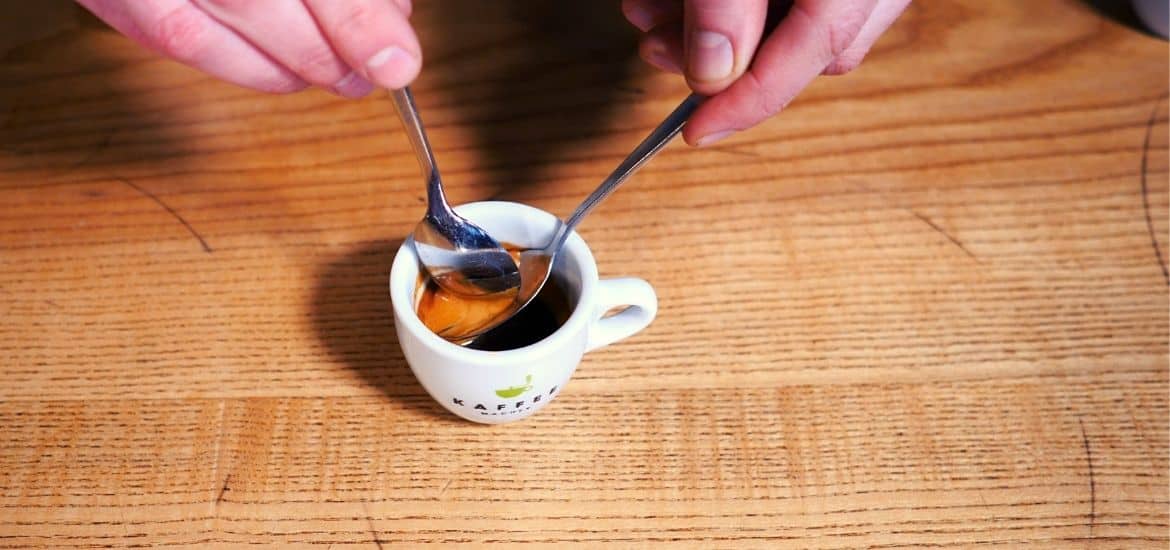
Whether you prefer coffee with or without crema is your decision. Why not try an experiment and extract two espressos. From one cup, remove the crema with two spoons, and with the other, mix it in. The coffees will taste noticeably different.
So. Crema kind of belongs to it, especially for visual reasons, because we've internalized this espresso drink so visually.
More crema is not better, and no crema doesn't necessarily mean the coffee is bad.

