



























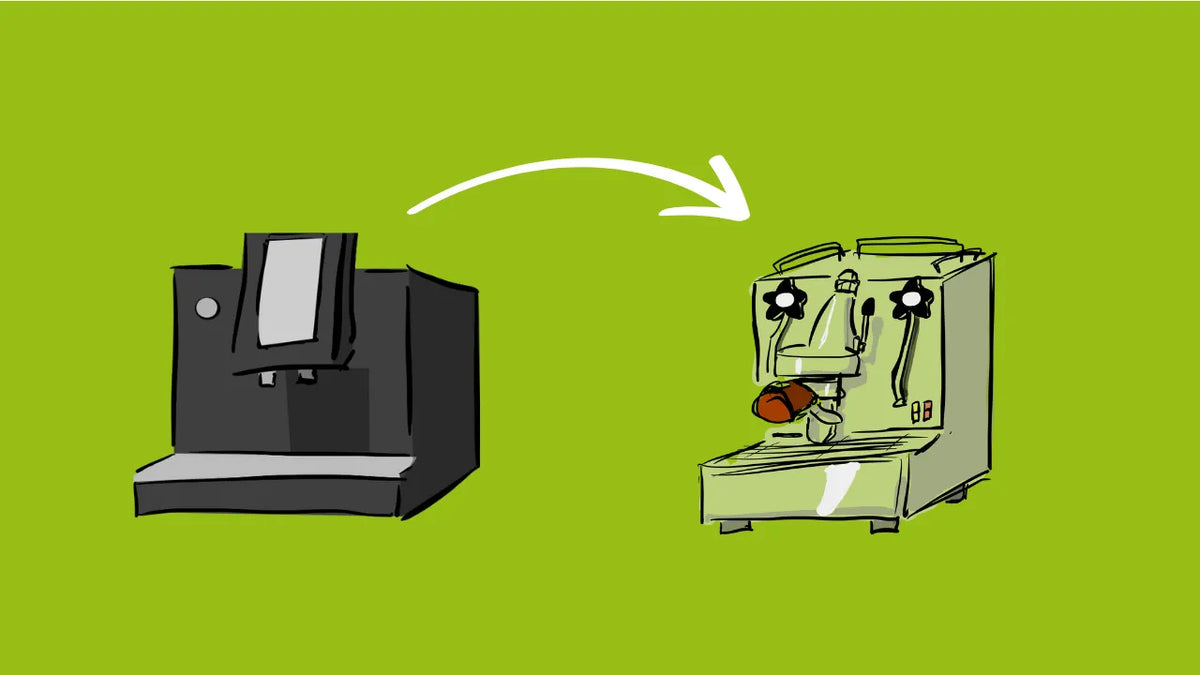

Automatic espresso machine or portafilter machine: a question that almost everyone who drinks espresso seriously eventually asks themselves. Maybe you already have an automatic machine at home. Maybe you're wondering whether the step to an espresso machine is really worth it. And most importantly: is the effort worth it?
One thing up front: We're not against automatic coffee machines. The automatic machine absolutely has its place, in certain situations, for certain people. But when it comes to espresso quality, there's a clear difference. And that can be explained.
In this article, we'll look at both systems honestly: their real strengths and their real weaknesses.
Portafilter vs. automatic espresso machine: the direct comparison
Before diving into details, here's the quick overview. Both systems have real strengths and real weaknesses.
| Criterion | Portafilter | Automatic espresso machine |
|---|---|---|
| Espresso quality | Very good (full control over extraction) | Good, around 70–75 % achievable |
| Lungo / Coffee cream | Good (with adjusted grind or Americano) | Very good (actual strength area) |
| Milk foam | Very good, learning curve required | Ok – good, consistent without practice |
| Grinder | Freely selectable, your choice | Built-in, often a compromise |
| Effort per cup | 3–5 minutes, craftsmanship required | Button press, quick done |
| Cleaning | Visible and done in minutes | Automatic prompts, internally difficult to access |
Why does espresso from the portafilter taste better?
When we prepare coffee, we extract everything from ground coffee that together with the brewing water makes up our espresso. This process is called extraction. The more uniformly the coffee grounds are ground and the more uniformly the brewing water flows through the coffee, the better the result tastes.
With the portafilter, we see exactly what happens: We distribute the coffee in the basket, tamp it evenly, and lock it in. The brewing water hits a uniformly distributed, controlled coffee puck. With the automatic espresso machine (technically: piston espresso machine), the opposite happens.
The freshly ground coffee falls into the brewing chamber and forms an uneven landscape of hills with air pockets and craters there. The piston presses everything together. The water finds the path of least resistance and shoots through the gaps.
The result: over-extracted coffee tastes bitter, under-extracted coffee tastes sour. Both happen simultaneously in the same cup. What's missing is the density, the creaminess, what we call texture and body. That's particularly noticeable when you drink both side by side.
Add to that the grinder. Many automatic machines have cheap conical grinders built in. With the automatic machine, you can't choose your grinder yourself. With the portafilter, you can. And good grinders are available for little money.
Old coffee in the machine: the problem with retention
In most automatic espresso machines, there's a so-called retention area between the grinder and brewing chamber: a pathway where already-ground coffee sits before it's even brewed. Modern machines have improved this, but often one or two portions of pre-ground coffee still sit on this pathway.
Freshly ground coffee loses most of its finest volatile aromas within minutes. In the humid, warm environment of the machine, this accelerates. The old coffee contributes to an unclean, bitter taste. The coffee oils begin to oxidize, and in some cases even a slightly rancid note develops.
With espresso grinders for portafilter machines, the industry has done a lot in recent years to minimize the retention area.
Always discard the first pull of the day or use it for a milk coffee: This empties the retention area and you'll have significantly better quality on the second shot. The same applies after longer idle times.
What really happens in the automatic machine
Coffee powder in the retention area. Moisture. Heat from the brewing group. That sounds like cleaning effort. And it is. But a large part of the stubborn dirt doesn't sit where the automatic cleaning programs target.
The automatic machine is a closed system. No automatic program really removes the oil residue from the deep passages between grinder and brewing group. Moisture and coffee residue: the perfect breeding ground for everything that makes coffee unappealing over time.
With the portafilter, everything is open. You see the dirt immediately, which creates the impression that you have to constantly clean. But: The daily wipe-down takes under a minute. The deep cleaning every two to three weeks is done in five minutes.
For whom is the automatic espresso machine still the right choice?
That's the question we don't answer in most portafilter articles. But it's just as important.
If you mainly drink long coffees (coffee cream, lungo, drinks with a strength between filter coffee and espresso), then the automatic machine really plays to its strengths. In a direct comparison at the same investment, the automatic machine makes a really good showing in long coffee. We've measured and tasted it ourselves: The coffee cream from a properly set automatic machine is very good. Balanced, creamy, with nice strength.
If milk drinks are the focus, the automatic milk frother is a real argument. The quality that a well-set automatic machine delivers from the nozzle takes hours of practice to achieve with the portafilter. If you make cappuccino and latte daily and don't want to deal with milk frothing technique, you'll do well with the automatic.
If you don't want to learn the craft (and that's a completely legitimate position), then the automatic machine is the more honest choice. The portafilter requires you to learn: adjust grind, find your brew recipe, read extraction. That's fun if you want it. If you don't, you won't be happy with it.
If you drink espresso alone and only need a single shot, the automatic machine has a structural advantage: it's optimized for short, individual pulls. With the portafilter, we basically brew with the double basket: two portions simultaneously give better extraction. For individuals who want a quick espresso every morning, that's unnecessarily complex.
With a properly set automatic machine and a matching coffee, for example El Botón, which was specifically developed for automatic machines, you can make really good coffee. We estimate the potential at about 70–75 % of what's possible with the portafilter. For long drinks and milk coffee, the gap is significantly smaller.
How to make espresso with the portafilter?
Still sounds too complicated? Let's take a quick look.
If you're coming from an automatic machine: Start with a ratio of 1:2.5 to 1:3. Example: 18 g ground coffee → 45–54 g espresso in 25–28 seconds. The result is less concentrated than a classic espresso, but close to what you're used to.
Learn all about espresso preparation in a step-by-step guide.
The portafilter tastes different: brew ratio and concentration
Anyone drinking espresso from a portafilter for the first time, after years with an automatic, will stumble. That's normal.
Espresso from the portafilter typically contains 7–9 % dissolved coffee particles. In private automatic machines, it's often only 3–5 %. That sounds like a small difference. It's not. Add to that many automatic machines are set by default to a higher water volume: 8 g coffee quickly becomes 35–40 g espresso there. With the portafilter, 8 g typically becomes 16–20 g, so significantly more concentrated.
The result is a denser, creamier coffee with more texture. Flavor literally explodes. That can be overwhelming if you're not familiar with it.
Our tip: Work your way in slowly. 1:4 as a starting point is absolutely legitimate: you'll still feel the difference in body and uniformity of extraction.
Lungo or Americano?
If you like long coffees, you have two routes with the portafilter. With lungo and café crema, the brew ratio is expanded to 1:6 to 1:10: from 10 g coffee you get 60–100 g coffee. The grind needs to be adjusted accordingly.
The more elegant option for long coffees is the Americano: 70–80 g hot water in the cup, then pull a double espresso directly over it. The result is a balanced long coffee with nice crema, without having to adjust the grind.
The grinder decides
The grinder is at least as important as the espresso machine. That sounds like a side note. But it's not. It's one of the decisive differences between portafilter and automatic machine: With the portafilter, you choose your grinder yourself.
Especially in the lower price range, it makes sense to spend about as much on the grinder as on the machine itself. A good starter setup:
DeLonghi Dedica with a DF54, Varia VS3, or Emil EM1
Don't buy a system where machine and grinder are permanently connected. Otherwise you're back to being tied to a built-in grinder, just like with the automatic. The grinder quality is the compromise. If you're still considering a machine with an integrated grinder, you'll find an honest assessment in our article on portafilter machines with grinders.
Cleaning the espresso machine
The short answer: It's done faster than you think. After that, you'll see that the machine is really clean.
Daily (under a minute):
Every two to three weeks:
All details on properly cleaning the espresso machine, including descaling and deep cleaning of the brewing group, are in our comprehensive cleaning article for espresso machines.
The smart portafilter machine
Still too complex? There are now espresso machines that want to close exactly this gap between portafilter and automatic.
The Maro espresso machine guides you step by step through extraction in beginner mode. If the espresso runs too fast, it automatically reduces pressure and flow rate. After the pull, you assess the result together with the machine, and it tells you how to adjust your grinder.
The Ligre espresso machine offers similar support. Particularly exciting: the matching grinder is a grind-by-weight grinder that automatically weighs the right amount of coffee each time.
The machine from nunc is slowly gaining market presence and goes even further: grinder and machine communicate directly. If the espresso runs too fast, the grind adjusts automatically.
The latest grinder from Mahlkönig, the Mahlkönig E64 WS, also aims in the same direction and offers guided grinding. It adjusts the grind when espresso extraction was too fast or slow and gives you the right amount thanks to integrated scales.
These machines make getting started easier. But they're not necessary. What initially seems complicated becomes easy after just a few pulls.
Frequently asked questions
Is a portafilter machine really better than an automatic espresso machine?
For espresso: yes, clearly. The portafilter allows controlled, uniform extraction that's structurally difficult to achieve with an automatic. For long coffees and milk drinks, the gap is much smaller. A properly set automatic makes really good coffee here.
How much time do I need daily for the portafilter?
For preparing a double espresso about 3–5 minutes, cleaning included. The machine needs a heat-up time, which depending on the model is between 3 minutes and 45 minutes. Modern entry-level machines are often ready in under a minute, as they signal. But definitely let hot water run through the still-cold portafilter first. With a timer, in the morning you can get even "slow" machines up to temperature on time.
Can I also make long coffee with the portafilter?
Yes, either as lungo/café crema (brew ratio 1:6 to 1:10, coarser grind) or as Americano (70–80 ml hot water in the cup, double espresso over it). The Americano is actually one of the best long coffees you can make.
Do I really need a separate grinder?
Yes. Without a good grinder, no good espresso: that applies to the portafilter too. The grinder is at least as important as the machine. In the entry segment, we recommend spending about as much on the grinder as on the machine. Please don't fall for double-walled baskets as an alternative to the grinder. Better stick with the automatic then!
Which coffee is suitable for the automatic espresso machine?
Medium to somewhat darker roasts with clear balance: not too light, not too complex. The automatic brews at a slightly lower temperature than a portafilter, which with very light roasts can lead to sour extraction. We've developed El Botón, a coffee specifically designed for automatic machines: robust body, wide temperature window, works both as espresso and as coffee cream. Many of our customers also appreciate Apas or Compadre.
Is switching from an automatic to a portafilter worth it?
If espresso quality matters to you and you're keen to learn a bit of craftsmanship: absolutely. If you mainly drink milk coffees or long coffees and just want something quick in the morning, you should honestly weigh whether the extra effort fits your lifestyle.
Conclusion
Portafilter or automatic espresso machine? The honest answer: It depends on what you want from it.
For espresso, the portafilter makes a clearly measurable difference. The uniform extraction, the free choice of grinder, full control over brew ratio and grind: that simply can't be replicated structurally. If you really want good espresso, there's hardly any way around the portafilter.
For long coffees and milk drinks, the automatic is stronger than many think. A well-set automatic with the right

