



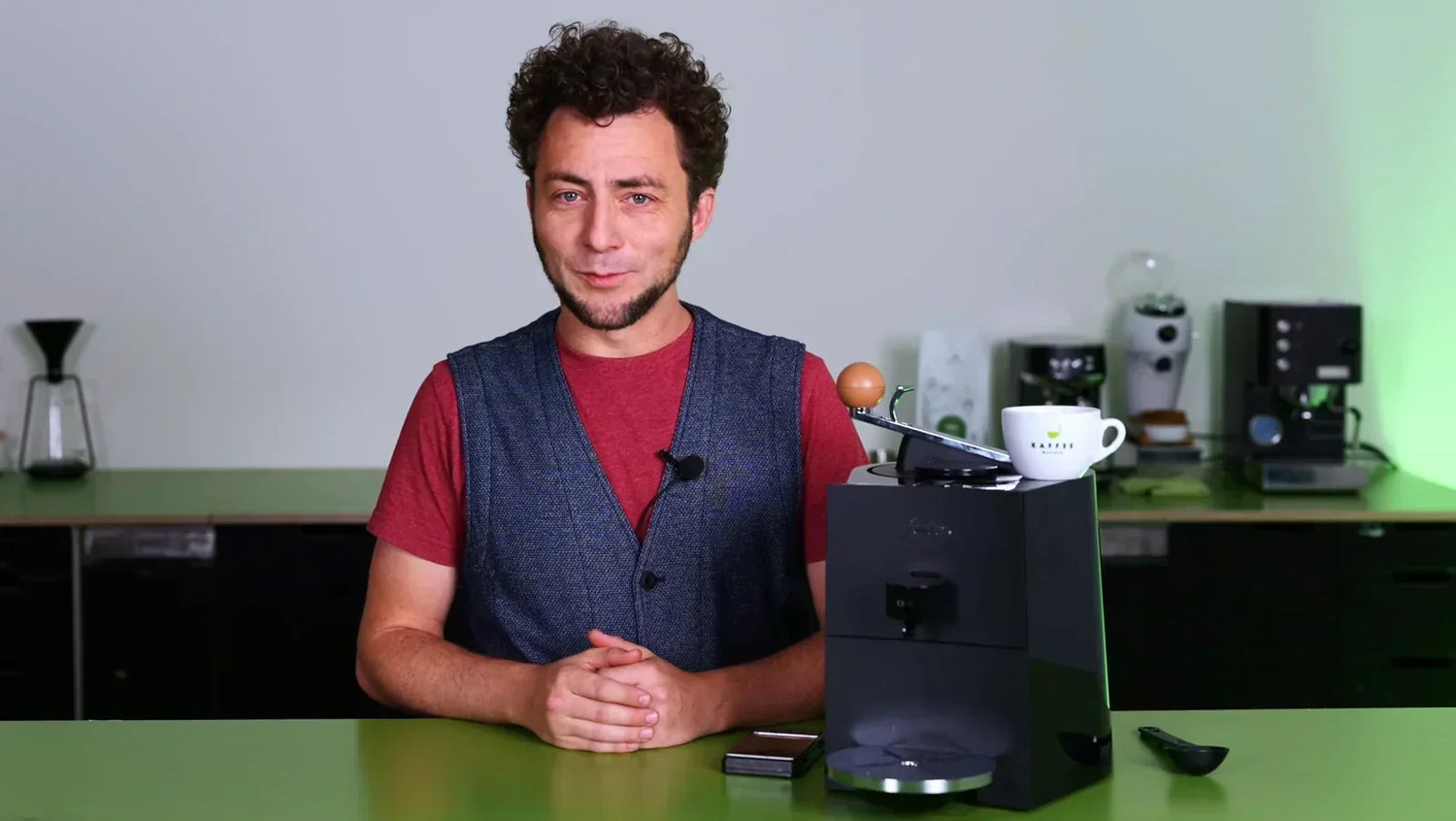

A Jura coffee machine has entered the market. However, the question arose whether it has also enriched it. Opinions on this were divided, and there was much discussion. We tested the Ono and identified both strengths and weaknesses. But let's start from the beginning.
As always, we purchased the Jura Ono ourselves. The test was not requested by Jura, and the manufacturer had no insight into our results before publication.
What kind of coffee machine is the Jura Ono?
Jura is known for its fully automatic coffee machines, which belong to the class of portafilter coffee machines. In these machines, a brewing group catches the ground coffee powder and an injection piston compresses the coffee. Then brewing water is pressed through the group. The term "fully automatic" refers to the grinder integrated in the coffee machine: the coffee is ground directly into an ejection chute or into the brewing group.
Exactly this automation is missing in the Jura Ono, however. The Ono deliberately forgoes the built-in grinder. Instead, externally ground coffee powder is added directly to the chute, compressed with a rotary lever, and then the brewing process is initiated.
The Jura Ono is thus a portafilter coffee machine without a built-in grinder. This is unusual not only for Jura. But what prompted the Swiss manufacturer from Niederbuchsiten to bring such a coffee machine to market? We explain exactly where the Ono sits between the types in the comparison of portafilter and fully automatic coffee machines.
Barista moments and capsule alternative
Jura positions this machine in an interesting area of tension. On the one hand, the advertising slogan "One cup, no capsule" promises an alternative to capsule coffee. On the other hand, the Jura Ono wants to create "conscious barista moments." Capsule coffee and barista attitude seem at first glance to be incompatibly far apart. But on closer inspection, Jura is moving away from the fully automatic machine with the Ono and taking a step in both directions.
Over the years, we have come to appreciate the capsule machine as a bridge coffee machine. This may sound strange at first, but there is a specific reason for it. Capsule coffee has made it visible and perceptible to many coffee drinkers for the first time that there are strong sensory differences between coffee varieties.
The color-differentiated capsules have brought visual variety into the coffee game in offices and kitchens, portionwise from orange to black, from Italian espresso blend to Ethiopian single origin. No espresso machine and no fully automatic could do that as effortlessly as the capsule.
The capsule became a transitional coffee machine to the portafilter. Once someone had recognized the variety of coffee, they wanted to unlock its full potential. This led to the next step toward the portafilter.
A few years ago, you could exchange capsule coffee machines with us for home barista courses. A fairly successful campaign.

Jura Ono: the halfway barista path
The Jura Ono presents itself as a halfway to the portafilter. It requires an external grinder. Pre-ground coffee would also work, but then we would rather recommend staying with capsule coffee. With a decent espresso grinder, ideally even a single-dosing grinder, the Jura Ono opens up interesting possibilities.
A single-dosing grinder grinds individual portions and has little retention, meaning little residue from old coffee powder. You weigh out the desired amount beforehand and grind it to the exact grind setting. Such a grinder is the perfect partner for the Jura Ono.
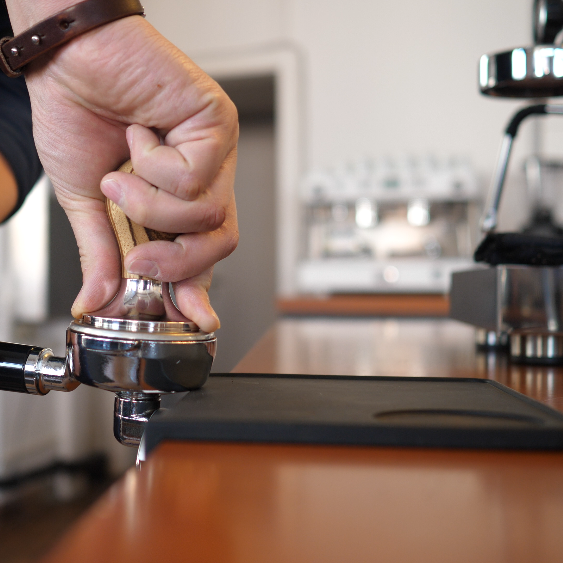
This interaction makes working with the Ono a pleasure. Grind coffee, extract coffee, switch to decaffeinated coffee and back again. Wonderful! Were it not for the problem that the espresso doesn't taste particularly good. In fact, the halfway barista path stops at the wrong point. Weighing and direct contact with the ground coffee is nice. But the most important thing in preparing good espresso starts after choosing the right grind: the even distribution of the ground coffee in the portafilter and the subsequent tamping.
The main problem with the Jura Ono: channeling through the rotary tamper
That's exactly what the Jura Ono doesn't do well. It doesn't do it well, like all fully automatic coffee machines with piston brewing groups. The ground coffee sits awkwardly in the grinding chute and has numerous irregularities. The Ono's rotary tamper gives us the feeling that we're tamping, but it doesn't prepare the ground coffee properly. This causes us to compress the irregularities and provoke strong channeling, which affects the taste of the later extraction.

How does the coffee from the Jura Ono taste?
Channeling is a formation of channels where the brewing water takes the path of least resistance and flows through channels in the ground coffee instead of extracting evenly. This is exactly the problem that occurs in almost all fully automatic machines, and the reason is inadequate distribution and compression of the ground coffee. And this is exactly the problem that also occurs with the Jura Ono.
Now we could say: fine, all fully automatic coffee machines share this. But if Jura promises barista moments, I wonder why the barista shouldn't be allowed to do exactly what he can do better than the fully automatic machine.
But how does it actually taste? The espresso from Jura is not good. It is difficult to measure the temperature of fully automatic coffee machines precisely. We placed a probe in the ground coffee and, from the interaction of water and coffee powder, obtained an average measured value of 84 degrees Celsius. According to our assessment, the brewing temperature is within the target range.
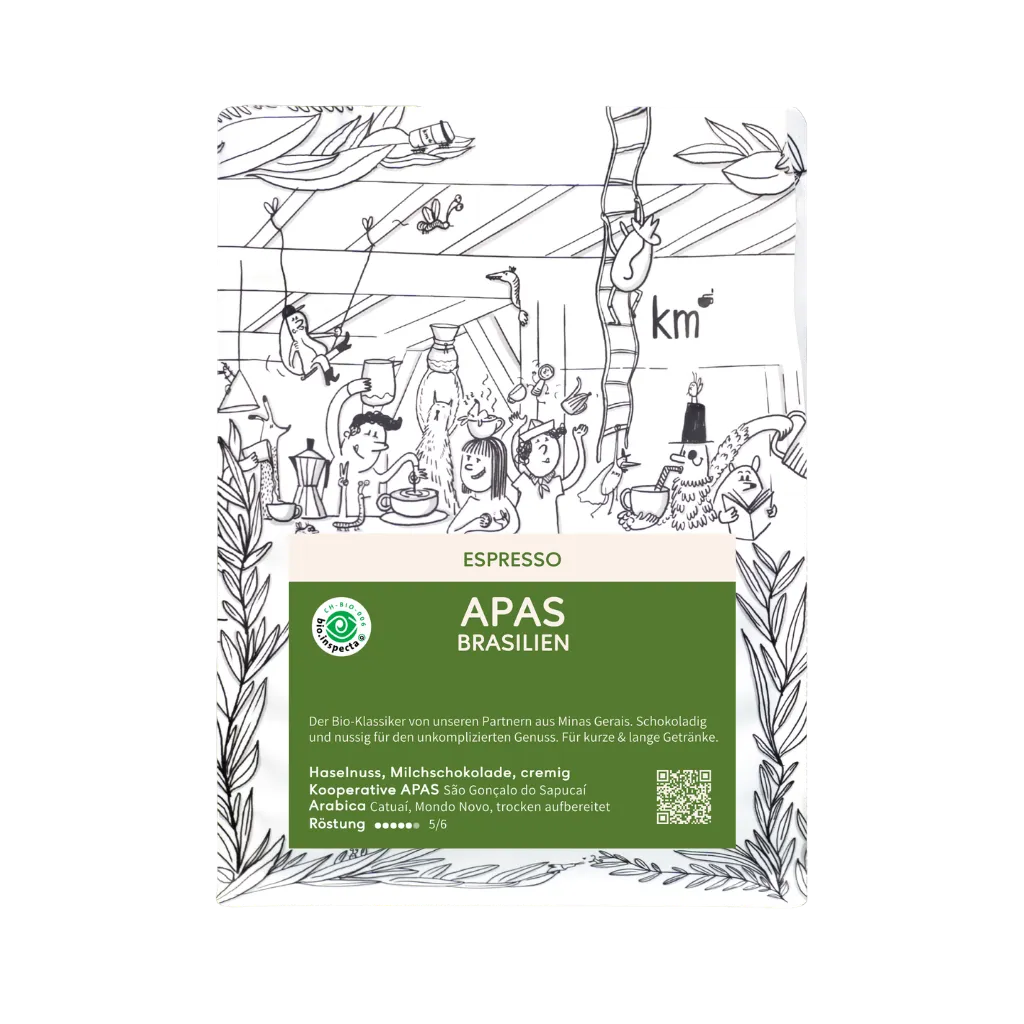
In the blind tasting, the Apas espresso, a dry-processed coffee from Brazil, performed well. The espresso cannot keep up in comparison with espresso machines like the Delonghi Dedica or the Gaggia Classic. How the two and all other devices we tested perform is shown in our overview of espresso machine tests.
With longer drinks, such as café crème, the Jura delivered better results on average in the blind tasting than the portafilter espresso machines. This is not surprising, as portafilter espresso machines don't have their strength here and, moreover, the use of a larger amount of water means that channeling is less pronounced.
What was striking was that all drinks in the cup were not very hot. However, this seems to be due less to the brewing temperature than to the long path of the brewed coffee from the brewing group to the cup. The coffee cools noticeably here, as Arne Preuss also found in the Coffeeness test.
Cleaning the Jura Ono: the best thing about this machine
I'm open to all types of coffee machines and work professionally as well as necessarily privately with all models. I have one main problem with fully automatic machines: they are often not clean. Even if elaborate automatic cleaning functions are present, the truth is also on the field. And there it is unfortunately often moldy, rancid, stale, damp and full of spores.
Not so with the Jura Ono. Of course we still have to clean it ourselves, but it's so easy. A turn of the rotary handle, pull to the 12 o'clock position and the Jura Ono is open and ready to be cleaned in the most important places. I like that!
Facts and price
We saw the Jura Ono in Switzerland at prices between 320 and 350 francs. In Germany and Austria, it cost roughly the same in euros. That's a lot of money for a plastic piston coffee machine without a grinder. We'll talk in the conclusion about who this investment could still make sense for.
| Feature | Jura Ono |
|---|---|
| Model designation | ONO Coffee Black, Item 15505 (EU) or 15506 (CH) |
| Design type | Piston brewing group without built-in grinder, thermoblock |
| Housing material | matte plastic |
| Colors and designs | Black |
| Display | Touchscreen |
| Water tank | 0.95 l |
| Minimum outlet height | 10.5 cm |
| Drinks at the push of a button | Coffee, espresso, quantities programmable |
| Weight | 4.75 kg |
| Dimensions (H × W × D) | 32.0 × 24.3 × 46.1 cm |
| Energy consumption espresso | 0.0115 kWh |
| Energy consumption lungo | 0.009 kWh |
| Price at time of test | approximately 320 to 350 CHF or EUR |
| Price today | approximately 144 EUR / approximately 309 CHF |
Prices including VAT. Price at time of test: own market observation June 2023. Price today: cheapest offers according to Geizhals and Toppreise, as of August 2026.
Exceptionally low energy consumption
Outstanding is the low energy consumption of the small built-in thermoblock. Here the Jura Ono could compete with the best in the industry, namely capsule coffee machines. Only the water necessary for brewing is heated. So when preparing a lungo we consume 0.009 kWh and when preparing an espresso just 0.0115 kWh. That was record-breaking.

Where you can buy the Jura Ono
The Ono continues to be sold, both through Jura itself and through specialty retailers and major online retailers. Price-wise, things have changed since our test: in Switzerland it's at around 309 francs, roughly at the level from back then, but in Germany you can now get it from around 144 euros. We have not sold espresso machines ourselves for years so we can test them independently.
If you get the Ono, you'll need a grinder and coffee to go with the machine. You'll find our roasts for fully automatic and piston machines in the coffee selection for fully automatic machines.
Conclusion on the Jura Ono: who is it suitable for?
I see a clear use case for the Jura Ono. It is particularly recommended for coffee lovers who enjoy longer coffee drinks such as Schümli, lungo, café crème or extended coffee. If a good coffee grinder is already available, the Jura Ono could be an interesting option. The longer coffees taste excellent, and the ability to switch coffee without having to remove beans from the fully automatic machine's bean hopper is a big plus.
As for the price: at the time of the test, the Ono was expensive for what it offered. In Germany this has since shifted; there it now costs only about half, and thus the calculation is much more favorable. In Switzerland, our assessment at the time continues to apply.
I also appreciate the separation of grinder and machine from a hygiene perspective. Many fully automatic coffee machines resemble wetlands inside with pronounced mold growth. Old and new coffee powder, spores and the traces of time tend to lead their own life in piston coffee machines. This is not the case with the Jura Ono. In addition to separating the grinder and machine, the simple cleaning of the machine makes it possible to avoid mold growth. With one turn and one movement we reach the coffee chute and brewing group. This is practically revolutionary for Jura, which usually does everything to prevent customers from reaching the inside of their machine.
However, the Jura Ono is less suitable for those who really prefer espresso or want to experience "barista moments." What the Jura Ono doesn't allow us to do, namely distributing and tamping with a tamper, is not complicated, is fun, offers these barista moments and guarantees better espresso than the Jura Ono.
Through the ability to choose the coffee amount yourself and define the brewing ratio, the Jura Ono does, however, build a bridge between fully automatic and portafilter machines. That makes sense, brings joy and allows you to experiment with different brewing recipes.
The energy consumption of the Jura Ono is outstandingly low, since only the water necessary for brewing is heated. This sets the machine apart from all machines with boilers.
A machine for the talkative
I see yet another use case for the Jura Ono. The machine stands out from all categories, enables manual preparation steps, offers room for choosing the coffee and defining the drink. It's not a capsule coffee machine and not a fully automatic either, but rather an approach to the espresso machine. I can imagine this machine standing in a kitchen with a passionate hostess or an aspiring home barista talking about coffee, praising the machine's advantages and celebrating hospitality.
The Jura Ono could also be an interesting coffee machine for anyone who appreciates certain automation advantages while still wanting to stand out from the masses of coffee machines through a different type of machine. The Jura Ono concept has no equivalent in the market and is unlikely to achieve major market penetration as a machine type. That's why the machine will remain a splash of color in kitchens and living rooms like no other machine provides. It offers an interesting alternative for those looking for something special and wanting to stand out from the norm.
As always, we purchased this machine ourselves as well. This test was not requested by Jura.