





The Fiorenzato Allground Sense Plus is the revised version of a grinder that we know well by now. We tested the version without a scale (without Sense in the name), the model that was sold as Sense until June 2025, as well as the Plus version and thus the newest version of the grinder.
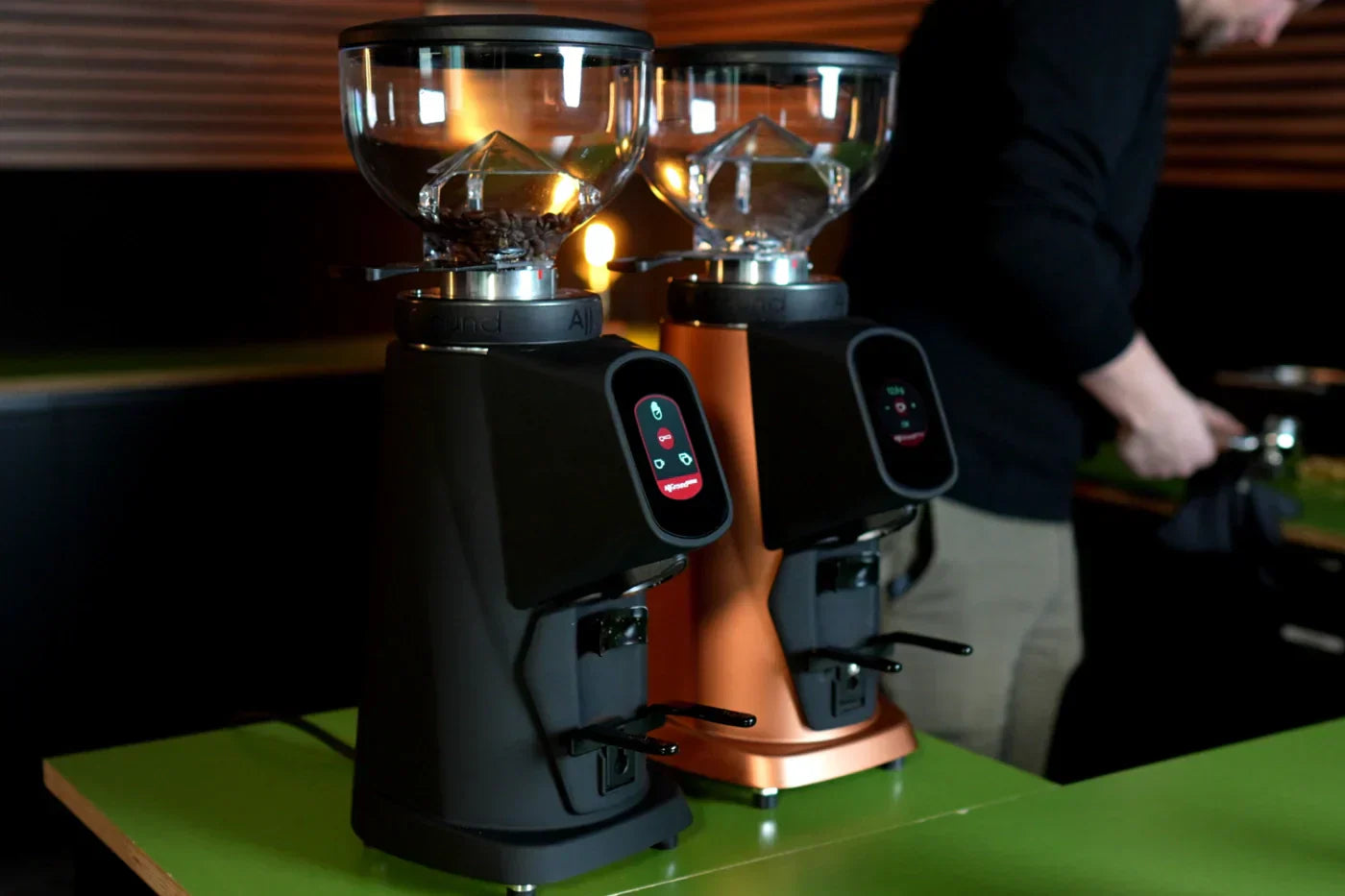
The Allground Sense Plus is a hopper grinder with integrated scale, so-called Grind by Weight, and 64-mm flat burrs. It costs just under 850 euros at Stoll Espresso and around 900 francs in Switzerland, positioning itself in the upscale home segment. We bought the grinder ourselves, as always—multiple times, I might say. The difference from its predecessor: a new display, better integrated, oval-shaped, and a gentle software update. Technically—grinding mechanism, chamber, flapper—the Plus version is identical to the old version without Plus. This means: the strengths remain. The weaknesses too. The changes are so marginal that some dealers don't even advertise the new grinder as a "Plus" version. However, the Plus version from June 2025 has completely replaced the previous version. If you have the version that was launched before June 2025—don't worry. From our perspective, there are no quality-relevant differences.
Design & Construction
At 9 kg and 44 cm tall, the Allground Sense Plus sits massively on the counter. Metal housing, high-quality construction, no wobble, no cheap gaps. The portafilter attachment fits well: in, solid, reliable. The new display is an aesthetic step forward compared to the previous version. It adopts the basic shape of the physical display and now mirrors it as an oval display. The IPS panel can now be viewed more easily from different angles and has clearer color reproduction.
A concrete software update is worth mentioning: Portions can now be programmed up to 50 g—the previous model limited single portions to 12 g. Not a game-changer, but anyone who wants to experiment with larger portions or filter coffee now has more room to play.
The optical grind setting grid is even coarser than the grinder's actual steps. This is a genuine weakness of the grinder and it's hardly understandable why Fiorenzato hasn't improved this easily fixable display since the original Allground was released. The red vertical line is as wide as 1.5 dots on the grid, and the dots themselves are already quite wide. They correspond with the grinder's grind steps. Since there's no numerical scale, you need to count the dots when adjusting the grinder if you want to return to a specific grind setting.

The community has found solutions—marking stickers, 3D-printed indicators, homemade scales. The fact that users are searching 3D printing platforms for solutions that the manufacturer hasn't provided in five years doesn't speak well for the manufacturer's willingness to improve.
Cleaning accessibility is exemplary. Access to the grinding chamber without tools, brush out, done. Three seconds and you're in. This is a reference and should serve as a model for other manufacturers. We rate the grinder's cleaning capability only as light green because the grind setting unfortunately needs to be adjusted—it doesn't automatically return to the old setting after cleaning the grinder. However, how quickly you can get to the heart of the grinder—the grinding chamber—is sensational.

Buy Fiorenzato Allground Sense Plus
Germany: Stoll Espresso, Bohnendealer, Lücke Technik
Switzerland: Adrianos
Austria: Bohnendealer
We recommend specialist partners who we know provide good work and reliable service. When ordering through our commission links, you don't pay more, but we receive a small amount of support—we invest it directly in new testing equipment.
Grinding Mechanism & Technology
The heart of the Allground Sense Plus: 64-mm flat burrs, fixed at 1,600 rpm. There's no RPM control. The grinder is designed for hopper operation with integrated scale, so-called Single Dosing is technically possible, but not its core promise.
The grind adjustment works with steps. A wheel with notches runs over a metal pin when adjusting, which physically fixes the positioning and provides an acoustic signal. Without the pin, the grind adjustment would work continuously. With the pin, there's the possibility of positioning the grind between the notch and the bump of the grid. This requires some finesse.
If you stay in the notches, we measured extraction time jumps of three to four seconds. This means, conversely, that it's hardly possible to set the grind cleanly within the steps. If you stay between the clicks, you trick the grinder and come much closer to the goal of grind adjustment.
The criticism of the manufacturer remains. If you always grind the same coffee and find your setting once, you'll get along well. If you frequently switch between roasts or actively work with the grind, you'll get frustrated—unless you aim for the in-between areas of the steps.

Grinding Speed & Noise Level
8 seconds for 18 g—that's fast, more than sufficient for home use. In 10 seconds of continuous grinding, 23.8 g comes out of the grinder. These are numbers with which you can happily serve multiple guests in a row. The speed is one reason why we can see the grinder very well in small-scale commercial use.
The noise level is 84.1 dB(A)—measured at 20 cm distance. This is the upper limit of what we classify as "medium": noticeable, but not a constant problem. Even in tone, no sharp whistling and no struggling motor. It's a high noise level of the more elegant kind. Eight seconds of operation—then silence.
Grinding Temperature & Consistency
The grinding temperature starts at 29.6 °C and rises to 32.0 °C after five consecutive grinds. No thermal problem, even with multiple extractions in a row.
And now for consistency. The standard deviation over 10 grinds is 0.067 g. The individual output values look like this, for example: 17.9 – 18 – 17.9 – 18 – 18 – 18 – 17.9 grams. The GbW system does what it promises: the set amount comes out, grind after grind, even with changing coffees, without the grinder needing to "break in" first. If 17.9 grams is dispensed once, that's within the limit range of the counter-checking grinder. No measurement errors, no recognition problems with the portafilter, no outliers.
With Grind-by-Weight grinders, an important quality feature is whether they can handle vibrations from the work surface. In the early days of grinders of this type, we once had a grinder on a table that would always stop when a streetcar passed by the house.
The Fiorenzato Allground Sense shows slightly different behavior in both versions we have. The Plus model stops with stronger vibrations of the grinder and continues grinding when there are no more vibrations. The model through June grinds through, shows different values during vibrations, but corrects itself once the vibrations end. If they don't last longer, both grinder versions reach their goal cleanly.
Retention
The retention is 7.1 g absolute—of which 6.6 g temporary, 0.5 g permanent. This hasn't changed with the Plus version. Grinding chamber, flapper, drive—everything is identical. And 6.6 g of temporary retention is too much. That remains our assessment.
But we want to say more clearly why—and for whom it's relevant.
The first problem is well-known: If you grind in the morning and come back to the machine in the evening, you'll pull 6.6 g of coffee through the next shot that has been sitting ground in the chamber for hours. With a double espresso, that's a third of the portion. The first espresso after a long break is familiar to many from the forums: watery, flat, strange. This explains it.
The second problem is less obvious—and for a GbW grinder it's actually the bigger one: Retention sabotages the adjustment. If you change the grind setting and pull the next shot immediately, you're still working with a third of the old grind. You adjust the setting, pull the next espresso, evaluate it—and adjust finer. But a third of the portion is again the previous grind. You're chasing a result you can never see cleanly as long as you don't explicitly empty the chamber. For beginners who want to learn with the GbW system and bought the grinder precisely for this reason, this is a real limitation.
What this means in practice: Always empty the chamber when you change the grind. We program the 1 button for 6 grams and consistently grind out 6 grams after every grind adjustment.
If you drink multiple espressos daily, you barely notice retention because the ground powder rarely sits long in the chamber.
Grind Setting Replicability
In the adjustment test—Espresso (T4), Ristretto (T5), Lungo (T6), Return to Espresso (T7)—the Allground Sense Plus shows a clear strength: the x50 value deviates between starting point (262.3 µm) and return (273.2 µm) by around 11 µm. For a stepped grinder, that's good. The mechanism engages precisely—if you find your point and come back, you land there again.
The paradox remains: Replicability works. Finding the ideal point between two clicks—that's the challenge.

Particle Distribution
We analyze particle distribution in cooperation with ZHAW using the Retsch Camsizer X2.
Espresso Setting (T4):
x50: 262.3 µm – Fines (Qf <100 µm): 31.8% – 60% Peak Width: 177.7 µm
A fines content of 31.8% is high: more body, more density, higher extraction resistance in the puck. A higher fines value is typical for inferior grinders or very good ones with a narrow main peak—as is the case with the Fiorenzato Allground Sense. The main peak at 177.7 µm is narrow. Very narrow. This means despite high fines content, consistent, structured extraction.
The grinder grinds precisely—and you feel that in the cup. What this adds up to: The Allground Sense Plus is not a specialist for one roasting style. It's a grinder that reaches out in both directions—from light-roasted specialty coffees (like those from our Purple Line) to classically developed espressos of Italian character like the Compadre.
Tasting
In blind tasting with the Apas Espresso (18 g in, 42 g out, 25 seconds), the Allground Sense Plus shows a clear signature: lots of sweetness, soft texture, beautiful body. The aftertaste is long and present—cocoa notes that linger unusually long. A light stone fruit component was also recognizable, which rarely comes through so clearly with this coffee.
This matches the PSD finding: high fines content, tight peak, body-focused cup with structured extraction. For specialty coffees and more classic roasts, a very solid combination.
A note for everyday use: You don't need a WDT tool for this grinder. The grounds distribute well on their own in the portafilter—with 18 g and centered insertion, there's hardly reason to complain.
Conclusion
The Fiorenzato Allground Sense Plus is a very good grinder. That's the key message—and we should have worked that out more clearly in the first test video.
It has two weaknesses that the manufacturer hasn't fixed for years. You can work around one of them yourself through modification. You can deal with another (grind setting), and if you grind a lot of coffee or grind in between, the third one won't be noticeable (retention). Unless you're buying expensive coffees...
Both are unnecessary. The grind setting slip-up is inexcusable for the price, and we hope Fiorenzato provides a real update—not from the community side.
Strengths:
Exceptionally precise, reliable GbW system—consistent results grind after grind. Excellent particle distribution: high fines content, narrow peak, structured extraction. Good grind setting replicability thanks to stepped mechanism. Tool-free cleaning, accessible in seconds—reference class. Robust, high-quality construction.
Weaknesses:
7.1 g absolute retention, of which 6.6 g temporary—unchanged from the previous version. Problem number one for anyone who rarely grinds. Problem number two for anyone who wants to learn with the GbW system. Grind adjustment too coarse: three to six seconds extraction time difference between two clicks, no number marking. The manufacturer hasn't done their homework.
For whom?
Anyone who grinds daily, gets a fixed coffee, and finds their setting once carefully and then leaves it alone. Anyone looking for a reliable GbW system that delivers the same amount grind after grind. Anyone who values clean, accessible cleaning. And anyone who wants a robust, high-quality grinder that convinces in the cup and is fairly priced.
Insider tip for small commercial use? Think about it. We'll take a closer look at the grinder for this purpose. The speed speaks for it. Retention is forgivable when lots of coffee is flowing—and how practical adjusting between steps is in everyday commercial use, we'll test.
For whom not?
Anyone who frequently switches between roasts and works precisely with the grind will suffer from the coarse increments. But a single-dose grinder is the better choice anyway. Anyone who drinks only one to two espressos a day and has long breaks between grinds will notice temporary retention in the cup. With 6.6 g retention, always empty the chamber before judging a grind adjustment.
Price-to-Performance:
Just under 900 euros for an excellent GbW system, excellent particle distribution, exemplary cleaning, and robust construction—that's very fair. The fact that retention and grind setting remain unchanged for years is not a purchase deterrent, but a missed opportunity. The potential is there. If Fiorenzato addresses these two points, it's a grinder without serious competitors in this class.
How the Allground Sense Plus stacks up against other GbW grinders, we show in our Grind-by-Weight comparison.

Technical Specifications at a Glance
| Property | Value |
|---|---|
| Price | 1,099 EUR / 950 CHF (RRP). Currently approx. 850 euros / 900 CHF |
| Burr Size | 64 mm |
| Burr Type | Flat |
| Operating Mode | Hopper (GbW) |
| Grinding Speed | 23.8 g / 10 Sec (Hopper) / 8.0 Sec for 18 g |
| Noise Level | 84.1 dB(A) |
| Grinding Temperature | 29.6–32.0 °C (first to last sample) |
| Retention Absolute | 7.1 g (of which 6.6 g temporary, 0.5 g permanent) |
| Consistency (Std. Dev.) | 0.11 g |
| x50 (Espresso Setting) | 262.3 µm |
| Fines Qf <100 µm | 31.8% |
| 60% Peak Width | 177.7 µm |
| RPM Control | No (fixed at 1,600 rpm) |
| Weight | 9.0 kg |
| Bean Hopper | 500 g |
| Grind Setting | Stepped (click stops, no number marking) |
| Special Features | GbW integrated, tool-free cleaning |