







There is no rulebook for Direct Trade, nor a testing authority. There is also no definition that two roasters would have to agree on. Yet the term appears on thousands of coffee packages, and nobody asks what direct trade actually means. Rather, it's a feeling that provides good cover. What we need is precision, otherwise the good principles will be lost.
Direct Trade refers to the direct purchase of raw coffee from producers without anonymous intermediary trading stages. The term emerged in the early 2000s among some US roasters in response to a world market price of 41 US cents per pound. To this day, there is no seal, certification body, or binding definition. Each roaster decides for itself what it means by the term, but nobody checks whether it's true.
"Is your coffee actually Direct Trade?"
The question came up in one of my roasting classes. "Your coffee is definitely Direct Trade, right?" I answered the way I've been answering for years: in convoluted layers, with qualifications, with lots of ifs and buts. My answer wasn't very satisfying for my conversation partner.
"Well," I usually say, "there's no definition of exactly how direct 'direct' has to be."
Today, when someone picks up a coffee package, they encounter terms like Relationship Coffee, Farm Direct, Ethical Sourcing, Direct Trade, fairer than Fairtrade, or all of them at once. Each of these terms sounds like proximity, but none of them says anything as long as there's no number or concrete facts behind them. Relationship Coffee means little if nobody takes a risk. Farm Direct conceals the fact that there are almost always multiple actors between farm and roastery; someone does logistics, someone does insurance, someone does financing, someone stores the coffee. Ethical Sourcing remains a feeling without concrete, measurable criteria.
Ask a handful of roasters what direct trade entails. You'll get longer or shorter answers. But no two will be the same.
Where Direct Trade came from and what the term once meant
September 2001. The coffee price falls to 41 US cents per pound, the lowest real value in a hundred years. Smallholder farmers can no longer service their debts, farms are abandoned.
In response to this situation, a few US roasters argued that quality could be a way out. Intelligentsia, Counter Culture, Stumptown. They traveled to farms, donated cupping courses so that producers could learn how their own coffee tasted, and tied prices to taste and quality instead of to the stock exchange. Intelligentsia set itself a standard: at least 25 percent above the Fairtrade minimum price, and completely transparent about it. Stumptown made a rule that a coffee could only be called Direct Trade after three consecutive years.
Why there was never a rulebook for direct trade
There was no audit, no paperwork, and no certification body. The idea of self-regulation prevailed. Three companies defined for themselves what they meant, and talked to each other about it—that was all. Today it's not a handful of roasters anymore, but thousands worldwide. Self-regulation remained, but nobody monitors each other anymore.
Directly traded coffee is not the same as Direct Trade
Lennart Clerkx founded This Side Up in 2013 in the Netherlands. He actually just wanted to organize dialogue between producers and roasters, but transport turned out to be the bottleneck, so mediation became importing. Today they buy coffee themselves, bear the risk, and pre-finance roasters.
For Lennart, the central question isn't who knows whom, but where the power lies. Whoever has the capital to execute the trade has the power. And the moment a middleman exists, dependency is created.
This leads to a distinction that hardly anyone in the industry makes.
What Lennart calls direct-washing
When This Side Up buys coffee directly from the producer, that's Direct Trade. When a roaster subsequently buys that coffee from This Side Up, they have acquired directly traded coffee. But they haven't engaged in direct trade themselves. They're retelling someone else's relationship work as their own.
This isn't semantic hairsplitting. Either someone buys on my behalf, or I do it myself. Lennart calls it the most common abuse he sees, and he explains why it bothers him: whoever claims others' work as their own undercuts precisely the roasters who do that work themselves.
Why we don't call ourselves Direct Trade, even though we could
We buy from algrano, This Side Up, Falcon, Plot Coffee, Ensambles and others. We've pre-financed coffees. We've also imported ourselves, complete with export documents, even though we're not logistics experts. By common definitions, some of our coffees would qualify as Direct Trade. We just don't say so because we're free riders on most of our coffees: others organize the logistics, storage, and we only pay when we pick up the raw coffee.
You can read where and how much coffee we buy in our transparency report.

Raw coffee is bagged for export in Ocotal, Nicaragua. Our bags don't have a label, but they have precise origin information.
Is there a Direct Trade seal?
No. There's no certification body, no logo, no testing standard, and from everything I hear, there won't be one.
Andreas Felsen, whom everyone calls Pingo, co-founded Quijote Coffee in Hamburg in 2010 and is one of Germany's pioneers of direct trade. I asked him whether a Direct Trade certification body could ever come about. His answer was a clear no, because, as Pingo says: roasters who've been living this culture for years have already earned their credibility. A third-party seal wouldn't be a marketing tool for them, but rather a negative image transfer. For the same reason, Quijote deliberately forgoes the organic and Fairtrade seals.
A shared rulebook fails for him even earlier. In the industry, interests are too far apart, particularly in how the term itself is used.
Why many don't mind Fairtrade and don't mind Direct Trade either?
There are doctoral theses, consumer magazines, newspaper features, entire websites full of criticism of Fairtrade. Rightly so—that belongs with a system that makes promises.
I asked Pingo whether he knew of a single consumer magazine that had critically examined Direct Trade. He knows none from Europe. From the US he knows forums, but apparently Direct Trade is questioned much more critically in Japan than it is here.
What's funny is that the explanation is quite simple; Fairtrade has a seal. A seal is a promise, a promise is verifiable, and the verifiable can be broken. Direct Trade promises nothing verifiable, so there's nothing to break.
Whoever makes no promise can't break their word.
That's the semantic black market we've set up for ourselves. I can write that I trade ethically, and nobody corrects me. I can write that this coffee is fairer than Fairtrade, and nobody corrects me.
Are middlemen in coffee trading really the problem?
In almost every story about direct trade, the middleman is the figure to be eliminated. Often they're called Coyotes, and whoever gets that name receives no sympathy.
Some are. Whoever merely holds out a palm, provides no added value, and creates dependency is a bad deal that can be avoided.
Others understand microeconomies. They handle local logistics, they pay cash when nobody else is buying. There are door-closers, and there are door-openers.
You can see what that looks like with Yulma Argueta. She didn't start growing coffee in Baja Verapaz, Guatemala until she was forty, and sold her first harvests locally without knowing how good her coffee actually was. We were able to export with her for the first time in 2025. So she wouldn't be dependent on us, we connected her with multiple exporters. Now she exports twice as much as she did last year.
Lennart said in conversation that so much of how coffee trading is set up today is based on colonialism. For those who want to learn more about coffee and colonialism, I recommend this podcast with Christian Cwik from the University of Graz.

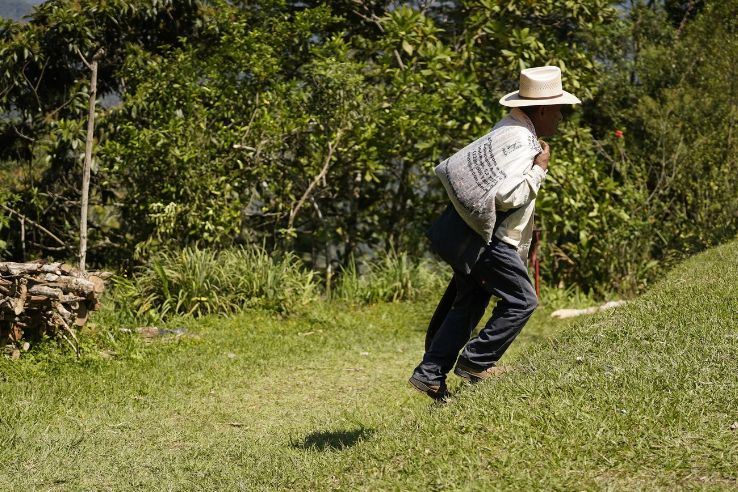
The coffee chain is long. Before coffee lands in a cup, it passes through many hands. Here on a farm in the Sierra de Zongolica, Mexico.
How you recognize real Direct Trade: five questions for every roaster
Because there's no rulebook for direct coffee trading, I created one. Not an official one, but one derived from what people say who take it seriously. Here are five questions that should be answered on every roaster's website.
We applied the test to ourselves. So are the Kaffeemacher Direct Trade roasters?
Question 1: partially passed. Most of our coffees do come through importers, but the relationship is between us and producers. Often importers like algrano then handle pre-financing, logistics, and storage. But we also regularly buy coffees from importers who offer us coffee from producers we don't know.
Question 2: so-so. Our average relationship duration is 4.52 years, which sounds solid. Only 37 percent of our partnerships have been running for three years or longer. By Stumptown's own standard, nearly two-thirds of our coffees wouldn't be allowed to bear the name "direct trade" since Stumptown only speaks of long-term relationships after three years.
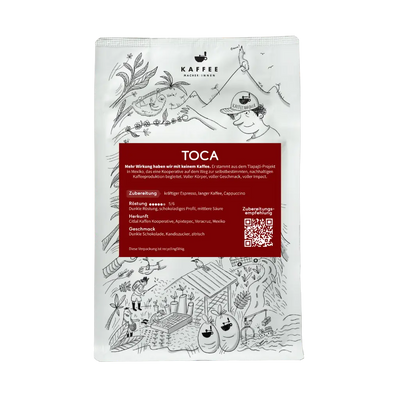
Question 3: partially passed. We managed Finca Santa Rita in Nicaragua ourselves from 2017 to 2025. Through a co-investment by buyers, we became partners on the Toca project in the Sierra de Zongolica. With most other coffees, someone else bears the risk.
Question 4: passed. We've been publishing our raw coffee prices since 2020. In 2025/26, our average FOB price was 5.76 USD per pound unweighted and 4.81 USD weighted, across 129,110 kilograms and 43 producers in 16 countries.
Question 5: failed. But: we develop criteria case by case, because every coffee partnership is different.
By this five-point test, we wouldn't be a Direct Trade roastery, and that's what we say everywhere. But we describe what we do, and if someone interprets that as direct trade, they're welcome to. How we work, what matters to us, how we build and maintain relationships, develop visions together with producers—we describe all that in our transparency report.
Does coffee become better through Direct Trade?
Not automatically. Pingo drew a clear distinction. Where Quijote is really on the ground, in Honduras, where Steffi travels two or three times a year, and in Ecuador, where he regularly goes, quality has developed together over the years. And in the two high-price years when many producers were selling their coffee expensively anyway and didn't deliver particularly loyally, Quijote still got its usual qualities. It's not automatic though, he says himself. It takes commitment, constant exchange, and the roastery has to speak up if something doesn't work.
Behind this lies an assertion that I think is the weakest in the whole field: that higher quality leads to higher income. Higher sale prices, yes. But high quality costs vastly more work, and who actually decides what good quality is?
For years there was a score sheet that the whole world calibrated to. The whole world? Most producers still don't know how their coffee tastes. And this sheet comes across as neutral but is full of subjective judgments. When a final score decides whether a coffee gets bought, the argument doesn't hold.

Very few producers know how their coffee tastes. We roasted the Romão family's Compadre coffee in Castelo, Brazil, and brought it back to them.
Direct Trade was an answer to 41 cents per pound of raw coffee. Today we're at many times that
Here's the blind spot of the whole debate for me. The founding logic of direct trade was an answer to a market in crisis. Because the exchange didn't deliver, quality was supposed to be a second way, at least for the few producers who had the luck, social, or cultural capital to get in touch with quality-oriented roasters in the first place. Intelligentsia's 25 percent above the Fairtrade minimum was formulated in a world where that minimum actually mattered.
On February 12, 2025, Arabica was at over 442 US cents per pound, an all-time high, more than five times the long-term average. By early June 2026, it was well over 250. In eighteen months, the C-Price swung between 270 and 440.
In such a market, producers in Brazil, Mexico, India, and Indonesia prefer to sell domestically rather than for export, because quick cash flows locally. They hold coffee back and influence prices themselves. They've figured out how speculation works.
What do they need a roaster for who visits once a year? I don't have a ready answer for that. I just think we're failing them unless we justify Direct Trade with arguments beyond 2001.
What this says about coffee trading
To be fair: something has changed, and at a place hardly anyone's paying attention to. Pingo says the Transparent Trade network has developed a kind of definitional power within the industry. Roasters approached importers and asked how much of their money actually reaches the producers. Demand for transparency rose significantly, though it came from roasters, not consumers.
As long as transparency is asked for from the back, it works. Once it's sold to the front, it gets fuzzy. Pingo calls it low-hanging fruit, and he's right: it takes little effort to know where your coffee comes from.
What the EUDR changes
When traceability becomes legally mandatory, a term that voluntarily promises it loses its value as a unique selling point. What remains as a distinctive feature is the question of price and risk. But those are exactly the points Direct Trade never regulated binding.
Let's call direct what deserves to be called direct
Lennart is currently working on making himself unnecessary. This Side Up no longer just supports roasters toward direct trade, but also producers. In Colombia, a partnership with his local partner has been running for eight years, and he now handles all the sales himself. The next step is setting up his own import company in the Netherlands. Lennart could keep this relationship, but he's spinning it out.
I find that as brilliant as it is admirable, and it shows where this could go.
We're currently examining what role regulations can play that producers set for themselves. Participatory guarantee systems work from the bottom up, they adapt to local conditions, and they don't need a certification authority in Europe. Whether that works, we don't know yet.
Conclusion
There won't be a Direct Trade bible. The particular interests are too great. But what there can be are declarations of intent that cost something. And discussions that sharpen the term instead of further softening it.
Test a few roasters who claim Direct Trade with the five questions suggested. That way we all gain clarity on where more precision is needed and where the wheat separates from the chaff.
Frequently asked questions about Direct Trade coffee
What does Direct Trade mean for coffee?
The direct purchase of raw coffee from producers or cooperatives without anonymous intermediary trading stages. The term emerged in the early 2000s among US roasters like Intelligentsia, Counter Culture, and Stumptown. No binding definition exists; each roaster decides for itself what it means.
Is there a Direct Trade seal?
No. There is no unified and official Direct Trade logo, no certification body, and no testing standard for direct trade. Unlike with Fairtrade or organic, nobody checks whether the claim is true. Whoever uses the term defines the criteria themselves.
Is Direct Trade better than Fairtrade?
Fair coffee trading comes from the same reasoning as direct coffee trading—that coffee prices are repeatedly too low. But the two systems solve different problems. Fairtrade secures a floor with a minimum price and is externally audited. Direct Trade targets quality, relationships, and higher prices, but is non-binding and unchecked.
What does Direct Trade mean for taste?
Does coffee become better through direct trade? No, not automatically. Regular, honest exchange between roaster and producer can improve the quality and taste of directly traded coffee over years if both sides invest. Direct purchasing alone doesn't achieve that.
What is direct-washing?
The term comes from Lennart Clerkx and describes roasters who buy directly traded coffee from an importer and present that importer's relationship work as their own. The coffee was directly traded, but the roaster didn't engage in direct trade themselves.
How can I recognize real Direct Trade?
By verifiable information: Who built the relationship, how long has it existed, who bears the financial risk, is an FOB price given, and are the roaster's criteria published somewhere?
Transcript of Podcast Episode 86 expand
DIRECT TRADE — WHO BENEFITS FROM DIRECT TRADING?
Kaffeemacher Podcast, edited transcript
======================================================================
› For reading along
This is the transcript of this podcast episode, edited and cleaned of filler words. The spoken cadence is preserved. The English original quotes from Lennart Clerkx and César Marín are in the original language.
I'm asked again and again whether our coffee is Direct Trade. My answer has always been layered and multifaceted. And I notice that it disappoints my conversation partner a bit. The way we communicate and present ourselves, isn't that already Direct Trade? Yes, I usually say, there's no precise definition of exactly how direct Direct really is.
That's when it becomes clear in such a conversation that this term has become highly charged and deeply imprecise, indeed misused. Ask a handful of roasters and coffee drinkers what direct trade entails. The answers will be shorter or longer, but never the same. A common denominator might be that direct trade is based on acquaintance between producers and roasters. Okay, I'd then say, but what is your acquaintance? A shared photo on Instagram? A wave from a distance, a handshake, herding pigs together, or having lived through crises together?
Direct Trade is unfortunately not quick to answer. Especially not when everyone has a different idea of it. So in this podcast I'm searching for the original meaning, for the rulebook, today's interpretation, the claims, and especially the question of who Direct Trade actually benefits and who it doesn't.
This is the Kaffeemacher Podcast. I'm Philipp Schallberger, welcome.
LET'S START WITH PRICE
------------------------
Direct Trade is basically also about the question of whether the money you as consumers pay and the money roasters pay actually reaches where it's intended. So it's about money and prices. We have to start there.
The coffee price today, in April 2026, is around 280 to 300 cents per pound. It's risen significantly over the past year and a half and is now down somewhat. But let's look back. In the 1980s, the coffee price was around 130 cents per pound. In September 2001, it fell during the so-called Coffee Crisis to 41 US cents per pound. That was the lowest real value in a hundred years and the result of price falls over four years.
What happened? Vietnam invested in rapid, large-scale intense production of Robusta in the nineties. Brazil also made quick advances in how much coffee could be harvested and processed. This resulted around the turn of the century in a massive drop in prices. 41 cents per pound. The price fell because oversupply was too great. Real production costs aren't reflected in the commodity price; they're obviously much higher. This led to job losses, poverty, and rural exodus. Smallholder farmers couldn't service their debts and had to abandon or sell their farms.
This crisis triggered an intensive debate about fair trade and the need for diversification in coffee production. Fairtrade, which everyone knows today, set a minimum price in 1988—a floor for protection. From 1988 to 2007, the Fairtrade minimum price was 176 cents per pound. So whoever could sell through Fairtrade channels during the 2001 coffee crisis had downside protection. According to various studies, however, only 13 percent of Fairtrade-certified coffee actually managed to be sold at Fairtrade terms. Demand collapsed because for many roasters it was clear: if cheap coffee exists, why pay for it? Just because it's Fairtrade?
THE BIRTH OF DIRECT TRADE
----------------------------------
That was the birth of Direct Trade. There were a few roasters in the US who wanted to buy and roast high-quality specialty coffees. The argument was that for the first time there was reason to invest in quality. Because when prices are that low, quality can be a path for producers with the necessary social capital to address a different market.
Among these pioneering roasters were Intelligentsia, Counter Culture, and Stumptown Coffee. These roasters personally went to farms and built relationships. There were others who did the same, and there were others who did it earlier. But these three communicated loudly and clearly about their intentions.
There was no audit. There was no paperwork. There was no certification body. The roasters argued that regular purchasing creates a relationship. Stumptown made its own rule that a coffee could only be called Direct Trade after three consecutive years. You had to know each other. So the pioneers of direct trade traveled to coffee countries. From the US it's quick to Central America, so it's no surprise that the first Direct Trade relationships were all Central American producers.
The core idea was to link quality and direct contact. Cupping, meaning quality evaluation through tasting, became the key to quality understanding. Many Direct Trade pioneers donated cupping courses so producers could learn the quality of their coffee. Price was tied to quality by these roasters, not to the commodity exchange. Intelligentsia early set its own benchmark, saying it would buy at least 25 percent above the Fairtrade minimum price and be completely transparent about it.
You see: through Fairtrade there was downside protection in response to the low commodity price. And then there was the idea that quality should be rewarded. That would be upside protection—in quotation marks. It's actually more of a way out, because not everyone could produce really good quality. I'll come back to that. But nothing was certified or controlled. Self-regulation was the idea. These pioneers set their own standards.
When I look at the coffee world today, I don't see just a handful of US roasters anymore, but thousands worldwide who are committed to buying coffee with as few detours as possible—directly from the producer. Some say this is fairer and the coffee becomes better as a result. The problem: who can actually verify this and what exactly can be verified?
To this day there's no universal definition of what Direct Trade is. This means suddenly lots of people do Direct Trade even though they're buying coffee very indirectly. So: what relevance does Direct Trade still have? What's true, what's copied, what's marketing—and who actually benefits from Direct Trade? Might it be that roasters profit from an undefined concept in the end, and producers just take the hit?
I'm trying to be as objective as possible about this topic. But you can already see: it's really multilayered. We roast coffee ourselves and we avoid Direct Trade in our communication. Even though I'd say much of what we do would qualify as Direct Trade by common definitions.
THE VOCABULARY OF PROXIMITY
----------------------
Straight from the farm. Relationship Coffee. Fairer than Fairtrade. Whoever picks up a coffee package these days probably encounters one of these terms or all three at once. Direct trade belongs to the basic vocabulary of the specialty industry. And that's exactly the problem. Because what is actually being communicated as direct today?
It's an incomplete list of terms that say much but actually nothing if they're not backed by numbers. Relationship Coffee sounds human but means nothing if there's no price and risk assumption behind it. Farm Direct obscures the fact that there are usually multiple actors between farm and roastery. Because someone has to do logistics. Someone has to handle insurance and financing. And someone might even be a warehouse operator. Ethical Sourcing sounds really good, but without criteria it's not a concept, it's a feeling. Transparency, on the other hand, is a term used very frequently. It has meaning if it's backed by numbers and not just mentioned as a term.
You see the central pattern: it's about suggesting proximity. But often responsibility is simply avoided with transparent information.
WHO HAS THE POWER?
------------------
I spoke with Lennart Clerkx from This Side Up, a Dutch raw coffee importer. Lennart founded it in 2013. His idea was that direct dialogue between producers and roasters would improve coffee quality, create fair treatment, and ultimately deliver competitive products. He also saw the bottleneck: transport. It's expensive when you buy small quantities. So This Side Up became an importer even though they didn't initially want to. They now buy coffee themselves, bear the risk, and help roasters with financing. Whoever buys coffee from This Side Up is buying directly traded coffee, says Lennart.
› Lennart Clerkx, This Side Up (Amsterdam)
"The definition is hard. Whether somebody does the transport, or whether somebody owns the relationship – all of that, I think, is secondary to who has the power in the relationship. Any middleman, however much freedom and however much transparency they give: because they have the financial means to execute the trade, they hold the power in the end. So you create dependency the moment there is a middleman there. Direct trade is when that power is dispersed between the roaster and the grower equally, when they become dependent on each other for each other's success.
That is actually the reason I started This Side Up as a direct trade facilitator: being a development economist, power was the most interesting aspect I saw. That's the problem in the industry. We can talk about living income and fair trade and all this crap, but in the end – who is allowing more money to go to origin? Who, by the grace of their goodness and good deeds, is allowing a bit more money to go there? There is nobody willing to give up power in the industry, and that is why direct trade is so important."
So for Lennart it's about power distribution. Who has the power in the coffee chain? And he talks about the middleman, a figure that many stories try to eliminate. But that's too simplistic and unfortunately goes unquestioned. The common refrain is: middlemen are bad, so you have to work directly with producers. But who can actually work truly directly with producers so it's worth it for them? And are middlemen always bad?
It's like this: if a link in the chain only holds out an empty palm, provides no added value, and creates dependency, then it's certainly a bad deal. You could do without that kind of middleman, if you could make it work. But often these middlemen simply fill a gap, and they understand microeconomies. They might handle local logistics or buy coffee in cash, providing quick money when nobody else would buy. Or they can be damaging. These middlemen are often called Coyotes—and by being named pejoratively, they can hardly receive sympathy. Sure, there are door-closers. But others might be door-openers. And there are roasters glad when someone fills the gap somewhere in the chain.
Lennart says in that context that they understand themselves as "The Good Middleman" at This Side Up because they take risk and pre-finance roasters. So I asked him further what in his eyes wouldn't qualify as Direct Trade.
› Lennart Clerkx, This Side Up
"I have a kind of split opinion. The obvious answer would be: if there is any kind of middleman there. But what qualifies as a middleman can get quite grey, because the work that we do and the work a roaster does is very similar in its execution. When a farmer and a roaster completely own the relationship and have all the communication, agree all the prices together, and they rely on a third party to finance them and to execute the trade in an equal partnership – that is a healthy situation. But I'm not sure whether it's direct trade. In my very strictest definition, even that would not be direct trade, because of the dependency that the financial middleman creates.
So in an ideal world, direct trade would have a capital source to execute the trade that is regenerative, one where the power of the capital is shared between all the parties, between both ends of the value chain. And that hardly exists today. In my more easy-going definition I would say: if you do not own the relationship, if somebody else is doing the hard work of maintaining that relationship and you are basically just copy-pasting their work and saying 'this is direct trade' – that is the most common abuse that we see. That is also how a lot of people abuse the work of This Side Up. Because yes, we trade directly with them, and what we do together is something to be proud of. But then to use the term direct trade for it…"
So if a roastery buys directly traded coffee from Lennart at six euros and then says "We as a roastery do Direct Trade," the term gets diluted. Yes, the coffee is Direct Trade when This Side Up buys from producers, according to Lennart. But when a roastery then buys that directly traded coffee onward, it's a coffee that was previously directly traded. The roastery bought a directly traded coffee, but it didn't conduct direct trade itself.
This isn't a trifle or semantic hairsplitting—it's a completely different scenario. You're more of a free rider here. Not that that's good or bad. It's just different. Either someone buys for me or I do it all myself. From the perspective of the early-2000s visionaries, a roastery buying coffee via This Side Up wouldn't be a Direct Trade roastery. But do you know what so many say? That they do exactly that and that they are exactly that.
› Lennart Clerkx, This Side Up
"There are many people who show it as direct trade, which I disagree with, because basically they showcase the work that we do. Them being proud of buying that coffee because of all the work that is done in the partnership between This Side Up and the grower – that is fantastic, that makes everyone proud. But then to go one step ahead and call it direct trade means you are undercutting all the roasters who are doing that work. And that is what is so special about direct trade. That's also where we see the frustration of roasters who are doing this work and really involving themselves intimately in the reality of the producer, and then seeing that people are basically copy-pasting the good middleman's messages."
And that happens because there's no strict definition and no measurable comparisons, let alone a ruleset they could jointly rely on.
I know a few roasteries that really do Direct Trade the way Lennart would define it. There's Quijote in Hamburg. There's Muyu from Locarno, they import coffee from Bolivia. There are brokers and a few others who do it all themselves: select the coffee themselves, import it themselves, finance it themselves, year after year after year. These roasteries are very close to the ideal communicated in the early 2000s. Other roasteries then buy from the Direct Trade roasteries and adapt the model.
I asked Lennart whether Direct Trade is an advantage for him and for the work with This Side Up.
› Lennart Clerkx, This Side Up
"There could be, if you look at it from a monetary perspective, because some larger companies might use us to direct-wash their coffees. But in the end it doesn't benefit us at all, because we exist to facilitate direct trade. Our top ten roasters, if you look at it year on year, they switch all the time, because we help people move towards direct trade. That's why we exist, that's the objective of our company. People showing our work and calling it direct trade – it might sell. It's a good question. I don't know whether it actually sells, or whether it's the pride that sells. So they should stay away from the term if it is not true. But then again, we have not been very vocal about what is and isn't direct trade. We just showcase what we do. We're not in the term-defining business, as it were."
Two things about that. First: that's where I see myself and where I see us as Kaffeemacher. We avoid using Direct Trade. But we tell what we do. There are times when we pre-finance coffees early. We've also imported coffee ourselves, meaning we did all the export paperwork, even though we're not logistics experts. But as a rule we work with importers who practice direct trade, and we buy the directly traded coffee from them. This includes GEPA, Algrano, Quijote, and others. Because we're free riders here, we at least avoid saying that we do Direct Trade ourselves.
Second: Lennart says he's not in the business of defining definitions. And yet we're discussing it here. Again for context: if everyone uses a term that's so fuzzy but at the same time so positively charged and represents a sales and positioning argument, then we need to define it rather than soften it. Because if we keep softening it, the term loses power.
WHAT THE PRODUCER SAYS
---------------------------
The discussion goes in circles if I only ask the processing side of the industry. So I asked a friend and coffee producer in Peru what he thinks about Direct Trade and what this approach brings him. Here's César Marín from Chacra de Dago in Peru.
› César Marín, Chacra de Dago (Villa Rica, Peru)
"Direct trade to me is not only about selling coffee without intermediaries, but about building a real relationship between producer and roasters. At the end of the day it's about speaking honestly about quality, price, climate, harvest, logistics and the many challenges that stay invisible behind the cup. In my case I travel often to Europe, because we believe the producer also needs to show a new face. We cannot only send the coffee and wait for feedback. We need to be present, explain our reality, understand the language of the roasters, have market knowledge and create trust and communication. In the end it is a relationship that we can build with time, transparency and mutual responsibility."
That's good, right? Honest exchange. Trust. Responsibility. Things that matter to him deeply. I just ask myself: isn't that simply a good approach to understanding and practicing trustworthy entrepreneurship? Being honest, trusting each other, and taking responsibility for the other side are really fundamental things. But apparently it's so far away that we need a name for it.
I then asked César whether Direct Trade is better than other systems—that is, the prevailing systems through which he would normally sell coffee.
› César Marín, Chacra de Dago
"I think it depends on an honest and serious relationship. A direct relationship can be beautiful if both sides are committed. But sometimes other partners also play an important role, especially when they help with financing and contracts and communication. For me it's not about saying direct trade is better than everything else. It's more about asking whether this business model creates more trust, more stability and more value for everyone involved. I think it's better, because it creates more of a human connection. When the relationship is strong, the roaster does not only buy big quantities, but they understand the process, they understand that the coffee they are buying is connected to the farm, to the family, to the territory and to decisions that started long before the coffee arrived at its destination. For producers, direct trade definitely helps us grow. It pushes us to improve quality, to understand the market, to communicate better and to show a more complete version of who we are."
Through exchange and visits we get to know the ideas and challenges of the other side. And that's really interesting. Honestly, I wish every roastery could earn the chance to work so closely with producers that respective wishes can be expressed at the same table and then discussed together as partners how to do it.
So we're dealing with a term that's been floating around for twenty years, maybe even longer. This term can be defined more narrowly, the way Lennart does it, who even speaks of direct-washing when someone buys their directly traded coffee, roasts it, and communicates it as Direct Trade. And we've heard an understanding that's considerably broader: César sees Direct Trade as a different form of trading, but especially of acting—because Direct Trade for him is based on trust, exchange, and honesty.
Maybe sometimes it would help if instead of talking about direct trade, we talked more about direct action. So start doing and just make it happen, and play less with the diverse ideas of consumers that direct always means better. It's really about bringing transparency to coffee trading and evening out power and knowledge asymmetries. The question is just: how do we get there? It'll be hard if we don't have a common language, grammar, and vocabulary.
A SIDE TRIP: WHY THERE IS NO DIRECT TRADE BIBLE
---------------------------------------------------
I'm taking a quick detour here. Warning, there's a break coming. But trust me, I'll come back. Religions.
Religions with a holy book have solved one central problem: canonization. At some point an authority said: that's in here, that's valid now. And deviations are heresy. It's verifiable, it's nameable, it's sanctionable. Whoever cites a holy book cites the same document as everyone else.
And that's something Direct Trade never officially did. There is no Direct Trade bible we can refer to. There are action intentions and visions. Some are more precise, others are more muddled to downright meaningless. Some get more traction because certain traders and roasteries have more trust in the industry. There are meetings and conferences, for example the Coretto in July 2025 in Hamburg, where roasteries like Quijote, Coffee Collective, Flying Roasters, and also GEPA were present. In circles like these, it's clear what Direct Trade means because their philosophy became action so strongly: pre-financing, long-term partnerships, regular visits through thick and thin. They don't even need to discuss it anymore; it's just part of what they do.
For most consumers, though, Direct Trade just sounds good because it suggests proximity, so it apparently doesn't need to be stated precisely. That's why there's this semantic black market. Much is allowed because it's not sanctioned. I can say anything and won't be held accountable. I can say I trade ethically, and nobody corrects me. I can say this coffee is fairer than Fairtrade, and nobody corrects me.
IN CONVERSATION WITH PINGO FELSEN, QUIJOTE COFFEE
--------------------------------------------
So why is it so hard to find a shared rulebook? I asked one of the pioneers of direct coffee trade in Germany: Andreas "Pingo" Felsen from Quijote Coffee.
Pingo: It's particularly difficult to find a shared rulebook for Direct Trade when we have completely different interests in our industry and also completely different interests in how we use this term. That it's possible to find shared content to fill this term is something we've shown, for example in our network, where we've agreed on a shared definition and, so to speak, minimum standards so we can talk about direct trade the way we imagine it together. But then of course there are completely different players in our industry who don't have coffee culture front and center but a profit interest. And that terms are used accordingly so they have maximum effect on public perception regarding coffee sales—nobody's surprised by that.
Philipp: I did some research on that and looked back. The early birds, the ones who really coined these terms, early 2000s. I don't know how many of them today would say that what roasteries do now is really Direct Trade. I think very few of them would qualify in what they said. I mean, they all had their own approaches back then. There wasn't a shared rulebook even then. They were just the first to say: we have an idea about this and we're saying what our company's philosophy is. But even back then there wasn't really a single rulebook. There never really was one.
Pingo: No, there was never a rulebook. Counter Culture and Intelligentsia did define it for themselves and they talked to each other back then. I think Counter Culture still has pretty similar standards as back then. Even though they've become very large, they still uphold the old ideals. Same as what we see here in Europe with Coffee Collective from Copenhagen, probably the pioneer in using the term Direct Trade in Europe. They actually still operate just as seriously in that coffee cultural sense as they did when they first used it.
Philipp: Then there were always events. I think you organized some too, that was in Hamburg, about eight years ago. It was about the Transparent Coffee Guide, about the gathering. That's like a flanking measure: it was about transparency, but with transparency also kind of pushing toward more direct trade. How would you look at that today? Has anything changed in transparency? Was there development?
Pingo: We're quite happy with how transparency has developed. Many coffee roasteries, even many who don't conduct direct trade by our standards, approached importers and classic middlemen and said: look, there's a need here. Transparency is really a thing. We don't want to use transparency only as a marketing slogan in our roastery; we really want to know how much of what we pay you actually reaches the producers. And the Transparent Trade network really gave good impulses, because we actually developed quite good impact—maybe even definitional power within the industry regarding transparency. Because there were really influential coffee roasteries on every continent who said: this here is transparency. For a while that worked directly; demand for transparency really rose. Not from coffee consumers, but from coffee roasteries wanting to know: where does my coffee come from, at least economically?
Philipp: And I find that so interesting. When roasteries want to know from importers how transparent a coffee is and what the chain behind it looks like, it works. I think you have a common denominator then. When it goes the other way, when it's a sales argument, then it gets a bit fuzzier. That's why I'd also say: transparency is really low-hanging fruit. You really don't have to make much effort to know where your own coffee comes from. But when it comes to Direct Trade, that's a different story, which is why it doesn't surprise me that there's so little agreement. I can tell my customers where my coffee comes from: I bought it at Aldi and relabeled it. And I can call that transparency too, right? Or I bought it from a big importer with years of experience. That too. And then I just write "transparent" on my website. And then it's just there. And the word transparent is enough. You don't have to fill it with content; you don't have to justify it. You just write "transparent" on your package or "we guarantee full transparency" and market the coffee. Is that really enough?
Pingo: Yes, it goes unchallenged. But Direct Trade also goes unchallenged, except from within our own industry.
Philipp: Do you know anyone anywhere who's looked at this critically from a consumer angle, like a consumer magazine or something?
Pingo: No, I really don't know that from Europe at all. I know it from the US, from various forums, and I just heard again that it's questioned very critically in Japan. Apparently nobody dares—at least according to travel reports from my colleague Matt who just got back—to use such terms and misuse them a bit, because apparently it's questioned much more critically there than in our consumer culture here in Europe.
Philipp: Do you think there will ever be a certification body for Direct Trade? That would be the next step. But if there were, you'd first need a shared rulebook. Do you think something like that could ever exist?
Pingo: No, I don't believe so. We see coffee roasteries that have been in the market for a long time and go their own way with their sourcing policy. I think all the pioneers of direct trade belong there, and many who've been doing it for a while now. They don't really need this certification at all. It's just another term. Everyone who's been doing this for a while and actually lives this culture has by now earned credibility and doesn't need a third-party seal. Using such a seal might even devalue it. I'd see it the same way as the deliberate choice we make not to use an organic seal or a Fairtrade seal: that the concern could well be justified that using such seals for roasteries like ours would mean more of a negative image transfer than it would be a marketing tool.
THAT LEAVES THE QUESTION OF QUALITY
----------------------------------
What remains is really the question of quality. What Direct Trade can mainly do is break through the anonymity of traditional trade. There are voices saying quality can be higher with Direct Trade because you're in direct exchange with producers. Maybe. But often there's no direct exchange at all, as we've heard.
Direct Trade needs to be compared to classic anonymous trade. Only then do the big breaks appear. There's no anonymity; there's direct exchange with each other. And especially there's no substitution of the coffee because suddenly a name is attached to the product.
But I see another fundamental criticism of the claim that higher quality leads to higher prices. First, sales prices can be higher, yes—but income doesn't rise because of it. Because high quality requires vastly more work. And that's where the dog is buried.
Who actually decides what good quality is? For years there was a score sheet that the whole world calibrated to. The whole world? Most producers still don't know how their coffee tastes. And that's why early Direct Traders were right to teach cupping skills so sellers and buyers could talk about the same impressions. What remains: this score sheet, this well-known evaluation form that associates coffee quality with points, comes across so neutral and yet is full of subjective judgments. When a final score decides whether a coffee gets bought, that's a weak argument that high quality leads to better living conditions. Because that takes more.
Philipp: Is it really the case when you look at it today that the quality is better?
Pingo: That depends entirely on our engagement in the respective countries, what shared progress we've made—together with the coffee producers. We see that in the countries where we're really very active on the ground—that's primarily Honduras, where Steffi travels two to three times a year for us, and a bit also Ecuador, where I go regularly—we can rely on qualities there that we've defined and developed together. In the countries where we're particularly engaged, where we communicate particularly well with each other and have taken shared quality development seriously, we've especially seen in the last two high-price years—when many producers could sell their coffees expensively anyway and didn't deliver particularly loyally—that there was definitely greater stability in our raw coffee supply than with other roasteries. We've been happy and felt confirmed, especially in the last two years, that we got the usual qualities, sometimes even increasingly better qualities, and didn't have to worry there. So I'd definitely sign off on that in the areas where we really seriously took care of it.
Philipp: So the effect of direct exchange can lead to better quality. But it's not automatically given; it's not inherently connected.
Pingo: No, it's absolutely not automatic. We have to be engaged and we really have to conduct this relationship on equal footing, constantly exchange, what's possible. And clearly: we as a roastery have to communicate our needs and take that seriously. If we're not satisfied with what we get, we have to speak up. We just have to deal honestly with each other. That's what direct trade is for: to build a real relationship, to learn to trust each other, and like in any relationship, we speak about things we expect and wish for. And then we have great chances of tending to have rising qualities.
Philipp: How long have you been doing Direct Trade as Quijote Coffee? Since the beginning?
Pingo: We set out from the beginning: to roast exclusively coffees that we buy directly in long-term relationships. We allow ourselves up to five percent of our annual sales for fun stuff that we import from coffee roaster friends. But yes, we take Direct Trade seriously and conduct it throughout so that all our coffees meet our self-defined criteria.
Philipp: How have these criteria that you set for yourselves developed in the last—what did you say—sixteen, seventeen years? You founded in 2010. Have you been at Direct Trade 3.0 since then, or how far are you?
Pingo: We've more or less stayed with our old criteria. We haven't developed them further. However, we have seen that this relationship in direct trade really does require relationship maintenance. We've distanced ourselves from some sources where we noticed: either our trading partners aren't meeting our standards, or we're just not managing to maintain this relationship so that we meet our own standards. In that sense, things have changed now and then. I think we've learned to focus on the coffee origins that really matter to us and to limit ourselves to those. We're a mid-sized roastery with seventeen people; we just can't travel around eight new countries one or two times a year and maintain real relationships. In that sense, what's changed is that we conduct relationships a bit more seriously and a bit more deeply than before.
Philipp: If you look ahead now, in ten years: fundamentally Direct Trade won't change. But do you think something new is coming? Or is it basically what it is, and it's just that more people need to keep their word?
Pingo: We see that many actors keep their word and that many roasteries that have founded recently are doing so for very sincere reasons and often engage very seriously with where their coffee comes from. I think there's somewhat of a renaissance of this coffee culture, that people don't just see coffee as a business model—like I want to open a nail salon or a dog grooming place, or maybe a coffee roastery, what makes the most profit. Maybe not a coffee roastery these difficult years. But in the new foundations we've observed in recent years, some things do make me quite optimistic that direct trade is not dead but continuing to develop somewhat. And particularly coffee roasteries really concentrating on one or two origin countries are increasingly coming to market. There are wonderful qualities, there are absolutely credible concepts.
Direct Trade is here to stay. Because genuine direct trade changes the world in small ways and creates new possibilities. But really only if we communicate precisely and don't appeal to the diffuse feelings of coffee consumers. Because that helps nobody.
DIRECT TRADE 2.0
----------------
To conclude, we flip around the absence of a rulebook. I mean: that's actually great. If we don't have one, then one might still come. Even if Pingo thinks not much more happens. But what if there really could be a Direct Trade 2.0? There have already been many meetings about it. But who would muster the courage in a world of so many roasteries and say: hey, that's our new standard now?
A flanking tool for that might be the Transparent Coffee Guide, where roasteries publish their purchase prices. That's an important step to even be able to talk about prices. But Lennart thinks about Direct Trade considerably further. And maybe what he's saying now is Direct Trade 2.0.
› Lennart Clerkx, This Side Up
"This is evolving into a direct trade incubator. We have incubated a lot of roasting companies to become direct traders, but we have not really incubated producers to do the same. That is what we are working towards this year. We will start in Colombia. We have worked with a producer for the last eight years, and over time he has invited a lot of roasters to the field, they picked coffee together, they developed intimate relationships. Basically, when the coffee comes to Europe it is ninety percent sold, and he does all the selling himself. That's been going on for the last three, four years, and it kind of felt that our relationship was stagnating. So what do we do, what is the next step? That is what you see as the next step in our evolution: a kind of safe space for direct trade to develop, with the capital that we find together and in a community that we develop together.
So it is not necessarily independence – I think direct trade 2.0 is interdependent, where we do not own it, where we have the guts to share the power that we build. We have the relationship, and we gave it to Juan Pablo in Colombia. The next step is also letting the middleman function go: having him set up an actual import entity in the Netherlands, for example. Because in the end, the middleman function we have is a placeholder. If you zoom out, fair enough, we have this position in the middle because we stole it. Colonialism is the basis of all coffee trade, and that power belongs in the hands of the farmers. So yeah, direct trade should be one where the power sits comfortably with the roaster and also the growers."
So Lennart is working on building relationships so strong that he can then step back out. He could say he keeps everything in the company, but he's spinning out the relationships he's built. And I find that as brilliant as it is admirable.
CONCLUSION
-----
The whole debate about Direct Trade is more important than ever. Because if we stop questioning what we exactly mean, we end up in cacophony that really doesn't help anyone and through which meaning is lost.
I also don't believe there will be a universal Direct Trade bible. The differences and particular interests of all roasteries are too great. Declarations of intent from specific groups of roasters and importers exist and there will be more. And that's good. Because every discussion that takes place sharpens the picture of Direct Trade and helps roasteries and importers handle such a highly charged term more carefully—a term that's existed for good 25 years and been interpreted so diversely that I find it remarkable that it still exists at all.
But because it does exist, we all have to care for it and really call direct what deserves to be called direct.
We'll talk soon.