












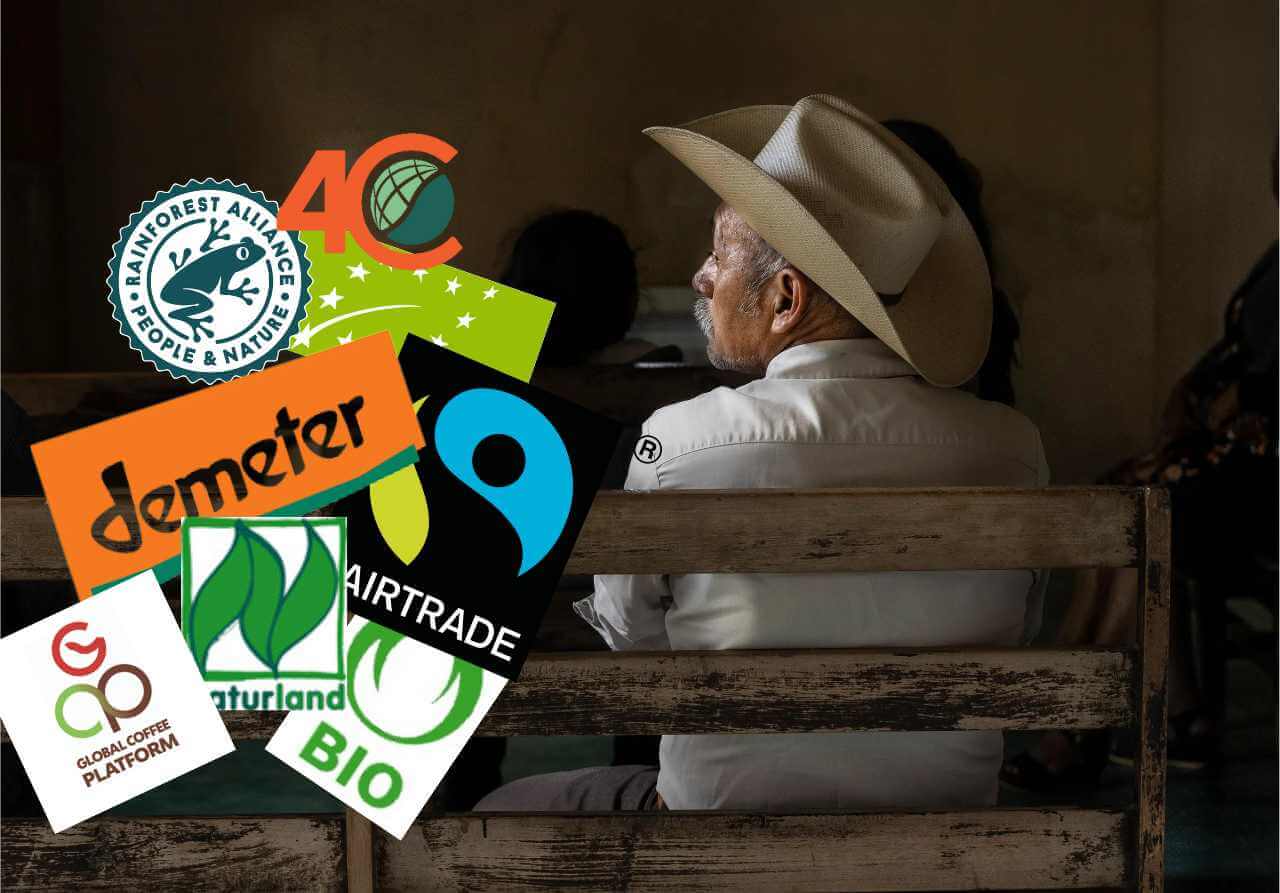
Coffee Certifications. Between Aspiration and Reality

Intro
I'm standing in front of the fish counter in the supermarket. Half of the displayed fish, mussels, oysters and lobsters are certified in one way or another. The labels are almost exclusively blue and green, bearing the keywords "fair", "responsible" and "friends" in their names and giving me a good feeling, which is the intention.
But I'm confused:
which label is actually good?
Or are they all good?
And what does "fair fish" mean when applied to a dead animal?
More and more questions come up and with them a lack of understanding that makes me uncertain, then critical and finally; suspicious. So I don't buy anything - not because I don't eat seafood - but because I also get the feeling that I don't understand this. I simply lack the background.
Fortunately I work with coffee and the label situation is much clearer - or actually not at all.
Because the coffee shelf in the supermarket, which I scan from time to time to feel the pulse of the times, unfortunately looks only slightly more organized.
Labels are actually a heuristic, a shortcut to quickly grasp facts,
sustainability communication expert Anja Schröder told me in a podcast. Actually, she says, because the multitude of labels can often be overwhelming. Because the use of buzzwords like fair, direct, organic and sustainable has long since become normal and therefore seemingly no precision is needed anymore, even though it's needed more than ever.
It seems there's a desire for certifications, for products manufactured according to a list of requirements. If we look at coffee here, however, it becomes clear: certified coffees don't all find their market. As citizens we wish for this, but as consumers we don't follow through on our noble aspirations.
In the specialty coffee sector, there are even obvious currents that regard certifications as a worse reference for what they do and have nothing good to say about them. It seems to me that there's more posturing than precise argumentation at work.
But one could ask: aren't certifications simply already "ok", and shouldn't the uncertified coffees rather be examined more precisely?
When I hear from coffee drinkers that they prefer to buy uncertified coffee rather than coffee from an undefined label, it's a sign of being overwhelmed and a reflex we also know from climate discourse - often companies are pointed to that claim to offset all emissions, yet more than 90% of companies don't offset anything at all.
So what exactly do these certifications do, and what don't they do?
What do they bring the producers?
How expensive are they?
Are they trustworthy and where does our distrust come from?

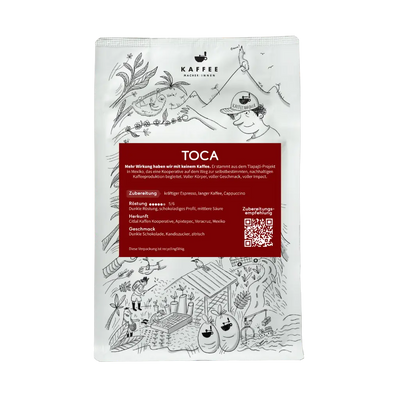
Don Roque from the Toca project in Mexico on his way to the farm (Photo: Miguel Guevara)
The Basics of Coffee Certification
What is a Certification?
I ask where linguistic precision is desired and verbal creativity is frowned upon: at DIN ISO; the German Institute for Standardization. According to this, a certification is
"a measure by an impartial third party that demonstrates that reasonable confidence exists that a properly designated product, process or properly designated service is in accordance with a specific standard or other normative document."
In this case, the standard is abbreviated with a seal, the normative document would be the guidelines of a seal, and the impartial third parties would be the audit bodies that, in our case, check the coffee producers and processing facilities against the rulebook of the respective seal.
In the coffee industry, there is no single binding seal that all actors along the supply chain are obligated to adopt. That's why we're talking about so-called VSS, Voluntary Sustainability Standards. The standards issued by Fairtrade, Rainforest Alliance, 4C etc. are all established, but are not mandatory for any market participant to accept.
These VSS are so far the most widely accepted tool for promoting transparency in the supply chain.
They also create comparability between certified and non-certified coffees, as the criteria catalogs are publicly accessible. Each label defines with varying degrees of clarity what the focus is.
The ITC Standards Map is probably the best place to identify, understand and compare different standards.

In this example I compare three well-known labels based on their social, environmental, quality and ethical components.

On https://www.labelinfo.ch/de/, you can also compare different labels based on product groups.
Both platforms precisely address the requirements of the labels, and the Standards Map also points to the relevant legal basis. It's fun to click through the platforms and understand how many different criteria each seal actually addresses.
This also means how many criteria producers and their organizations have to meet.
"It's certainly no walk in the park",
the managing director of one of our partner cooperatives told me. Because the transparency that is supposed to build trust on the consumer side only comes about because an audit body goes through all the questionnaires with the producers. In the process, nothing is left unturned.

Don Adrian from the Toca project has been working on soil improvement for years
Like any audit, it's also about doing as much as possible as well as possible, but under no circumstances doing anything wrong.
If a deficiency, such as "improper" storage of fertilizer according to the criteria catalog, is noted, remedial action is needed. Other non-compliant criteria are considered deal-breakers and result in the loss of the label.
This stringency and rigor is what gives the label its credibility and any reason for being. But what role do certified coffees play in the market, and what do they mean for the producers who are certified and want to bring their coffee to such a market?
The Reality Check
At the Retailer
"There are many different certifications, besides the well-known ones, also company-owned ones like C.A.F.E Practices from Starbucks or AAA from Nespresso",
notes Christian Cvrljak, trader at InterAmerican, the specialty section of the world's largest trader Neumann Kaffee Gruppe.
"But with Robusta there isn't much certified coffee yet. New farmers are being certified every year, but the numbers are still small."
The Neumann Kaffee Gruppe trades globally in approximately 40% third-party certified coffees, InterAmerican in approximately 70%.
"The trend is clearly moving towards certified coffees," says Cvrljak, "especially when we look at the new EU regulations. At the end of 2024, the Deforestation Law comes into effect. If the law comes as intended, you can only buy certified coffee in the EU and Switzerland."
The Market...
From 2010 to 2020, more and more producer organizations got certified. According to the Coffee Barometer, between 2020-22 approximately 55% of globally produced coffee was certified in one form or another.
If so much coffee is certified, there should be an effect and we should be reading more and more positive news, right?

Chart from the Coffee Barometer, 2023
55% of coffee was certified, but in 2021 only 26% of it was taken up in the market as such. The other 74% of certified coffee ended up in the market for conventional coffee.
This means that certified producers probably did their homework to get the certification in the first place, but at the end of the season they don't get a premium because the market for certified coffee is too small. Or because too much coffee is certified.
... Doesn't Exist
It won't happen that 100% of certified coffees find their intended market, as this is also about supply and demand. "50-60% should be aimed for," I'm told by a well-informed contact. Because as long as the supply of certified coffees is greater than the demand, certifications remain cheap.
With 4C, for example, premiums are 2-3 cts/lb (1 lb = 1 libra = 0.45 kg), with Rainforest Alliance just under 5 cts/lb - that's significantly less and not comparable to the fixed prices and premiums that Fairtrade offers. The only problem is that Fairtrade is too expensive for many buyers (=traders and roasters). Following the motto: it can be sustainable, but it just can't cost so much.
So those looking for a cheaper sustainability label than Fairtrade find it in Rainforest Alliance, 4C or then company-owned certifications, which are cheaper in part because they are not audited by a third party.
As long as the oversupply of certified coffees exists, they are theoretically attractive to buyers. If this imbalance tips in the direction that the supply of certified coffees becomes smaller, certified coffees will become more expensive and even less attractive to buyers than they are today.
When I realized what I had written in the last four sections, I had to pause several times - a system that has good intentions attracts producers for something that has no guarantee of success.
It's a bit like a lottery with 30 instead of 100 numbers. The odds are pretty good that I'll win something, but it might not happen. In one place the wheel of fortune decides, in another those who shop.

Coffee producers ask themselves daily: what will the market price be? (Photo: Miguel Guevara)
"It's simply also a business"
"It's simply also a business," says Kleber Cruz of GEPA. On the one hand, producer organizations pay a fee to use the seal. On the other hand, retailers pay the licensing costs, which at Fairtrade are currently 20-24 cts/kg, according to Cruz. Producers pay audit fees, consumers pay licensing fees. These are different billing parties, but it's about the same label.
So more and more producers are being certified, while at the same time the market for certified coffee is growing little to not at all in some cases - Fairtrade and organic are stagnating, RFA and 4C - the cheaper alternatives - are growing.
It feels to me like the plastic recycling quota. It seems everyone is oriented towards making everything recyclable, but the quota is growing far too slowly. The consumption of new plastic is growing much faster.
So where exactly is the appeal for a producer to participate?
Why should someone get certified, what comes with additional costs and hopes, but the prospects of success are slim?
The Significance of Certification for Coffee Producers
Cooperatives, producer organizations, but also individual producers can open up new markets with certification. Again, Kleber Cruz from GEPA.
"Of course, certifications are needed if an organization wants to enter retail."
Retailers like to tout that they're doing "more" for sustainability in coffee, and they often do this by committing to certifications. Coffees that have made it as certified coffee to the shelf have reached their target market. Many others don't make it to the shelf at all, or were purchased under unfair conditions, the so-called combos.
Few supermarkets take responsibility themselves and create new solutions within their assortment, seek direct exchange and invest on site. In Switzerland there are examples of this from Migros and Coop. Those who know of other examples (from Germany and Austria) are welcome to share them in the comments.
The demand for certified coffee at supermarkets in Germany, Austria and Switzerland seems to be increasing, but still remains the smaller portion of the assortment compared to overall. Retailers are generally open to VSS , but large roasters like Nestlé, JDE and others often have their own sourcing and sustainability programs, which are then only 2nd party verified, i.e., not third-party audited, and are therefore cheaper.
What does this situation mean for everyone who produces coffee and gets certified?
Certification Costs for Coffee Producers
Fairtrade and Fairtrade/Organic
"The costs of certification are a problem," states Kleber Cruz, who is responsible for green coffee purchasing at GEPA. The price of the annual certification audit depends on the size of the cooperative. With this, Cruz is referring to Fairtrade, which only certifies democratically organized cooperatives of small producers.
The certification costs of the following cooperatives give an idea of how great the financial pressure is on the cost side:

Fairtrade certification costs depend on the size of the cooperative and the volume produced. All information collected ranges between 2,500 - 3,000 EUR per year - but only per audit.
"Audit bodies try to combine different certifications, but that's tricky",
reports Cruz. Anyone who wants to supply multiple markets with organically produced coffee has to be certified for each target market. The EU, the USA, Australia, Japan - these are all large markets, but each has its own certification.
"If I don't want to lose the Japanese market, but can only send two containers there, then I get certified anyway."
So those who can produce, certify and ship more have lower certification costs per kilogram overall. But if the market doesn't exist to absorb all the certified coffee, then certification costs are additional expenses with no countervalue.
Rainforest Alliance
Unlike Fairtrade, Rainforest Alliance (RFA) also certifies individual farms. We could become a member of RFA with our Finca Santa Rita if we meet the criteria catalog.
Producers pay for the audit at a certification body of their choice. The costs incurred depend on the audit body, not on RFA. In addition, like any certification, there are costs for implementing the required measures. For coffee, RFA charges 0.015 dollars per pound (lb) of green coffee as a fee that the so-called first buyer has to pay, i.e., the party that first buys the coffee from the cooperative or farm.
What Premium Do Producers Get for Certified Coffee?
In the following calculation example, we compare a Fairtrade, a Fairtrade Organic double-certified one, and one from RFA with each other.
Audit costs for producers, processors (e.g., roasters) and marketers (e.g., supermarkets) are to be paid annually by all. This is the same for all certifications listed here.

A Brutal Conclusion for Producers
Whether the effort is worth it for coffee producers at the end of the day needs to be discussed elsewhere. This requires a specific analysis with concrete targets.
But what I've heard repeatedly during my research is that double-certified (Fairtrade/Organic) cooperatives have been increasingly selling their coffee in the local market in recent years because it's more attractive for them.
An example:
A cooperative in Peru sells its certified coffee in Peru because, first, the coffee is paid for in a few days and, second, because the financing costs that would accrue for bridging the time until the money from the international buyer arrives are eliminated. Interest rates in Peru go as high as 30%. And these eat up the premiums of certified coffees again.
With Fairtrade's increase in the minimum price to 180 cts/lb, the problem described above becomes even bigger. I'm told that demand in Europe has decreased significantly. Fairtrade and Fairtrade-Organic certified coffees are in high demand in the USA right now because Fairtrade USA simply didn't go along with the increase to 180 cts/lb.
When the Cat Chases Its Tail
Let me summarize this circular reasoning point by point:
- Producers/organizations pay for the audit to get a label and thus access to a differentiated market
- each market has its own requirements, so producer organizations often get certified multiple times, which always comes with multiple costs, often around 2,500 to 3,000 USD per audit
- Fairtrade guarantees a minimum price for coffee, while at RFA producers and buyers negotiate the premium themselves, which is significantly lower than with FT
- the market is too small for certified coffee, only 26% (2021) of certified coffee found a target market and received a premium, for 74% of certified coffee there was no premium even though it met the criteria
- cooperatives are increasingly selling on the local market because they earn more doing so than if they exported certified coffee. Not because more is paid there, but because there are fewer additional financing costs
The system doesn't work as intended across the board. And yet people continue to get certified. I quote Kleber Cruz from GEPA again at this point: "It's simply also a business."
What would the alternative be? No certification?

Those who diversify and grow more can find additional sales markets (Photo: Miguel Guevara)
The Discourse
Since I started working with coffee, I've been asked whether certifications are good, bad, effective or useless. In that time I've had many conversations with cooperatives, certifiers, audit bodies and companies that are themselves certified. Especially with them, there's naturally an understanding that certifications are the way to go.
When I listen to the voices of consumers, I think I can distinguish three different discourses.
"Rather Specialty Coffee Than a Label"
One of many promises from certain specialty roasters is that they forego labels because a label provides no sensory quality and the direct approach of working with producers is much more worthwhile.
The labels discussed here never had a focus on sensory quality, so this argument doesn't count. "Direct collaboration" is a vague term. How direct is direct? And who is excluded and why at what point in the supply chain, with what consequences?
Direct collaborations are often designed for individual producers or smaller farms, which clearly does not correspond to the intent of certifiers, who work as inclusively as possible. So forgoing labels for quality demands and an imprecisely defined definition of direct trade are reasons that can certainly be questioned.
"Label and Good to Go"
I perceive a different discourse among meso- and macro roasters, namely that they rely on certified coffees. This often comes with big promises that a roaster is now particularly sustainable and that - purely by buying certified coffees - it would turn things for the better. As if a label were insurance for a good future and a safeguard to do the right thing.
However, a label cannot bring about comprehensive change, as they are not designed for that. The respective requirement catalogs specify concrete points to be met, but these - even if detailed - are not tailored to the specific partners.
Labels don't address point solutions, and that's where there's a great opportunity for traders and roasters to build a bridge, perhaps also with a certifier: win-win-win.
Partnerships will be the future, which various certifiers are already pursuing. Furthermore, certifiers are increasingly offering additional know-how. "It's increasingly about risk analysis and compliance," says Peter Lerch of Rainforest Alliance. In the process, trader programs must be more transparent and externally audited.
"Fraud and Deception"
I thought the days of unfounded rejection of transparent concepts were over. But no, I was recently proven wrong.
A potential customer was interested in our coffee.
When I mentioned the organic seal, the guest interrupted me and found himself in a lengthy tirade against every seal. Everything was a lie, worthless, all cheaters, nobody would care, etc.
I walked the guest to the door.
Labels are subject to constant criticism, constantly having to reassert and justify themselves. Transparency is growing every year, there are still a lack of precise long-term studies on effectiveness, but there's neither a hidden agenda nor dubious dealings. Labels are also a business, whether you like it or not, but they're not an underground organization.
Label 4.0
"Labels are no longer pure labels,"
Peter Lerch of Rainforest Alliance told me. Certifiers tackle various issues in the coffee chain intensively, scientifically and even publish discussion papers to expose themselves to public reflection.
New EU laws like EUDR (Regulation on deforestation-free supply chains) of course also affect certifiers, so they have to stay directly in tune with the times and in dialogue with their producer partners and issue policy statements on them.
But there's still a lot of education work needed to communicate all the changes made, Lerch continues. For me, this is the discourse that determines everything, because here certifying organizations can prove what added value they provide in times when nothing is really stable anymore.
In 2012, I first heard of the post-label era, a time when labels would no longer be needed. It was said to be very close. I still don't believe it, and I can't imagine an end anytime soon. Labels like Fairtrade, Bio Suisse, Rainforest Alliance or Demeter are deeply anchored in consumer perception, these labels will still exist in 20 years - but the processes behind them will continue to evolve.
Conclusion
One of my guiding questions comes from marketing guru Seth Godin: who's it for and what's it for?
Who are we doing this for and why are we doing it. With labels, there are at least two addressees: consumers can learn with labels to shop more mindfully, and producers could find a market with these consumers.
The question of the what remains important and has lost none of its relevance: the goal of the labels discussed is to improve the livelihoods of small producers, who are often backed into a corner. Regardless of how well, often and long-term this succeeds, nothing will change about the "what."
Labels are part of the coffee ecosystem. Katja Schmittner of Fairtrade Max Havelaar once told me in a podcast: "If Fairtrade is no longer needed, we've done our job." Labels create visibility for problems that can be addressed by buying a labeled coffee.
The effectiveness of labels in coffee is disputed. There are scientific papers, but they mostly have to select individual case studies. The impact reports of the certifiers themselves often don't go into as much depth and breadth - and if they do, please share the links in the comments.
And when I ask cooperatives directly how big the impact is, the answers are never clear, but rather describe a state of what labels make it possible to think and why it might be worth it. So making clear claims is difficult.
The great strengths of certifiers are that they create comparability, defining what sustainability is and what "sustainable" means. They also enforce accountability, as a third party conducts an audit.
The risk of greenwashing is significantly smaller with certified coffees than with non-certified coffees, since the latter are not subject to external review.
Roasters working without labels are not required to be accountable. But there are voluntary alternatives where you can engage as a roaster and share data. Transparency Coffee or self-authored transparency reports like from Vote Coffee are means of providing voluntary accountability.
From a consumer perspective, it's understandable that a label jungle can sometimes confuse more than clarify. Especially when it comes to a roaster's or retailer's own labels.
Reaching for labels that have been established for a long time is a safe choice because the label organization must be accountable. To play it safe in a supermarket, buy double-certified coffee, FTO - Fairtrade and Organic.
Outro
I don't eat fish from the ocean, only from Swiss rivers and lakes. So I don't find anything at the fish counter and buy a smoked trout from the fish farm in the neighboring village.
The fish labels confused me, each one sounded really good. So you can get the feeling that certifications give you certainty about something that might never happen, that you might never fully understand, and perhaps shouldn't because someone else takes care of it.
Label organizations have the very large ambition of addressing macro-challenges in the coffee sector. But it also needs the micro, and that's where private individuals, companies and NGOs can work on it at the same time. Their approaches are less scalable because they're point-specific, but the underlying thinking is replicable and good things get copied.
It will never be enough to rely on labels. But it also doesn't help to shoot sharply against certifications. If anyone should be held accountable, it's all those who don't buy certified coffee, don't take point measures at the source, or buy coffee from dubious sources.