











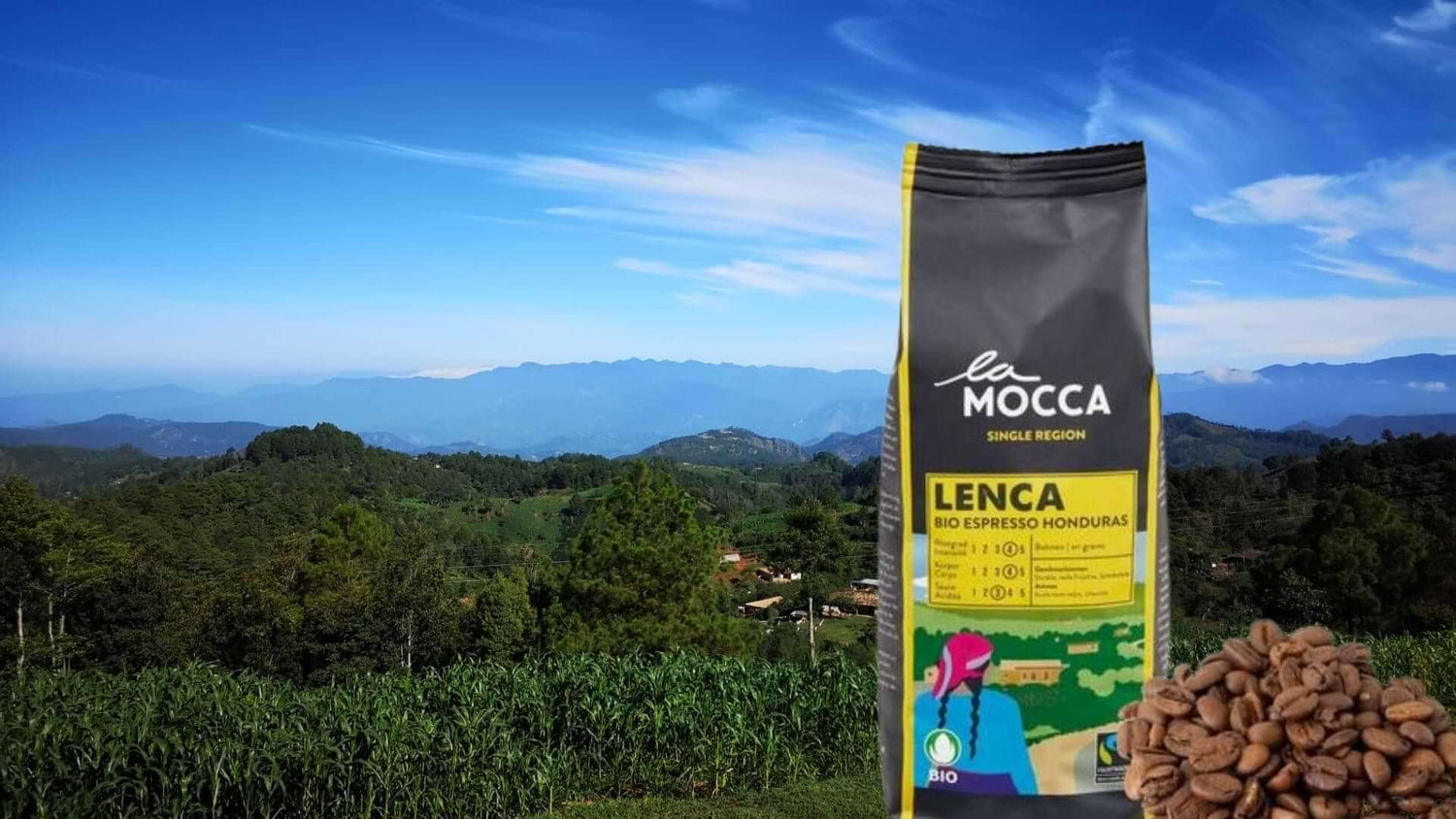

Supermarkets have enormous influence through their purchasing decisions. In the example of "Lenca", a coffee from Coop's range, a supermarket becomes aware of its responsibility, makes investments on the ground, and pays the correct prices. We were able to accompany this project and are delighted with the finished product.
In a recently published blog article and video, we discussed the opportunities and shortcomings of supermarkets with regard to coffee. Special attention is paid to blends, the mixtures. With the quantities sold in supermarkets, it is usually a matter of cheap raw coffees. And because they are a commodity, an interchangeable raw material, the coffees are replaced depending on availability and prices, so that consumers don't notice.
But there is another way: and that would be a commitment to a specific coffee, to a specific producer group, to long-term investment in one place. We are happy to support such projects, they can have a beacon character. And the Lenca project by Coop is exactly one of those.
Fact Finding Mission 2019
At the end of 2018, we came into contact with a project team from Coop. Their goal was to start a coffee project, analogous to the criteria of their successful chocolate project in Honduras: specialty coffee in the supermarket, correctly paid, sensorially distinctly different from the mass, produced by a cooperative interested in long-term cooperation.
Chocolat Halba, Coop's chocolate division, already had local staff with experience in intensive collaboration with small-scale producers. It was with them that I conducted a so-called fact finding mission in Honduras in the summer of 2019.
We visited various cooperatives that were selected for the project through careful preliminary selection. As exciting as such a task is, it must be managed with equal precision. For a selection always also means an exclusion.
The selection criteria were therefore multifaceted. In one of my first origin projects with small-scale producers, I learned from my mentor that in a discovery process one must proceed with great care, especially in the initial clarifications—not making hasty promises, being open, but still somewhat reserved in the concrete implementation. With this principle in mind, we visited various cooperatives in Honduras in one week and sought a partner for the project.
The Coffee Producers: COSAGUAL, Gualcinse, Honduras
We found success with COSAGUAL, a cooperative in Gualcinse, on the border with El Salvador. COSAGUAL was already Fairtrade and organic certified, was very well-established in community building, and had strong interest in taking on the joint project.
Gualcinse is located in a very dry area. The climate is heavily influenced by the Pacific. The clouds usually empty themselves about 50km further east. This opened up the opportunity to produce dry-processed coffees. However, the infrastructure was not yet ready for it—COSAGUAL had just made its first microlot of 600kg naturals, but for large-scale production there was a lack of the appropriate setup.
Investments on the Ground
If you are serious about a project coffee, you must invest on the ground. And for the long term. Since there was above all a lack of drying capacity, Coop committed to making the investments for a drying house. Tim Willems, our project manager of the Kaffeemacher:innen Farm Santa Rita in Nicaragua, was on the spot. Tim has already implemented several drying systems and was now able to also oversee this project in Gualcinse.
Within months, simple drying tables were transformed into a solid drying house that is well-ventilated. In the first year, production was increased from 1 to 8 tons, and 12 tons are planned for this season.

COSAGUAL with standard drying tunnels in summer 2019

The construction site in 2020

The finished drying house at the end of 2020

Cherries are dried on seven floors
Training on Site for an 86.5-Point Coffee
An investment is useless if know-how is not also trained. A local coffee trainer trained the COSAGUAL team. Coop financed an Ikawa sample roaster and so the quality teams in Honduras and Switzerland can taste the same roasting profiles and determine quality together early on.
Tim Willems also helped define the post-harvest process. When the coffee cherries arrive, they are first washed and floated, then laid out on predefined drying beds. Initially they are higher up in the drying house, and as they dry further they move down and dry to the desired residual moisture content over more than 20 days.
The resulting coffee is very heavy, abundantly fruity with notes of cherries, a juicy acidity, and a deep chocolatey structure.
The cherry quality required for such a specialty coffee must be high and uniform. Ripeness and uniformity are independent of elevation. This means that this project includes producers from different elevations and does not exclude lower farms.
What is the Correct Price for Such a Coffee?
Coop asked us how the price for such a raw coffee should be set? It is not our task to determine the price, but to ask the producers what they need. So COSAGUAL defined the price and Coop paid it. Simple as that. No haggling. Coop pre-financed the coffee, which was especially important during the Corona situation.
A New Supply Chain: COSAGUAL - algrano - Hochstrasser
The coffee from COSAGUAL was made export-ready at the Beneficio Santa Rosa in Copán. With algrano, we found a partner for Coop who delivered the coffee to Switzerland. From Basel it then went on to Hochstrasser in Lucerne, where the coffee is roasted around the team of coffee trainer and roaster André Strittmatter.
Lenca - an Exception?
We as Kaffeemacher:innen are happy to support such projects that include various areas such as community building, training, correct prices, long-term engagement, own direct investments, and purchase guarantees.
Supermarkets and large roasteries have the leverage to create a big impact with a simple change of course.
How we otherwise think about supermarket coffee, we have discussed in detail here:
Lenca, the project coffee from Honduras, is a great example for us that shows exactly the points mentioned above. However, Lenca is only one coffee in the Coop range that works in this way. The sensory aspect of the Lenca coffee is a cornerstone here, so the effort is significantly greater than for other coffees.
The other coffees in the range are sensorially less complex and (still) do not come from projects where Coop takes on such a high level of responsibility. We wish for and encourage all supermarkets to take this path. More self-engagement, taking responsibility, setting up new supply chains and striving for direct relationships themselves. Only in this way can we create perspectives for coffee producers. The constant replacement with the cheapest raw coffees available is a vicious cycle that spirals downward and helps no one. We see Lenca as a beacon example of how many things can be done differently.