














Understanding coffee transparency: From farm gate through FOB to the roastery

Transparency is a buzzword in the coffee world. Roasteries advertise it, labels promise it, and consumers demand it, often without knowing exactly what it means. Frequently it is reduced to a single figure: the FOB price. But a price alone, divorced from its context, says a lot and at the same time nothing. And yet transparency is more important today than ever before. It is not a marketing tool but must be a fundamental attitude for the entire value chain.
Almost all of us drink coffee, but almost no one has ever been on a coffee farm. That's not necessary to appreciate coffee either. Similarly, it's not necessary to understand coffee production if the story of coffee is well communicated. But for that story to be told, transparency is needed. The term has been ubiquitous since the mid-2010s, is often used, but perhaps not always interpreted the same way.
The Misunderstanding: What We Mean When We Talk About Transparency
What is Transparency?
The term "transparency in the coffee chain" refers to how openly and comprehensibly information about the path of coffee is shared — from the farm to the cup. It's about shedding light on every single step of this complex supply chain.

Information is available, but it is not always shared
In short, transparency means telling the entire story of coffee openly. Not just where it comes from, but also the conditions under which it was grown, at what price, and with what impact on people and the environment. It goes beyond labels and attempts to create a deeper connection from the beginning to the end of the coffee chain.
Coffee trading was not transparent for centuries. Because where transparency is absent, accountability is also absent. Coffee was a classically colonial product produced with slave labor. Until well into the 20th century, people were forced into coffee production. And to this day, in certain regions, people produce coffee out of lack of alternatives and are trapped in dependent structures. But it can also be different: when work is done transparently and communicated about it.
Is there more demand for transparently traded coffee?
Not directly.
There is a clear upward trend for Fairtrade coffees. In Germany, sales rose by 13% in 2024 and have a market share of 5.3%. In Switzerland, 18% of all coffee sold carries the Fairtrade label, and in 2024, sales increased by 22%.

From the Fairtrade Impact Report 2024/25
However, the latest study by the DKV shows: A clear majority of respondents show little interest in the exact background of coffee production. Taste, strength, and price continue to dominate general purchasing behavior. Only 42% of test subjects found "sustainable production" important to very important, while 67% found price important.
Perhaps transparency is more of a topic for the specialty coffee market, since there is often the notion: Small roasteries are automatically more transparent, quality coffee is inherently more sustainable, and mentioning the exact origin creates enough proximity and trust.
However, I would not confirm any of these three ideas.
The size and quality orientation of the roastery play no role in how transparently someone operates. Stating the exact origin is today merely a communication decision — the information is available at most roasteries. The equation "high quality = high sustainability" also doesn't add up.
I have drunk qualitatively fantastic coffees from farms that use glyphosate heavily and neglect worker rights. And I have drunk really bad coffee from farms that could be a compass for many others in terms of sustainable coffee production.
Is Transparency Sustainable? Untangling the Concepts
By this point, it's clear: the transparency concept blends with ideas of sustainable production, fair payment, and good partnerships. This overloads the term and makes it imprecise.
Transparency is not a concept, but an instrument to achieve the stated goals in the first place. Just as a solar panel is an instrument to make a light bulb shine, transparency enables us to see things. Nothing more. Companies that use transparency as a tool can go far beyond seeing and trigger changes with clear vision.

A new way of seeing is needed. La Capilla, Coscomatepec, Mexico
A transparent attitude creates the foundation for being able to act more sustainably in the first place. It is the basis for trust, long-term relationships, and authenticity. And that's exactly why transparency is more important today than ever: it is the foundation for good and stable relationships at every point in the chain.
How the Market Forces Transparency: The Changing Price
Coffee is always traded because it is a cash crop. An agricultural crop planted for sale or export purposes and thus to generate profit — cash (money) through the crop (planted culture).
The way coffee is sold and bought, i.e., traded, differs in who negotiates with whom and on what basis a price is set. A large cooperative in Brazil doesn't seek small roasteries as buyers who only buy bags and not containers, while a large trader doesn't include micro-producers in their portfolio for reasons of granularity.
The C-Price is always part of a price negotiation between buyer and seller. When the green coffee price reached one new high after another in autumn 2024, the world realized that specialty roasteries are also affected by this C-Price. It's not that quality-oriented roasteries are immune to it; on the contrary: everyone is in the same boat. And that's a good thing.
The C-Price, however, is not the true cost price for green coffee. It reflects supply and demand, which is determined by actual coffee availability, volume estimates, and speculation.
The C-Price is public, and coffee producers often know the smallest fluctuations much better than many roasteries. Because: when the price goes up, producers wait to sell. When it goes down, they tend to sell.
A New Negotiating Culture Through High Prices
Especially since higher coffee prices, many buyers have had to engage even more with the C-Price. It became clear that no one acts independently of it, no matter how stable a relationship with coffee producers is. And that's why the C-Price moved so strongly to the center of negotiations that there was a new understanding of prices.
For years, especially specialty roasteries said that the C-Price is far too low for a producer to live on. Now it's high, and that puts roasteries in a challenging position because they have to raise prices, which fuels concerns about customers jumping ship.
So in recent months, I've witnessed many buyers and sellers discussing prices and individual cents more intensively than ever before. Roasteries (buyers) had to demonstrate how much they need to raise prices, while sellers (traders, producers, cooperatives) argued how high local prices are, how small their margins are, and how high credit risk is.

Information exchange in both directions. Apas visiting us in Basel
The high C-Price has led to more transparency in price setting. Sellers and buyers have communicated their figures as openly as never before. And that knowledge is now there. I am convinced that as an industry we will not fall back into a pre-2024 era because the strong price pressure brought a knowledge surge that is now decisive. Price negotiations will be more transparent from now on.
Far From Transparent Enough Yet: Moving Toward True Cost Price
"Open book" was the motto for many buyers in recent months, sharing their figures with sellers. That would have been unthinkable just a few months ago. Buyers' concerns forced them to communicate more transparently. And yet the true cost price remains untouched. The selling price that accounts for all production costs, including so-called externalized costs like environmental impacts.

Self-made bio-fertilizer at Apas in Brazil
That must be the next step to get truly transparent pricing. This includes determining what good income is for producers. "Good income" cannot be determined by roasteries or a C-Price.
In a perfect world, producers would decide what they need, but the C-Price remains the reference. But to get a more realistic understanding of how the C-Price should be classified, tools like the Living Income Benchmark from Fairtrade help. This can help provide contextualized figures for what reasonable wages in certain regions of the world could be. Furthermore, knowledge of production costs, a margin, plus external costs would be needed to calculate a comprehensive price for green coffee.
This is a long road and it requires more transparency for all stakeholders in the coffee chain to answer these questions. Transparency is essential for proper price formation. Beyond that, we must ask ourselves:
who actually benefits from transparency?
For Whom Is Transparency Crucial? Different Perspectives
Of course, there are limits to transparency.
When we talk about transparency in the coffee chain, we imply trading practices, prices paid, growing methods, perhaps working conditions, and environmental impacts. Usually these are topics related to cultivation.
Roasteries that demand a lot of transparency from traders and producers are invited to show just as much transparency themselves. As a principle, this could apply:
The degree of transparency I demand from you, I will also give to you.
And with that, one sets one's own limits on transparency, because there may be topics one doesn't like to talk about. So on the chain, one finds one's own kind.
What Do Individual Actors in the Chain Get From Transparency?
Let's assume that the greatest possible degree of transparency is applied on a particular coffee chain, everyone feels comfortable with it, and information flows in both directions — from seed to cup and from cup to seed. Often there is information asymmetry. But when that is broken, there are opportunities for all involved.
When information asymmetry is broken, there are opportunities for everyone:
Producers:
- Empowerment through knowledge of the value of their product and the ability to negotiate fair prices beyond production costs.
- Access to direct, long-term partnerships that enable stability and investments in sustainable growing methods.
- Improved working conditions and fair wages for farm workers, who are often underpaid.
Green Coffee Importers:
- Their important role as bridge-builders between producers and roasters, managing logistics and quality assurance.
- The opportunity to strengthen trust throughout the entire chain through their own transparency (e.g., about their margins and services).
- Risk management through detailed knowledge of origin and production conditions.
Coffee Roasters:
- Building a strong brand and credibility through authentic stories and traceable origin.
- Improving purchasing strategies through deeper insights into producers' cost structures and optimizing the supply chain.
- Differentiation in competition and attracting a conscious customer base that values ethical consumption.
Customers:
- Ability to make informed purchasing decisions that align with their personal values (e.g., environmental protection, social justice).
- Understanding the "true price" of coffee, which reflects the social and ecological costs throughout the value chain ("True Pricing").
- Appreciation of the product and the work behind each cup of coffee through detailed origin information.
Understanding Transparency Correctly. The Need for Contextual Knowledge
If you compare two 87-point coffees, one from Kenya and one from Brazil, you know that these 87 points taste different. Coffees from Kenya and Brazil taste fundamentally different, but can have high ratings on individual flavor attributes and thus reach 87 points.
Same score, different reason, we often say at tastings.
But if I only communicated the 87 points without the context of origin, variety, processing, etc., then it tells me that the coffee is probably very good. But I still don't know how it tastes, what it might be suitable for, and who else might enjoy it.
Similarly, bare numbers and facts in the transparency debate are not helpful. An FOB price viewed in isolation, the harvest and processing method, ownership structures in the chain — all information that says little without context. Two examples of this:
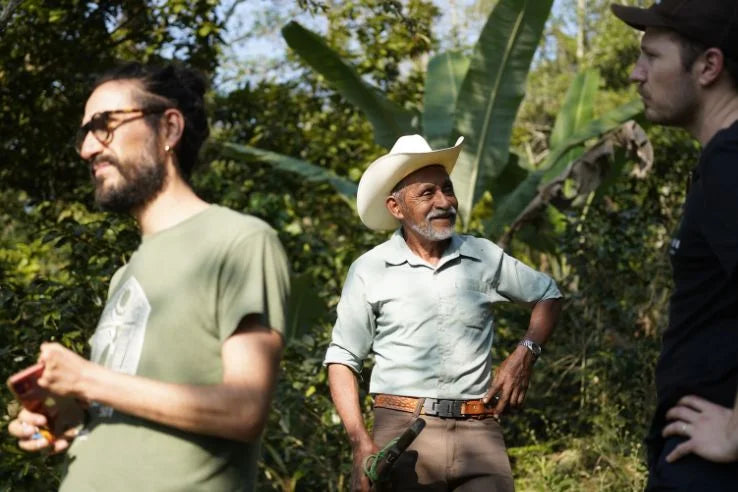
Don Roque produces high-quality coffee; the yield per hectare is under 1 ton
High Price for Good Coffee:
Micro-producers in the mountainous Oaxaca region of Mexico are often completely dependent on their small harvest. This makes the coffee exclusive and more expensive. A higher price is necessary here for their survival and is determined by scarcity, not solely by cup quality.
Low Price for Amazing Coffee:
A fantastic lot from a Colombian producer with over 100 hectares of land was rated qualitatively higher, but was priced identically to the Oaxaca coffee. Through size, efficiency, and modern fermentation in large tanks, the coffee could be produced more cheaply.
The prices were identical, but had no direct relation to sensory qualities; rather, they reflected economies of scale and growing methods. Without context, a price is just a number.
What Do Price Statements Like FOB Really Say?
Initiatives like "The Pledge" invited roasteries in 2018 to share FOB prices to bring transparency to price-setting. That was an important step in the right direction, so a small wave went through the specialty world. To this day, many roasteries share their purchase prices on an FOB basis.
"FOB is just the beginning", according to the 2019 vision. Only when all prices in the coffee chain become transparent does it become possible to calculate a Living Income Price or even a true cost price.
The FOB price (free on board) means that the exporter bears all costs up to loading onto the ship. Once the coffee is on the ship, follow-up costs go to the import side. An exporter may, but doesn't have to be, the producer themselves.
Before and after this, additional costs are incurred, which are reflected in different price models:
Harvester Wages
Does not appear in classical price models, but is included in the farmgate price. There is a reference point for this, the "Living Wage" approach, which differs from "Living Income": While "living wage" reflects employment, "living income" is the reference for self-employment. The "living wage" approach is thus used to determine harvester wages; for farm owners, "living income" applies.
Ex-Farmgate
The price a producer receives for coffee directly from the farm.
FOT (Free on Truck)
The price after the coffee has been transported from the dry mill to the port and changes ownership there.
FOB (Free on Board)
The price when the coffee is loaded onto the ship. The exporter bears all costs up to this point.
DDP (Delivered Duty Paid)
The price for coffee when it arrives, cleared customs and taxed, at the roastery's doorstep.
The costs mentioned are so-called Incoterms: definitions that establish who bears which costs and when goods are handed over. Furthermore, Incoterms provide information on whether the goods are transported further by the buyer or seller.

Every coffee chain has its peculiarities and often never functions identically.
Coffee supply chains are based on Incoterms that are often similar but differ in detail. Some peculiarities can be:
- it is not a single producer, but she is part of an organization (e.g., cooperative)
- individual producers typically don't own a dry mill, i.e., the facility where coffee is made export-ready
- the dry mill service can be purchased, or the dry mill buys the coffee and exports it
- cooperatives or exporters (traders) typically own dry mills
- the exporter always needs a counterpart, the importer, who then buys the coffee. These can be subsidiaries or independent companies.
Hence the questions:
So what does the FOB price really say?
Without context, not much.
The basic idea behind FOB communication is that eventually you'll have enough transparency to calculate Living Income. But for that, neither the FOB price nor the ex-farmgate price is sufficient. More precise calculations are needed that address the individual life contexts on the ground.
In that case, without context, the FOB price is simply a number. And just because a roastery communicates this price does not mean it's a good price for producers.
I repeatedly see roasteries stating the FOB price with additional information that the paid price is x times higher than the C-Price (the exchange reference price). I believe this means two things:
- the willingness to communicate transparently, which is needed and commendable
- the intention to conduct different communication, but which is incomplete if not contextualized
Context is king — as long as the FOB price stands alone, it doesn't mean much. Only by capturing additional data points does a more complete picture emerge of how the coffee was traded.
An FOB price of $10 per pound of green coffee seems high. But if the ex-farmgate price was only $5, that means the costs for processing, logistics, and export margin have doubled the price — a tremendous markup. Just because a roastery communicates the FOB price is no guarantee of a fair price for producers.
Here are our FOB prices that we pay for green coffees.
Is Transparency Also Fair?
As mentioned at the beginning, transparency is an instrument that helps us understand what happens in a long trading chain. Where a product is charged with monetary and idealistic value, whose contribution in the chain improves the product, and what we can learn from it moving forward.
Transparency is necessary, but by itself is not an explanation for deeper understanding of a commodity chain. Similarly, transparent information without subsequent action is no guarantee of fairness.
An ethical dilemma can arise when we find ourselves in information asymmetry; when one part of the coffee chain knows more about the market and more about the other part than vice versa. The goal should therefore be that the benefits of transparency also reach producers and thus work together on solutions.
The Future of Transparency
Coffee companies that are accountable to third parties, e.g., a label organization like Fairtrade or Rainforest Alliance, or shareholders, must per se work more transparently than many smaller companies and often show a higher degree of precision.
Whether this information is then shared with customers and producers is another story. The exercise of learning more about one's own chain has long been practiced, especially at larger companies. Who ultimately benefits from it is unclear.
So for change to happen at all, transparency is needed across entire supply chains. But above all, there is a need for an understanding of how we, as companies, individuals, and institutions, position ourselves toward transparency. If it represents the guardrail for our actions, we think it in both directions ("I share as much as I ask"), and see it as a creative means for change processes, then it is a powerful tool for a future-proof coffee chain.