


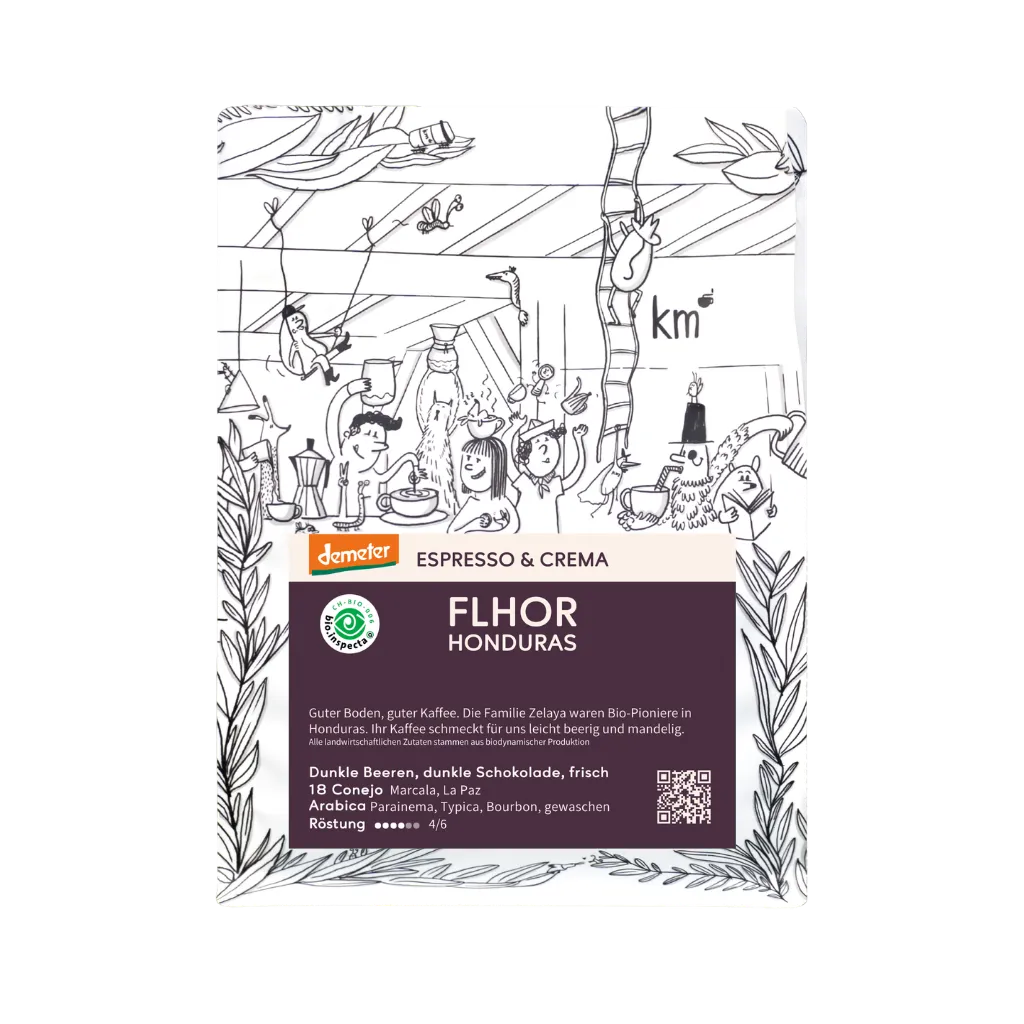

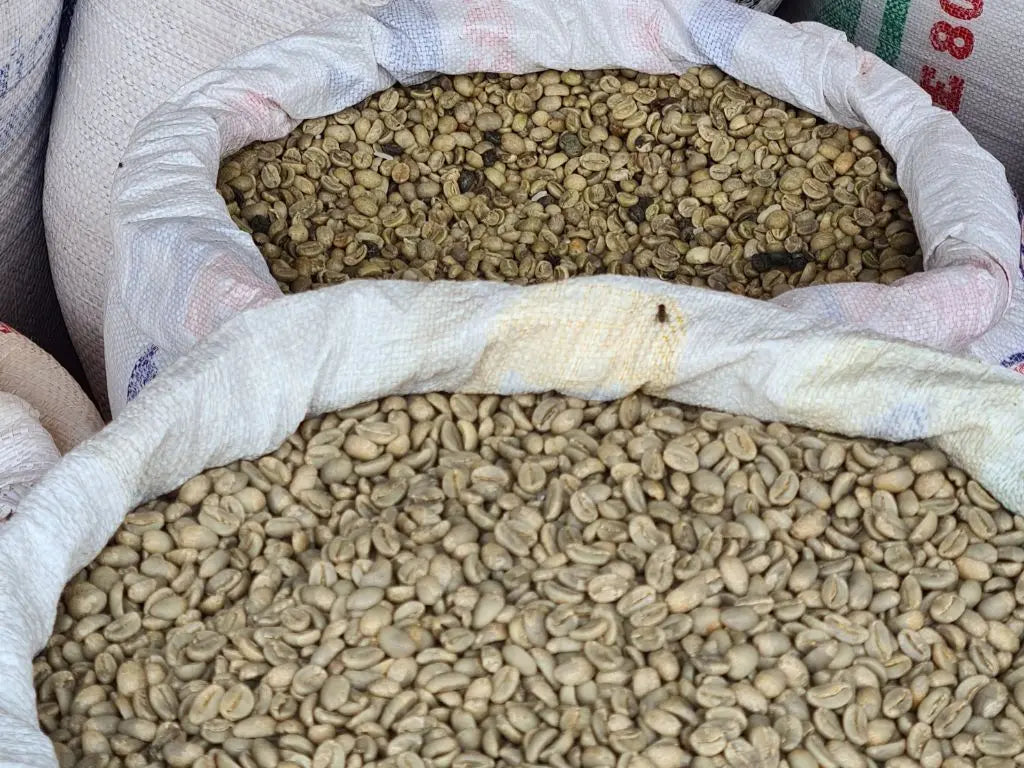

Most coffee roasters do not disclose where their raw coffees come from. Instead, communication is dominated by brand names or emotions. The fact is: almost all roasters buy and roast the same raw coffees as everyone else. We give you tips on how you can still guess what you're drinking.
When we did our second tasting of Italian espresso, we noticed how hardly any roastery declared the origin of the coffees they used. Instead, there was talk of "carefully blended" and "carefully selected" raw coffees.
And this is not an isolated case.
Exactly the same applies to many coffees that are drunk daily in Germany, Switzerland and throughout Europe. So if no information about origin is provided – what are we actually drinking?
Many forgo transparent origin information. No country, no region, no farm, no processing method. But why exactly?
Why the origin is not disclosed
There are several reasons why roasteries omit origin information.
Flexibility in blending:
The ingredients of a blend can be adjusted depending on market availability and price fluctuations. This substitution is standard practice. As long as the coffee tastes the same, coffees are swapped out. Especially in times like now, when prices have risen sharply, blends are remixed to compensate for price increases.
Sensorially, there must be no deviation, but in terms of content, especially the constantly available blends look different again and again. A classic example is substitution between washed coffees from Honduras and Peru: in both countries, coffee is processed using the washed method on a large scale. The general character of both coffees is similar, with nutty and citric notes to the fore.
These coffees are often described as "cheap acidity component" - at least before November 2024, before prices rose sharply. In addition, Honduras is in the northern hemisphere and Peru in the southern hemisphere, so the harvest times are staggered. Ideally, there is always fresh coffee from these countries, which makes substitution even easier, but especially increases sourcing flexibility.
Branding takes center stage – not content
We are constantly amazed by a brand identity that apparently takes precedence over transparency. There are indeed roasteries that provide a blend ratio based on the species used, usually Arabica and Robusta.
We then read, for example, "100% Arabica" - if we used only this information for wine, it would be as precise as: 100% wine from red grapes. Surely we can do better.
But we find this description even more superficial: coffee with "the finest beans from the finest growing regions in the world". This is not only very simplified marketing speak, but above all it is remarkably anachronistic in 2025 and leaves consumers in the dark.
No accountability to consumers
There is no obligation in Switzerland or the EU to disclose the exact origin (country, region), variety, or processing on the coffee package, as long as no misleading information is provided.
However, if an origin is voluntarily stated, it must be correct. It is permissible to name a higher-level geographic area (such as "South America") instead of a country. The statement "100% Arabica" is allowed, provided it is true.
Transparency is voluntary, but if stated, then accurately and not misleadingly. The EU Deforestation Regulation (EUDR) that comes into force in 2026 does demand transparency, but only between the party placing the product on the market and EU authorities.
The regulation requires importers and traders to be able to prove the exact origin (down to the plantation) to rule out deforestation. However, this information does not necessarily have to appear on the packaging for end consumers, and probably no roastery will handle it that way.
What we can still know
Even if nothing is stated on the package, contextual knowledge, sensory analysis, and two solid sources help us clarify the picture: The 2024 Coffee Report by Brand Eins and Tchibo shows which countries export the most coffee. And the European Coffee Report 2023/24 proves:
Over 58% of coffee imported to Europe comes from just two countries: Brazil and Vietnam.
This comes as little surprise because Brazil and Vietnam are the largest coffee-producing countries. Brazil produced 66.4 million 60kg sacks of coffee, Vietnam 30.1 million. Or put differently: Brazil produced 38% and Vietnam 17% of global coffee supply. Colombia follows with 7% and Indonesia with 6% (see statistics).
Coffees from Brazil and Vietnam are therefore used almost across the board in most coffee products. It should be noted that Vietnam exports almost exclusively Robustas, and Brazil is the largest Arabica producer, but also the second-largest Robusta (Conilon) producer.
If we look at the statistics from the European Coffee Report, we can read a lot into them.

Germany imported the most coffee of the 27 EU states, between 2021-2023 it accounted for almost 34% of all imports to the EU. Some of the largest roasteries like Tchibo, Dallmayr and others are in Germany and buy coffee. Italy is the second-largest importer and purchased 23.5% of all raw coffees to the EU in the same period. Belgium, Spain, and the Netherlands follow.
The largest importers in the EU
Germany, Italy, Belgium, Spain, and the Netherlands accounted for more than 82% of total raw coffee imports to Europe in 2023. The largest roasteries in the mentioned countries are:
- Germany: Tchibo, Jacobs Douwe Egberts
- Italy: Lavazza, Illycaffè
- Belgium: Miko Coffee
- Spain: Cafés Candelas
- Netherlands: Douwe Egberts
Costs are cut with raw coffee - a "race to the bottom"
This chart is particularly interesting, as it says a lot about the competitive pressure between coffee roasteries. From 2021-23, we see a sharp decline in imports of Brazilian coffee and a sharp increase in coffee from Vietnam on the other hand.

What does this mean?
Since the vast majority of Arabica coffees from Brazil are imported to the EU, these were apparently replaced with Robusta from Vietnam. And because the latter became cheaper over the same period, it's clear that here it wasn't just about sensory tweaking, but above all about costs.
But today it looks different: Robusta became more expensive and is now twice as expensive as Arabica from Brazil in 2023. Compared to this, Robusta is still cheaper today.
If nothing is stated on the package, there is therefore a very high probability that the roasted coffee comes to a large extent from Brazil and Vietnam.
Uganda ranks third with 7.8% among the most imported coffee-producing countries.
Over 70% Robusta is produced and exported in Uganda - so here too, it seems likely that it is price reasons why Uganda is so important for the EU market. On the other hand, we see many more bio-certified cooperatives in Uganda. Therefore: bio-certified Robusta in Germany comes largely from Uganda.
Mass-market vs. specialty
The import data also shows: countries like Ethiopia, Guatemala, Mexico, or Costa Rica also export to the EU. However, in significantly smaller quantities, and often for the specialty market.
What makes coffee from these countries special?
Ethiopia
- is famous for floral and fruity coffees. In Ethiopia, coffees are divided by grades, with Grade 1 coffees representing the highest quality
- for the mass market, Grade 3 and Grade 4 coffees are often used, which are less uniform and clean, but still retain the original taste characteristics
- often just a few percent in a blend is enough for the coffee to smell noticeably different in aroma and thus stand out from the crowd
Peru, Honduras, Mexico
- are among the leading exporters of dual-certified (organic and fair trade) coffee. These are usually washed, citric coffees, and are often substituted
But: what about Colombia, the third-largest coffee producer?
Switzerland in comparison
The chart from the Swiss Sustainable Coffee Platform shows: In Switzerland too, most coffee comes from Brazil, but the structure is significantly more diverse. And: much less Robusta is imported.

Colombia is in second place. We suspect that Nespresso, one of the top three roasteries in the world, is responsible for this. Since Nespresso's introduction in 1986, according to our own research, 120 - 150 capsule varieties have been filled with coffees from Colombia.
Coffees from Colombia are very diverse, can be floral, fruity, chocolatey, light and heavy, and offer great diversity in application options, especially for a diverse range.
Vietnam ranks third, but is closely followed by India at 7%. We suspect that primarily washed Robusta is imported here, which is generally softer than the dry-processed Robusta from Vietnam.
Costa Rica and Guatemala also appear earlier. They are coffees that are not only more expensive, but also bring a special story for many roasteries.
Costa Rica in particular is also a popular travel destination for Swiss tourists - it's quite possible that expectations, wanderlust, and consumer behavior meet here.
Why origin information matters
In very few cases, and this applies across all European countries, is the exact origin communicated. We increasingly see a "regional" limitation, for example: coffees from Central and South America.
With wine, no one would accept "from Europe" on the label.
With coffee, that seems to be fine.
But precisely because of this, roasteries evade transparent communication, because:
- No origin = no accountability
- No story = no connection
- No transparency = no control
Anyone who doesn't say where the coffee comes from leaves themselves open to swap it out at any time – without firm commitment to transparency or long-term partnerships. But this presents great opportunities: those who tell the individual stories can reach an even broader audience.
Tips on how you can guess the contents
If nothing is stated on the package, we can still roughly figure out what's in it.
Not in detail, but in pattern:
Dark roasted, communicated as "strong" coffees:
- often coffees from Brazil and Vietnam – efficiently produced, sourced cheaply, interchangeable at will.
- the coffees have little acidity, offer a nutty flavor profile, and the Robusta provides the classic espresso note
Milder coffees
- often with washed coffees from Peru or Honduras, because on the one hand they are sensorially substitutable, cheaper, and bring a citric acidity that is especially attractive for longer coffees
Organic and fair trade coffees
- often from Peru, Honduras, Mexico, Tanzania, and Uganda
- because that is where the largest dual-certified coffee cooperatives are located
If we know this, we can make more conscious choices. And perhaps buy the next coffee from somewhere where origin is more than an empty promise.
Annex: Legal situation
Legal situation in Switzerland:
- There is no general obligation to state the exact origin of coffee beans (e.g., country, region) on the package. The statement "100% Arabica" is permissible, as long as it is correct and actually contains only Arabica beans
- However, if an origin is declared (e.g., "from Peru" or "from South America"), this information must be correct and not misleading. False or deceptive statements are prohibited and monitored
- Swiss origin statements ("Swiss Coffee") may only be used if the beans have been fully processed in Switzerland. The origin of the beans themselves does not have to be stated, provided no misleading Swiss association arises
- For processed foods (such as roasted coffee), it is permissible to state a higher-level geographic area (e.g., "South America") instead of a country, provided this corresponds to the facts
- The variety (e.g., Arabica, Robusta) does not have to be stated, unless it is advertised ("100% Arabica"), in which case it must be correct.
Legal situation in the EU
- There is also no general obligation in the EU to disclose the exact origin of coffee beans on the package. Statements such as "100% Arabica" are permissible as long as they are correct
- If an origin is voluntarily stated, it must be truthful and not misleading
- Since 2020, the origin of the "primary ingredient" must be disclosed if it does not match the declared origin of the product. Example: If a coffee is sold as "Made in Germany" but the beans come from Brazil, the origin of the beans must be stated. For pure coffee without such claims, this obligation does not apply.
- The new EU Deforestation Regulation (EUDR) requires importers and traders to be able to prove the exact origin (down to the plantation) to rule out deforestation. However, this information does not necessarily have to appear on the packaging for end consumers
Sources:
- Noerr: Special origin declarations for protected geographical indication
- Gastrosuisse: Declaration
- LW-RK: Correctly stating origin on packaging
- Focus-Swiss: Swissness for SMEs
- BMEL: Obligation to disclose origin for pork, sheep, goat and poultry meat
- CMS-Deutschland: National special requirements for origin labeling
- Delikatessen-Schweiz: The secret of the perfect Café crème
- BLV: Explanations on the Ordinance of the EDI concerning
- Information about food (LIV)
- BMEL: Uniform food labeling throughout the EU
- Official Journal of the European Union: REGULATION (EU) No 1169/2011 OF THE EUROPEAN PARLIAMENT AND OF THE COUNCIL
- WKO: Food Information Regulation (LMIV)
- KVG: FAQ on the application of Regulation (EU) No 1169/2011 on the provision of food information to consumers - LMIV