



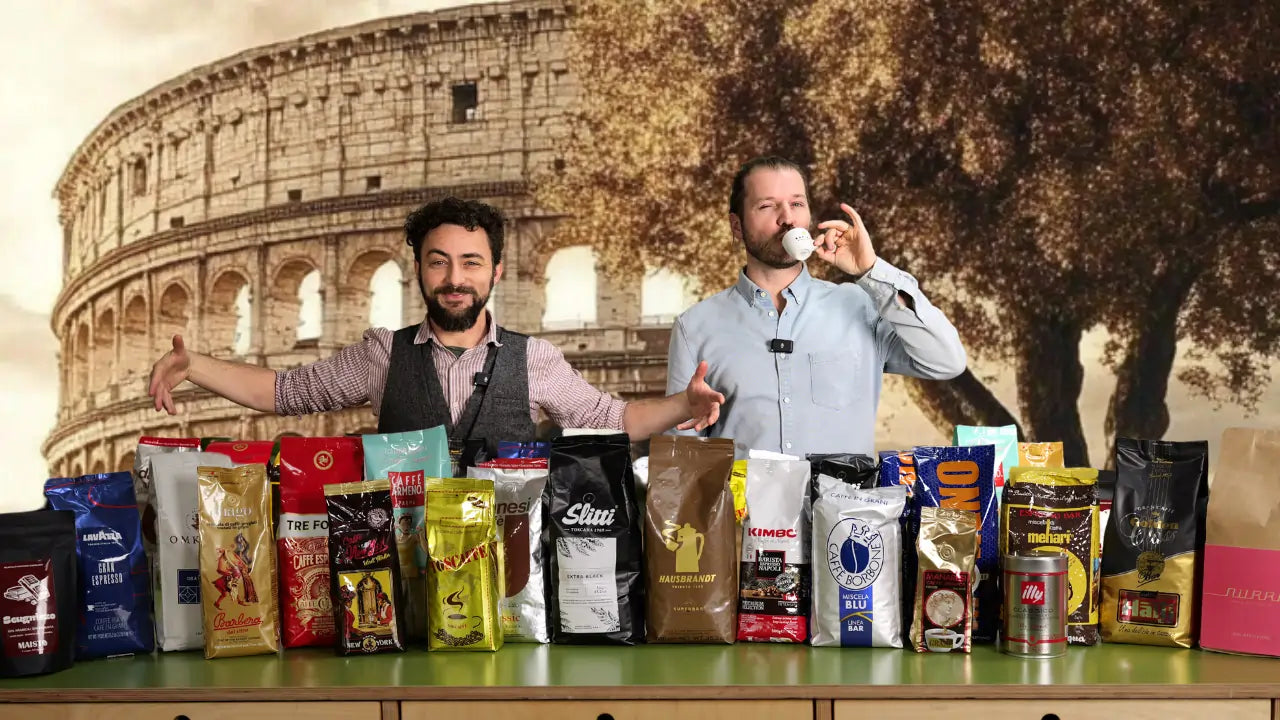

For many coffee drinkers, "real Italian espresso" is the ultimate benchmark. But how does this coffee actually taste? How is it prepared? And which beans are used for it? We tasted your top 20 favorites. Three coffees stand out from the crowd.
We often hear in barista courses that coffee always tastes better as soon as someone takes a trip down south. The claim is that whoever drives through the Gotthard Tunnel or over the Brenner Pass will be treated to a "really good espresso" on the other side.
Is that really true?
It's quite possible that the anticipation, the holiday feeling, the sight of the machine, and well-known bean brands all play into the moment, meaning the espresso is perceived differently than when it is made at home.
Or perhaps the ratio of the amount of ground coffee used to the extraction volume in the cup differs significantly from what is common practice north of the Alps.
So, our goal in this major test was to answer two main questions:
- Which coffees does our community identify as good Italian espresso?
- And how exactly should it be prepared?
Regarding the first point, we asked you in September 2024 which coffees we should taste. Over 2,000 votes were cast. We tracked down the top 17 with the help of Philipp from Vettore, and we had three more coffees selected by connoisseurs of Italian coffee: Philipp Vettore himself, Giovanni Meola, and Antonio Nurri. Regarding the second point, preparation: in our first video from 2019 on Italian espresso, we prepared the coffees on a Nuova Simonelli Black Eagle. Our standard recipe of 18g in and 45g out at a 93°C brewing temperature would not have suited all the coffees, according to the consensus in the comments.
So we invited Antonio Nurri, who traveled to Basel bringing along his own machine (Nurri Leva). Antonio is a coffee roaster in Naples and develops his own coffee machines, which already enjoy a cult status for many.

Antonio was assisted by Gianni Marzinotto, who successfully competed in the Home Barista Championship 2023 organized by us. Together, Antonio and Gianni found individual recipes for all the test coffees and prepared them on the Nurri Leva.
Tasting Criteria and Test Procedure
Extraction
- Individual recipes by Antonio and Gianni on the Nurri Leva
- The test was conducted double-blind: Damian from the roastery team coded the original bags and then gave the test bags a new code. Neither Antonio and Gianni, nor Benjamin and Philipp knew which coffee was being tasted.
Sensory Evaluation - Decisive for the Ranking
In evaluating the overall flavor impression, we distinguish between several criteria:
Good/bad bitterness
There are different types of bitterness. Some are pleasant, while others can inhibit perception. Here we evaluate based on intensity and quality. More about bitterness in coffee in this article and video.
Sweetness-acidity balance
Here we examined the coffee for the ratio of sweetness to acidity. The perceived sweetness in a coffee supports the acidity - the more sweetness we can perceive, the more pleasant the acidity becomes.
Body (Weight) and Texture
The weight or body of the coffee is less than half the battle: we can always brew coffees to be as heavy as possible, but that might come at the expense of texture:
Texture - here we analyze the so-called mouthfeel, i.e., how the coffee spreads on the tongue. If the coffee is silky, creamy, watery, velvety, etc., we reward that with a high score. If the coffee is harsh, dusty, chalky, or mealy, we deduct points.
Aroma Spectrum
Here we describe the variety of aromas. If the coffee sits in the chocolatey range, does it branch out a bit into nutty, or even slightly fruity notes?
Evaluation of Physical Bean Quality
The evaluation of the physical bean quality had no direct influence on the final ranking. Indirectly, however, we rated coffees with a poorer bean appearance lower because physical bean defects can have a marginal to strong influence on the sensory profile.
Broken beans
Does the coffee consist of many broken beans, or do we find none at all? Broken green coffee beans burn during roasting and can introduce strong burnt notes into the cup.

A mixed bean quality with broken beans, husks, craters from hot roasting, and a lot of oil
Oiliness
How oily is the coffee? The more coffee oil appears on the surface, the faster the coffee can become rancid in taste.
Evaluation of Transparency
Just like the physical bean quality, we did not include transparency and sustainability in the sensory ranking, but we examine and evaluate each coffee for these aspects in the individual analysis below.
Roast date
Is the roast date known?
Indication of green coffees
Which green coffees are used, and in what ratio?
Traceability
Is it limited to the minimum specification "Arabica/Robusta"? Who names the countries of origin, or details exactly where the coffees come from?
Certifications
Does the coffee have certifications or not?

In search of transparency
The Results: Best Italian Espresso
We tasted all the coffees in one day. In the end, there were 19 instead of 20, as one package didn't reach us in time. Antonio and Gianni created individual recipes, and Benjamin and I tasted the coffees.
We saw major differences in green coffee quality, as well as in the intensity of the roast. Some coffees fit very well into the notably broad definition of espresso italiano. Other coffees surprised us because we would not have classified them as a "classic Italian espresso."
In this table, you can see the overall winners. Below that is the analysis of the individual coffees.

The Winner: Illy Classico

Sensory Profile:
Floral notes in the aroma give the coffee character. Light to medium body, silky texture. Citric, delicate acidity. Balanced, caramel notes in the finish.
Bean Quality: relatively uniform, some broken beans
Recipe: in: 18.1g, out per cup: 14.7g, Ratio: 1:1.62, Time: 34 sec
Oiliness of the beans: 2/5
Roast date: yes
Indication of green coffees: no, only: 100% Arabica
Traceability: no
Certifications: no
The Runner-Up: Manaresi

Sensory Profile:
Very soft texture with a high balance of sweetness to acidity. Diverse flavor notes, from intense hazelnut, macadamia, and licorice to dried fruit and tobacco. A pleasant aftertaste and a medium roast.
Bean Quality: mostly uniform size, few broken beans, good
Recipe: in: 18g, out per cup: 17g, Ratio: 1:1.89, Time: 20 sec
Oiliness of the beans: 1.5/5
Roast date: no
Indication of green coffees: no, only 100% Arabica
Traceability: no
Certifications: no
Third Place: Omkafè Diamante

Sensory Profile:
Oily texture, dense body. Lots of nougat, dark chocolate, the whole brown sugar spectrum, a touch fruity (stone fruit), long aftertaste with a medium-dark roast and medium acidity.
Bean Quality: very good bean appearance
Recipe: in: 18g, out per cup: 15.6g, Ratio: 1:1.73, Time: 34 sec
Oiliness of the beans: 1/5
Roast date: no
Indication of green coffees: only ratio: 92% Arabica, 8% Robusta
Traceability: no
Certifications: no
Slitti Extra Black - the Robusta-heavy one

Sensory Profile:
Very dark roast with pleasant and soft bitterness. Dense body and creamy texture. Notes of cocoa, caramel, and lots of wood in the aftertaste, caramel-like sweetness. Slightly coating in the finish.
Bean Quality: Oiliness of the beans: 1.5/5
Recipe: in: 18.1g, out per cup: 15.8g, Ratio: 1:1.75, Time: 33 sec
Roast date: yes
Indication of green coffees: only ratio: 35% Arabica, 65% Robusta
Traceability: no
Certifications: no
Caffè Moreno - straight as a line

Sensory Profile:
Very dark roast with tobacco and woody notes. Heavy body. Little complexity and high bitterness, low acidity.
Bean Quality: above average amount of broca and broken beans
Oiliness of the beans: 4/5
Recipe: in: 18.1g, out per cup: 16g, Ratio: 1:1.77, Time: 20 sec
Roast date: no
Indication of green coffees: no
Traceability: no
Certifications: no
Nurri 100% Napoletano - from the South

Sensory Profile:
A lot of creaminess with a dense texture. Notes of dark chocolate, caramel, and cashews. A very long, sweet aftertaste with pleasant, soft bitterness.
Bean Quality: relatively uniform bean appearance, some broken beans
Oiliness of the beans: 2/5
Recipe: in: 18g, out per cup: 19g, Ratio: 1:2.1, Time: 33 sec
Roast date: yes
Indication of green coffees: no
Traceability: no
Certifications: no
Lavazza Gran Espresso - the top dog

Sensory Profile:
Medium body, rather thin texture. Balanced in sweetness and acidity. Simple in the aftertaste with positive bitterness. Few characteristic notes, a lot of roasted almonds. A bit "normal".
Bean Quality: relatively uniform, a few crushed beans
Oiliness of the beans: 3/5
Recipe: in: 18.2g, out per cup: 18.9g, Ratio: 1:2.08, Time: 20 sec
Roast date: no
Indication of green coffees: no
Traceability: no
Certifications: no
New York Extra - hot tobacco

Sensory Profile:
Roasted almonds, cocoa, and woody notes. A strong bitterness with a long aftertaste and standalone acidity. Medium body and somewhat hollow texture.
Bean Quality: broken beans and some craters coming from the hot roast
Oiliness of the beans: 2.5/5
Recipe: in: 18.1g, out per cup: 17g, Ratio: 1:1.88, Time: 26 sec
Roast date: no
Indication of green coffees: no
Traceability: no
Certifications: no
Hausbrandt Superbar - strong and dark

Sensory Profile:
A "strong coffee" - very dark, somewhat sharp aftertaste. Creamy body, dominated by very dark sugars. Bitterness initially soft, then harsh.
Bean Quality: relatively uniform, some quakers
Oiliness of the beans: 3/5
Recipe: in: 18.2g, out per cup: 16.1g, Ratio: 1:1.77, Time: 27 sec
Roast date: no
Indication of green coffees: no
Traceability: no
Certifications: no
Haiti Golden Class - Old, old school from Rome

Sensory Profile:
Medium body with a hollow texture. Acidity is dominant, while dark aromas prevail. Malty and dark caramel notes. The aftertaste seems somewhat burnt, and a chalky bitterness defines the finish.
Bean Quality: relatively uniform, some quakers and broken beans
Oiliness of the beans: 2/5
Recipe: in: 18.1g, out per cup: 20g, Ratio: 1:2.21, Time: 25 sec
Roast date: yes
Indication of green coffees: no
Traceability: no
Certifications: no
Mago Barbera - no balance

Sensory Profile:
A lot of texture with medium acidity. Notes of tobacco and strong roast, some nougat. The acidity doesn't balance the coffee. The oxidized note, together with the intense roasting, gives the coffee a rancid aftertaste.
Bean Quality: quite a lot of broken and crushed beans
Oiliness of the beans: 2/5
Recipe: in: 18.1g, out per cup: 16.2g, Ratio: 1:1.79, Time: 26 sec
Roast date: yes
Indication of green coffees: no
Traceability: no
Certifications: no
Maisto Scugnizzo - dark, oily, is this the South?

Sensory Profile:
A "strong, Italian coffee". Very heavy, darkly roasted. A bit of molasses. Very high bitterness due to the dark roast. A bit salty (Robusta quality?) in the aftertaste.
Bean Quality: partly brittle beans due to dark roast
Oiliness of the beans: 5/5
Recipe: in: 18.3g, out per cup: 13.3g, Ratio: 1:1.45, Time: 28 sec
Roast date: yes - but only month
Indication of green coffees: only 65% Arabica, 35% Robusta on package, but precise on product sheet
Traceability: included in the product sheet: breakdown of green coffees
Certifications: no
Danesi Classic - is classic good?

Sensory Profile:
Very dark roast with high bitterness. Notes of ash, wood, and molasses. No acidity. Heavy body, hollow texture. Sweetish-bitter aftertaste.
Bean Quality: many brittle beans due to the dark roast
Oiliness of the beans: 2/5
Recipe: in: 18.3g, out per cup: 16g, Ratio: 1:1.75, Time: 25 sec
Roast date: no
Indication of green coffees: no
Traceability: no
Certifications: no
Toscaffè Oro

Sensory Profile:
High intensity of Robusta flavor. Acidity not well defined. Medium body, medium texture, long aftertaste with high bitterness. A bit salty.
Bean Quality: some quakers
Oiliness of the beans: 2/5
Recipe: in: 18.1g, out per cup: 14.8g, Ratio: 1:1.64, Time: 28 sec
Roast date: no
Indication of green coffees: no
Traceability: no
Certifications: no
Tre Forze

Sensory Profile:
Dark nougat, dark nuts. A heavy, creamy body with poorly defined texture. High bitterness that carries into the aftertaste. Hardly any acidity.
Bean Quality: relatively uniform, some broken beans
Oiliness of the beans: 2.5/5
Recipe: in: 18.2g, out per cup: 16.3g, Ratio: 1:1.8, Time: 24 sec
Roast date: no
Indication of green coffees: no
Traceability: no
Certifications: no
Kimbo Napoletano - a lot of everything

Sensory Profile:
Dark roast that emphasizes dark sugars. Dark wood in the aftertaste. Roastiness dominates, acidity does not help with balance. Long bitterness in the aftertaste, rather harsh and metallic, little sweetness.
Bean Quality: relatively high amount of broca and broken beans
Oiliness of the beans: 5/5
Recipe: in: 18.2g, out per cup: 14.5g, Ratio: 1:1.6, Time: 28 sec
Roast date: yes
Indication of green coffees: no
Traceability: no
Certifications: no
Passalacqua Mehari

Sensory Profile:
Almost foamy body. Very dark roast notes, ashy, carbon-like, no sweetness left. A hard and chalky bitterness dominates the aftertaste.
Bean Quality: broken beans and some broca as well as green coffee husks
Oiliness of the beans: 5/5
Recipe: in: 18g, out per cup: 13.5g, Ratio: 1:1.5, Time: 28 sec
Roast date: no
Indication of green coffees: no
Traceability: no
Certifications: no
Borbone Miscela Blu

Sensory Profile:
"Straightforward" coffee, high weight, lots of body, somewhat hollow texture. Limited aromatics, hardly any acidity, simple.
Bean Quality: relatively uniform bean appearance
Oiliness of the beans: 4/5
Recipe: in: 17.9g, out per cup: 15.3g, Ratio: 1:1.7, Time: 26 sec
Roast date: yes - but only month
Indication of green coffees: no
Traceability: no
Certifications: no
Caffè Armeno Penelope

Sensory Profile:
"A coffee straight as a line - no left, no right." Hardly any weight. No acidity. A lot of bitterness, a bit grainy. Astringent aftertaste, unpleasant bitterness.
Bean Quality: relatively high amount of broca, craters due to very hot roasting
Recipe: in: 18g, out per cup: 15.6g, Ratio: 1:1.73, Time: 32 sec
Oiliness of the beans: 3/5
Roast date: no
Indication of green coffees: no
Traceability: no
Certifications: no
What is a classic Italian espresso?
There is no clear answer to this. In our survey, coffees were selected that we then tasted blind and did not find to be "classically Italian" in that setting. Strong coffees, darker roasts, lots of body, sometimes with a higher percentage of Robusta and low acidity - we hear these descriptions often.
But precisely the coffees from Manaresi (Rank 2) and Omkafè (Rank 3) do not match this definition. They showed distinct acidity, the roasts were medium-dark, and if there was Robusta in the blend, we couldn't taste it.
One coffee that we described as a "congruent Italian espresso," meaning a coffee where the rather imprecise idea of the category seemed compatible with the product in the cup, was the espresso from Hausbrandt.

In tasting mode
Italian Espresso: dark, darker, darkest?
Not at all. We tasted a whole spectrum of roast levels. Medium roasts from the top 3, as well as medium-dark roasts from Caffè Armeno, Lavazza, Tre Forze, or Nurri, right up to the very dark coffees from Maisto, Moreno, or Passalacqua.
Here too it shows: there is no uniform roast level for what is considered classic Italian espresso.

In addition to oily-dark beans, we also tasted medium roasts
Italian Espresso: Robusta bombs?
Yes and no. We had coffees that showed floral notes (Illy), others that advertised 100% Arabica, and those that worked with high-quality Robusta beans. Some roasteries put Robusta front and center (Slitti), emphasizing the weight and woodiness.
Freshness - Consumers are left in the dark
What is standard for specialty roasteries apparently does not apply to many Italian roasteries: only six out of 20 roasteries precisely stated the roast date: Slitti, Kimbo, Illy, Nurri, Haiti, Mago. Two roasteries at least specified the month: Maisto, Borbone.
Twelve of the 20 roasteries leave consumers in the dark. It is quite possible that you get coffee that is already a year old or much older.
Arabica-Robusta Ratio - hardly any info
Here too, we were amazed at the brand self-perception that seemingly trumps transparency. Only three roasteries noted on the package that they use "100% Arabica" coffees: Illy, Manaresi, Slitti.
If we were to use this specification for wine, it would be as precise as: 100% wine made from red grapes. Surely it can be done better. Only three roasteries detail on the packaging how many parts of Arabica and Robusta make up the blends: Omkafè, Maisto, and Slitti.
Not a single roastery communicates the actual origin of the beans used on the packaging.
A third describes them as "the best beans from the best growing regions in the world" - thereby joining the marketing speak of the biggest supermarket roasteries.
Transparency and Sustainability. Far from it.
Even if certifications do not provide total assurance that the coffee used was sustainably produced, they guarantee a minimum standard. One that all 20 roasteries ignore.
None of the tested roasteries relies on certifications (FairTrade, Organic, Rainforest, etc.), or at least they do not write it on the packaging. Furthermore, all roasteries refrain from describing exactly what kind of coffees are used. Thus, the question of who the coffee actually comes from doesn't even arise. Only Maisto provides a leaflet detailing how the blend is composed.
The data mentioned are superficial, exactly how traders would describe the coffees, giving you an idea of where the coffee comes from, but not exactly from whom. Even if this is little by 2026 standards, it is a lot and commendable in this panel.
Almost all tested espressos in this panel, from small and larger roasteries, thus rely exclusively on their brand strength as a guarantor of good work.
This is surprisingly anachronistic in the year 2026 and shows how much catching up there is to do.
We wish roasteries would show significantly more awareness for sustainability issues and their communication.
Conclusion
We tasted a limited selection of Italian coffees, but clearly saw that there is hardly any inner coherence of a distinct category. We also know that the Italian coffee world goes far beyond the 20 tasted espressos.
Large roasteries scored very well to good in our test. This is a testament to the fact that these companies invest heavily in the consistent quality of green coffees, standardizing quality controls, and perhaps prioritizing consistency over story.
Smaller roasteries often get some advance praise and thrive on the charm inherent in smaller enterprises. However, this charm is not perceptible in a blind tasting. That is where the qualitative wheat is separated from the chaff. We had coffees from smaller roasteries that selected very good green coffee and roasted it precisely. Likewise, we had coffees from smaller (and also larger) roasteries that selected mediocre green coffee and roasted it either very fast or very hot, so that sometimes only the roast notes dominated.
Sugar
We tried all coffees without sugar. Because sugar masks the quality of the coffee. As long as a coffee is only enjoyable with sugar, the feeling and brand loyalty significantly outweigh pure sensory analysis.
We were amazed at how little a role transparency and sustainability play with the selected coffees. Many supermarkets act more transparently here by putting the roast date on the package. The roast date must be a no-brainer, regardless of the type of coffee. We did not have a single coffee that was advertised with a certification - at least not on the packaging.
Even "Italian espresso" is made of coffee beans. And all roasteries are confronted with the same challenges facing the coffee industry. Therefore, we wish for a greater shift towards transparency and understandable, assumed responsibility along the coffee supply chain.
Next time 30 espressos?
The 19 tasted espressos provided a snapshot of what is consumed and appreciated as Italian espresso. We remain interested and open to gaining a comprehensive picture - as diverse as it may be - of Italian espresso.
So if you are missing a coffee in the list now, feel free to write in the comments what we should taste next time. And perhaps in a few years, it will be 30, instead of 20.