



























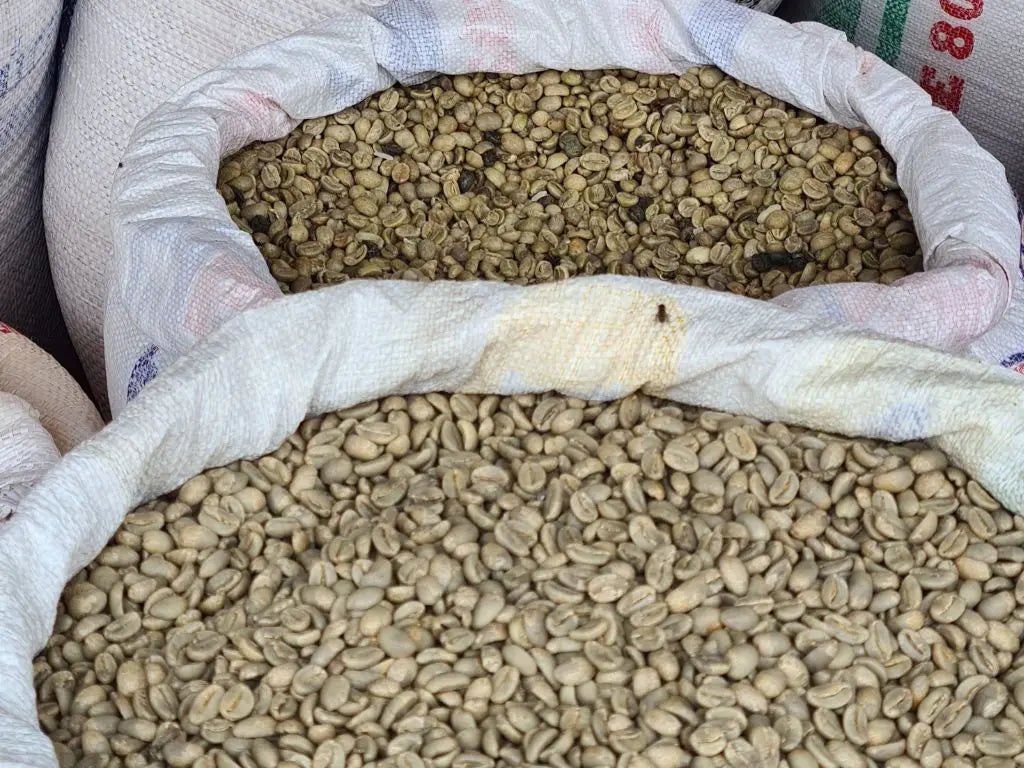

Most coffee roasters do not disclose where their raw coffees come from. Instead, communication is dominated by brand names or emotions. The fact is: almost all roasters buy and roast the same raw coffees as everyone else. We give you tips on how you can still get an idea of what you're drinking.
When we conducted our second tasting of Italian espresso, we noticed how hardly any roastery declared the origin of the coffees they used. Instead, there was talk of "balanced blends" and "carefully selected" raw coffees.
And this is not an isolated case.
This applies to very many coffees that are drunk daily in Germany, Switzerland and throughout Europe. So if no information about origin is provided – what are we actually drinking?
Many forego transparent origin disclosure. No country, no region, no farm, no processing method. Why exactly?
Why origin is not stated
There are several reasons why roasters skip origin information.
Flexibility in blending:
The components of a blend can be adjusted depending on market availability and price fluctuations. This substitution is common practice. As long as the coffee tastes the same, coffees are swapped. Especially in times like now, when prices have risen sharply, blends are reformulated to compensate for price increases.
Sensorily, there must be no deviation, but in terms of content, especially the constantly available blends look different again and again. A classic example of this is the substitution between washed coffees from Honduras and Peru: in both countries, coffee is processed washed for large volumes. The general character of both coffees is similar, with nutty and citric notes to the fore.
These coffees are often described as "cheap acidity component" - at least before November 2024, before prices rose sharply. Additionally, Honduras is on the northern hemisphere and Peru on the southern hemisphere, so the harvest times are staggered. Ideally, there is always fresh coffee from these countries, which makes substitution even easier, but above all increases procurement flexibility.
Branding takes center stage – not the content
We are repeatedly amazed by a brand self-concept that apparently trumps transparency. There are indeed roasters that specify a blend ratio based on the species used, mostly Arabica and Robusta.
We then read, for example, "100% Arabica" - if we used this specification alone for wine, it would be as precise as: 100% wine from red grapes. That could be better.
Even more superficial, however, is this description: coffee with "the finest beans from the finest growing regions of the world". This is not only very simplified marketing speak, above all it is remarkably anachronistic in 2025 and leaves consumers in the dark.
No accountability to consumers
Neither Switzerland nor the EU has an obligation to disclose the exact origin (country, region) or variety, cultivar or processing on the coffee package, as long as no misleading information is provided.
However, if an origin is voluntarily stated, it must be correct. It is permissible to name a superordinate geographic area (such as "South America") instead of a country. The statement "100% Arabica" is permitted, provided it is true.
Transparency is voluntary, but if stated, then correct and not misleading. The EUDR deforestation regulation that takes effect in 2026 does require transparency, but only between the person placing the product on the market and EU authorities.
The regulation requires importers and traders to be able to prove the exact origin (down to the plantation) to exclude deforestation. However, this information does not necessarily have to appear on the packaging for end customers, and no roastery will likely handle it that way.
What we can still (find out)
Even if the package says nothing, contextual knowledge, sensory analysis and two solid sources help clarify the picture: The 2024 Coffee Report by Brand Eins and Tchibo shows which countries export the most coffee. And the European Coffee Report 2023/24 proves:
Over 58% of coffee imported into Europe comes from just two countries: Brazil and Vietnam.
This is hardly surprising, since Brazil and Vietnam are the world's largest coffee producing countries. Brazil produced 66.4 million 60kg bags of coffee, Vietnam 30.1 million. Or put another way: Brazil produced 38% and Vietnam 17% of global coffee production. Following are Colombia with 7% and Indonesia with 6% (see statistics).
Coffees from Brazil and Vietnam are therefore used almost universally in most coffee products. It should be noted that Vietnam exports almost exclusively Robustas, and Brazil is the largest Arabica producer but the second-largest Robusta (Conilon) producer.
Looking at the statistics in the European Coffee Report, we can read a lot.

Germany imported the most coffee of the 27 EU states; from 2021-2023 it was almost 34% of all imports into the EU. Some of the largest roasters such as Tchibo, Dallmayr and Co. are in Germany and purchase coffee. Italy is the second-largest importer and purchased 23.5% of all raw coffee into the EU during the same period. Belgium, Spain and the Netherlands follow.
The largest importers in the EU
Germany, Italy, Belgium, Spain and the Netherlands accounted for more than 82% of total raw coffee imports to Europe in 2023. The largest roasters in the aforementioned countries are:
- Germany: Tchibo, Jacobs Douwe Egberts
- Italy: Lavazza, Illycaffè
- Belgium: Miko Coffee
- Spain: Cafés Candelas
- Holland: Douwe Egberts
Savings on raw coffee - a "race to the bottom"
This graph is particularly interesting, as it says much about the competitive pressure between coffee roasters. From 2021-23 we see a sharp decline in imports of Brazilian coffee and a sharp increase in coffee from Vietnam on the other side.

What does this mean?
Since largely Arabica coffees from Brazil are imported into the EU, these were apparently replaced with Robusta from Vietnam. And because the latter became progressively cheaper over the same period, it's clear that not only was sensory quality adjusted, but especially costs.
But today it looks different: Robusta became more expensive and is now twice as expensive as Arabica from Brazil in 2023. Compared to this, Robusta is still cheaper today.
If nothing is stated on the package, the probability is very high that the roasted coffee comes to a large extent from Brazil and Vietnam.
Uganda ranks third with 7.8% among the most imported coffee origin countries.
Over 70% of Robusta is produced and exported in Uganda - so here too there is reason to suspect that it is partly price reasons why Uganda is so important for the EU market. On the other hand, we see much more bio-certified cooperatives in Uganda. Therefore: bio-certified Robusta in Germany comes largely from Uganda.
Commodity versus specialty
The import data also show: countries like Ethiopia, Guatemala, Mexico or Costa Rica also export to the EU. However, in significantly smaller quantities, and often for the specialty market.
What makes coffee from these countries special?
Ethiopia
- is famous for floral and fruity coffees. In Ethiopia, coffees are divided by grades, with Grade 1 coffees representing the highest quality
- for the mass market, Grade 3 and Grade 4 coffees are often used, which are less uniform and clean, but still retain the original taste characteristics
- often just a few percent in a blend is enough that the coffee smells noticeably different, especially in aroma, and thus stands out from the crowd
Peru, Honduras, Mexico
- are among the leading exporters of dual-certified (organic and fair trade) coffee. These are typically washed, citric coffees, and are often substituted
But: what about Colombia, as the third-largest coffee producing country?
Switzerland in comparison
The graphic from the Swiss Sustainable Coffee Platform shows: in Switzerland too, most coffee comes from Brazil, but the structure is significantly more diverse. And: much less Robusta is imported.

Colombia ranks second. We suspect Nespresso, one of the world's top three roasters, is responsible for this. Since Nespresso's introduction in 1986, according to our own research, 120 to 150 capsule varieties filled with Colombian coffees have been released.
Colombian coffee is very diverse, can be floral, fruity, chocolatey, light and heavy, and offers great variety for a diverse product range.
Vietnam ranks third, but is closely followed by India at 7%. Here we suspect that mainly washed Robusta is imported, which is usually softer than dry-processed Robusta from Vietnam.
Costa Rica and Guatemala also appear earlier. These are coffees that are not only more expensive, but carry a special story for many roasters.
Especially Costa Rica is also a popular travel destination for Swiss tourists - it's quite possible that here imagination, wanderlust and consumer behavior meet.
Why origin information matters
In very few cases, and this applies across all European countries, is the exact origin communicated. We increasingly see a "regional" limitation, for example: coffees from Central and South America.
With wine, no one would accept having only "from Europe" on the label.
With coffee, that seems to be acceptable.
But precisely because of this, roasters avoid transparent communication, because:
- No origin = no retention
- No story = no connection
- No transparency = no control
Whoever doesn't say where the coffee comes from leaves themselves open to swap at any time – without firm commitment to transparency or long-term partnerships. Yet there are real opportunities here: whoever tells the individual stories can reach an even broader audience.
Tips on how you can guess the contents
If nothing is stated on the package, we know roughly what's in it anyway.
Not in detail, but in pattern:
Dark roasted, communicated as "strong" coffees:
- often coffees from Brazil and Vietnam – efficiently produced, inexpensively sourced, interchangeable.
- the coffees have little acidity, offer a nutty flavor profile, and the Robusta provides the classic espresso note
Milder coffees
- often with washed coffees from Peru or Honduras, because on the one hand they are sensorily interchangeable, cheaper and bring a citric acidity that is especially attractive for longer coffees
Organic and fair trade coffees
- often from Peru, Honduras, Mexico, Tanzania and Uganda
- that's where the largest dual-certified coffee cooperatives are located
If we know this, we can make more conscious decisions. And perhaps buy the next coffee from somewhere else, where origin is more than an empty promise.
Annex: Legal situation
Legal situation in Switzerland:
- There is no general obligation to state the exact origin of coffee beans (e.g. country, region) on the packaging. The statement "100% Arabica" is permissible as long as it is correct and actually contains only Arabica beans
- However, if an origin is declared (e.g. "from Peru" or "from South America"), this information must be correct and not misleading. False or deceptive statements are prohibited and are monitored
- Swiss origin statements ("Swiss coffee") may only be used if the beans have been fully processed in Switzerland. The origin of the beans themselves need not necessarily be stated, as long as there is no misleading Switzerland association
- For processed foods (such as roasted coffee), it is permissible to state a superordinate geographic area (e.g. "South America") instead of a country, provided this corresponds to the facts
- The variety (e.g. Arabica, Robusta) need not necessarily be stated, unless it is advertised ("100% Arabica"), in which case it must be correct.
Legal situation in the EU
- The EU also has no general obligation to disclose the exact origin of coffee beans on the packaging. Statements such as "100% Arabica" are permissible as long as they are correct
- If an origin is voluntarily stated, it must be truthful and not misleading
- Since 2020, the origin of the "primary ingredient" must be declared if it does not match the stated origin of the product. Example: If a coffee is sold as "Made in Germany" but the beans come from Brazil, the origin of the beans must be stated. For pure coffee without such claims, this obligation does not apply.
- The new EU deforestation regulation (EUDR) requires importers and traders to be able to prove the exact origin (down to the plantation) to exclude deforestation. However, this information does not necessarily have to appear on the packaging for end customers
Sources:
- Noerr: Special origin information with protected geographic indication
- Gastrosuisse: Declaration
- LW-RK: State origin information on packaging correctly
- Focus-Swiss: Swissness for SMEs
- BMEL: Obligation to provide origin information for pork, sheep, goat and poultry meat
- CMS-Deutschland: National special obligations in origin labeling
- Delikatessen-Schweiz: The secret of the perfect café crème
- BLV: Explanations on the EDI regulation concerning
- Information about food (LIV)
- BMEL: EU-wide uniform food labeling
- Official Journal of the European Union: REGULATION (EU) No 1169/2011 OF THE EUROPEAN PARLIAMENT AND OF THE COUNCIL
- WKO: Food Information Regulation (LMIV)
- KVG: FAQ on the application of Regulation (EU) No 1169/2011 concerning consumer information on foodstuffs-LMIV

