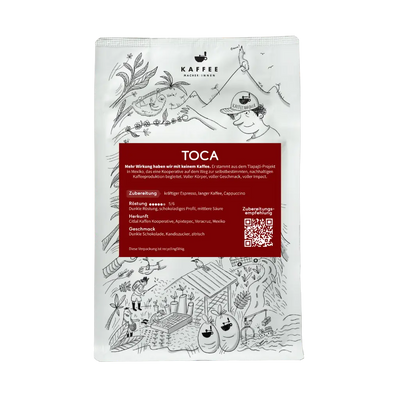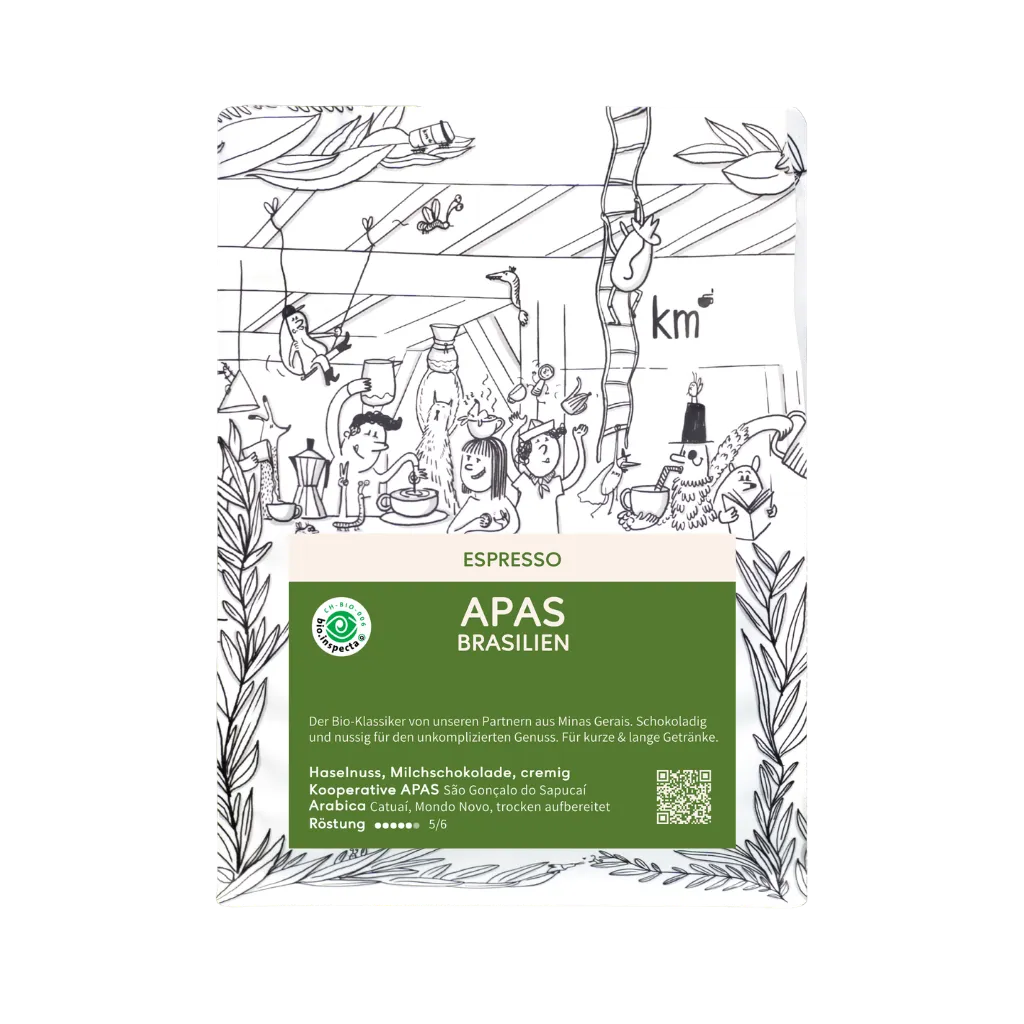

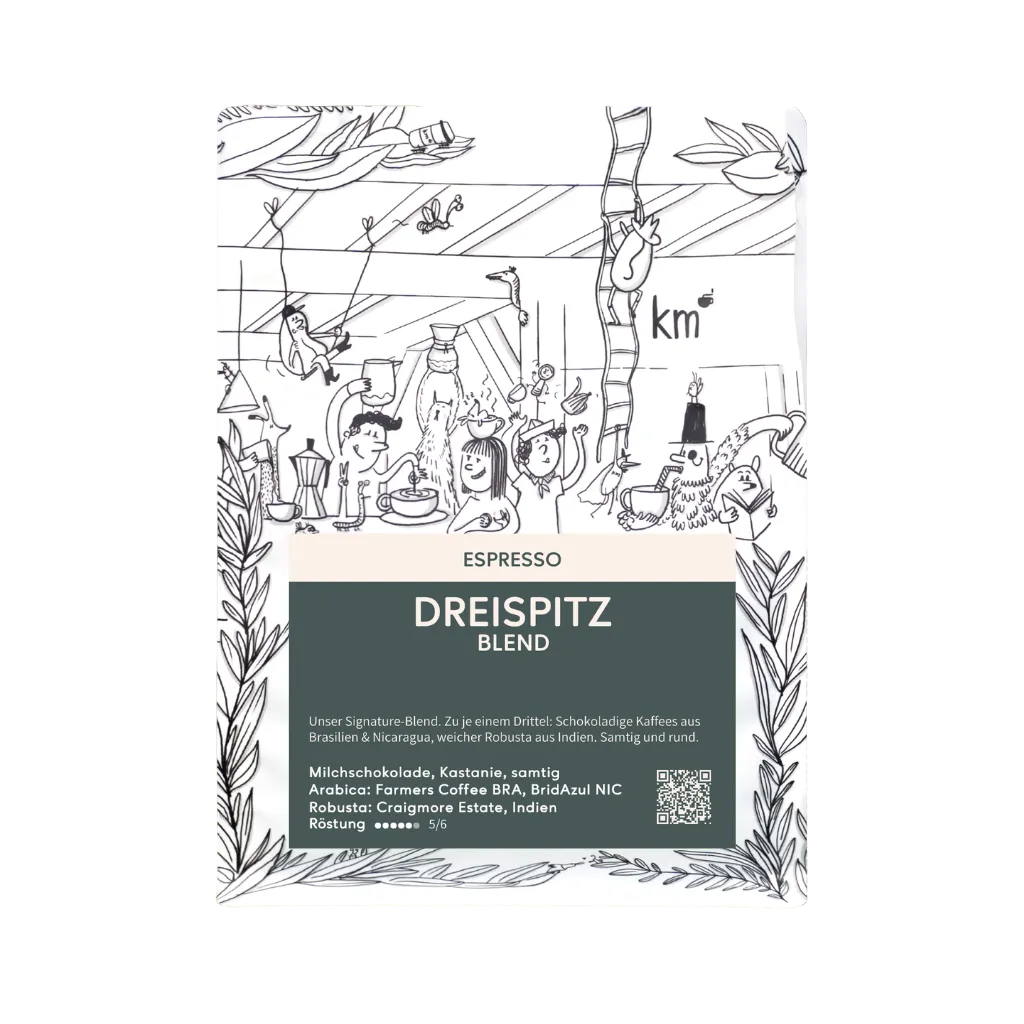

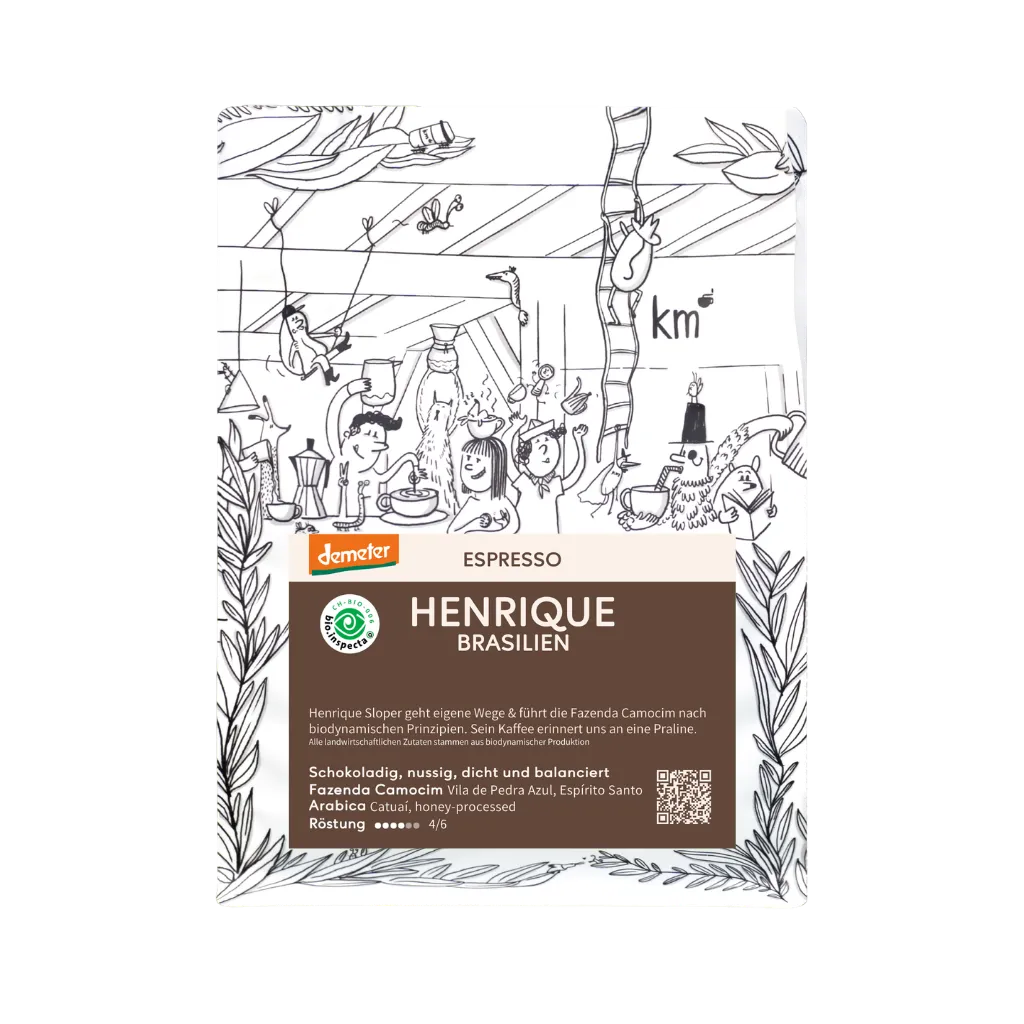

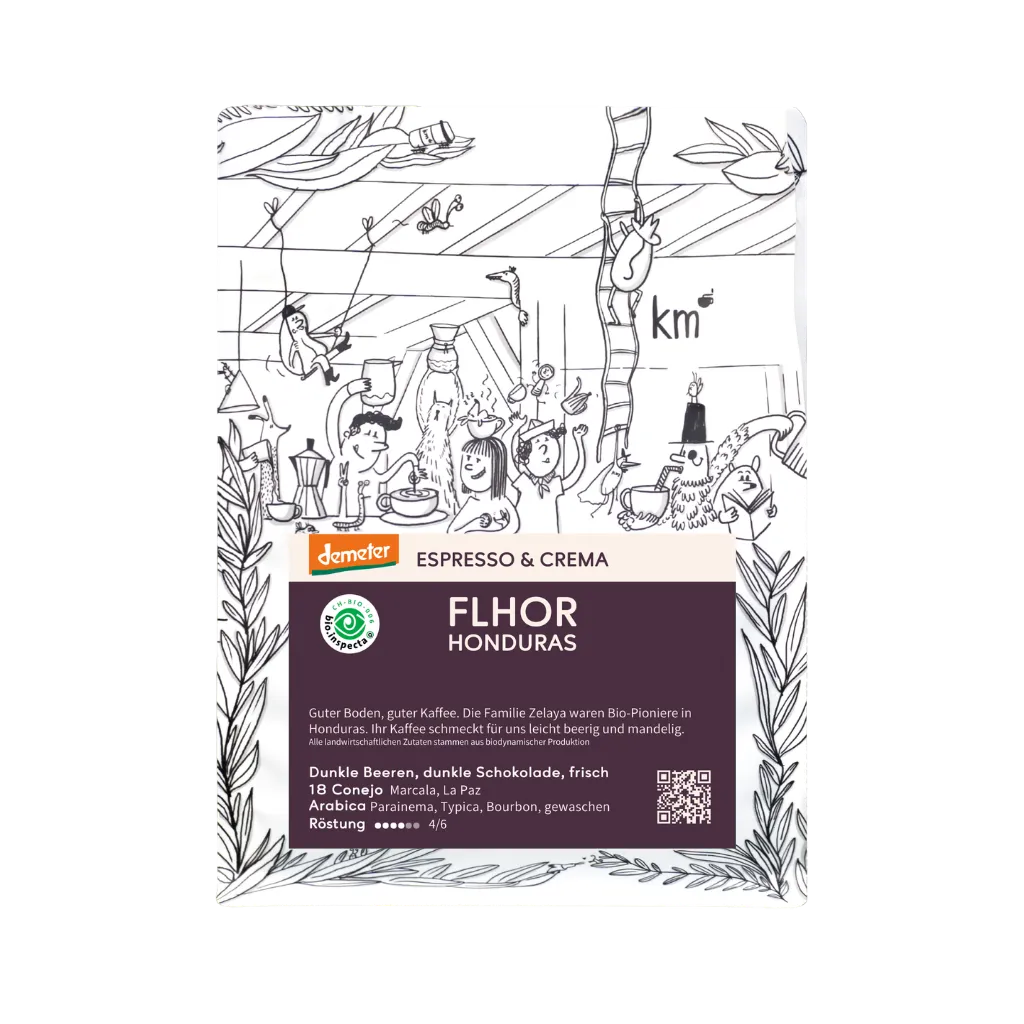





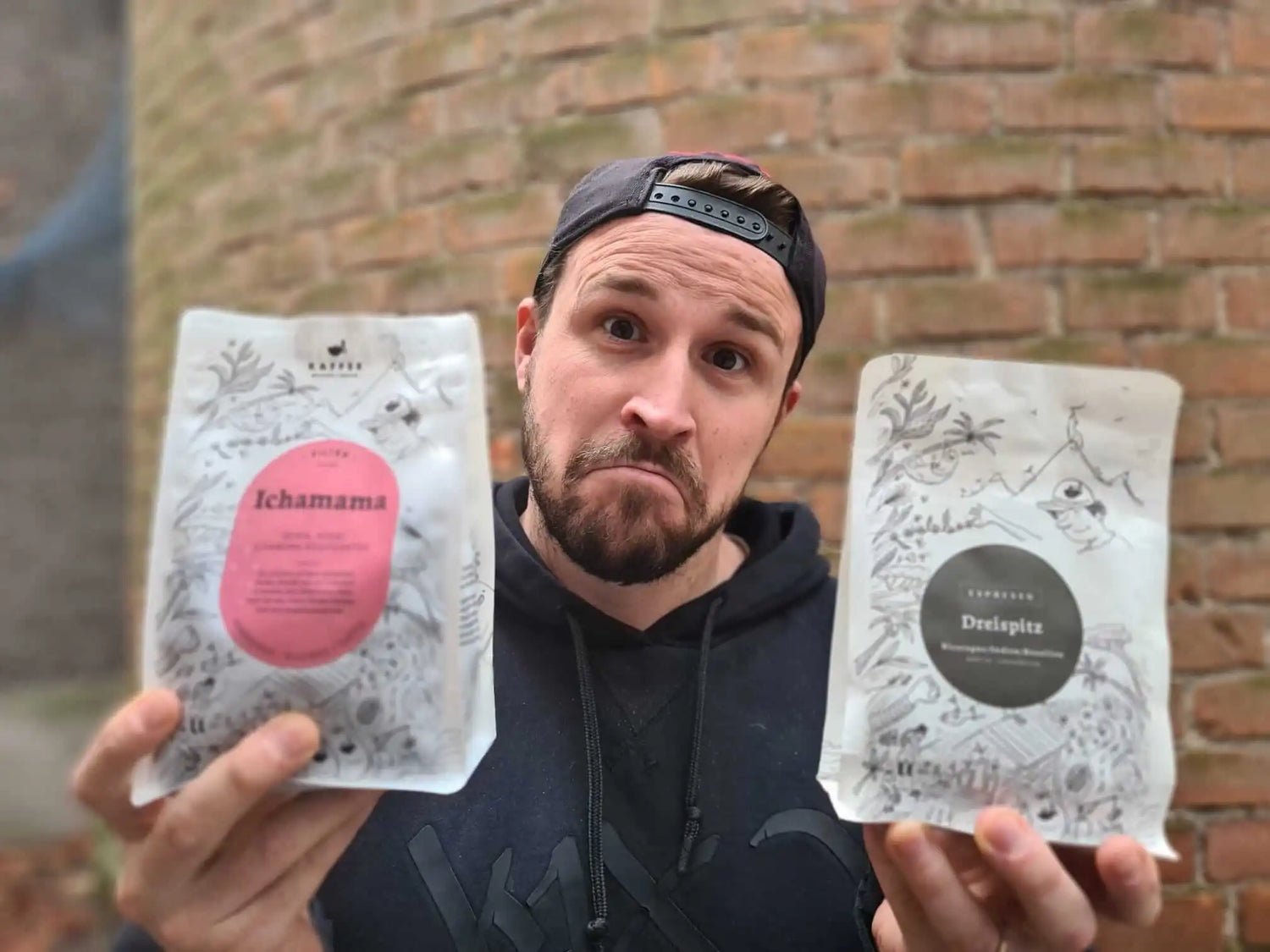
What is the most sustainable coffee packaging?We switched our coffee bags from paper-plastic composite to mono-plastic. These are apparently considered more sustainable. But how sustainable are they really? We compared.
First of all: there's still a long way to go to truly sustainable packaging. We found that not much has changed with the new packaging, at least as far as our carbon footprint is concerned.
After our packaging ran out, we faced the question: Can we improve in this area? After conversations with suppliers and online research, we decided on mono-plastic packaging as a more sustainable solution.
In the meantime, we continued searching and strengthened our efforts in the area of sustainability. Through internal CO2 measurement, the topic of packaging came back into focus, as it accounts for approximately 55% of the roastery's emissions (The measurement already refers to the new packaging). This still corresponds to approximately 4% of emissions across the entire chain. (Reference to an average of conventional coffees from Brazil between 2001-2014. Source: ecoinvent)

What is plastic?
Plastics are made from crude oil (also partly from natural gas).
When crude oil is distilled, it produces raw gasoline, also called naphtha. This is converted through cracking into ethene, propene and butene. From which various plastics can be made. (There are different processes in all steps, but we don't want to get into too much detail here.)

Mono-plastics for coffee packaging are typically plastics based on polyethylene (PE) or polypropylene (PP).They are considered sustainable because, unlike all composite materials (paper/plastic, plastic/plastic, aluminum/paper, etc.), they have a major advantage: they are recyclable.
This means composite packaging ends up in waste incineration, mono-plastic packaging, perhaps not. Perhaps the argument for sustainable packaging is mainly based on this. Hence the big question: how many of our packages are actually recycled and how?
Carbon Footprint: New vs. Old Packaging
For more on CO2 and climate change, check out here. For reference: CO2e stands for CO2 equivalents and converts the impact of all greenhouse gases into CO2.
This metric makes it easier for us to compare carbon footprints. However, it also carries the risk of becoming too fixated on it, keyword: carbon tunnel (More on that another time.)
Carbon Footprint of Individual Materials
First, we look at the emissions of individual materials. To be meaningful, it would not be correct to only consider the production of individual materials, but every processing step, as well as disposal, must be taken into account.
Therefore, we rely here on ecoinvent, a life cycle assessment database with which processes and procedures can be created using LCAs (Life Cycle Assessments), and a study on "Climate Benefits of Material Recycling*)

| Material | Production Emissions |
Recycling Emissions |
Disposal/Incineration Emissions |
| LDPE |
2.14 |
0.7 |
2.7** |
| LLDPE |
1.91 |
0.7 |
2.7** |
| PP |
1.9 |
0.7 |
2.7** |
| PET | 2.83 | 0.7 | 2.7** |
| Glass* |
0.9 |
0.5 |
|
| Aluminum* |
11 |
0.4 |
0.2 |
| Paper & Cardboard* |
1.1 |
0.7 |
0.2 |
This means that for 1 kg of our mono-LDPE packaging (which corresponds to approximately 70 250g packs), 2.14 kg CO2e /kg is produced in the production of raw material.
We could not find exact data for further processing, so we rely on a data set in ecoinvent for the production of packaging film. Thus, further processing accounts for 0.82 kg CO2e /kg.
We do not include another life cycle and its associated emissions. What we found is that sorting, washing, and melting result in an additional 0.7 kg CO2e per kg. (Source: ecoinvent) Add to this further processing.
What is Recycling?
Recycling reuses waste and returns it to the economic cycle. In Germany, recyclable materials are collected in yellow bags and then processed further. This means they are sorted, cleaned (e.g., labels are removed), and then melted down so they can be reused. A distinction is made here:
- Reuse: Multi-way bottles can be filled up to 50 times
- Material recycling: PET bottles can be melted down and then made into new PET bottles
- Energy recycling: waste incineration. Not counted in the recycling rate
The sale of recyclable material abroad is counted in the quota.
Differences in Recycling between Switzerland and Germany
In Germany, packaging waste is separated in the so-called dual system and collected nationwide ("Yellow Bag"). As a company, we are obliged to finance this system through contributions as producers of packaging put on the market.
In Switzerland, work is being done on a nationwide collection and recycling system «Collection 2025». Currently, there is no uniform system here yet.
Note 1: In general, the incentive for plastic recycling is low because it causes higher costs and efforts than the production of new material.
Note 2: The recycling code serves as a marking and is intended to help consumers with sorting.
Detailed information on recycling can be found here.

Is Mono-Plastic Better Than PET?
Does mono-plastic have a recycling rate like PET bottles (92% ***) or does the quota of the German dual system (63% ****) apply, or the German plastic packaging quota of 2020 (46.2% *****) or the worldwide quota from the OECD report (9% ******)?
What is the Carbon Footprint of the New Packaging Depending on the Recycling Rate?
We now calculate the footprint depending on the different recycling rates. By proportionally excluding disposal from the calculation for further processing.
| Recycling Rate | Emissions per kg |
Emissions per Package |
| 100.00% |
2.96 |
0.042 |
| 93.00% |
3.15 |
0.045 |
| 63.00% |
3.96 |
0.057 |
| 46.20% |
4.41 |
0.063 |
| 9.00% |
5.42 |
0.077 |
What do these numbers tell us? On their own, they only tell us that a high recycling rate is better than a low one. Fair enough.
Interim Result: Our bag has a carbon footprint of 0.063 kg CO2e per bag at the current recycling rate in Germany
What is the Footprint of the Old Bag?
Our old packaging consisted of:
| Material | Weight in g/m² | |
|
Paper |
40 |
27.97 % |
| PET |
16.8 |
11.75 % |
| PE |
76.8 |
53.71 % |
| Valve | 0.67 |
0.47 % |
| Adhesive and Paint | 8.42 |
5.89 % |
| Zipper |
0.31 |
0.22 % |
| Total |
143 |
This results in 4.49 kg CO2e /kg which corresponds to 0.064 kg CO2e per 250g pack

You can see that the paper content has a positive impact on the carbon footprint because it produces a much lower footprint both in production and in incineration.
The more plastic in the packaging, the higher the emissions.
Are Our New Bags More Sustainable Than the Old Ones?
With the paper content of the old packaging at 28% and Germany's current recycling rate, we improved by 54g CO2e per kilogram of packaging. This corresponds to approximately 0.77g CO2e per 250g package.
| Germany Recycling Rate 2020 | Emissions Old Packaging |
Emissions New Packaging |
| 46.20% |
64.257 |
63.481 |
However, transport is not considered in this analysis, and processing into mono-LDPE film appears to be more energy-efficient compared to the production of the stand-up bag with zipper and valve.
What is the Most Sustainable Coffee Packaging?
We still have not been able to answer the following questions. New ones come up every day. We are working on gathering information and continuously updating this blog. If you also have questions about sustainable coffee packaging, information, tips, and addresses, please share them in the comments.
- What are realistic values for recycling coffee packaging?
- How does transport affect the carbon footprint?
- What are the actual emissions in the production of the packaging?
- How many times can our packaging be recycled?
- What are the emissions for reprocessing?
- What are the life cycles of recyclates and their carbon footprints?
Additionally, we have not considered what other impacts plastic has (environmental pollution, water consumption, land-use change, etc.), and the fact that even if it doesn't end up in incineration, the negative impacts on the environment are enormous. Here, the worldwide recycling rate of the OECD is alarming and becomes even more alarming when you consider worldwide plastic production of 367 million tons *******.
Our goal, therefore, must be to avoid plastic wherever possible and, whenever possible, separate waste to achieve high recycling rates.
We have had the new packaging in circulation for a short time and are now searching for better alternatives suitable for our coffee while these packages are being used up. Compostable PLA? BIO-PE, single-use or multi-use glass, paper?
Sources
* Hillman, "Climate Benefits of Material Recycling", 2015, as of: 18.11.22
** DIW, "On the Way to Climate Neutrality: Plastic Recycling Must Come Into Focus", 30.06.21, as of: 18.11.22
*** BVSE, "PET BEVERAGE BOTTLES: HIGH RECYCLING RATE AND INCREASING USE OF RECYCLED MATERIAL", Nov. 20, as of: 18.11.22
**** Nörr, "Has the Dual System Failed at Plastic Recycling?", 14.02.2022, as of: 18.11.22
***** Burger, "Generation and Disposal of Packaging Waste in Germany in 2020", Sept. 2022, as of: 18.11.22
****** Zeit, Only Nine Percent of Globally Used Plastic is Recycled, 22.02.2022, as of: 18.11.22
******* Statista: "Global and European Plastic Production in the Years from 1950 to 2020", 2022, as of: 18.11.22