























An attempt at a simple explanation
Let's start at the very beginning to understand climate change and its background. When we talk about climate change today, we're actually talking about human-caused climate change. Climate change existed before humans too. It's the human-amplified climate change that presents us with the greatest challenges.
The greenhouse effect, created by the atmosphere, ensures that Earth's surface temperature is 16 °C. Without an atmosphere, it would be -18 °C. This and other conditions first made it possible for life on Earth to emerge.

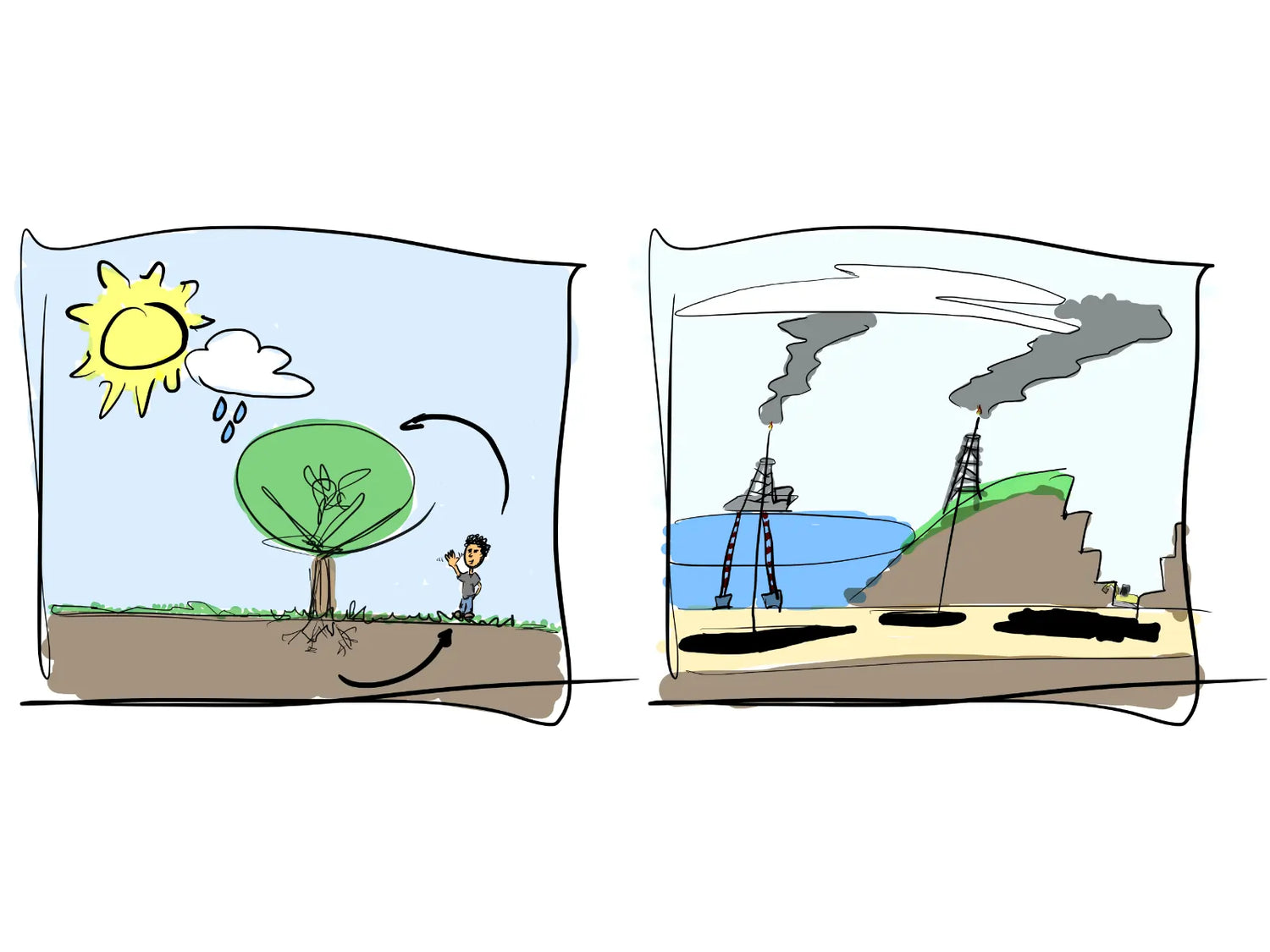
By burning fossil fuels, the carbon cycle is thrown out of balance. So many greenhouse gases are emitted that more carbon dioxide accumulates in the air than plants and oceans can absorb. The excessively high carbon dioxide concentration leads to an increase in Earth's surface temperature.
Factors for the emergence of life on Earth
When the universe was created, all elements were already present in atomic form. Through gravity and other forces, stars and planets formed, including our Earth.
What is the habitable zone?
The habitable zone is the region where planets are capable of holding water in liquid form, which is a prerequisite for life. Earth, along with Venus and Mars, is in the habitable zone of our solar system. Habitable zone is another term for the life-friendly zone. However, only Earth was capable of binding water vapor long-term due to its composition. On Venus, the volatile components were split off by the Sun's UV radiation, and the water evaporated. Mars has too little mass, so gravity didn't have enough force to bind the water vapor. (Mars: 3.69 m/s², Earth: 9.81 m/s²)

Water - How it came to Earth?
Through collisions with asteroids, which mostly contained water in frozen form, water accumulated as water vapor on Earth. At that time, Earth was still a glowing sphere and as more water arrived, atmospheric pressure and temperature dropped. This caused much water to fall as rain on Earth, and oceans and seas formed.
The collision with the protoplanet (a designation for a precursor to a planet) Theia not only brought water to Earth.
The formation of the Moon
The Moon formed from the collision with Theia. Theia was a body roughly the size of Mars. The chunks broken off from Earth and Theia collected in Earth's orbit and coalesced into the Moon.
This slowed Earth's rotation speed from 3 to 4 hours to 24 hours. Correspondingly, the winds that previously swept across the Earth's surface at up to 500 km/h decreased. This corresponds to an F5 tornado.
F5 - Incredible Damage - Wooden houses are torn from their foundations, moved far away, and torn apart. An F5 tornado can peel asphalt off the road.
- https://de.wikipedia.org/wiki/Fujita-Skala
Additionally, the rotation axis stabilized at 23.4° to the ecliptic (ecliptic = planetary plane; designation of the plane of the planets' orbits around the Sun).
The atmosphere and greenhouse gases
Earth's atmosphere consists of five layers, with the lowest one known as the homosphere or colloquially as air. It is made up of various substances.
| Gas | Percentage |
| Nitrogen | 78.08 % |
| Oxygen | 20.95 % |
| Argon | 0.93 % |
| Carbon dioxide | 0.04 % |
Even though carbon occurs in small quantities, as the most common greenhouse gas, it has a large effect on the climate.
As early as 1856, Eunice Newton-Foote conducted an experiment in which two glass flasks were placed in the sun. One contained "normal" air and the second contained carbon dioxide. Both heated up, the one with air to 37.8 °C, the one filled with CO₂ to 49 °C.
This is because CO₂ molecules are set into vibration by solar radiation and the associated energy, and later release this energy in random directions, thus also back toward the Earth's surface. This applies to the other greenhouse gases as well.
CO₂ is the most frequently occurring and most stable greenhouse gas, which is why the others are usually summarized in CO₂ equivalents (kg CO₂e or kg CO₂eq). CO₂ is created by the decomposition and burning of carbon-containing compounds.

| Greenhouse gas | Warming potential (GWP in CO2e) |
| Carbon dioxide (CO₂) | 1 |
| Methane (CH4) | 25 |
| Nitrous oxide (N2O) | 298 |
| Partially halogenated fluorocarbons (HFC) |
124 to 14,800 |
| Perfluorinated hydrocarbons (PFC) |
7,390 to 12,200 |
| Sulfur hexafluoride (SF6) |
22,800 |
| Nitrogen trifluoride (NF3) |
17,200 |
Explanation using methane as an example
Two factors determine the influence of a gas on climate warming:
- Retention time and
- Radiative forcing of the gas.
This determines the influence.
For the calculation, the warming potential is considered over 100 years (GWP-100). If it were only considered over 20 years, the factor would be even more extreme.

The carbon cycle

Carbon is life - chemistry is divided into two major fields:
- inorganic chemistry with approximately 200,000 compounds (without carbon) and
- organic chemistry with approximately 20,000,000 compounds, all containing carbon. The human body consists of 60% water and 9.5% carbon. Carbon is therefore the main component in the body, alongside oxygen and hydrogen.
The carbon cycle describes the exchange of carbon between animals and plants. For a simple illustration, we consider human metabolism (cellular respiration) and plant photosynthesis.

During photosynthesis, the plant converts water and carbon dioxide into sugar and oxygen with the help of solar energy. While in human metabolism, sugar and oxygen are converted into carbon dioxide, water, and energy.
Expanding further, we now excrete carbon-containing compounds that are decomposed by fungi and microbes. If this conversion takes place anaerobically, methane is produced, which is converted to CO₂ over time. If it takes place aerobically, CO₂ is produced directly. (This decomposition process occurs in us and is also the reason why cows have such a high CO₂ footprint.)
This cycle also occurs in water (lakes and oceans), as well as between the spheres. (Hydrosphere, biosphere, atmosphere)
When plants and animals die, carbon compounds settle, and over millions of years, under the influence of pressure and heat, fossil fuels form. Oil and gas form in the ocean; coal forms on land.

(Anthropogenic) climate change
Earth is constantly subject to climate fluctuations. Since its formation, there have been warmer and colder periods. Since the last ice age about 12,000 years ago, the climate was relatively stable. Only since 1980 has a sharp increase in mean atmospheric temperature been observed.
Carbon dioxide plays a particularly important role in this (see chart), which is created by burning fossil fuels to generate energy. Combined with humanity's increasing energy demand, CO₂ emissions rose from 2 gigatons in 1900 to 34.8 gigatons in 2021 (maximum 2017: 37.1 Gt).

Feedback processes and tipping points
The increase in temperature and changes in climate can lead to effects that further amplify these changes. This amplification effect is particularly dangerous for humanity, especially when tipping points are exceeded. Tipping points are events that can no longer be reversed once they are crossed. The environment's reactions to climate changes are completely natural, but cannot be reversed and can make the planet uninhabitable for humans.
3 examples of these feedback loops are:
Reduced albedo (= reflectivity of a planet/body)
As ice surfaces melt, incoming solar energy is no longer reflected directly by the white surface but is absorbed by the dark ocean surface.
Conversion of rainforest to steppe
Additionally driven by deforestation, warming threatens to dry out the rainforest's climate. The forest depends on abundant rainfall, which it needs for photosynthesis. Less water, less photosynthesis, less CO₂ that can be stored. This means more CO₂ in the atmosphere.
Thawing permafrost
In Siberian and Canadian permafrost soil, at depths of a few meters, probably several billion tons of carbon from the last ice age are bound in organic materials. Should this thaw, thousands of tons will be released.
These feedback loops are tied to specific temperatures and are also called tipping points. Once these are exceeded, it can lead to a domino effect that can no longer be stopped.

With this background knowledge, we look in the next article at coffee and climate change. What is the impact of coffee on climate change and what is the influence of climate change on coffee?