



























An attempt at a simple explanation
Let's start at the very beginning to understand climate change and its background. When we talk about climate change today, we're really talking about human-caused climate change. Climate change has occurred even without humans. It is the climate change intensified by humans that presents us with the greatest challenges.
The greenhouse effect, created by the atmosphere, ensures that a surface temperature of 16 °C is established on Earth. Without an atmosphere, it would be -18 °C. This and other conditions made it possible for life on Earth to emerge.

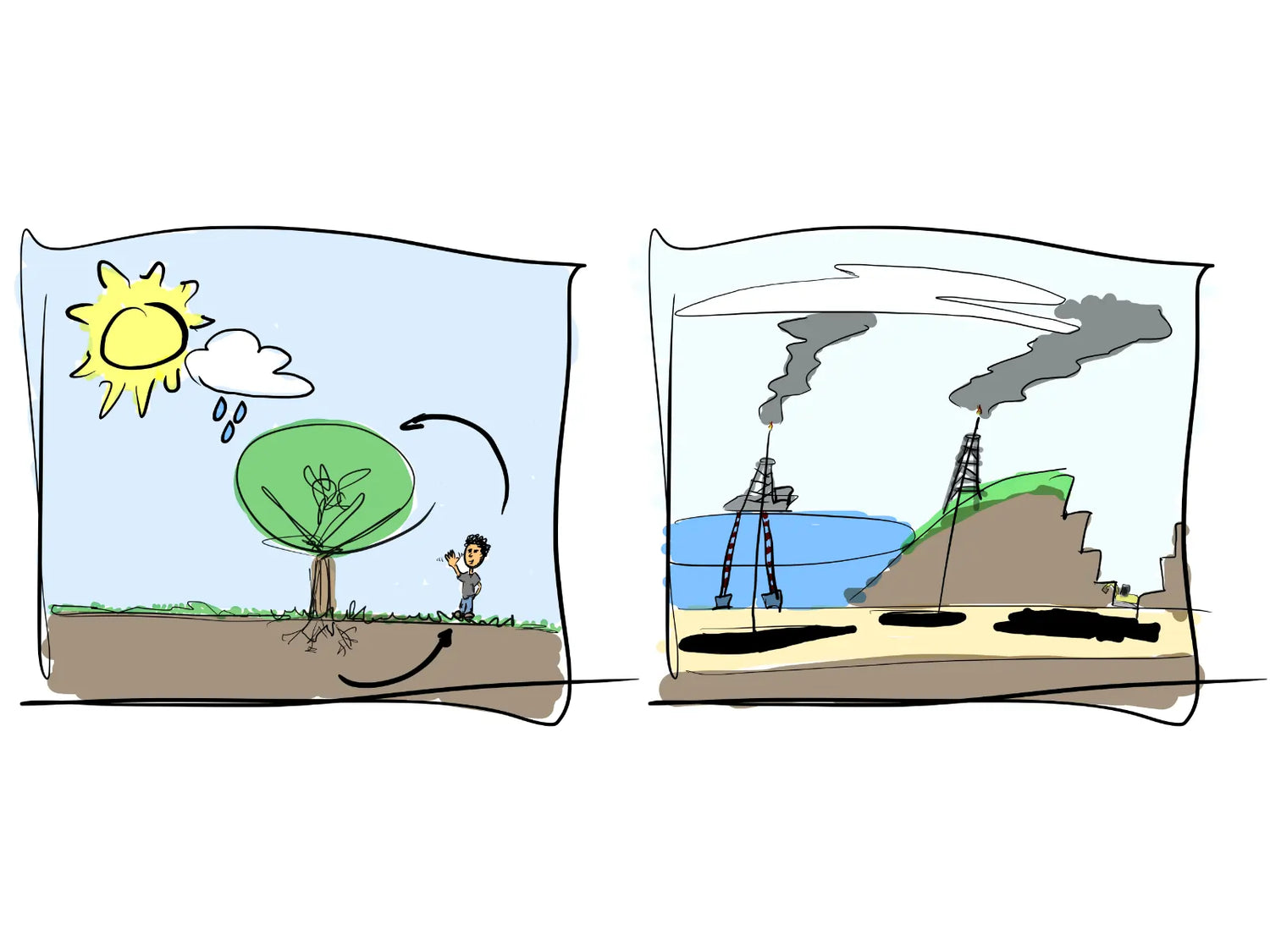
Through the combustion of fossil fuels, the carbon cycle is thrown out of balance. So many greenhouse gases are emitted that more carbon dioxide accumulates in the air than plants and oceans can absorb. The excessive carbon dioxide concentration leads to an increase in Earth's surface temperature.
Factors for the emergence of life on Earth
At the origin of the universe, all elements already existed in atomic form. Through gravity and other forces, stars and planets formed, including our Earth.
What is the habitable zone?
The habitable zone is the region in which planets are able to retain water in liquid form, which is a prerequisite for life. Earth is located with Venus and Mars in the habitable zone of our solar system. Habitable zone is another term for the life-friendly zone. However, only Earth was able to retain water vapor long-term due to its composition. On Venus, the volatile parts were split off by the Sun's UV radiation, and water evaporated. Mars has too little mass, so gravity did not have enough force to retain water vapor. (Mars: 3.69 m/s², Earth: 9.81 m/s²)

Water - How it came to Earth?
Through collisions with asteroids that contained water mostly in frozen form, water accumulated as water vapor on Earth. At that time, Earth was still a glowing sphere, and with more water, atmospheric pressure and temperature dropped. As a result, much water fell as rain on Earth, and seas and oceans formed.
The collision with the protoplanet (term for a precursor to a planet) Theia not only brought water to Earth.
The formation of the Moon
The Moon formed from the collision with Theia. Theia was a body that was approximately the size of Mars. The fragments knocked off Earth and Theia accumulated in Earth's orbit and clumped together to form the Moon.
As a result, Earth's rotation speed slowed from 3 to 4 hours to 24 hours. At the same rate, the winds decreased, which had previously swept across Earth's surface at speeds up to 500 km/h. This corresponds to an F5 category tornado.
F5 - Incredible Damage - Wooden houses are torn from their foundations, displaced far, and torn apart. An F5 tornado can peel asphalt off the road.
- https://de.wikipedia.org/wiki/Fujita-Skala
Furthermore, the rotation axis stabilized at 23.4° to the ecliptic (Ecliptic = planetary plane; designation of the plane of the orbital paths of planets around the Sun).
The atmosphere and greenhouse gases
Earth's atmosphere consists of five layers, with the lowest, known as the homosphere or colloquially as air. It is made up of various substances.
| Gas | Percentage share |
| Nitrogen | 78.08 % |
| Oxygen | 20.95 % |
| Argon | 0.93 % |
| Carbon dioxide | 0.04 % |
Even though carbon occurs in small amounts, as the most common greenhouse gas, it has a major effect on climate.
As early as 1856, Eunice Newton-Foote conducted an experiment in which two glass flasks were placed in the sun. One contained "normal" air and the second contained carbon dioxide. Both heated up, the one with air to 37.8 °C, the one filled with CO₂ to 49 °C.
This is because the CO₂ molecules are set into vibration by solar radiation and the associated energy, and later release this energy in an uncontrolled manner, thus also back toward Earth's surface. This applies to other greenhouse gases as well.
CO₂ is the most occurring and most stable greenhouse gas, which is why the others are usually summarized in CO₂ equivalents (kg CO₂e or kg CO₂eq). CO₂ is produced from the decomposition and combustion of carbon-containing compounds.

| Greenhouse gas | Global warming potential (GWP in CO2e) |
| Carbon dioxide (CO₂) | 1 |
| Methane (CH4) | 25 |
| Nitrous oxide (N2O) | 298 |
| Partial halogenated fluorocarbons (HFC) |
124 to 14 800 |
| Perfluorinated hydrocarbons (PFC) |
7390 to 12 200 |
| Sulfur hexafluoride (SF6) |
22 800 |
| Nitrogen trifluoride (NF3) |
17 200 |
Explanation using methane as an example
Two factors determine a gas's impact on climate warming:
- Residence time and
- Radiative forcing of the gas.
This is how the influence is calculated.
For the calculation, the warming potential is considered over 100 years (GWP-100). If it were only considered over 20 years, the factor would be even more extreme.

The carbon cycle

Carbon is life - chemistry is divided into two major areas:
- inorganic chemistry with approximately 200,000 compounds (without carbon) and
- organic chemistry with approximately 20,000,000 compounds, all with carbon. The human body consists of 60% water and 9.5% carbon. Carbon is thus the main component in the body along with oxygen and hydrogen.
The carbon cycle describes the exchange of carbon between animals and plants. For a simple representation, we consider human metabolism (cellular respiration) and plant photosynthesis.

During photosynthesis, the plant converts water and carbon dioxide into sugar and oxygen using solar energy. During human metabolism, sugar and oxygen are converted into carbon dioxide, water, and energy.
Extending this, we now excrete carbon-containing compounds that are broken down by fungi and microbes. If this conversion takes place anaerobically, methane is produced, which is converted to CO₂ over time. If it takes place aerobically, CO₂ is produced directly. (This decomposition process occurs in us and is also why cows have such a high CO₂ footprint.)
This cycle also occurs in water (lakes and oceans), as well as between the spheres. (Hydrosphere, biosphere, atmosphere)
When plants and animals die, the carbon compounds settle, and over millions of years, under the influence of pressure and heat, fossil fuels form. Oil and gas form in the sea; coal forms on land.

The (anthropogenic) climate change
Earth is repeatedly subject to climate fluctuations. Since its formation, there have been warmer and colder periods. Since the last ice age approximately 12,000 years ago, the climate was relatively stable. Only since 1980 has a sharp increase in mean atmospheric temperature been observed.
Carbon dioxide plays a particularly important role in this (see graph), which is produced by burning fossil fuels to generate energy. Combined with humanity's rising energy demands, CO₂ emissions increased from 2 gigatons in 1900 to 34.8 gigatons in 2021 (maximum 2017 37.1 Gt).

Feedback processes and tipping points
The increase in temperature and the change in climate can lead to effects that further amplify these changes. This amplification effect is particularly dangerous for humanity, especially when tipping points are crossed. Tipping points are events that can no longer be reversed once they are reached. The reactions of the environment to climate change are entirely natural, but they can no longer be reversed and can render the planet uninhabitable for humans.
Three examples of these feedbacks are:
Reduced albedo (= reflectivity of a planet/body)
As ice surfaces melt, incoming solar energy is no longer reflected directly by the white surface, but is instead absorbed by the dark ocean surface.
Desertification of the rainforest
Additionally driven by deforestation, warming threatens to dry out the rainforest climate. The forest depends on much rain, which it needs for photosynthesis. Less water, less photosynthesis, less CO₂ that can be stored. This in turn means more CO₂ in the atmosphere.
Thawing permafrost
In Siberian and Canadian permafrost soil, at depths of a few meters, there are likely several billion tons of carbon from the last ice age bound in organic materials. If this thaws, thousands of tons will be released.
These feedbacks are tied to specific temperatures and are also called tipping points. When these are exceeded, they can trigger a domino effect that can no longer be stopped.

With this background knowledge, in the next article we look at coffee and climate change. What is the impact of coffee on climate change and what is the influence of climate change on coffee?

