




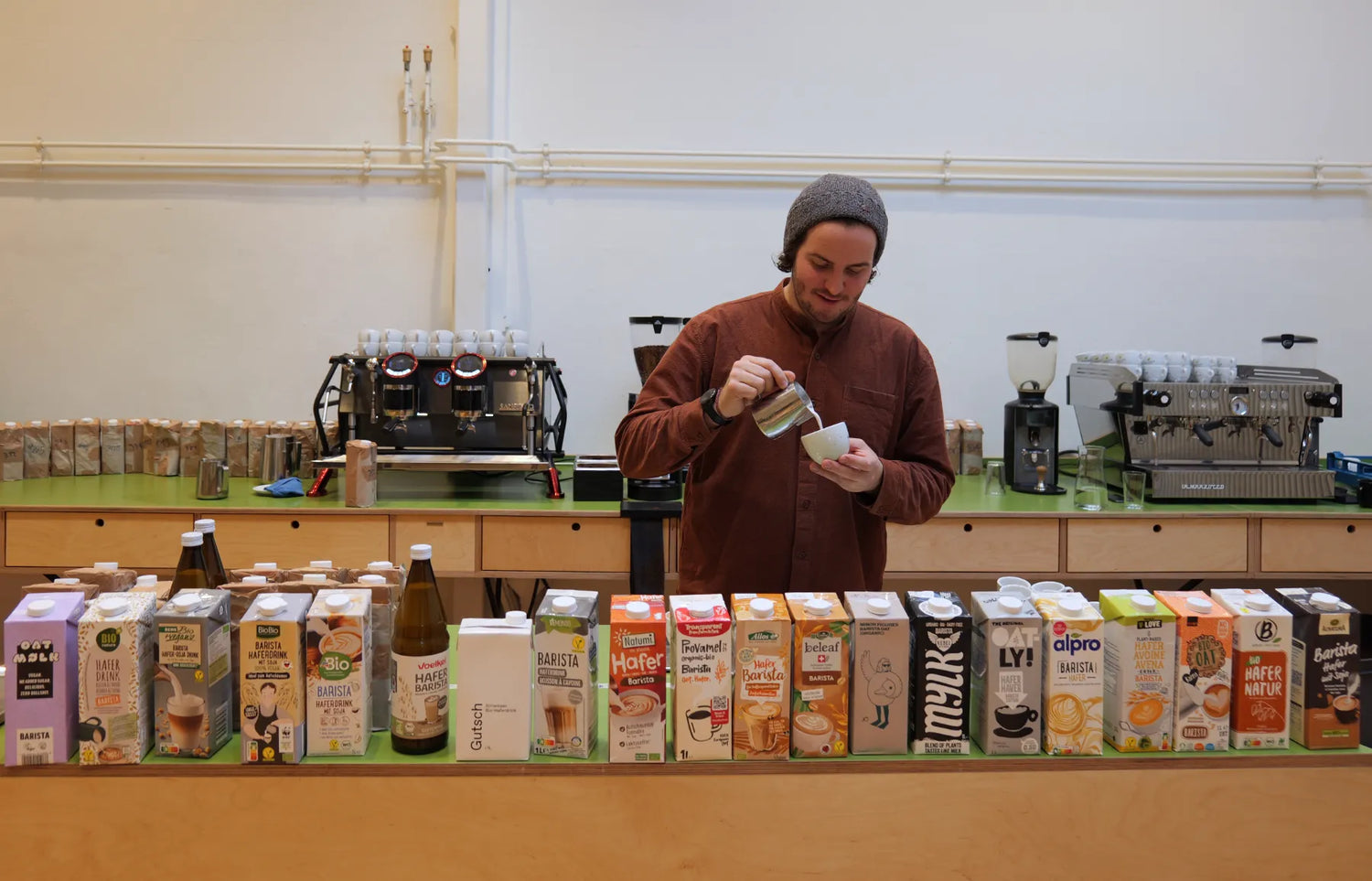

Good barista oat milk makes a cappuccino better! The most important criteria for a good interplay between oat milk and coffee are foaming performance and creaminess, as well as balance in taste with the espresso. Which oat milk or oat drink meets these criteria best? And which manufacturer is also transparent in production, CO2 footprint, and ingredient disclosure?
We wanted to find out exactly. For this, we tested 20 oat drinks and had them tasted in a blind tasting by six baristas, roasters, tasters, and food technologists. The reigning Swiss Latte Art champion then put the oat drinks through a foaming and latte art test.
In this article, we use "oat milk" and "oat drink" synonymously. Oat drink is the formally correct term for oat milk. According to EU regulations, it is not milk but a milk substitute product. We use both oat milk and oat drink in this article as is common in everyday language.
The results of the test series reveal some surprising findings. To the chapters of the test series.
- Results at a glance
- Taste winners
- Foaming performance and latte art
- Sustainability and transparency
- Price/performance
- Conclusion
- How was it evaluated?
- Sources and further links
Results at a glance
The best oat milk on the market is the one that matches your interests and criteria.
Across all categories we established in our test, the oat barista milk from dm performed best overall.
The absolute taste winner in the cappuccino, however, is the barista oat drink from Mølk.
In the category sustainability and transparency, Minor Figures Organic took first place.
The foaming ability proved to be very good in many oat drinks. Only a few fell short. The foaming behavior of the very good drinks was too close together to crown a single milk as the "best".
How did the various oat milks perform in the different categories? The summary shows this.
The best oat milk is the one that suits you best. In this sense, we invite you to browse through our results. We explain how we evaluated what in each chapter.

Taste winners
And the winner is…. Mølk! Taste-wise, the milk from the German startup stands out especially in combination with foamed milk. The oat drink took first place both with a strong chocolate espresso and with a fruity espresso.
In the chocolate espresso, the cappuccino made with Mølk proved well-balanced. The foamed oat drink complemented the coffee well without overpowering it. The cappuccino was described as caramel, chocolatey, and nutty, with a special reminder of walnuts. Despite a somewhat dry effect in the aftertaste, the overall balance was good.
In combination with the fruity coffee, the oat milk showed similar characteristics. The cappuccino was creamy, nutty, and caramel-like, suggesting that the oat drink's own flavor contributes here as well. The espresso itself has no pronounced nutty or caramel notes. The fruity aromas of the coffee did not have the same presence as the notes of the darker espresso roast.
The texture of the oat milk was described as buttery, oily, and sticky, which worked very well with the espresso when foamed and warm. As a cold oat drink, Mølk also ranked fourth, with some tasters describing the oily note as too intense and slightly artificial.
The barista oat milk from dm also showed good performance, with Aldi Suisse and Lidl Barista oat drink following taste-wise. dm oat drink barista and Lidl barista oat drink ranked in the top two positions in the blind tasting of the pure and cold oat drink. How was it evaluated?

Foaming performance and latte art
Delicious milk is not automatically foamable in the same way. Only well-foamable milk can then be used as creamy foam for latte art. Swiss Latte Art Champion Dario Pieber therefore foamed each oat milk twice for us and poured it as a cappuccino with a heart. All oat drinks were used anonymously.
As a conclusion, it can be stated that almost all alternative milks used showed good to very good foaming performance. Six oat drinks received full points. They were able to be enriched well with air in the extraction phase and homogenized very well in the rolling phase. During pouring, the surface remained smudge-free, the contrast was good, and the surface proved stable and bubble-free.
The differences among the majority of oat drinks were so small that we can unreservedly recommend all barista oat drinks for foaming.
Very good milk foaming behavior
With 10 out of 10 points:
- REWE Bio + vegan barista oat
- Aldi Suisse
- BioBio oat barista Netto
- Alnatura oat
- Provamel oat drink barista bio
- Coop Karma Bio oat drink
9.25 out of 10 points:
- Mirgos V-Love Bio · oat drink
- Lidl CH/DE - barista oat drink
- Beleaf oat drink barista
- Natumi Bio barista oat drink
Good milk foaming behavior
8.5 out of 10 points:
- dm oat drink barista with soy
- Minor Figures Organic oat
- Gutsch
- Mølk
- Berief Bio oat-soy drink 1l
- Rebel Kitchen BIO MYLK barista
7 out of 10 points:
- Oatly Germany oat drink barista edition
- Alpro barista oat milk
- Voelkel oat drink barista
Medium foaming behavior
5.5 out of 10 points:
- Allos oat barista

Sustainability and transparency
When evaluating the sustainability and transparency of oat drinks, we did not compare them to cow milk, but instead created a direct comparison with each other. In a direct comparison between oat drink and milk, oat drink typically performs better (see WWF study as PDF).
(We also have two articles <1> <2> and a documentary film about cow milk. If you want to learn more about milk.)
In terms of transparency, we evaluated whether a life cycle assessment is available, whether the origin of ingredients and nutritional information are available. In the area of sustainability, we considered origin, production, CO2 footprint, sustainability reports or goals, and waste management. For this, we not only researched online but also contacted manufacturers and included their responses.
Results of sustainability and transparency
Minor Figures achieved the most points. As a B-Corp company, they can particularly score with comprehensive information about their products and their sustainability goals and commitments. The same applies to Rewe and Berief, who share third place. In second place is Gutsch, which operates very locally and maintains close relationships with their producers.
| Rank | Name | Sustainability |
|---|---|---|
| 1. | MINOR FIGURES ORGANIC OAT | 10 |
| 2. | Gutsch | 9.5 |
| 3. | REWE Bio + vegan barista oat | 8 |
| 4. | Berief Bio oat-soy drink 1l | 8 |
| 5. | dm oat drink barista with soy | 7 |
| 6. | Oatly Germany oat drink barista edition | 7 |
| 7. | Coop Karma Bio oat drink | 7 |
| 8. | Voelkel oat drink barista | 7 |
| 9. | BioBio Bio-oat barista Netto | 6 |
| 10. | Migros V-Love Bio · oat drink | 6 |
| 11. | Allos oat barista | 6 |
| 12. | Provamel oat drink barista bio | 6 |
| 13. | Aldi CH - Bio Natura | 5 |
| 14. | Alnatura oat | 5 |
| 15. | Natumi Bio barista oat drink | 4.5 |
| 16. | Rebel Kitchen BIO MYLK barista | 4 |
| 17. | Beleaf oat drink barista | 4 |
| 18. | Mølk | 3 |
| 19. | Alpro barista oat milk | 3 |
| 20. | Lidl CH/DE - barista oat drink | 0 |
What statements can we make?
Basically, all oat drinks are grown and produced in Europe. Only Rebel Kitchen's Mylk contains "coconut cream," which likely does not come from Europe.
According to their own statements, manufacturers strive to work as locally as possible, but often have to resort to products from other European countries.
The CO₂ footprint is far below that of conventional milk, namely about half. The comparison data does not come from an organically produced oat drink but from Oatly. Transport data from Scandinavia to the supermarket in Germany is also included. This suggests that emissions from organically produced oat drinks grown and processed in "Central Europe" would have an even smaller footprint.
Some of the products are labeled as climate-neutral, meaning emissions are recorded and offset. However, since it is not known exactly which emissions are produced during the manufacture of the beverage, we did not include these in our assessment.
The ecological scarcity method, which in addition to "Global Warming Potential" also considers land use change, acidification, and heavy metal pollution, allowing for a more comprehensive view, can confirm this. The difference is not as pronounced as with CO2e, but oats still have a clear advantage.

Price/Performance
Assessing the price-to-performance ratio of various oat milks reveals the difficulty of weighting the evaluated parameters. However, this is difficult to do across the board, as different purposes vary depending on use and interest.
Those who like fruity espressos will place less value on the taste of oat milk in combination with dark espressos. Those who also like using oat milk for cereal place more value on performance in the cold state. We decided to treat all evaluated criteria equally and used the average of the parameters.
The results of this comparison are as follows:
- With a price-to-performance score of 5.68, "dm oat drink barista with soy" tops the list, closely followed by "REWE Bio + vegan barista oat" with a score of 5.60 and "BioBio oat barista Netto" with 5.33
- "Alnatura oat" also scores well with price-to-performance scores of 4.42.
- At the bottom of the list we find "Coop Karma Bio" and "Beleaf oat drink barista" with price-to-performance scores of 1.61 and 1.49 respectively.

Conclusion
Oat drinks and alternative milks are becoming increasingly important alongside the home espresso machine. The cappuccino with oat milk is no longer missing from many cafés. In our own cafés, 25% of all cappuccini ordered are now made with oat drink.
Our test shows that numerous oat drinks now come into their own very well in combination with espresso.
Manufacturers have done a lot of work in recent years, especially when it comes to foaming ability, and the barista editions we tested live up to their name.
Foaming ability is good to very good in almost all tested milks.
In terms of sustainability and transparency, the gap between exemplary and deficient is very wide. There is still room for improvement from all manufacturers.
How was it evaluated?
Sustainability and Transparency
Transparency evaluation
We searched online for information about the drinks. We wanted to find out not only about the ingredients and nutritional values, but also more about the sustainability and origin of the drinks and their components. It is clear that ingredients must be listed on the packaging. But if you want to find information online beforehand, you should also find these values on the providers' websites and shops.
Unfortunately, we could not find any information about the drinks in the Lidl online shop, for example. Gutsch is missing the nutritional table and Natumi the ingredient list. Otherwise all information was available.
However, information about origin, production, and LCA (life cycle assessment) is less easy to find. Only Oatly has published an LCA here. Minor Figures has indicated a footprint for their drink, but less detailed than Oatly, which indicates different footprints for different markets. Migros provides a comparison value for their oat drink: The CO₂ footprint corresponds to 4 km of car driving. This puts the footprint in good context. However, it is not possible to make a comparison with other manufacturers from this, and therefore Migros does not receive a point in this area.
Additional points in this area could be earned through information about origin or production site location. For about half of the tested drinks, we were able to find at least information about the country of production on the website.
Sustainability evaluation
While transparency evaluates data availability, the focus in sustainability evaluation is on the quality of the information provided.
We spent a long time thinking about how to handle missing data and vague data. The result was that we did not rate missing information with 0 points, and in case of unclear or imprecise statements, we assumed the worse option.
For example: Statements were often made like: "We source our ingredients from local farmers. However, as demand increases, we sometimes have to resort to, for example, oats from the EU." In such a case, "Europe" was applied for origin.
For published footprints, we rated them as present if they are smaller than the footprint of milk* (1.36 kg CO2e /L).
We considered various certifications in the manufacture of the drinks, including Bioland, Naturland, Bio-Knospe, and Demeter. Each of these certifications has additional restrictions on the use of additives and cultivation methods. However, we did not particularly highlight any specific method, as an investigation of this would be beyond the scope of the work. A separate study would be needed for this. However, we rated all certifications that have additional restrictions compared to EU-organic higher.
We also did not study the sustainability reports and goals of individual providers in detail, but used them to get a picture of the status in each company.
We asked manufacturers about their waste management. There were many interesting answers about what is done with the different waste product. From reusable shipping packaging to feeding oat residue to pigs, there were different approaches and solutions.
Origin
- 0 points, non-EU countries
- 1 point for origin in Europe
- 2 points country of origin = country of distribution
Production
- 0 points conventional
- 1 point EU-organic
- 2 points Bioland | Naturland | Bio-KnospeCH | Demeter
CO2 footprint published = 1 point
Sustainability report/goals = 1 point
Waste management present = 1 point
Oat drinks from Beckum
During our research, we noticed that many manufacturers produce their drinks in Germany/North Rhine-Westphalia or specifically in Beckum. Berief is headquartered there, and two minutes' walk away is Soja GmbH, which shares management with Berief. (As of summer 2023)
It is not surprising that Rewe, Alnatura, and Netto have the same ingredients and nutritional table. Rewe and Aldi South name Soja GmbH as their filler, while Netto names Berief as the producer. However, Berief's own oat milk was also part of the test.
Taste
Warm evaluation: Cappuccino
Six testers evaluated four different aspects of each oat milk. The harmony of espresso and oat drink, mouthfeel (texture, weight), aftertaste, and visual appearance were evaluated.
The maximum score that could be given per aspect was 6 points. This resulted in a maximum total score of 144 points per oat milk (6 points per aspect multiplied by 4 aspects multiplied by 6 testers). However, since in practice the entire point range is rarely exhausted, for display purposes the maximum score was reduced by 10%. This set an adjusted maximum score of 129.6 points. This score corresponds to 100% of realistically achievable points. A score of 88% therefore corresponds to 114.1 points (88% of 129.6 points). To display the ratings on a scale of 1 to 10, the percentages were divided by 10. Thus, a rating of 88% corresponds to a score of 8.8 on a scale of 1 to 10.
This approach was applied both with a fruity espresso and with a classic and darker espresso roast ("chocolate").
Cold evaluation: Pure oat milk
In addition to evaluating the four aspects, each tester also rated the taste of the cold milk. Each tester could award up to 6 points, with 6 being the highest and 0 the lowest score. This resulted in a maximum total score of 36 points per tasting. However, since each oat milk was tasted twice, each oat milk could achieve up to 72 points in total.
As before, the maximum score was also reduced by 10% here to allow for a more realistic representation. This set an adjusted maximum score of 64.8 points. This score corresponds to 100% of realistically achievable points for tasting cold milk.
The highest-rated oat milk achieved 46 points in this category. To display this on a scale of 1 to 10, the achieved score was first converted to a percentage (46 out of 64.8 points equals approximately 71%) and then divided by 10. Thus, the best oat milk received a rating of 7.1 on a scale of 1 to 10 for the taste of cold milk.
Price-to-Performance Evaluation
To calculate the price-to-performance ratio, we first calculated the average of the ratings for each brand in the five categories of fruitiness, chocolatiness, cold milk, sustainability, and foaming ability. Ratings in these categories were given on a scale of 1 to 10, with 10 being the best result.
The price-to-performance was then calculated by dividing the average of the ratings by the price of the respective oat milk. The resulting value provides an impression of how much "quality" or "value" you get for each euro spent. A higher value means a better price-to-performance ratio.
Sources, Further Links, Notes
*https://www.wwf.ch/sites/default/files/doc-2020-10/2020_10_%C3%96kobilanz%20Milch%20und%20pflanzliche%20Alternativen.pdf
Philipp Schallberger is co-founder of Gutsch. He was not involved in the evaluation or development of the test criteria. The tasting was conducted blind. No taster knew which milk they were tasting at any given time.

Thanks and Team
The oat milk test was prepared by Tobias Milz and Felix Hohlmann. Tobias Milz is an environmental technologist and regularly writes about his research on coffee and sustainability on our website. Felix Hohlmann is German Barista Master 2024 and prepared the cappuccini with barista trainer Andrea Perin. Dario Pieber is Swiss Latte Art Champion and was responsible for consistent foaming of the cappuccini in the latte art test.
The sensory panel consisted of the aforementioned Tobias Milz and, from right to left:
Pascal Rutz, confectioner, barista, and founder of Brootmacher:innen
Gabriela Blank, barista, human resources administration KM, yoga instructor, co-founder of Rabbithole Basel
Nicolas Schwob, food scientist, co-founder Rabbithole Basel, R&D Vito
Nadja Schwarz, Q-grader robusta and arabica, wine sommelier, federal diploma hotel-restaurant manager HF, sensory course instructor
Philipp Schallberger, head of Kaffeemacher:innen roastery, partner, sensory, former juror at World Barista Championships and World Brewers Cup
Thanks to all those involved for their participation, as well as the other supporters in the background.