

















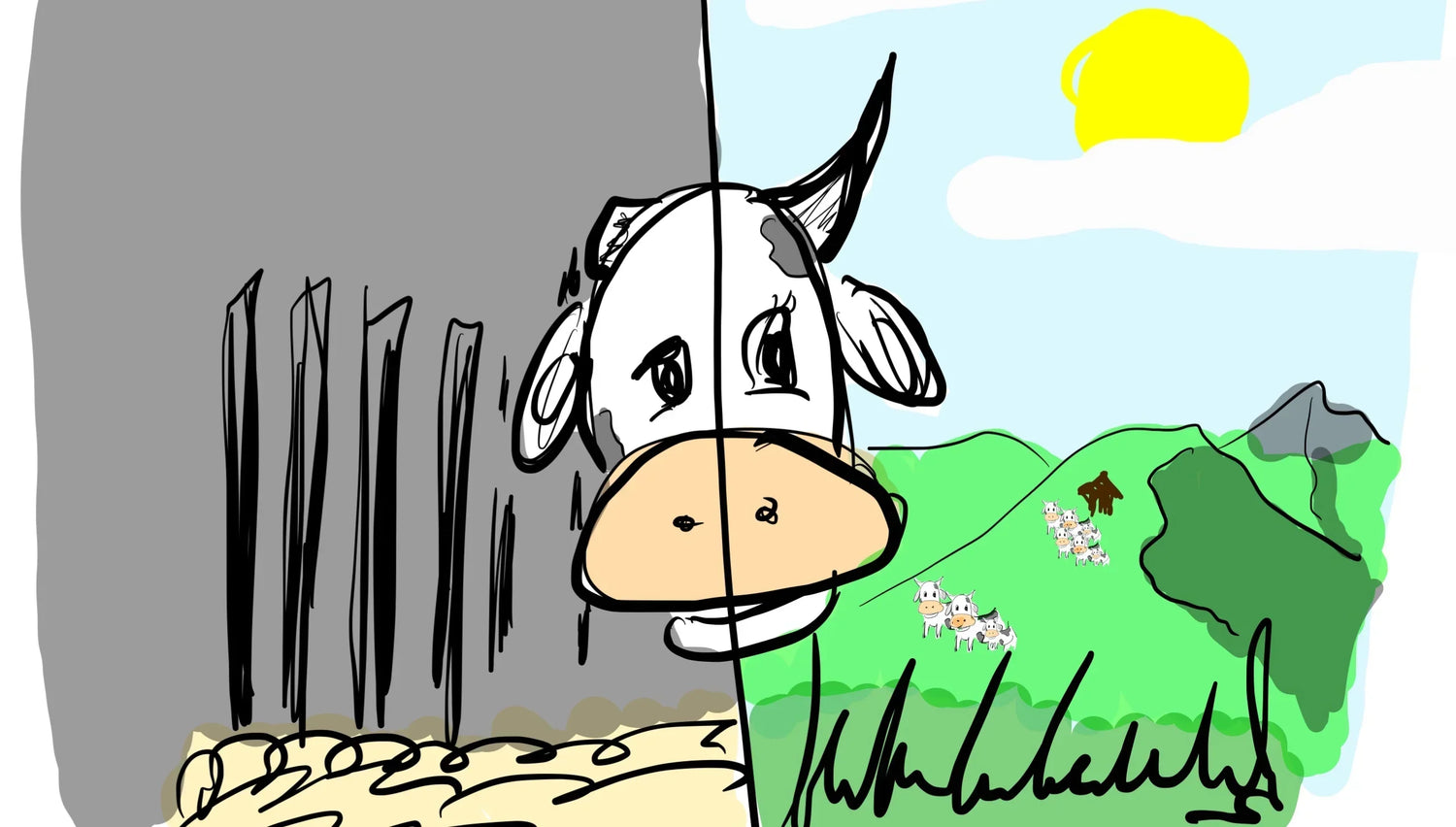
Milk is not just milk. Between one milk and another milk, there can be worlds of difference. And we're not talking about taste, fat content, or price, but about their impact on our environment.
In our cafés, more than 70% of coffee drinks are prepared with milk. That's approximately six times more milk than coffee. For this reason alone, milk is just as much in focus for us as coffee is.
Are we allowed to drink milk? This question is suitable for opening an extensive ethical discussion. The article should focus less on ethics, animal welfare, or nutritional physiology (you'll find more leading links at the end of the article), but rather deals primarily with climate impact.
To do this, we want to present two perspectives. One leads to the conclusion: Cows are climate killers. The other paints a different picture. But why does cow's milk have such a high societal standing in the first place, and why are cows' climate impacts so high in terms of global emissions?

What is milk?
Milk exists whenever a mammal has offspring. Without offspring, no milk. When we drink a milk other than mother's milk, we're always drinking the milk of an infant. So without a lamb, no sheep's milk; without a puppy, no dog milk; without a baby, no mother's milk; and without a calf, no milk. Cow's milk is so important <1> that it's the only milk that doesn't require the animal species to be mentioned. This is also anchored in law: Within the EU, only milk from cows may be labeled simply as "milk" in trade.
After the nursing period (lactation), lactase production normally stops in all mammals. Without lactase, milk proteins can no longer be broken down and milk can no longer be processed in the body. Humans are the exception. They are the only mammal that can still consume milk and dairy products after infancy. Approximately one-third of the world's population is lactose intolerant today. How did this come about?
A new study explains: Livestock farming already began when people settled. However, milk was reserved for the young. Especially during famines, people were forced to resort to animal milk. In times of malnutrition and scarcity, intolerances typically led to death, and thus the "lactose tolerant" prevailed. Gradually, cattle became less of a work animal and more of a livestock animal.
Starting in the 1960s, people first spoke of mass animal farming as we know it today. The term promised supply security at the time and had a positive connotation.
To date, there are approximately 950 million cattle <2>, of which approximately 260 million are dairy cows <3>. Per capita milk consumption in Germany in 2022 was 46.1 kg. (The trend is declining) <4>.
Status Quo
A look at the list of most climate-damaging foods shows that the top three positions are occupied by cow, butter, beef, and dairy products (cream, milk, and cheese) <5>. This suggests the conclusion that a world without cows would be a better one.
The milk system
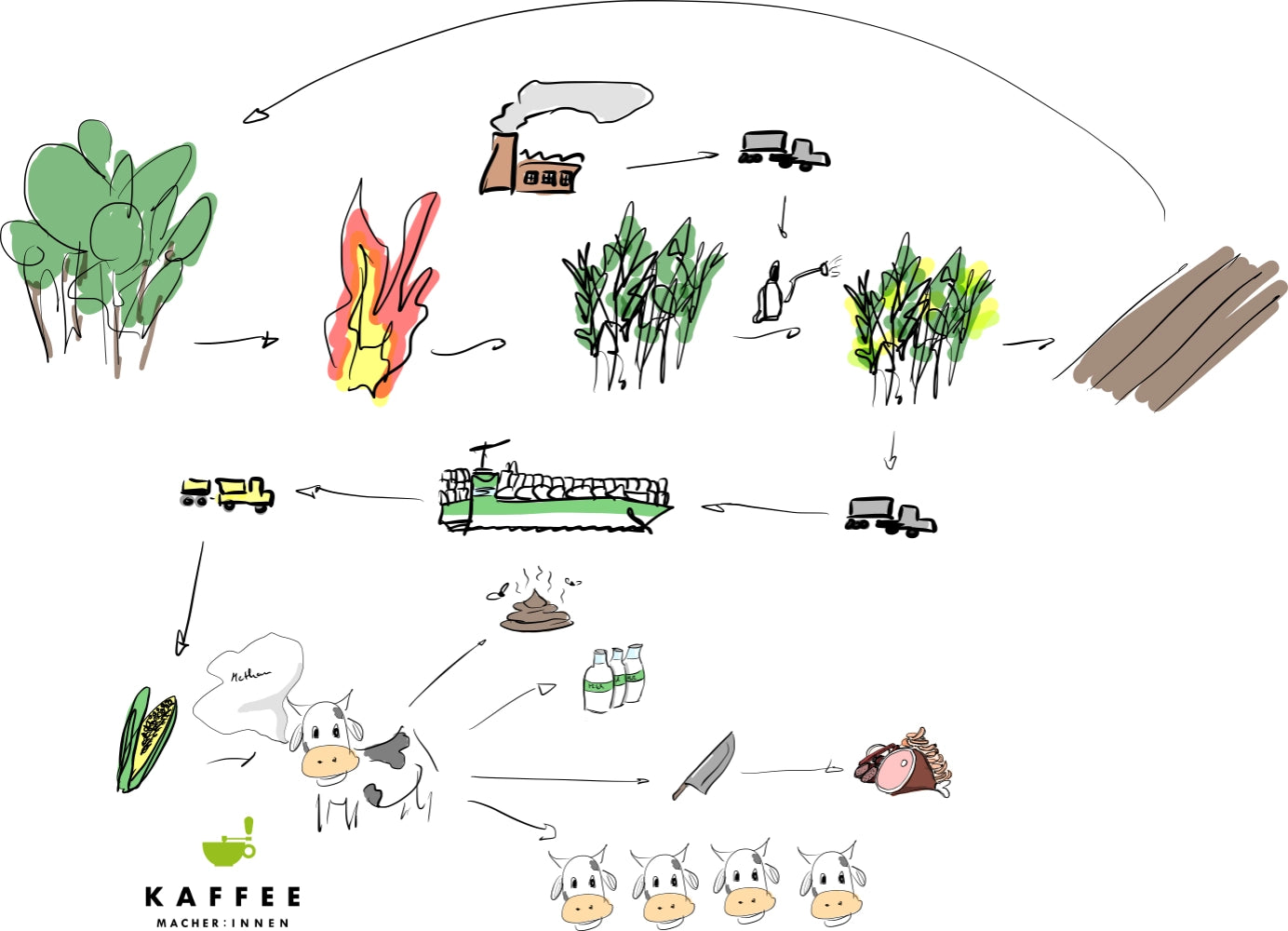
Conventionally produced milk (and dairy products) perform particularly poorly in climate assessments. This is because the cultivation of concentrated feed alone, which is largely imported from overseas, causes deforestation there and releases large amounts of stored carbon. The resulting monocultures require large quantities of fertilizer. Fertilizer production is resource-intensive and generates large amounts of CO₂. When applied, these can produce significant amounts of nitrous oxide. (Nitrous oxide is particularly harmful because it has 300 times the climate impact compared to CO₂). The transport of concentrated feed to Europe creates additional CO₂. With the transported plants, stored nitrogen also comes to Europe and over-fertilizes the fields in the form of cow manure. This creates depletion in cultivation and over-fertilization in Europe. Both lead to measures that result in more carbon dioxide in the atmosphere. A vicious cycle for soils and the climate.
Additionally, the cow itself produces large amounts of methane (approximately 550 L per day; methane is about 28 times more harmful to the climate than CO₂) when processing food. This means the methane emissions "from the cow" are responsible for approximately 48% of agricultural emissions in Germany in 2022 <6>.
Depending on the type of farming, this results in Germany in 0.9 kg CO2e (organic pasture farming, with allocation of meat sales) to 1.64 kg CO2e (conventional farming without grazing, without allocation) <7>, but the global average is 2.4 kg CO2e per liter of milk <8>.
Emissions (global average) are approximately equal to the emissions produced by burning one liter of gasoline. (Tank-to-wheel assessment → i.e., combustion alone, without extraction)
Is 1 liter of milk as harmful as 1 liter of gasoline?
Are there solutions?
There are various approaches, from increasing milk yield to feed additives that reduce methane emissions <9>.
One solution would be to increase milk yield while methane emissions remain constant. A hundred years ago, a cow's milk yield was approximately 2,000 liters per year; today it's about 8,000 liters. (These are values from cows bred for milk production. With dual-purpose breeds, values are lower. With our dairy farmer, for example, cows produce about 4,000L per year.) If we spread a cow's daily methane emissions of approximately 550 L (which corresponds to approximately 400 g) across its annual milk yield.* The milk from a hundred years ago had a footprint of 2.05 kg CO₂ equivalents, compared to 0.51 kg CO2e today. If feed additives are added that promise one-third methane reduction, it would be only 0.34 kg CO2e. This would correspond to a reduction of nearly 84%. However, an error is regularly made in this assessment: only the output is considered.
The cow a hundred years ago most likely only ate grass from pasture, whereas today's cow must receive the concentrated feed described above to achieve such performance. Feed additives also have to be manufactured, processed, shipped, and added to the feed.
Is the cow from a hundred years ago probably the more sustainable one? And perhaps the solution doesn't lie in technological progress but in the form of farming?
The climate killer… or not?
In many assessments, the cow is viewed as a milk machine and its emissions are calculated onto the end product like those of machines. These machines can be optimized, output increased, and emissions reduced. All technical optimization for a living being. We want to present another perspective.
Change of perspective
Every human emits CO₂, just like cows we metabolize our food and emit CO₂ (and also methane) in the process. This may only be a small part (between 168 and 2,040 kilograms of carbon dioxide per year) <10>.
Comparison of CO₂ equivalents of methane from dairy cows and CO₂ from humanity
Assumption 1: 8 billion people; each emits on average 1.1 t CO₂ per year through their breathing
Assumption 2: 260 million dairy cows; each emits approximately 400 g methane per day; the greenhouse gas effect of methane is 28 times higher than that of CO₂. Thus the average CO2e emission is 4.1 t CO₂ through methane excretion.
Accordingly, humanity emits 8.8 billion t CO₂ while dairy cows emit "only" 1.07 billion t CO2e through their methane emissions. (If you also add cattle from meat farming, the emissions would be 14.98 billion t CO2e)
(The breathing of cows and methane emissions from humans are missing here)

Both our breathing and the methane emissions from cows are part of the carbon cycle. Methane breaks down into CO₂ and hydrogen. This CO₂ is taken up by plants, which store the carbon and release oxygen back into the atmosphere.
Cows provide us with proteins and carbohydrates that would otherwise not be available to us. We can digest corn and soy ourselves, but not grasses.
Where do we get our milk?
We source our milk from Jonas Plattner. He runs a small-scale organic milk production farm in Reigoldswil in Switzerland.
The farm
- Jonas lets his cows graze on 30 hectares of land
- He owns 15 cows and 1 bull
The cows
- The cows are a dual-purpose breed: they produce less milk but somewhat more meat when they're older
- Jonas' cows live to about 15 years old, which is very old in dairy production
- The bull is part of the cow herd
- The cows produce milk twice daily, approximately 10 liters per cow
- In a week, the cows produce approximately 900 liters
The feed
- The cows eat exclusively grass, hay in winter
- Concentrated feed such as soy or corn is not used; Jonas also dispenses with silage
The farming method makes the difference - Regenerative agriculture
We all know that trees bind CO₂. But far more important for our climate are soils: forest soils, meadows, and moors. Technical solutions in the fight against global warming mimic what nature has already solved.
With mass animal farming, more and more animals were kept on less and less land. This allowed the remaining land to be used to grow feed. But as described, this leads to depletion in one place and over-fertilization in another.
However, when cattle return to the meadows, they can provide additional carbon sequestration and make these pastures, which are unsuitable as cropland, available for human nutrition. For ideal carbon sequestration, they need to be kept in small grazing areas at short intervals so that this small area can be grazed and fertilized with cow manure (mob grazing). After that, this area remains undisturbed for a certain period to recover. This promotes root growth before the cattle are allowed to graze again.
No grassland without grazers.
If you calculate the carbon sequestration that can result this way against the emissions, the overall balance of cattle looks completely different. Unfortunately, there are few studies on this. One of them is by "White Oak Pastures" <11>, which concludes that for every kilogram of meat, approximately 1.6 kg of CO₂ is stored in the soils.

Conclusion
Back to milk. We have it in our own hands; we can choose for our needs at home: Do we support the status quo, do we turn to alternatives like oat milk, or do we choose the regenerative option. Two out of three options tend to have positive climate effects. That sounds good. (The fact is, however, that the actual share is still small.)
In Germany, there are approximately 100 farms that produce milk not only regeneratively but also additionally through retention farming. What's special about it is that the calves grow up with their mothers and drink first, and humans take what's "left over". The organic share of all milk produced is approximately 3.5%, of which approximately 2% is retention farming <12>.
As citizens, we reject mass animal farming, but not as consumers.

Further links:
- TED Talk Allan Savory
-
TED Talk Bobby Gill
- Farm Rebellion on Disney+ - Trailer
- NDR Green Garage - Beef enjoyment without guilt?
- The Milk System on Netflix - Trailer
- ARTE Documentary: What are we still allowed to eat?
Books
- The Cow is Not a Climate Killer! - Anita Idel
- Rebels of the Earth: How we save the soil - and ourselves! - Benedikt Bösel
- Holistic Management Handbook - Allan Savory
Sources:
<1> cf.: statista.com, Milk - Germany, Status: 28.09.23
<2> cf.: https://de.statista.com/statistik/daten/studie/28931/umfrage/weltweiter-rinderbestand-seit-1990/, Status: 28.09.23
<3> cf.: agrarheute.de, Dairy farming XXL: Herd size growing worldwide, Status: 28.09.23
<4> cf.: tagesschau.de, Why Germans drink less milk, Status: 28.09.23
<5> cf.: utopia.de, These 6 foods are worst for the climate, Status: 28.09.23
<6> cf.: umweltbundesamt.de, Contribution of agriculture to greenhouse gas emissions, Status: 28.09.23
<7> cf.: umweltbundesamt, Making hidden environmental costs of agriculture visible using the example of milk production systems, Status: 28.09.23
<8> cf.: bauernverband.de, Methane emissions in cattle farming, Status: 28.09.23
<9> cf.: dsm.com, The proven solution for methane reduction, Status: 28.09.23
<10> cf.: co2online.de, What does humans breathe out, Status: 28.09.23
<11> cf.: whiteoakpastures.com, Study: White Oak Pastures Beef Reduces Atmospheric Carbon, Status: 28.09.23
<12> cf.: ardmediathek.de, Content, Status: 28.09.23