














Coffee can be produced climate-neutrally, but when conventional cow's milk is used in a cappuccino, the impact on the ecological footprint is much greater. So what to do? Stop drinking cow's milk and only drink plant-based drinks instead? We made a documentary film.
Whether it's espresso-based milk drinks or just a splash of milk in the coffee, in the communication about the products, almost only the coffee is mentioned. Because it's what roasteries and cafés like to highlight - the story behind the bean, the taste, and the producers.
But when we also look at the mixing ratios of the drinks, the focus on coffee in no way reflects the large surplus of milk. In a cappuccino, we have about one part coffee and up to five parts milk. With a latte macchiato it's even more extreme – we have almost eight times as much milk in it.

It's clear that for many it's about the coffee taste, and milk can support the coffee positively. That's true for us too. At the same time, we set the criterion for ourselves to be as strict in the selection of ingredients as we try to be with coffee.
From "who grew this coffee" to "where exactly does this milk come from"?
Cow's milk can be produced extremely industrially, as in this documentary film demonstrates well – or cow's milk is produced on medium-sized and smaller farms. When we buy milk from regional brands, or even directly marketed milk, we can much more easily find information about the milk's origin. From "coffee origin" to "milk origin".
If we ask ourselves the same questions as we do with coffee, we would need to ask here:
- Who produces our cow's milk, where, and under what circumstances?
- How good/harmful is it for the climate?
- Who earns how much here?
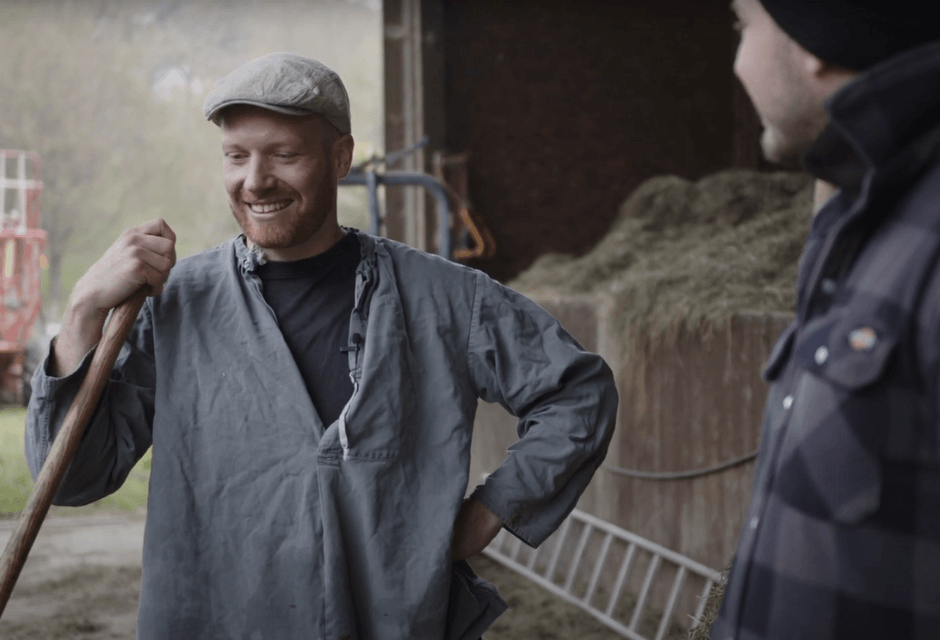
And that's exactly what we did. I went to Jonas Plattner in Reigoldswil, who supplies the milk for our Café Frühling and the Kaffeemacher Café at Basel train station.

Jonas Plattner in the cow stable.
I was accompanied by Elias Kaiser from Metaproductions, who co-conceptualized and produced the film. Caroline Siefarth from the Delica placed milk in a scientific context, and Daniel Baertschi discussed milk in a climate context.

Dr. Caroline Siefarth, Delica
The day with Jonas felt similar to a visit to a coffee farm. I tried to ask similar questions, and this overview emerged.
Small-scale organic milk production in Switzerland, using Jonas Plattner from Reigoldswil, BL as an example
The farm
- Jonas lets his cows graze on 30 hectares of land
- He owns 15 cows and 1 bull
The cows
- The cows are a dual-purpose breed: they give less milk, but somewhat more meat when they're old
- Jonas' cows live to about 15 years old, which is very old in milk production
- the bull is part of the cow herd
- the cows give milk twice a day, about 10 liters per cow total
- in a week the cows produce about 900 liters
Feed
- The cows eat exclusively grass, and hay in winter
- Supplementary feed like soya or corn is not used, and Jonas also forgoes silage
The price
- Jonas markets his organic milk exclusively directly
- we pay him 1.85 CHF/liter
- in the supermarket in Switzerland, 1 liter of organic milk costs about the same
- The purchase price of a dairy for organic milk in Switzerland is currently (November 2021) 80 cents per liter. The purchase price for conventional milk is about 65 cents.
- So Jonas can generate about 1 franc more because he markets directly
Subsidies
- Swiss agriculture is heavily subsidized
- Jonas lives almost 100% from milk sales
- But in reality, these 100% are only 50%, because the other 50% are the subsidies he receives as a farmer
- therefore, the true cost, subsidy-free price for 1 liter of Jonas' organic milk would be double, i.e., 3.70 CHF

Key points from Caroline Siefarth
- Milk powder is becoming increasingly common, especially in emerging and developing countries
- Milk is extremely nutritious – milk fat, milk sugar, milk proteins, minerals
- there are different types of milk foam – protein foam (voluminous and firm) and fat foam (fine-pored and glossy)
- we absorb cow hormones. As long as we consume milk in regulated amounts, it's not harmful to our health at all, because we barely absorb them and break them down quickly. Compared to hormones that humans produce, the hormones in milk are very low and diluted
- but through feed, more hormones can get into the milk, as can antibiotic residues.

Jonas' cows have horns because that feels right to him.
Key points from Daniel Baertschi
- Good milk = Ideally, the animal has only eaten grass and spent a lot of time outdoors
- there is too much milk, especially from cows fed with supplementary feed
- there are agricultural lands that are not suitable for arable farming – but perfect for dairy farming
- "feed no food" – we have land competition, it makes little sense to grow food (land) that is then fed to the cow
the cow is not a climate-damaging animal if it doesn't eat supplementary feed. It's part of a cycle. When the cow eats grass, stands outdoors, it's not a climate culprit.
- everyone who eats is connected to agriculture
- regenerative agriculture is a system in which nature is promoted again – no standard, no certification, with a focus on healthy soils
- it aims to bring the ecosystem into harmony with agricultural production and regenerate it
Cow's milk – quo vadis?
In recent years, cow's milk and particularly cows have increasingly become the target of climate discussions. When the cow serves as a meat supplier, it has the highest impact on greenhouse gases. When understood as a dual-purpose breed, serving as a milk supplier and at an advanced age as a meat supplier, its CO2 footprint is lower.

The discussion is complex.
Whether cow's milk is compatible with climate goals shouldn't seem like an idle question to us – rather, we can see opportunities in everything we consume to question things.
Especially in the coffee industry, we should do this, since we have such a strong focus on coffee and its background. We must be fair to milk and recognize the opportunities.
Alternative milk, or plant-based drinks, are not just a trend, but the best alternative for those who avoid cow's milk for health, ethical, or sustainability reasons. However, there are also major differences here – soya performs worse than oat, because oat can be produced regionally. A good study on this can be found here from the Albert Schweitzer Foundation. For a good overview of greenhouse gas emissions in coffee, there is a good graphic here at The Conversation.