




























While coffee can be produced climate-neutrally, when conventional cow's milk is used in a cappuccino, the impact on the environmental balance is much greater. So what to do? Stop drinking cow's milk and only drink plant-based drinks instead? We made a documentary film.
Whether espresso-based milk drinks or just a splash of milk in coffee, in product communication almost always only the coffee is mentioned. Because that's what roasteries and cafés love to highlight - the story behind the bean, the taste, and the producers.
But when we look at the mixing ratios of the drinks, the focus on coffee in no way reflects the large excess of milk. In a cappuccino we have about one part coffee and up to five parts milk. With a latte macchiato it's even more extreme, as we have almost eight times as much milk in it.

It's clear that many people care about coffee flavor, and milk can positively support the coffee. That goes for us too. At the same time, we hold ourselves to the standard of being just as strict in selecting ingredients as we try to be with coffee.
From "Who grew this coffee" to "Where exactly does this milk come from"?
Cow's milk can be produced in an extremely industrial way, as shown well in this documentary film - or cow's milk is produced on medium-sized and smaller farms. When we buy milk from regional brands, or even directly marketed milk, we can much more easily get information about the milk's origin. From "coffee origin" to "milk origin".
If we ask ourselves the same questions as we do with coffee, we would need to ask here:
- Who produces our cow's milk where and under what circumstances?
- How good/harmful is that for the climate?
- Who earns how much here?
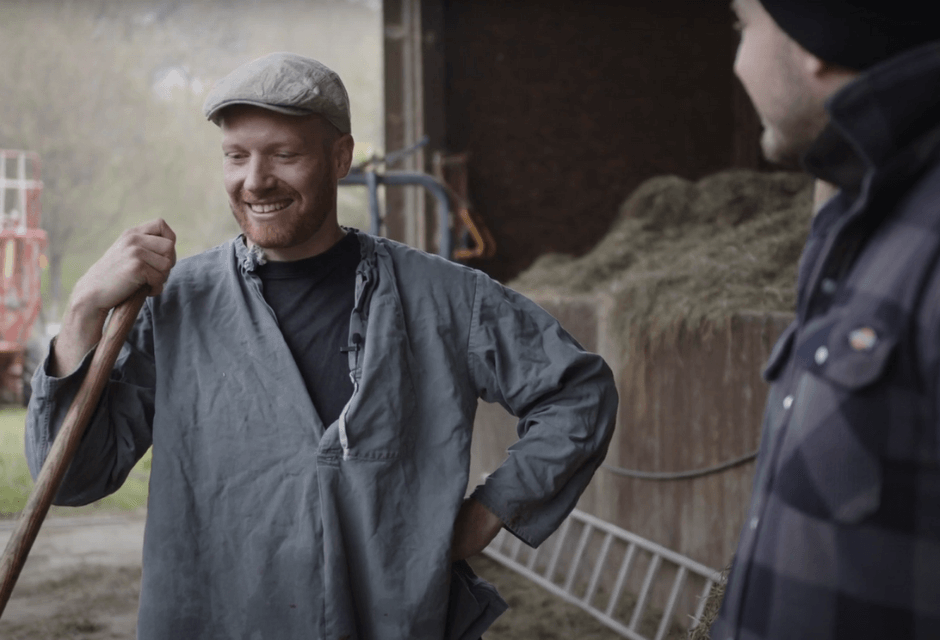
And that's exactly what we did. I drove to Jonas Plattner in Reigoldswil, who supplies the milk for our Café Frühling and the Kaffeemacher Café at Basel train station.

Jonas Plattner in the cow stable.
I was accompanied by Elias Kaiser from Metaproductions, who co-conceived and produced the film. Caroline Siefarth from Delica placed milk in a scientific context, and Daniel Baertschi discussed milk in a climate context.

Dr. Caroline Siefarth, Delica
The day with Jonas felt similar to a visit to a coffee farm. I tried to ask similar questions, and this overview emerged.
Small-scale organic milk production in Switzerland, using Jonas Plattner from Reigoldswil, BL as an example
The Farm
- Jonas lets his cows graze on 30 hectares of land
- He owns 15 cows and 1 bull
The Cows
- The cows are a dual-purpose breed: they give less milk, but somewhat more meat when they're old
- Jonas' cows live to about 15 years old, which is very old in milk production
- the bull is part of the cow herd
- the cows give milk twice a day, about 10 liters per cow total
- in a week the cows produce about 900 liters
The Feed
- The cows eat exclusively grass, hay in winter
- Supplementary feed like soy or corn is not used; Jonas also avoids silage
The Price
- Jonas markets his organic milk exclusively directly
- we pay him 1.85 CHF/liter
- in Swiss supermarkets, 1 liter of organic milk costs about the same
- The purchase price of a dairy for organic milk in Switzerland is currently (November 2021) about 80 cents per liter. The purchase price for conventional milk is about 65 cents.
- So Jonas can make about 1 franc more because he markets directly
The Subsidies
- Swiss agriculture is heavily subsidized
- Jonas lives almost 100% from milk sales
- In reality, though, these 100% are only 50%, because the other 50% are the subsidies he receives as a farmer
- so the cost-true, subsidy-free price for 1 liter of Jonas's organic milk would be double, i.e., 3.70 CHF

Key Points from Caroline Siefarth
- Milk powder is increasingly common, especially in emerging and developing countries
- Milk is extremely nutritious - milk fat, milk sugar, milk proteins, minerals
- there are different types of milk foam - protein foam (voluminous and firm) and fat foam (fine-pored and glossy)
- we take in cow hormones. As long as we consume milk in regulated amounts, this is not harmful to our health at all, because we barely absorb them and break them down quickly. Relative to hormones that humans produce, the hormones in milk are very low and diluted
- through feed, however, more hormones can get into the milk, as can antibiotic residues.

Jonas' cows have horns because that feels right for him.
Key Points from Daniel Baertschi
- Good milk = Ideally the animal has only eaten grass and spent a lot of time outside
- there is too much milk, especially from cows fed supplementary feed
- there are agricultural land areas that are not suitable for crop cultivation - but perfect for cattle farming
- "feed no food" - we have land competition; it makes little sense to grow food (land area) that is then fed to the cow
The cow is not a climate-damaging animal if it doesn't eat supplementary feed. It's part of a cycle. When the cow eats grass, is outside, it's not a climate culprit.
- everyone who eats is connected with agriculture
- regenerative agriculture is a system in which nature is promoted again - no standard, no certification, with the focus on healthy soils
- it aims to bring the ecosystem into harmony with agricultural production and to regenerate it
Cow's Milk - Quo Vadis?
Cow's milk and particularly cows have increasingly become the focus of climate discussions in recent years. When the cow serves as a meat supplier, it has the highest impact on greenhouse gases. When it's understood as a dual-purpose breed, serving as a milk supplier and as a meat supplier in old age, its CO2 footprint is lower.

The discussion is complex.
Whether cow's milk is climate-compatible should not seem like an idle question to us - rather, in everything we consume, we can see opportunities to question things.
Especially in the coffee industry, we should do this, as we have such a strong focus on coffee and its background. We need to be fair to milk and recognize the opportunities.
Alternative milk, or plant-based drinks, are not just a trend, but the best alternative for those who avoid cow's milk for health, ethical, or sustainability reasons. However, there are also major differences there - soy performs worse than oats because oats can be produced regionally. You can find a good study on this from the Albert Schweitzer Foundation here. For a good overview of greenhouse gas emissions in coffee, you can find a good graphic here at The Conversation.

