







In our last post, we tested various espresso brewing temperatures and their effect on taste. Here we show you how and where the espresso brewing temperature is measured, and how you can measure the temperature of your machine at home.
The perfect brewing temperature for espresso is between 91° and 95°. For a darker roast, we recommend the range of 91° to 93°. For lighter roasts, we recommend 93° to 95° espresso brewing temperature.
Try this at home and set different brewing temperatures to see what tastes best to you personally. But the question here is where exactly we measure, and how precise the whole thing is.
Espresso and brewing temperature – plenty to discuss
Since I started dealing with coffee, brewing temperature has always been worth a long conversation. Different brewing systems and designs of brewing groups significantly change the consistency and the impact of temperature. This often leads to a lack of clear statements about which range the optimal brewing temperature should be in.
Nevertheless, or precisely because of this, we've tackled this topic and first examined the sensory changes and the strength or extraction. Rightfully, questions followed in the blog and in the comments of the YouTube video:
- where do you measure the temperature?
- how consistent is such a machine?
- how precise are these measurements?
To answer these questions, we first need to understand the design of boilers and brewing groups and their impact on temperature.
Espresso brewing temperature with thermoblock machines
A thermoblock heats the water as it flows through a tube inside the block. This also means that with small thermoblock systems, the inlet temperature is crucial.
Fresh tap water is usually cooler than water that has been sitting in the machine tank for a while and has taken on the ambient temperature. The two water temperatures are different and need to be heated for different lengths of time. This means we end up with different brewing temperatures again.
We recommend always using fresh water to keep the starting conditions consistent. The larger the thermoblock, the fewer fluctuations you can expect. With sophisticated systems, like we see with the Decent Espresso Machine, the thermoblock performs more consistently than a boiler system. This works because the brewing group is preheated by an additional heating element and numerous temperature sensors control the water supply.
With the thermoblock, measurement is done with a thermostat that often switches on and off in the 5-6 degree range. So it might start heating at 104°C and stop at 110°C. Temperature fluctuations can occur here as well.
The temperature measured here is the temperature in the block and not the actual brewing temperature. Depending on the design, this then ranges between 87°C and 93°C.
Warning – too cold brewing temperature with thermoblock when…
when you flush the group shortly before extraction. This is because: before extraction, the thermoblock sits at approximately 104°C. When you start the extraction and the boiler heater switches on at that moment, you'll begin brewing at approximately 87°C and end too hot. That's why we recommend flushing thermoblock machines immediately after removing the portafilter, and thus before grinding, so the thermoblock can heat up again. Thermoblock machines are generally too cold rather than too hot.
Procedure for brewing with thermoblock machines
- Remove the portafilter
- Flush the group briefly, short water extraction
- grind and fill the portafilter
- extract
After step two, the thermoblock heats up quickly and you'll achieve a higher brewing temperature.
Thermostat and pressostat instead of PID
With almost all boiler machines without temperature control (PID), the temperature is regulated via a mechanical thermostat or pressostat.
The thermostat
Let's start with the thermostat, as it's rather rare and usually found in cheaper machines. As soon as the boiler cools down slightly, it signals the heater to heat again. Since we generally have much more water in a boiler than in a thermoblock, boiler machines are much more consistent in temperature. The thermostat also regulates the temperature in approximately a 5 degree range.
The pressostat
Slightly more precise, and therefore also installed in most dual boiler machines without PID, is the pressostat. It also passes the message to the heater to heat up, but regulates this via pressure. With both methods, measurement is taken in the steam area of the boiler.
With a built-in boiler of usually 1.5 to 1.8 liters of capacity, the temperature fluctuates slightly with both systems. With the functioning of a so-called heat exchanger, the inserted cylinder in a classic dual boiler machine, temperature fluctuations are limited. Adequate flushing before brewing also helps here to reduce the temperature of the thermo-siphon system (design of a Faema E61 brewing group, in which water circulates permanently) in front of the brewing group, so you don't extract the coffee with too hot a temperature, making it more bitter than it actually would be.
Again, the principle applies: the larger the boiler, the more consistency. With a 3-liter boiler, there's much more water, which loses much less temperature especially during extraction. Even at the moment when the pump pumps cold water from the water tank into the heat exchanger. The results in the cup are thus much more consistent. With the Basilea with PID and a 3-liter boiler, we measured a temperature fluctuation of less than 0.4 degrees – that's world championship level!
Where do we measure with temperature-controlled machines?
There are first of all major differences between dual boilers with PID and dual or multi-boilers. How these machines are designed and how they work, we discussed in detail in this article.
Dual boiler with PID
Let's take the next step in the price segment and go to dual boilers with PID. Now we no longer measure mechanically via pressostat or thermostat, but via a sensor. This allows precise measurement and precise control of the heater. Often with dual boiler machines without PID, heating systems either heat fully or not at all. Once a sensor is installed, the heater in the boiler maintains a more constant temperature, either through full heating or targeted heating pulses.
Measuring PID correctly
Measurement is then taken in the steam area. Therefore, with PID machines, you must always convert the displayed temperature according to the machine's manual.
For example: 124°C displayed boiler temperature can correspond to a brewing temperature of approximately 92.5°C. But always consult your machine's manual, as this differs from manufacturer to manufacturer.
Even with PID machines, we would recommend flushing immediately before brewing, as the water can also heat up very much in the brew head and you thus start brewing at a very hot temperature.
Dual or multi-boiler
With luxury models with dual or multi-boilers, we measure in each boiler separately. This allows for very high steam temperature, independent of a differently set brewing temperature. But again, the principle applies: the larger the boiler, especially the coffee boiler, the more consistently you'll be able to brew.
New systems in the professional gastro sector take it even further. To achieve consistency of less than 0.5 degree temperature fluctuation during brewing, brewing groups are now actively heated to make them even more consistent. This results in a multi-boiler machine with two coffee boilers per brewing group and active boiler heating. Fluctuations are thus minimized to 0.1 to 0.2°C and are therefore negligible.
Measuring espresso brewing temperature at home
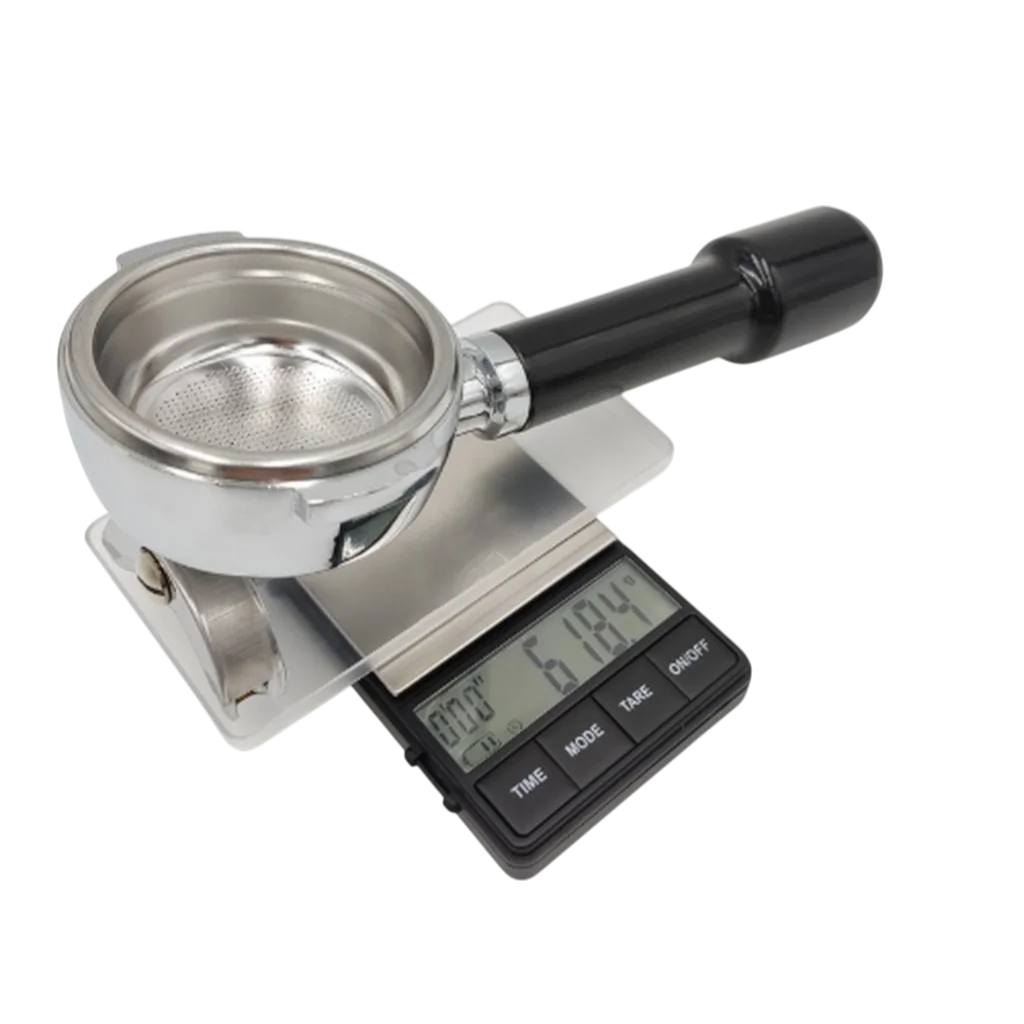
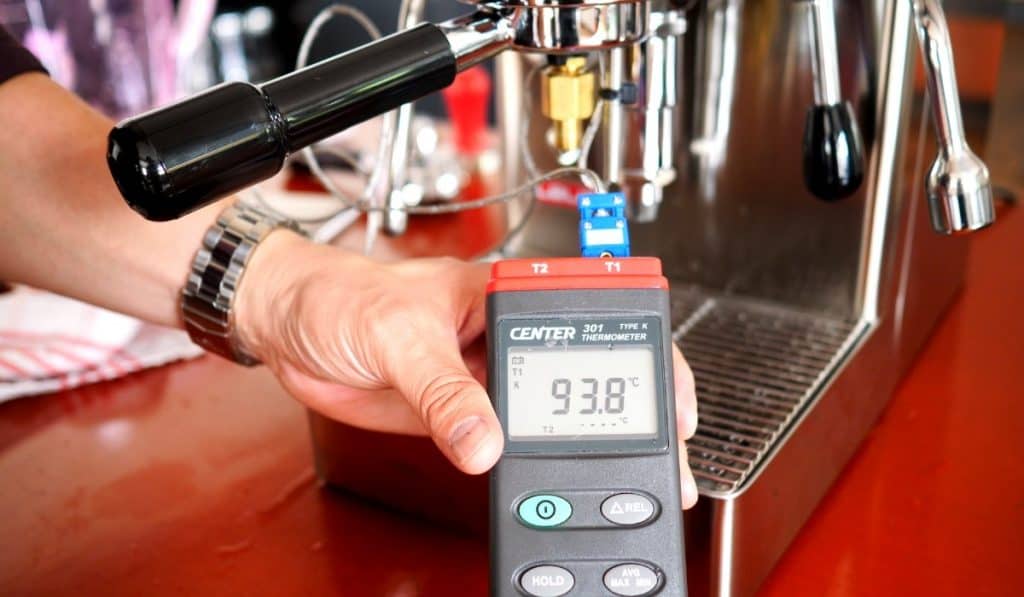
To measure the brewing temperature on your own machine, you need a temperature probe that you insert deep into a portafilter outlet. Then you start an extraction without coffee – it's important that you always do this with a hot portafilter. There are also portafilters with built-in thermometers. We use these, for example, for our tests, as this also creates resistance against the pump.
If you want to take the measurement with coffee, the water will of course lose significant temperature at the beginning of brewing, as the coffee is at room temperature in the portafilter. You'll notice a significant increase during brewing.
But don't forget to drink your coffee while you're measuring.