



























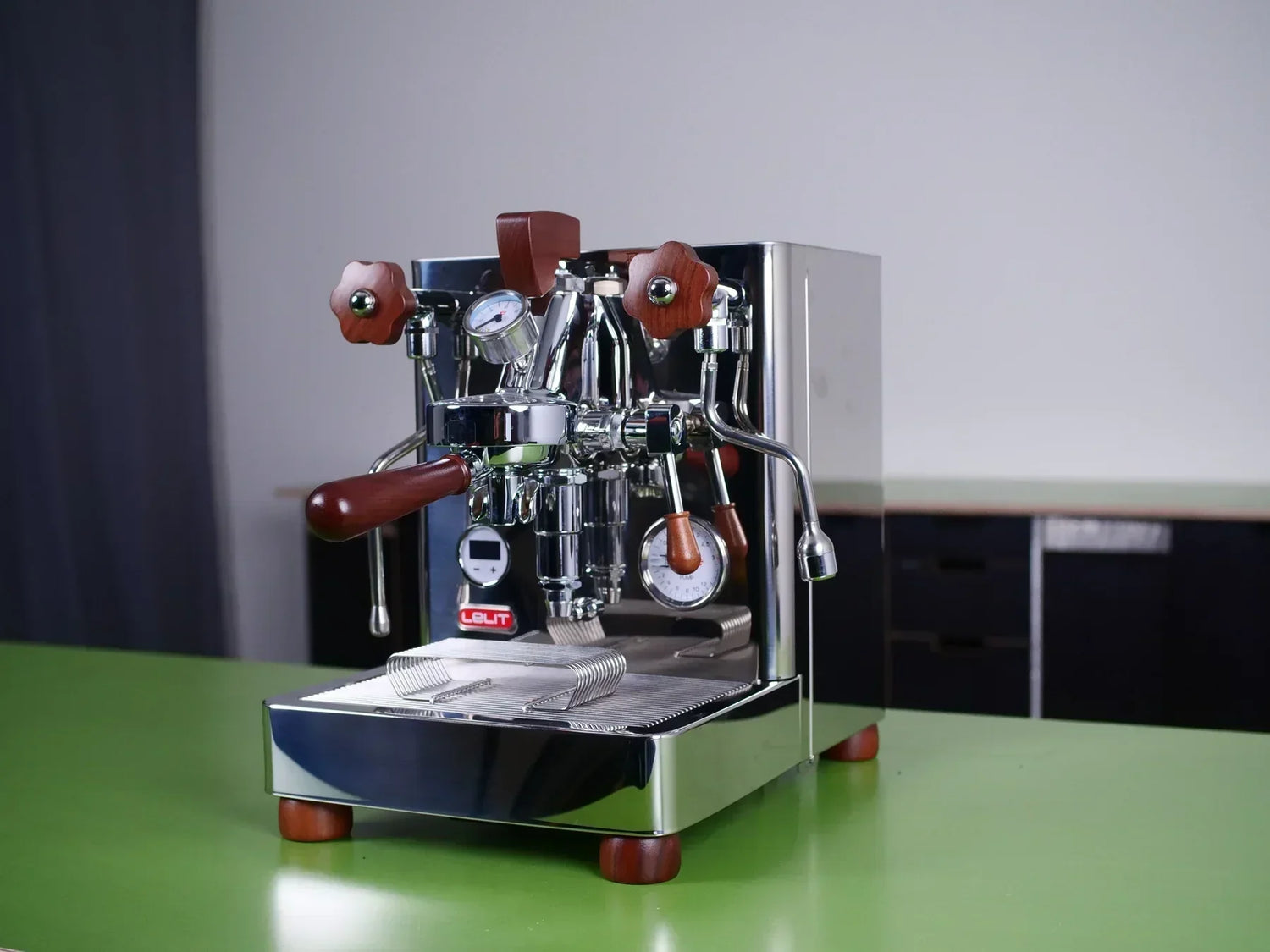

We can talk about the Bianca V3 from Lelit from various perspectives and barista skill levels. It is a very good dual boiler espresso machine that doesn't have to hide its core capabilities compared to any other dual boiler in its price class. While the potential of adjustment and operating options is virtually unlimited, we can operate the Bianca V3 just as easily as any other espresso machine with a Faema E61 group head.
We write this clearly and directly at the beginning of this article so that all home barista beginners don't get lost as we dive into the depths and possibilities of the Lelit Bianca V3.
You decide what the Bianca V3 is for you as an espresso machine and how you operate it. You can pull the lever and let the rotary pump work at standard pressure of 8–9 bar. Or you open up the world of flow rate, pre-infusion, and puck resistance.
In any case, you can grow as a home barista with the Lelit Bianca V3. And the possibilities are virtually unlimited. How the Bianca compares to other Lelit models can be found on our overview page Lelit: all espresso machines and grinders in the test.
Where you can buy the Lelit Bianca V3
We don't sell espresso machines ourselves. We stopped doing that three years ago so we can write about machines without our own sales influencing what we say. What we do instead: The following specialist retailers distribute the Lelit Bianca V3 and we can recommend purchasing from these businesses. All offer the possibility to adjust the machine's offset.
Germany:
Switzerland:
We search for specialist partners who we know do good work and provide good service, and we stay in close contact with the retailers mentioned. The links are what are known as commission links. If you order through one of these links, you don't pay a cent more, but we receive a small commission that we invest directly in new test equipment.
We continue to look for competent partners in the German-speaking region for you.
About the Bianca V3 Test
We purchased our Bianca V3 ourselves. When Lelit brought new color models of the machine to market, we were offered one for free for marketing purposes. We declined. We generally purchase the espresso machines we test. In a few cases we have borrowed very expensive espresso machines, like the Faema Faemina, on a rental basis. When that is the case, we make it clear. Beyond that, we have no consulting relationship with Lelit and have tested this espresso machine like all others to the best of our knowledge and conscience. In addition to the espresso machine at hand, we have compared numerous Lelit Biancas in our home barista courses over the past few years, taken measurements of them (and adjusted the offset, more on that later).
This test took a long time. This is partly because the Bianca V3 is a complex espresso machine. It's also because we wanted to understand and investigate more deeply the entire topic of flow rate control, pressure profiles, and their consequences on taste, as well as changes to the coffee puck during brewing. This process is far from complete. Nevertheless, we are now at a point where we can present a first version of a Lelit Bianca test.
We are working on many further investigations on the topics mentioned above, some of which will occupy us for months or even years. That's why this test will continue to grow with our research and learning. Don't see it as finished, but rather as a provisional picture describing the Lelit Bianca as an espresso machine.
Do you have experience with the machine? Then write to us in the comments. If you have questions about the machine, you can also reach us by email. We would be grateful, however, if you first ask the community, because many people have the Bianca espresso machine at home.
Test Report and Material Collection for the Lelit Bianca V3
Here's an overview of what will be released from us about the Lelit Bianca.
- Long test video (German)
- Videos in English and Spanish (publication to follow)
- Material collection with curves, measurements, etc.
- Test report
In a Nutshell – This is the Lelit Bianca V3
- Flexible espresso machine that can grow with you. Good for beginners and with a steep learning curve for those who want to dive into the depths of espresso brewing.
- Quiet dual boiler with sufficient power and good temperature stability.
- Dual flow rate control via paddle and electronic low-flow control.
- Suitable for light, medium, and dark roasts, short and long coffee drinks, and milk frothing.
- Smart in many ways, e.g. through repositionable water tank or quick heat-up time through override at startup.
- Low power consumption without steam boiler. High energy demand with steam boiler.
Technical Specifications of the Lelit Bianca V3
All values are our own measurements, not manufacturer specifications.
| Feature | Value |
|---|---|
| Type | Dual boiler with Faema E61 group head |
| Height | 40.5 cm with paddle, cup tray at 38.5 cm |
| Width | 29.3 cm |
| Depth | 50.0 cm, with side-mounted water tank 41.3 cm |
| Portafilter overhang | 9.5 cm additional forward |
| Weight | 27.0 kg |
| Brew boiler | 800 ml, insulated |
| Steam boiler | 1.5 liters, can be switched off |
| Water tank | 2.5 liters, can be mounted left or right |
| Drip tray | 0.98 liters |
| Pump | Rotary pump, 8 to 9 bar, 61 dB |
| Group head | 58 mm, 58.55 mm tamper included |
| Heat-up time | 17 minutes to target temperature and warm portafilter |
| Brew temperature | 93 °C, deviation 1 °C |
| Standard deviation | 0.99 ° (KM protocol, 17 min.) / 0.69 ° (WBC, 1 hour) |
| Consumption without steam boiler | 0.133 kWh for heating plus 5 double espressos |
| Consumption with steam boiler | 0.4259 kWh for heating plus 5 double espressos |
| Flow control | Two needle valves, mechanical via paddle and electronic |
The Dual Boiler and the Faema E61
A "Faema E61 with dual boiler" sounds as ordinary as so many other espresso machines on the market. But the paddle on the thermosyphon already signals: "I'm different". No, not different like a La Marzocco Mini with fake paddle, which is nothing more than a shot start, but different, with manual flow rate control. And not only that: Lelit gives us in the V3 version a dual needle valve that we can control manually and electronically. More on that later.
Let's stick with the Faema E61 and the dual boiler. The former is in principle so classic that we could reference what feels like four dozen articles on our blog. Except for the inlet of the needle valve and the downstream pressure gauge, which shows the pressure against the resistance of the coffee puck.
The Lelit Bianca V3 comes with a brew boiler of 800 ml and a steam boiler of 1.5 liters. Size-wise, this is in the mid-range of boiler espresso machines and promises solid performance. The water is driven by a quiet rotary pump, which we measure at 61 decibels.
The 2.5-liter water tank is a sign of what Lelit likes to do and does often: think outside the box. This is symbolized by the water tank not being integrated into the espresso machine but hanging on the back. If we loosen one screw on top and one on the bottom, the tank can be removed and mounted on either the left or right side of the machine. It sounds nice, but what for? The Bianca gives you the flexibility to be positioned on the right or left wall, and anyone without depth on their countertop will also appreciate the reduction in the rear area. The water tank itself can only be removed from the top, but it folds nicely and comes without hoses.
Otherwise noticeable: A dual pressure gauge for steam and brew pressure, the "Lelit Control Center" with PID control, and many smart adjustment options.

Size, Design, and Build Quality
Standard, the Lelit Bianca comes in stainless steel with wooden handles and a wooden paddle. Optionally, it's also available in white or black for a hefty premium. The aesthetics, for diplomatic reasons, are in the eye of the beholder. We've heard everything from "old" to "stylish" about the Lelit Bianca. The fact is that the stainless steel variant, like all stainless steel machines, seems to chronically attract fingerprints. When we tap on the machine, it sounds tinny. Other espresso machines in the same price class seem more solid in terms of material thickness. The white and black variants, however, appear much more robust, even if that's just the additional coating of the stainless steel body.
The Bianca V3 is a compact espresso machine with a height of 40.5 cm with the paddle. The machine's cup tray is at 38.5 cm height. The Lelit Bianca is 29.3 cm wide and 50.0 cm deep. However, the water tank can be mounted on the side, reducing the depth by 8.7 cm. Also worth noting: The portafilter protrudes at the front and adds 9.5 cm to the depth. The machine weighs 27.0 kg.
We've already mentioned the quiet operation of the Bianca. In addition to the quiet pump, rubber dampeners in many transition areas are responsible for this. Whether on the drip tray grates, the cup tray, or the water tank lid, rubber stops prevent vibrations and thus noise everywhere.
Below the drip tray, we notice sharp edges. However, the visible edges are always curved and thus unproblematic. The drip tray holds 0.98 liters.
Included Accessories
The included accessories for the Lelit Bianca are impressive. In addition to a bottomless portafilter, the typical Lelit portafilter with two spouts is also included. These are positioned so close together that they're also suitable for extracting into a single espresso cup. Therefore, it can also be used as a single-spout portafilter. However, the proximity of the two spouts requires precise aiming to fill two cups. Since the distance between the spout and drip tray is quite high, an included grid riser makes aiming easier. Balancing a scale on it could be a challenge, though.
The included accessories also include a water filter cartridge, which is not recommended in our test of filter cartridges, a blind basket, a plastic spoon (why?), and 18g and 20g baskets.
We particularly like the polished tamper, which according to Lelit has a diameter of 58.55 mm and sits almost flush with the included basket. The distance to the edge is only 0.4 mm. By the way, the portafilter mount of the Lelit Bianca is a standard 58 mm, so many portafilters are compatible.
In addition to a hard water connection set, a microfiber cloth and an additional 4-hole tip for the steam wand are included.

Lelit is Smart: 17 Minutes Heat-Up Time and a Reconfigurable Water Tank
Time and again, manufacturer Lelit from Baitella, Brescia, Italy surprises us with going the extra mile. Faema E61 espresso machines are a dime a dozen, and most work in similar ways. But Lelit doesn't just rely on this proven technology and leave it at that. The engineers at the company are constantly looking for smart solutions to make the machine better.
This shows in the details, such as the forward-curved portafilter, which shows the home barista the creamy flowing espresso. It goes deeper when we look at the Lelit Control Center's control options or the strategic overheating at machine startup. Lelit deliberately heats the brew boiler above the target temperature to warm up the portafilter faster, then lets the temperature fall back to the desired value. For the Lelit Bianca, this results in a heat-up time we measure at 17 minutes until target temperature and heated portafilter are reached. That's about 8 to 12 minutes faster than the average Faema E61 group head espresso machine.
The dual flow rate control, programmable pre-infusion, and reconfigurable water tank outside the machine are further evidence that even a proven system can tolerate innovative thinking.
Access to the boiler below the machine makes maintaining the Lelit's heating much easier since it doesn't need to be removed.

10 seconds low flow at startup (slow flow rate).
Flow Rate Control Squared
The Lelit Bianca V3 is equipped with dual flow rate control. An upstream needle valve can be programmed for low and normal flow (Low Flow = low flow), and a downstream needle valve can be used with a paddle for further flow reduction.
It's remarkable how little is said about water flow rate in espresso machines, considering how important it is for drink preparation. Pressure is often cited, and cheaper espresso machines with vibration pumps are frequently advertised with pressure potential of 15 bar. Yet high pressure does not equate to good coffee or even even extraction.
Excursus on Pumps
Pressure is generated by the espresso machine's pump. Cheap espresso machines are equipped with a vibratory pump, which implements the speed of water delivered to the portafilter relatively sluggishly, then builds up pressure against the coffee. A rotary pump gets up to speed faster, and accordingly pressure build-up against the puck and in the pressure gauge is much more rapid. With rotary pumps, we set the grind a bit finer. Nevertheless, the first extraction drops often appear after 5 to 6 seconds. With the vibratory pump we usually wait over 8 seconds. The third, rarely used pump is the gear pump. This pump can regulate its "pressure application" relative to extraction. The vibratory and rotary pumps typically deliver the set pressure relatively statically. Espresso machines like the Decent or San Remo YOU show that more flexibility is possible with these pumps than is often used.
We can reduce the actual pressure the pump exerts on the coffee puck by reducing the flow rate after the pump through valves. In the case of the Lelit Bianca, two needle valves are used for this. Speaking figuratively, we, or the needle valves, sit on the hose. But why does Lelit outfit the Bianca with two needle valves? And what is the consequence of the reduced flow rate, which also expresses itself in pressure on the puck?
Low Flow Means Even Extraction?
Yes and no. An espresso shot can be divided into different phases: a saturation phase, where the brew water saturates the entire coffee, a main extraction phase, and finally a phase where the coffee puck's extraction capacity decreases and the puck's resistance drops sharply. This knowledge helps modulate the flow with espresso machines that have flow rate control.
If we brew an espresso not with full pressure of 8 to 9 bar against the puck, but for example with 6 bar, it's easier to achieve more even extraction. High pressure increases the likelihood of channeling and also reduces the puck's resistance more quickly. However, with low pressure we cannot extract everything from the coffee.
However, anyone who doesn't want to spend much time on careful puck preparation generally does better with lower brew pressure. Pressure reduction is not limitless, though, because if the pressure applied to the puck drops too much, extraction is reduced or the coffee drink's strength is too low. Taste-wise, it won't be perceived as espresso anymore.
Low Pressure at the Start
Low pressure at the start, in combination with very low pressure, allows complete water saturation of the coffee puck. If this can be achieved before full brew pressure is applied, more even extraction is guaranteed. If dry spots remain in the coffee puck, the following water will avoid them. Dry coffee is fundamentally water-repellent (hydrophobic), until it's saturated.
If a pressure increase follows complete saturation, the coffee puck can offer long, even resistance, provided it was carefully prepared and compressed.

Manual Flow Rate Control
The paddle of the Lelit Bianca allows manual control of the espresso machine's flow rate. The home barista has almost all options here. First, the espresso machine's lever must be pulled.
With the paddle at 9 o'clock, hardly any water flow is delivered. With the paddle at 6 o'clock, we measure 2.5 to 2.8 g/s on the scale without resistance. At 3 o'clock we determine a flow between 4.9 and 5.1 g/s. With the paddle fully open we reach just under 6 grams per second of flow on the scale.
Important: These values are each not measured against pressure. Against the standard pressure of our Scace portafilter, the pressure is as follows:
With the Scace's back pressure, we measure around 2 g/s flow and 4.8 bar pressure at 6 o'clock. At 3 o'clock we achieve 2.5 g/s with 7.5 bar pressure against the Scace. Fully open we reach between 2.7 and 2.8 g/s with 8.1 bar pressure. These values should be interpreted with caution. The water flowing out of the Scace is sprayed onto the cup bottom with relatively high pressure, which negatively affects the scale's measurement accuracy.
The pressure values with the Scace only represent an approximation of what happens in a portafilter and when using coffee. During coffee extraction, the puck's resistance decreases over the course of the extraction.
What's important for your Lelit at home is that you can adjust the settings of your needle valves and shape the flow through each area accordingly.
Tips for Working with the Paddle
To achieve repeatable results, we generally recommend working with fixed positions. A changing pressure on the gauge is normal, as the coffee puck's resistance decreases with brew time.
By the way: If the paddle isn't exactly at 6 o'clock, that has little effect. However, orientation at fixed points still makes sense.
The paddle also offers possibilities to "repair" shots. If water shoots through the puck too quickly, a bold grip can reduce the flow rate and thus slow the shot. Taste-wise, that will taste better than a thin super-under-extraction.
Electronic Flow Rate Control
While the V2 of the Lelit Bianca only had manual flow rate control, the V3 version comes with additional electronic control. This gives the machine not only many new options but also allows defining fixed profiles and sequences. Shot reproducibility has greatly increased.
The electronic needle valve control is not as flexible as the manual one. Essentially, two "Low-Flow" phases can be defined: one at the beginning and one at the end. At the beginning, the duration of the low flow is set. At the end, the beginning of the low flow is set.
We measure around 1.5 - 1.7 g/s and 3.1 bar with the Scace's resistance in the low-flow phase.
Combining Electronic and Manual Flow Rate Control and Pre-infusion
By combining manual and electronic flow rate control, additional operating possibilities for the Lelit Bianca can be unlocked. For example, the low flow can be further reduced by using the paddle.
Programmable pre-infusion offers additional possibilities. By activating pre-infusion, a pause option is enabled. If pre-infusion is not further combined with low flow, the Bianca starts with normal flow and pressure and then pauses for a selected time.
It makes sense to combine the pre-infusion time with a low-flow time. For example, 10 seconds of pre-infusion could be combined with 10 seconds of low flow and a subsequent 5-second pause.
Bianca V2, V3, and V4: What's Different
The versions of the Bianca can be distinguished by the extent of flow control. The V2 had only the mechanical paddle. The V3 tested here additionally has the electronically controlled needle valve, so the programmable low flow, and thus much better reproducibility. Anyone coming from a V2 and working only with the paddle gains little. Anyone who wants to call up profiles gains a lot.
We don't have our own measurements for the Bianca V4 yet. We'll add what we can write about it once we've had it in the lab.
No. Pagaia is Lelit's new flow control, which was introduced in 2026 in the Mara X3 as well as in Elizabeth 3 and Victoria 3. The relationship is there conceptually, but the technical approach is different: The Bianca reduces flow behind the pump via two needle valves, so the water is slowed. Pagaia instead regulates the pump itself via pulse-width modulation and delivers less water from the start. Both aim at the same thing, namely flow control instead of pressure control. The Bianca is thus the machine that started this thinking at Lelit. How Pagaia works is in our article on Lelit Pagaia.
Espresso Quality Potential
We've talked about the possibilities of espresso preparation. Of course, we have to do the work ourselves, adjust the grind on a good grinder, and prepare the espresso cleanly. If that works, the espresso will work too. The Lelit Bianca V3 provides all the prerequisites for good espresso. The options discussed above are pathways to this, as is the good temperature stability we'll discuss next.
We're often asked whether a particular espresso machine "matches" certain coffees. And indeed, there are some espresso machines that show their strengths with lighter or darker roasts. We give the Lelit Bianca the accolade: "can do it all". From a complex Doña Margarita from our Lila line to the stronger all-purpose Dreispitz to filter coffee brewed as espresso – with the Bianca and its adjustment possibilities, you can essentially brew anything.

Temperature Stability
When it comes to temperature, three questions are interesting:
- How fast does the espresso machine get hot?
- How stable is the temperature during the shot?
- How stable is the temperature from shot to shot?
To monitor temperature stability and heat-up time, we use the Scace 2 with a K-type sensor and a PCE-T 330 data logger. This allows us to record both the WBC protocol and the KM protocol, which we use for heat-up monitoring, e.g., at 15, 20, or 25 minutes. In between, we let the espresso machines cool down completely for a full day. A truly demanding test protocol.
According to our measurements, the Lelit Bianca reaches its target temperature of 93 degrees Celsius (+/- 1 degree Celsius) after 17 minutes. While the first temperature in our measurement was 92.03 degrees average, the temperature rose over five shots at one-minute intervals to 93.16 degrees. The standard deviation over these five shots, measured from second 4 to 25 of extraction, was 0.99 degrees at the KM protocol after 17 minutes. That's a good value.
In the WBC protocol measurement after one hour of operation, we get a standard deviation of 0.69 degrees Celsius. With this, the Lelit Bianca is not far from the World Barista Championship target of 0.55 degrees Celsius.
We can confirm very good temperature stability from shot to shot and during the shot for the Lelit Bianca. With longer dwell times, we recommend, as with all Faema E61 group heads, a flush shot before the shot.

Setting Offset: 4 to 8 Degree Deviation Out of the Box
The biggest and most important problem to watch out for is the sometimes massive offset. Over the past six months, we've measured over 20 Lelit Biancas. The Bianca is also frequently with participants from our Home Barista courses at our academy. We also use this opportunity to check the temperature of the espresso machines. Of course, we want to send our course participants home with a well-calibrated espresso machine (standardly, all Home Barista participants bring their espresso machine with them).
The Lelit Bianca's offset usually ranges between 4 and 8 degrees Celsius. In virtually all cases, this was negative, meaning the machine was actually too cold. Offset means there's a measured deviation between the temperature shown on the PID control and the actual brew temperature. To rely on the temperature display, verification of the temperature by a specialist dealer is essential. Beware of online purchases – proper temperature adjustment is unlikely.
The test machine's offset was 6 degrees Celsius. This meant that at a displayed temperature of 93 degrees, we actually had a brew temperature of 87 degrees. It's important to note that the control knows two offset values: one on the user interface and one in the technician or submenu. The latter value is the one that must be adjusted.

Steam and Frothing Performance
From a dual boiler costing over 2000 euros, we expect not only good frothing performance, but of course also parallel frothing while pulling an espresso. What feels confirmed in frothing can also be objectively demonstrated. The frothing performance – and again, the range of possibilities Lelit has provided – makes it possible for us to tailor the Lelit Bianca to everyone.
To assess steam power, we use 300 ml of 20-degree cold water and check how long it takes to heat to 60 degrees.
In the standard setting with 125 degrees boiler temperature, we need 47 seconds for this with the standard 2-hole nozzle. If we want more power, we set the Bianca to 135 degrees. The same exercise is then completed in about 36 seconds. Those wanting even more pressure switch to the 4-hole nozzle, which is also included. Now we need 25 seconds to heat the 300 ml to 60 degrees.
As we said: The Lelit Bianca can be the frothing partner everyone wants. Those who want to froth well and confidently set it to 4-hole at 135 degrees. Those who prefer to take their time working through the phases of frothing stay at 125 degrees and try the 2-hole nozzle.

Energy Consumption of the Lelit Bianca
Depending on how espresso machines are used, their energy consumption differs. Espresso machines consume electricity primarily when they heat the boilers to temperature. The power consumption of the pump or displays is minimal compared to the thirsty boiler heating.
Those who only drink espresso consume much less electricity than cappuccino drinkers. Provided the usually larger steam boiler can be switched off. With the Lelit Bianca, this is possible. If we only turn on the 0.8-liter, insulated brew boiler, energy consumption is significantly reduced. We come to 0.133 kWh consumption for heating and preparing 5 double espressos. Preparing one espresso uses 0.1194 kWh in this scenario, accounting for and including heating.
When the steam boiler is switched on, consumption is more than three times as high. We measure 0.4259 kWh, using the same criteria accounting for heating and 5 double shots. For preparing one cappuccino including heating 0.34616 kWh is used.
Conclusion on the Lelit Bianca V3
When we consider the overall performance of the Lelit Bianca, what remains is primarily recognition of a consistently very good espresso machine. Few wishes remain unfulfilled, as the entire package is right. The variety of adjustment options and variants in flow rate control, the LCC possibilities, the good technical implementation, and the comprehensive included accessories make the Lelit Bianca an excellent espresso machine. Additionally, the espresso machine is very competitively priced, and not just when we consider the entire package compared to other dual boiler espresso machines.
Only a few wishes remain that would make the Lelit Bianca the perfect espresso machine: precise and good pre-setting of the offset, somewhat more material thickness on the flanks, optimized energy use when using the steam boiler, and finally, a quiet wish for a flow meter and thus a programmable shot stop.
Honestly, it might even be good that the Lelit Bianca can't do that too. Because as it is, even espresso machines in the same price class have great difficulty keeping up with the Lelit Bianca.
At the beginning, we asked who the Bianca is right for. Toward the end, we'd say: It's an espresso machine that can grow with you, and therefore we have no reservations in recommending this machine investment to espresso beginners as well.
How the Bianca compares to Elizabeth, Mara X, and other Lelit models can be found on our overview page Lelit: all espresso machines and grinders in the test.
Frequently Asked Questions About the Lelit Bianca V3
Does the Kaffeemacher Portafilter Fit the Lelit Bianca?
Yes. The Bianca has a 58-mm mount per E61 standard, so our portafilters fit. Both our bottomless portafilter 58 mm E61 and the portafilter with dual spout 58 mm E61 can be clamped directly in. The double spout is particularly interesting if you're having difficulty hitting two cups with the included Lelit portafilter because its spouts are very close together. The bottomless portafilter is the tool with which you can even see channeling, and thus the most sensible first addition if you want to work with the Bianca's flow control.
Which Baskets and Shower Screen Can I Use?
Included are 18g and 20g baskets plus a blind basket. Because the Bianca follows the 58-mm standard, standard precision baskets and shower screens for E61 group heads fit. If you're already working on the puck, it's worth looking at our baskets. Lelit did well with the tamper – the included polished tamper is 58.55 mm and leaves only 0.4 mm distance to the basket edge.
Can I Connect the Bianca to Hard Water?
Yes, a hard water connection set is included. The Bianca has a rotary pump, which makes hard water operation technically straightforward. If you stay with the tank: It holds 2.5 liters, hangs on the back of the machine, and can be rearranged left or right with two screws, reducing depth by 8.7 centimeters. In any case, pay attention to appropriate water; we don't recommend the included filter cartridge based on our test of filter cartridges.
How Much Space Do I Need for the Bianca?
Plan for 29.3 centimeters width and 40.5 centimeters height with the paddle. Depth gets interesting: 50.0 centimeters with tank at back, 41.3 centimeters with side-mounted tank. Add 9.5 centimeters because the portafilter protrudes at the front. If your work surface is under a cupboard, check the height above the cup tray, which is at 38.5 centimeters. The 27-kilogram weight is more of an argument to choose the location right the first time.
Bianca V3 or Lelit Elizabeth?
The decision comes down to flow control, not steam. The Elizabeth PL92T is a true dual boiler starting at around 1,050 euros, it can do espresso and milk in parallel and is at temperature after 20 minutes. But it has no paddle and no programmable low flow. If you want to modulate extractions, there's no way around the Bianca. If you just want good espresso and cappuccino, the Elizabeth is the more sensible choice and you save more than half.
Bianca V3 or Mara X3 with Pagaia?
The Mara X3 costs 1,699 euros and brings flow control via Pagaia, but it's a heat exchanger two-group, not a dual boiler. In our measurements, the Bianca has significantly better temperature control: 0.69-degree standard deviation in the WBC protocol, while the X3 in the same stress test over 14 shots spans a 7-degree temperature window. If you want flow control and temperature stability, choose the Bianca. If you have less space and less budget, the X3.
What Color Variants Are There and Is the Premium Worth It?
Standard is stainless steel with wooden handles and wooden paddle, plus there are coated variants at a significant premium. A practical argument beyond taste: The stainless steel variant chronically attracts fingerprints; the coated variants appear more robust and are easier to keep clean. Whether that's worth the premium is up to your cleaning motivation.
Where Do I Find the Manual and the Offset Setting?
Settings are done via the Lelit Control Center, the PID control on the machine. Important for temperature: The control knows two offset values, one on the user interface and one in the technician or submenu. You need to adjust the one in the submenu. Because the offset out of the box is typically 4 to 8 degrees negative, it's worth having the specialist dealer do this or controlling it yourself with a measurement portafilter.
What Does the Lelit Bianca V3 Cost?
It costs over 2,000 euros; the exact price depends on version and color variant and varies considerably in retail. We deliberately don't quote a daily price but instead refer to the specialist retailers mentioned above. More important than the last euro: Buy where your offset is adjusted.
Appendix and Supplementary Materials
Pressure and Flow Rate Measurements
Below we show you some options for how the Lelit Control Center can be used to run different profiles. These curves were recorded with the help of the Espresso Smart Sensor and its accompanying app. However, we used a Scace 2 as the portafilter. The curve would look slightly different with coffee, as the coffee's resistance decreases during use. The resulting pressure on the puck would decrease. We find this visualization helpful in showing the principle of the different curves.

5 seconds pre-infusion followed by a 5-second pause.

5 seconds pre-infusion, 5 seconds pause with 20 seconds low flow. After 40 seconds total, low flow again.

5 seconds low flow pre-infusion, 5 seconds pause.
As always, we purchased this espresso machine ourselves. This test was not requested by Lelit.

