








Comparing wine and coffee is very general. But if we focus on specific topics, we get further. In this blog, we discuss two products that repeatedly spark debate: natural wine and specialty coffee. Can the two fields learn from each other?
Coffee and wine are cultural beverages that need to be explained and contextualized. Special varieties of both beverage categories require even more effort to fully understand them, such as specialty coffees and natural wines.
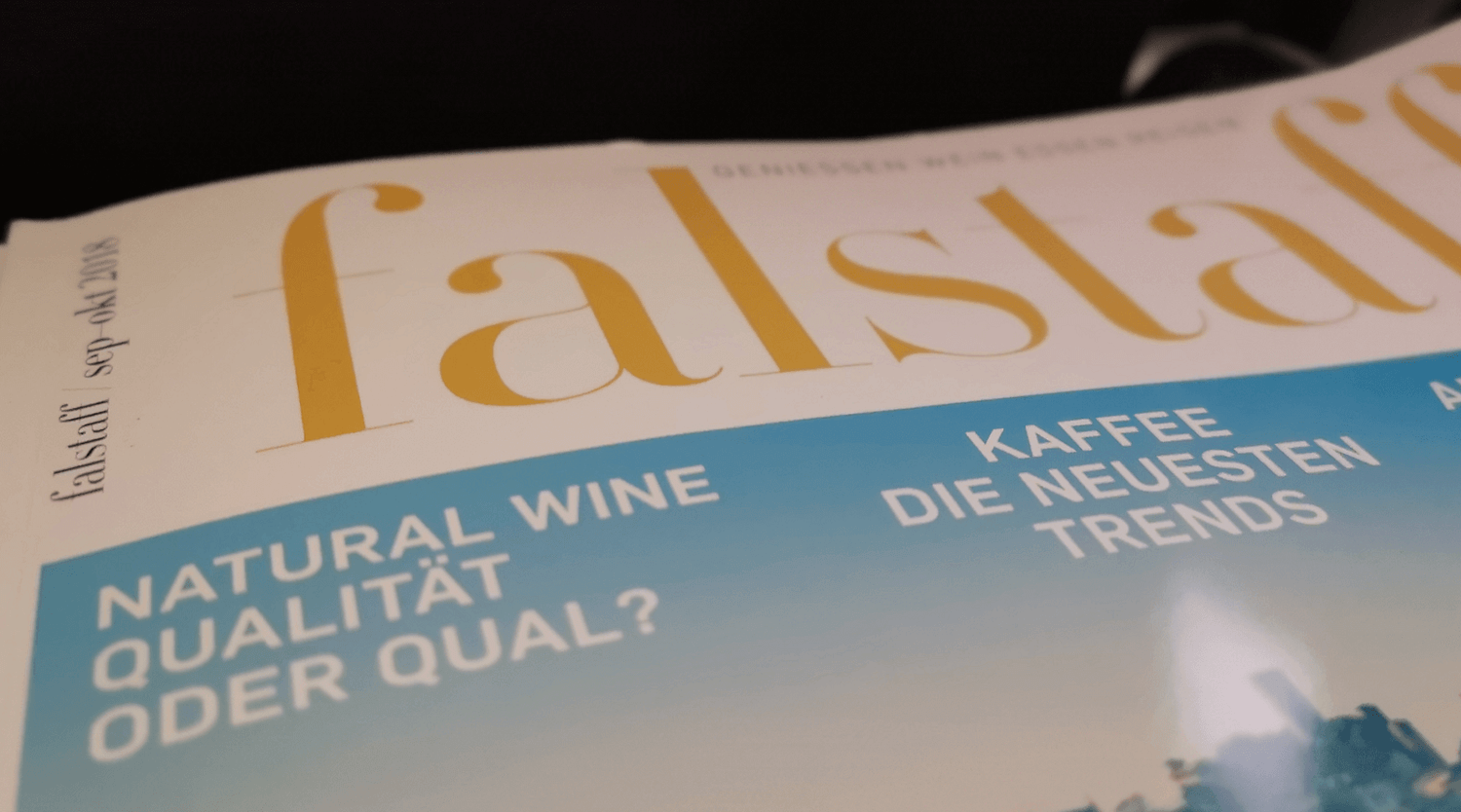
In the September issue of the culinary magazine Falstaff, the cover reads (see photo above): «Natural Wine – Quality or Ordeal?» Right next to it, another headline: «Coffee. The latest trends» Coffee and wine together on the cover of a glossy magazine. Either coffee has arrived where it belongs, or natural wine has managed to become socially acceptable. Or both.
What is Specialty Coffee?
According to the official definition of the SCA, these are coffees that are free of primary defects and score at least 80 points in a tasting. These points are obtained by evaluating and quantifying the coffee's sensory attributes. We have explained this definition further.
What is Natural Wine?
An answer I quite like comes from Martin Helfer in an interview with vi-tis:
«I don't like using the term natural wine. Wine is a product of human cultivation. Grapes don't ferment on their own and become wine.»
Martin Helfer in vi-tis, November 2018
Helfer prefers the term «unadulterated wines, created with as little intervention as possible, meaning, in the vineyard we work biodynamically, in the cellar the wine is merely accompanied. (…) No «unnecessary» interventions during fermentation, no acidification, no filtering or fining. No sulfur either.»
It becomes clear: Natural (or unadulterated) wines thrive on reduction to the essentials. They define themselves through exclusion criteria that are standard for «conventional wines.»
Specialty coffee is less about exclusion and much more about a flavor definition. The production method of coffees has no bearing on whether a coffee qualifies as specialty coffee. On one hand, the term is not protected, and on the other, there are no agronomic guidelines that would legitimize certain practices as specialty.
Specialty coffee = it's about tasteNatural wines = it's about production method and taste
Mature Specialty Coffee Market and Adolescent Natural Wine Market?
Specialty coffee is a niche and must remain one, otherwise it wouldn't be special anymore. However, a niche can grow. The colorful, trendy, and contentious contributions and concepts these days come from the specialty coffee world, and the larger coffee world watches and copies what makes sense for them. This avant-garde versus mass market relationship is a normal course of things.
Nevertheless, representatives of the specialty coffee world have managed to make the product socially acceptable and mature with it. Hardly anyone who hasn't heard of the «filter coffee trend» or tasted «Single Farm Lots».
To put it somewhat dramatically: specialty coffee has arrived in the middle of society – only not everyone likes it, and that's OK.
Natural wine, on the other hand, carries with it this absurd constellation that the production method is very old while the market is still very young. My grandparents made wine back in a time before yeast was added to start fermentation. Actually, they made something like natural wines – they just didn't call it that.
Helfer is asked whether consumers actually know what natural wine is – «More and more.» However, there is no labeling requirement for wine, the consumer doesn't know what a conventional wine is allowed to contain and how much sulfur, it only says sulfite.» Helfer continues and explains:
«Hardly any winemaker says he produces natural wine. He simply produces wine according to his philosophy, always with the highest possible quality and what nature offers him, depending on the year.» He further notes that it's currently a «hype», but one that will last.
Martin Helfer, vi-tis, November 2018
We've only seen natural wines occasionally in restaurants – where they have their own concept, or where they're a bit more daring. So far I haven't seen natural wines in your average pub. For them, it's still too special. Perhaps it doesn't need to be, and it fares the same as specialty coffee. A bit of niche sometimes helps to stay attractive.
Is Taste a Matter of Age?
If we were to calculate the average age of our participants in the coffee maker courses, we would clearly land on a number under 50. There may be many reasons for this, but let's stick with openness to new flavors.
Thinking about coffee anew, opening yourself to new flavors, takes some courage. You also have to allow it, since coffee is an emotional product. For many, coffee is their 5-minute meditation, the moment that belongs to them. You might not want someone telling you how coffee should or could taste.
Wine is often no different – «I don't like the French ones» I recently overheard in a restaurant. Rigid ideas certainly don't help you get to know wine anew. The natural wine audience would likely also fall into the under-50 category.
Martin Helfer says on this: «If you've been drinking your Bordeaux for 30 years, your palate is conditioned to exactly that taste.» Or, as a friend of mine put it: you can't teach an old monkey to peel a banana.
Mutual Learning
Specialty coffee is not the youngest, but rather a young phenomenon that is developing rapidly. The turbulent phase is over, and it's becoming more mainstream. Sometimes I think natural wines are at a similar point. They still need to prove themselves, we need to explain and compare.
However, natural wine has one decisive advantage that we coffee people are also hoping for soon; access to fine dining. Chefs and sommeliers as advocates help establish natural wine. In combination with food, wines – and the food – sometimes seem completely new. But after the espresso, less risk is often taken. You generally get what you expect, and that's actually a real shame. More on that in a future post.
A great concept that brings together natural wines and specialty coffee is, for example, 169 West in Zurich: https://www.gaultmillau.ch/zuri-isst/169-west-pure-trinkfreude