















In eastern Mexico, in Córdoba, two sisters run a family ranch in its fourth generation. For a few years now, they have specialized in direct contact with roasters, opening up new markets and opportunities, and have launched a decaffeinated coffee with what are arguably the shortest supply chains in the world.
Actually, the plan for the two sisters Melisa and Jimena was originally different than taking over a ranch - Melisa studied architecture and was drawn to Switzerland. Jimena studied agricultural science in Mexico and decided, after completing her studies, to take over the family business together with Melisa.
Family businesses follow a different dynamic than many other businesses.
Family bonds can mean motivation, obstacle, but also obligation and pride. Melisa and Jimena have themselves witnessed how the last 20 years have been challenging. They have experienced the hopes and the pain, and have seen that especially in Mexico, it is time for young women to make their mark in a male-dominated field.

Melisa and Jimena, 2022
Diverse Tasks at Rancho San Felipe
Rancho San Felipe is today run in its fourth generation by the two sisters. Their father, Adrián, oriented the ranch toward coffee, greatly expanded the network, and thus became a fixture in the coffee region around Córdoba, Veracruz.
The Rancho San Felipe itself produces almost no coffee today, but instead conducts experiments with varieties and offers tours through its own gardens.

Melisa shows us the nursery at Rancho San Felipe, where they cultivate not only coffee but also shade trees, fruit trees, and flowers.
The ranch purchases coffee cherries or already depulped coffee from the region, processes it further, dries and sorts it until it is export-ready. Rancho San Felipe thus creates its own blends, which Benjamin Distl, Melisa's partner, then primarily exports to Europe.
At the same time, however, the ranch also processes coffee on behalf of producers, even roasts it, or seeks market channels within Mexico itself. This broad approach helps the ranch cover a wide range of fields and utilize the potential of its infrastructure.
On the ranch in Córdoba, in addition to a Beneficio Humedo - that is, the place where cherries are depulped, fermented, and washed - there is also a Beneficio Seco. There, the dried coffee in parchment is cleaned of foreign materials, separated from the parchment skin, sorted by size and density, bagged, and cupped.

Rancho San Felipe at night.
The facilities have been in operation for a long time, and Melisa and Jimena have long-term plans. Step by step, they want to renovate the ranch. The history of the ranch goes back more than a century, when the area was also much larger. A lot has changed, and the two are eager to start new projects and build on old relationships.
The Sueño - The Project for Our Decaffeinated Coffee with Descamex
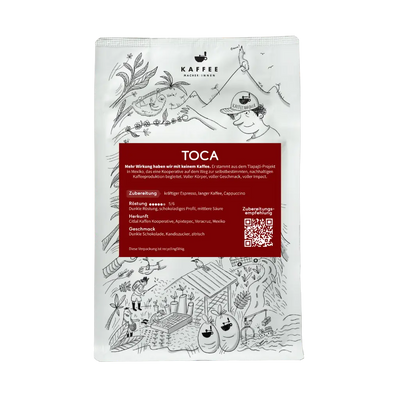
And this approach manifests itself precisely in the decaffeinated coffee that Rancho San Felipe now makes for us. A few years ago, we asked Benjamin Distl if they would be interested in making a specialty decaf?
The main reason was that Rancho San Felipe and Descamex, one of the two companies worldwide that decaffeinate raw coffee using only water and pressure, are almost neighbors. Both companies are based in Córdoba. And because Melisa and Jimena's father already knew the people in charge at Descamex, bringing the pieces together was quick.

Cupping at Descamex, who decaffeinates our decaf using only water
But a raw coffee was still missing, and that is now being provided by Rafael Reyes. Reyes purchased thousands of new seedlings of the Geisha variety, unaware that they weren't actually Geisha at all. He hoped to succeed in a highly sought-after market this way. After two years, it then turned out that they were certainly not Geisha varieties and he had been "misinformed" in his purchase.
This was just the moment when Melisa and Jimena came into contact with him - Rafael Reyes had also been in contact with their father, but back then the two sisters were still younger.
In Reyes's memory, however, they were probably still "the girls" (las niñas), who one day showed up on the farm, and he called them exactly that from then on.
Unlike before, however, they now came with a business idea about how they could help Reyes. Reyes's coffee fit sensorially exactly in the range that we also desired for the decaffeinated coffee. Sweet, notes of maple syrup, full-bodied, with moderate acidity.

Rafael Reyes's farm in the Sierra de Gallego
Reyes supplies the cherries, Rancho San Felipe depulps and ferments them, dries the beans, and delivers them to Descamex, ten minutes up the road toward Orizaba.
Initially, they produced one batch with Descamex, which corresponded to approximately 2.5 tons of raw coffee. The demand for a hyper-local, decaffeinated coffee continued to rise - with us and with friendly roasters - so that Rancho San Felipe has now increased the amount fivefold.

Don Ramiro, the farm manager, with the Sueño - from farm to roastery and back
The New Coffee Generation at Rancho San Felipe
Today, Melisa and Jimena are at the helm of the ranch, Beni takes care of the export and marketing of the coffee, both domestically and internationally. Beni himself also roasts coffee for the local market. When he was at one of our roasting courses in 2021, he surprised everyone when he said that he had been able to reduce his roasting time from "60 minutes to 40 minutes."

The old 70kg roaster - it runs and runs and runs
Of course, that's a long roasting time, but the machine doesn't allow for more. For local needs, however, he has optimized the system to the point that they increasingly roast private label for producers and have also created an additional sales channel with their own brand.
Whoever makes coffee doesn't just make coffee.
The tasks are so multifaceted at Rancho San Felipe in Córdoba because many of the projects have grown historically. There is the large garden, where they cultivate flowers and succulents and sell them in their own flower shop in Orizaba. There is the model farm, where they conduct experiments with varieties, test different types of compost, grow fruits, lead tourists through the farm, and show them coffee trees. There is the beehive for their own honey, and the drying beds for their specialty lots, which already account for almost ten percent of the total harvest.

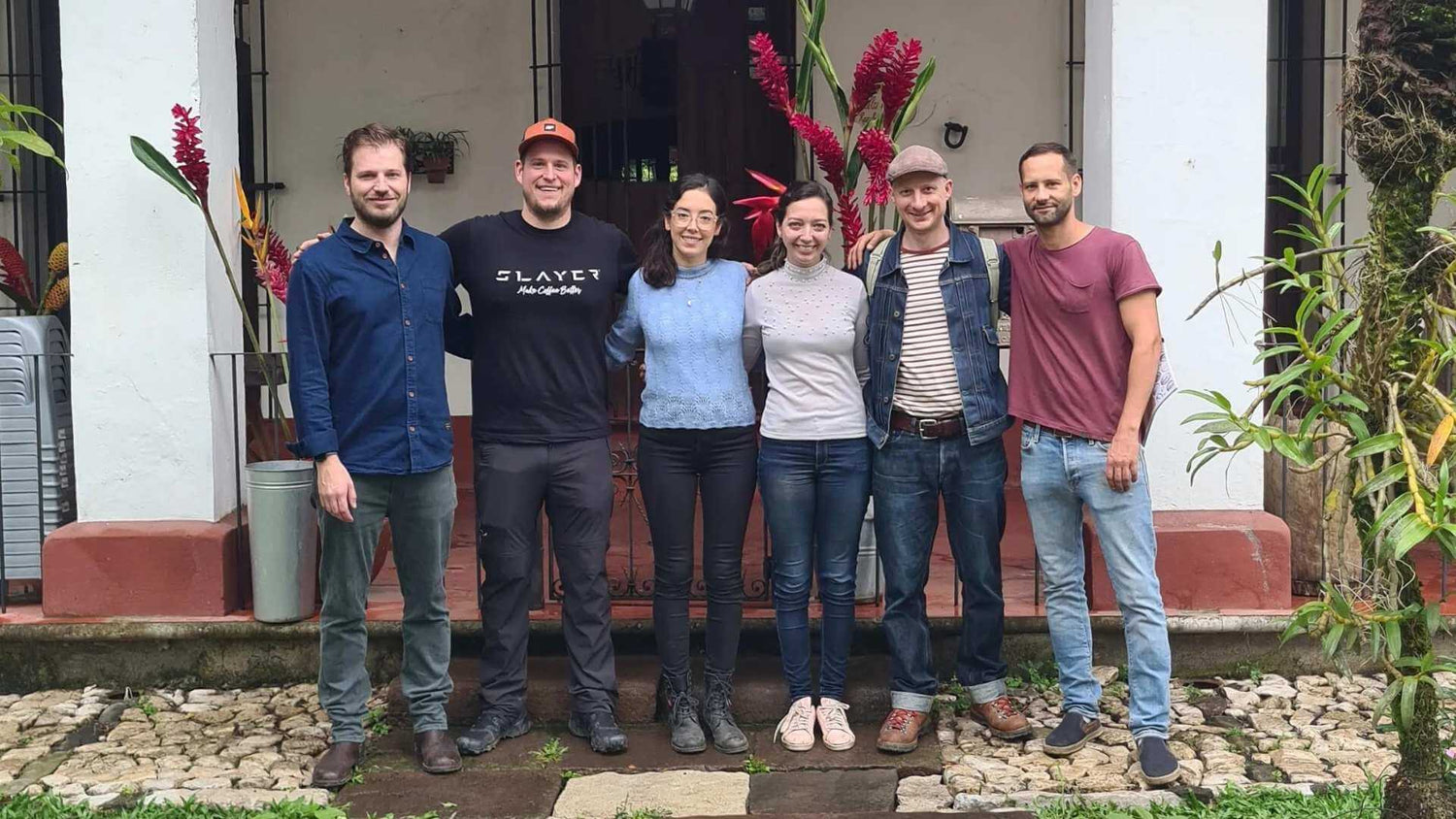
Visit in October 2022, from left to right: Philipp, Michel (Team Coffee Makers), Melisa, Jimena, Patrizio (Ballon Coffee Roasters), Beni
Melisa, Jimena, and Beni have taken on a huge project. We are impressed by the dedication, creativity, and humility with which they step into the footsteps of a family tradition. They have their program, are open to projects, sense where the specialty coffee market is heading, and know exactly that working with coffee is never just about coffee, but about people, relationships, and old bonds, which they are now carrying into a new era.