



























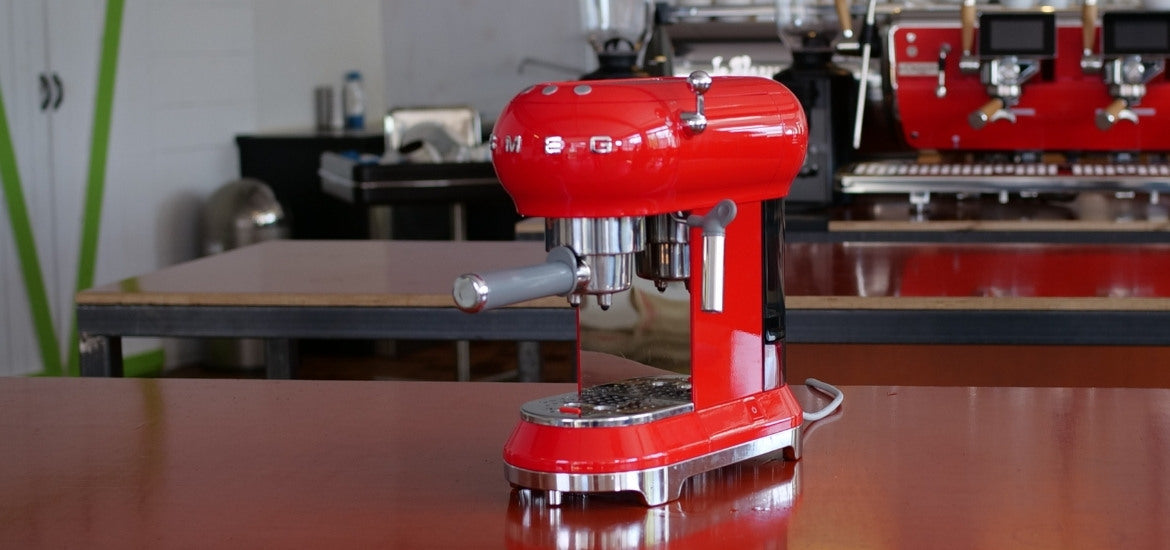

The Smeg espresso machine ECF 01 is positioned at around 300 euros and 330 francs retail price in the upper budget entry-level segment of espresso machines. But can the machine convince when compared to other machines in the thermoblock class and is the design premium worth it compared to the structurally similar Delonghi Dedica EC 685?
In this article and our two test videos, we address exactly these questions. And of course, the cardinal question hovering over everything is: does the espresso taste good? (We couldn't resist. 😉)
Short answer upfront: yes, with two crucial tips you can tune the Smeg ECF 01 to make good espresso.
In addition to the short video version, we also shot a half-hour test, which you can watch here.
Smeg espresso machine ECF 01 the better Delonghi Dedica EC685?
When we look at espresso machines, we usually focus on a single model and try to evaluate it on its own terms without immediately bringing competitors into the picture. With the Smeg espresso machine, that's hardly possible. The colorful design machine is too similar to Delonghi's budget entry-level model. The controls are the same, the drip tray is similar, the water tank is identical. And even looking inside, it's clear – these machines have a high degree of kinship. Smeg takes a different design approach, but what's inside in terms of motor and other components – comes at most from Delonghi's neighboring factory. From the portafilter mount to the input power (1350 kW) to the annual power consumption according to the manufacturer (54 kWh), only the appearance differs.
Design is a matter of opinion. And it's up to you to decide whether the design of this machine for you, your kitchen or living room justifies almost double the price compared to the Delonghi Dedica EC685*.
The Smeg ECF01 (right) next to the Delonghi Dedica EC685.

Exterior and delivery contents of the Smeg espresso machine
The Smeg espresso machine ECF 01 presents itself in "50s retro style" according to its own description. This refers to a smoothly rounded mix of plastic and metal available in numerous color options. The machine is around 15 cm wide, 33 cm high and 33 cm deep, weighs just under 5 kg, and the water tank holds one liter.
Included is a plastic tamper for pressing the coffee in the portafilter as well as three double-walled baskets. To put it mildly, the tamper is good for nothing, except perhaps wrapping up headphone cables. The pressing surface is slightly warped, doesn't fit cleanly into the portafilter, and you can't apply any force to the stick. The dosing spoon side is also the opposite of ergonomic – and by the way, also not suitable for dosing (we'll address this topic during espresso preparation). The drip tray is small but shows the water level well with a small float indicator.
The included double-walled baskets, also called pressure baskets, crema baskets, compromise baskets or affectionately fake baskets, prevent really good espresso extraction and deserve their own section below.
There would have been room for Smeg to justify the premium price of the machine compared to the sister model with little effort. Decent baskets and a tamper – that would have been it. Missed opportunity…

On the left the double-walled baskets of the Smeg espresso machine and on the right the plastic tamper.
Decent baskets versus double-walled compromise baskets
I would be quite tempted to launch an extensive fundamental discussion here about the pros and cons of double-walled baskets, but I'll postpone that to its own article. Instead, let's look at the functional principle of double-walled baskets and briefly contextualize the advantages and disadvantages.
The functional principle of the basket is hinted at in all its names: crema basket, double-walled basket or pressure basket. A double bottom structure first lets the coffee flow through a base surface with many holes, then it must flow through a second base surface, the actual exit surface with only one hole.
A large amount of espresso is pressed here under maximum pressure through a tiny hole. As soon as the coffee emulsion exits this high-pressure space and enters a space with lower pressure, the CO2 trapped in it expands and turns into foam. The higher the pressure difference, the more foam.
At the same time, the fine hole reduces the flow speed of the coffee regardless of the grind size. This suggests that the coffee flows out espresso-like and slowly.

A double-walled basket cut open in side view, also known as a pressurized basket.
Advantages:
- Old coffee can be used and crema still forms.
- Pre-ground coffee can be used because the outlet speed is controlled by the outlet hole, not by the grind size.
- An espresso-like drink can be brewed.
- A grinder is not needed.
- Even the worst coffee looks beautiful.
Disadvantages:
- Making good espresso is unlikely.
- Baskets suggest good extraction time, but the coffee still doesn't taste good.
- Crema forms, which also indicates that extraction was fine. But that's not true or often not true. So crema is no longer a good indicator of fresh, quality coffee.
Double-walled baskets simulate a good, desirable extraction time for espresso and fake crema, which is created by high pressure but not by fresh coffee. Crema is a positive characteristic when it forms through the use of fresh coffee.
When using double-walled baskets, there is largely under-extraction because coarser coffee is used. This leads to a relatively acidic cup. At the same time, individual particles are strongly extracted under the high outlet pressure, which also promotes bitterness in the coffee. The result is unbalanced and lacks the sweetness that could balance the espresso.
Classification of double-walled baskets
Double-walled baskets allow you to brew an espresso-like drink with cheap espresso machines without having to buy a grinder. We advise against it and recommend a good super-automatic espresso machine instead. The espresso result is generally better because the coffee is freshly ground. Espresso machines with double-walled baskets are a compromise that provides no added value.
The upgrades we made to the Delonghi Dedica EC685 can be partially applied to the Smeg espresso machine as well
Upgrade with good baskets for the Smeg espresso machine
Of course, the Smeg espresso machine's baskets can be replaced with classic espresso baskets. This simple upgrade combined with a decent tamper completely changes espresso performance.
What an espresso machine must deliver is consistent pressure and decent temperature stability around 93 degrees Celsius. And the Smeg espresso machine has this potential if you work with our rinsing and heating protocol. Then the machine initially performs at the upper limit with around 95 to 96 degrees Celsius, then drops during the 25 to 30 seconds of extraction time to just under 90 degrees, then stabilizes again. For a machine in this price segment, this is a good progression and especially one that is achieved consistently. For the brewing water temperature to flow from the machine in this range, we've developed a short water rinsing protocol for you.

Tip: Good espresso through water rinsing protocol
First, the portafilter of the Smeg espresso machine ECF01 should be preheated. When you start the espresso machine, this is not sufficiently heated to temperature and pulls down the temperature in its cold state during brewing. To preheat the portafilter, run the water from one or two espresso shots through the empty portafilter. Warning, the drip tray is very small! It's best to draw the water directly into a container.
Then when preparing an espresso, follow this temperature-surfing protocol:
- Remove the preheated portafilter, grind the coffee, dose it into the portafilter and tamp carefully.
- Start water draw without the portafilter locked in. First there is a pre-infusion phase that outputs only a small amount of water. After a short pause, the main water output starts. After one second, stop this main water output.
- Then immediately lock in the portafilter and start the extraction.
If you use a single-walled basket and get the brewing temperature under control with our temperature protocol, you can pull good espressos with the Smeg espresso machine ECF01.
Suitable baskets are available, for example, from Graef*. Meanwhile, however, some manufacturers have brought completely bottomless portafilters with matching baskets to market very cheaply. This combination is cheaper than the conversion we show in our upgrade video.

We remove the plastic insert to install a single-walled basket.
Converting the basket to a single-walled basket
Converting the basket to a single-walled basket is not complicated and can be done by an untrained hand. First, the inserted basket is pried out. Our barista trainer shows this in the test video at minute 18:50. Then the screw on the back is loosened and the plastic insert is removed. This prevents the installation of a different basket.
The tension spring is reinserted and the new basket is pushed in. What's somewhat unsightly is the center hole that now remains open. If you pull espresso doppio as double shots, the hole doesn't matter much – even if the coffee doesn't flow out beautifully.
Elegant is a sawed-off portafilter that makes it bottomless. A well-prepared extraction without channeling is something very fine – but requires a lot of practice.
Which coffee for the Smeg espresso machine?
Since the temperature of the Smeg espresso machine also temporarily drops below 90 degrees even with our suggested surf protocol, we recommend medium to medium-dark espresso roasts. These inherently have less acidity, which is further emphasized by lower brewing temperatures.
From our selection, coffees like Apas are most suitable.

Adjusting the grinder for brewing espresso
If you opt for a single-walled basket, you can't avoid adjusting your espresso grinder. The grind size forms the resistance in the portafilter that determines the espresso flow time. Since the Smeg espresso machine first goes through a wetting phase (pre-infusion), we recommend brewing times between 25 and 35 seconds depending on the espresso.
We've explained in detail exactly how to set up a grinder and espresso here. What's crucial is that the grinder provides you with the basic requirements for brewing espresso. It should be able to grind fine enough, adjust consistently, and not accumulate too much retention.
When purchasing a grinder and espresso machine, the importance of the grinder is often neglected. However, the better it is, the better the conditions for good espresso are. Especially in the range up to 500 euros, the grinder should cost more than the espresso machine. The cheapest decent electric espresso grinder we've tested so far is the Sage Smart Grinder Pro. However, we've also found three hand grinders in the price range under 100 euros that grind espresso-fine.
Steaming milk with the Smeg ECF01
The Smeg espresso machine is capable of steaming milk foam with thick texture that is also capable of latte art. However, it's not so easy to control the air volume that's added during steaming. The large opening of the steam wand makes careful control and guidance of the steaming phases difficult.
With some practice, you can still make milk foam. Compared to the best milk-steaming espresso machine in a similar price range, the Sage Bambino Plus, the Smeg espresso machine looks dated.

Conclusion on the Smeg ECF 01
The Smeg espresso machine ECF01 scores as an espresso machine with the potential to brew good espresso. It performs like the Delonghi Dedica EC685 and here already lies the challenge when looking at the Smeg. What justifies the almost double price compared to the Dedica? The included equipment doesn't score points, there are no strong pro arguments except for the appearance. And here the verdict lies in the eye of the beholder.
We can only give one recommendation: make the upgrades, whether with the Smeg ECF01 or Delonghi Dedica EC685.
*We purchased the test unit. That's a principle for us with all tests. Because we want to evaluate all devices neutrally and without outside influence. The link is an affiliate link to Amazon. If you order something through the link, it doesn't cost you more – but our machine testing fund reduces its deficit. If the machine is available from your local dealer, we recommend buying it there.


