



























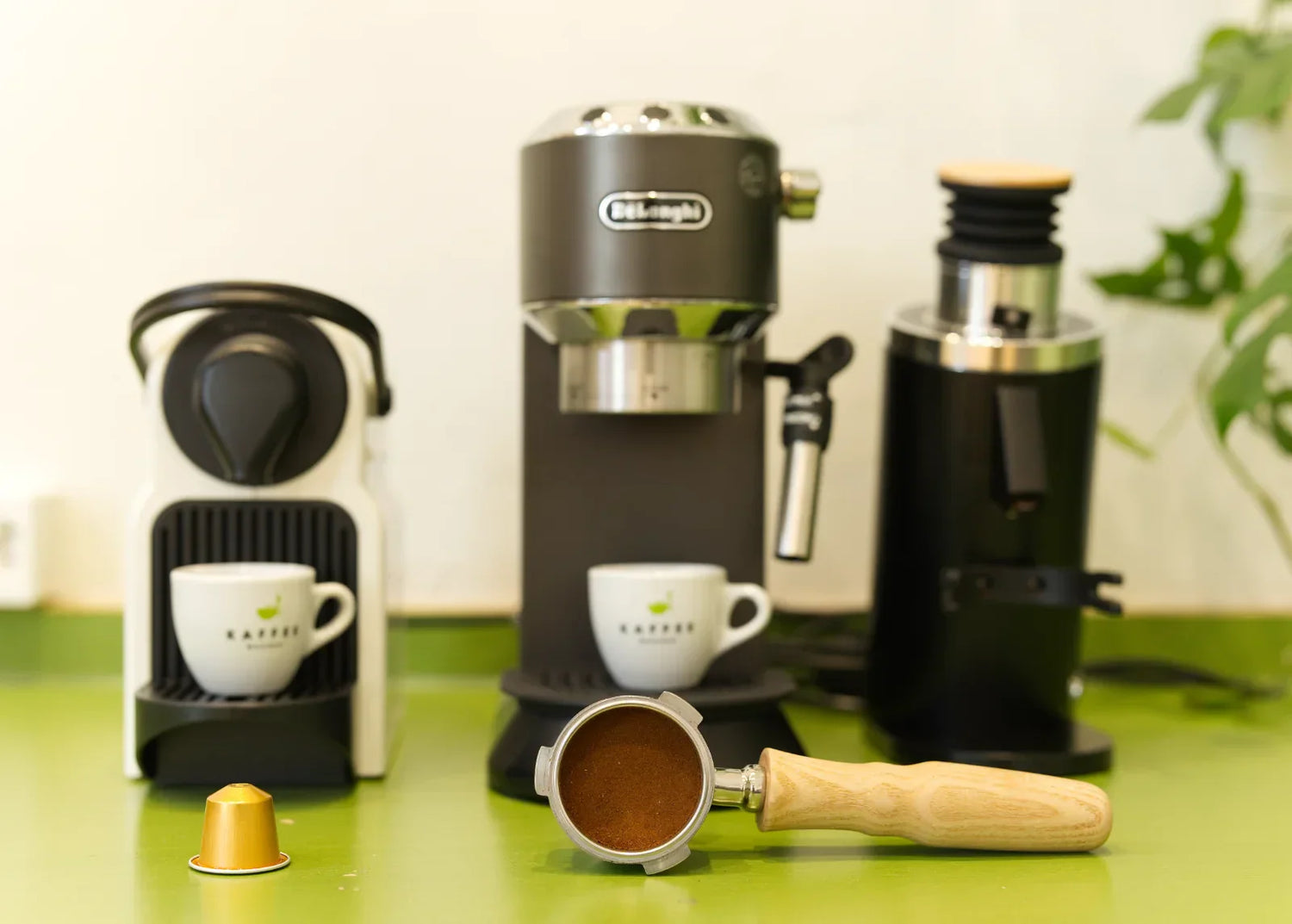

You have a capsule coffee machine and are thinking about switching to a portafilter machine. What changes? Is it really that complicated? And will the coffee taste better afterwards?
In short: A lot changes. It's not complicated. But there's a learning curve ahead. And the espresso? It will literally knock your socks off.
What you need to know before buying, which accessories are really necessary, and how to nail your first espresso, we'll show you here.
Capsule vs. Portafilter: What's the actual difference?
A capsule machine is designed for maximum convenience: insert capsule, press button, done. Pre-dosed coffee powder, fixed water amount, no mess, minimal effort. The result is a functional espresso, but not a particularly good one.
The main reason is the drink ratio. A typical capsule machine brews with about 5 grams of coffee and fills the cup with 50 to 70 grams of water. That's a ratio of roughly 1:10. The espresso becomes thin, has little body, and no texture.
With a portafilter, we brew with 16 to 18 grams of coffee and extract about 45 grams into the cup for a double espresso. Ratio: 1:2.5. The ratio for a single espresso is the same. This is a fundamentally different drink. Stronger, fuller, silky. This simply doesn't come out of the capsule.
| System | Coffee Amount | Output | Ratio | Character |
|---|---|---|---|---|
| Capsule Machine | ~5 g | 50–70 g | ~1:10 | thin, watery, little texture |
| Portafilter | 16–18 g | ~45 g | ~1:2.5 | strong, full-bodied, silky |
At your first sip of espresso from your own portafilter, you might be startled. This espresso is strong. Exactly as it should be. But also the way you get it served at the first Italian gas station heading south.
What exactly is in a capsule and why the system limits taste, we explain in our article How do coffee capsules work?

The grinder comes first, not the machine
This is the most important sentence for everyone starting out: The grinder is more important than the espresso machine.
An espresso machine is essentially hot water under pressure. What controls the espresso is the grind size. Ground too coarse, the water runs through too quickly and the espresso becomes watery and under-extracted. Ground too fine, too much resistance builds up and the extraction takes forever or stops completely. The grinder is your strongest control lever.
As a rule of thumb, we recommend: Split your budget in half. 50 percent for the portafilter machine, 50 percent for the grinder. If you invest 600 francs, buy a machine for 300 and a grinder for 300 francs, not a 500-franc machine and a cheap grinder on top.
What this looks like in the most budget-friendly version, we show using the example of the DeLonghi Dedica: the most affordable espresso machine we can recommend, together with a grinder and a single-wall basket for around 250 francs.
For getting started, there are very good grinders under 300 francs available today. The G-Iota DF54 is a well-known example with very good value for money. If you want to approach the grinder selection systematically, you'll find an overview by type and budget in the grinder articles.
Hand grinders also work very well together with a portafilter if they grind fine enough. For daily use, electric grinders are more convenient. But whoever grinds a hand grinder in the morning also has a more relaxed routine. We ourselves have several hand grinders in our range and provide recommended grind sizes for espresso. For getting started, we recommend the Timemore C5 ESP Pro. If you want to grind electrically and can spend little, you'll find an option in the same price range in our KitchenAid Artisan grinder test.
Portafilter machines with built-in grinders sound practical. We advise against them: The integrated grinders are almost always the weakest part of such combination devices. More on that here.
The accessories you really need
Besides the machine and grinder, you need a few more things. The list is manageable.
Scale (essential). This is the most critical item. You need to know how much coffee you're using and how much espresso lands in the cup. Without a scale, you can neither work reproducibly nor adjust the grind size meaningfully. A simple postage scale is enough to start. Our espresso scale with timer.
Tamper. For evenly compacting the coffee powder in the portafilter. Often comes with the portafilter. But a good tamper with the right diameter makes the job noticeably easier. Tampers in shop.
Knockbox. The knock box, where you tap out the spent coffee puck. Knocking it directly into the trash also works, but the basket tends to fall out and gets annoying. Our knockbox.
Barista Towels. You need at least two separate towels: one for the portafilter, one for the steam wand. Never use the same one for both. Barista towels in 3-pack.
Milk Pitcher. If you want to froth milk, you'll need a pitcher. We've developed our own stainless steel versions that bring joy for beginners and advanced users alike. Milk pitchers in shop.
Plan for roughly double the space of your capsule machine. Machine, grinder, knockbox, scale: it all needs room. If you have a narrow kitchen, you should measure it before buying.
Preparing Espresso: Step by step
The workflow with the portafilter becomes routine after a few attempts. Here are the parameters, assuming a double basket that holds 16 to 18 grams of coffee. For smaller baskets, maintain the brewing ratio and scale down.
Grind size is your most important control lever. If the espresso runs through in under 20 seconds, the coffee is ground too coarse: grind finer. If it runs too slowly or not at all, it's ground too fine: grind coarser. This is how you dial in to the right setting.
"Put a small piece of paper and a pen next to the espresso machine and jot down: how much coffee, grind size setting, output grams, extraction time, and how it tasted. After a few tries, you'll have your recipe and can always go back to it."
More on extraction time: Espresso extraction time explained | Complete guide: How to prepare espresso

The three most common mistakes at the start
These mistakes happen to almost everyone. It's good to know them beforehand.
1. The double-wall basket. Many entry-level portafilter models, including the De'Longhi Dedica, come with a double-wall basket in the package. This basket has only a single opening on the bottom instead of many small holes. It creates artificial back-pressure and thus crema, regardless of how fresh or coarse the coffee is.
The problem: You don't get honest feedback on your grind size. The result always looks the same, no matter what you do. Switch to a single-wall basket as soon as possible. Double-wall vs. single-wall basket
2. Old coffee. Fresh coffee releases CO₂ during brewing, creating resistance. Old coffee doesn't do that anymore. Only buy coffee that is at most two months old from the roast date. Good roasters put the roast date on the bag.
3. Machine not properly heated up. A machine like the Dedica shows brewing readiness after a few minutes, but the portafilter is still cold at that point. Solution: Run an empty shot of hot water through the installed portafilter, then extract your espresso. For the Dedica, we've described this as a heating protocol in four steps.
If you want to dive deeper: In the article 20 mistakes when making espresso, we go through all the typical problems that happen with the portafilter.
Which coffee is right for capsule switchers?
Those coming from capsule machines are usually used to dark, strong flavor notes: chocolatey, somewhat bitter, heavy body. That's a good starting point.
Start with espressos that are dark roasted and forgiving. Even if you make a mistake at first, the result still tastes good. Lighter roasted coffees are complex and rewarding, but they forgive little when it comes to grind size and brew temperature.
With us, the Compadre works well as an entry point: strong, chocolatey, classic Italian, and very forgiving in preparation. If you're looking for a slightly more complex entry, the Apas is a good choice. If you want to try different directions first, the Espresso tasting set is a good start.
Over time, you'll know your taste and can work your way further into the world of specialty coffees. But there's time for that.
Conclusion
Switching from a capsule machine to a portafilter is a real decision: more space, more accessories, a small learning curve. But the curve is short. And what awaits on the other side is an espresso that is nothing like the one from the capsule.
The key takeaways: Buy a good grinder first, not the most expensive machine. Invest in a scale. Get fresh coffee. Write down your first recipe.
For the fastest entry, we recommend a Home Barista Course. If you're still not sure which machine is right for you: Which espresso machine is right for me?

