



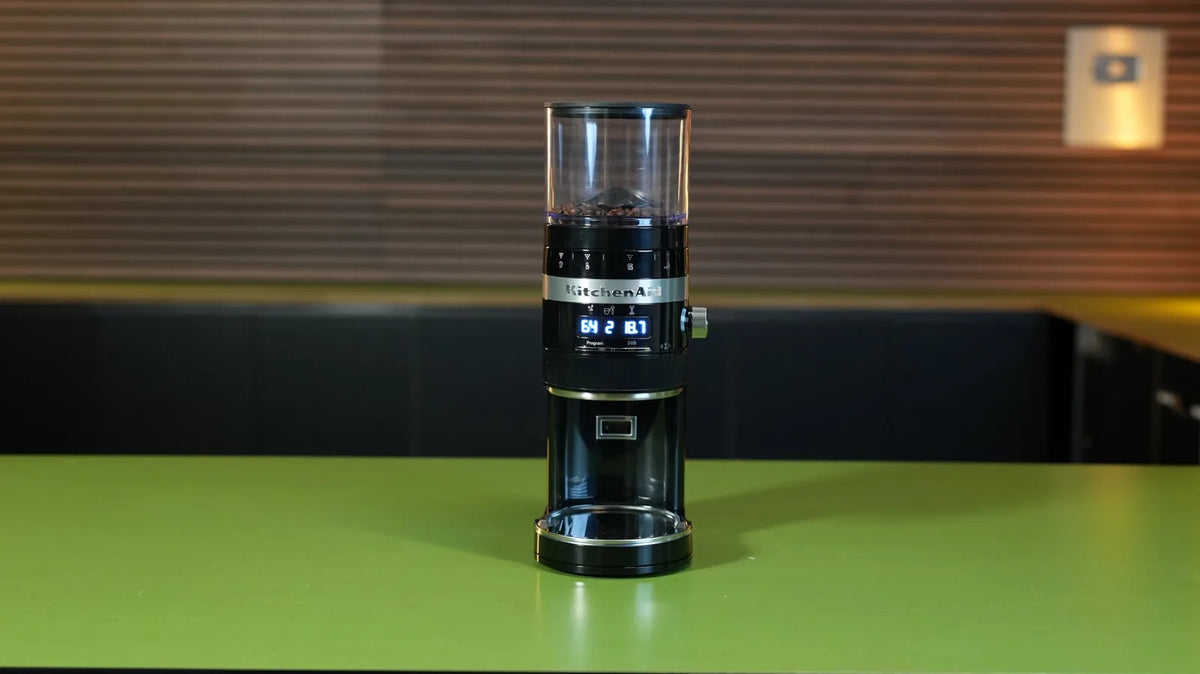

Cheap coffee grinders have a recurring problem: they often don't grind fine enough for espresso. That was the first and most important test question that the KitchenAid Artisan 5KCG8433 also had to face. The small grinder has quite a bit to offer: it's time-controlled and equipped with a conical burr. A portafilter holder also does its job. As always, we also bought the KitchenAid Artisan 5KCG8433 ourselves so we can test independently.
The grinder is number 97 in our test field and went through the complete protocol: retention, grinding temperature, dosing consistency, volume, particle distribution at ZHAW and of course tasting.
The short answer first: Yes, it grinds fine enough for espresso. And the espresso tastes better than we expected at this price. The long answer has a few limitations, and they're important before you buy.
Build: 2.9 kg of plastic with portafilter holder
The Artisan is a small grinder. 38 cm tall, just over 12 cm wide, with the knob on the side a bit more than 14 cm. It consists mainly of plastic, with metal in the burr and inside. Accordingly light at 2.9 kg. This is not a grinder that sits like a solid monument on the counter, but it fits next to a small portafilter machine.

The bean hopper holds 340 g and has a detail we really liked: it can be closed with a turn and removed. If you want to change coffee, you turn the hopper closed, take it off, empty a few half-ground beans from the burr, and put the hopper back in with different coffee. That's unusually well solved for a grinder in this price range.
At the bottom sits a portafilter holder, hidden behind a removable catch tray. KitchenAid's own portafilters fit there, as do smaller portafilters like the De'Longhi Dedica. A professional 58mm portafilter from a Faema brew group won't sit properly though: the edge is too narrow, the sieve gets pushed upward. If you work with 58 mm, you grind into a dosing cup and weigh it. The included cup fits in the holder and is practical for filter coffee. For transfer to the portafilter it's less suitable because the spout is too large.
One more thing stands out: the ground coffee comes out of the grinder without significant electrostatic charge, in a fine, targeted stream. No coffee dust sticking to the wall.
Conical burr with 70 steps: Fine enough for espresso?
The heart of the KitchenAid coffee grinder is a stainless steel conical burr. The grind size is adjusted via 70 steps on the knob, and there's also a coarse adjustment inside on the cone, which you can also remove for cleaning.
With the over 100 grinders we've tested so far, it's almost always true: the smaller the number, the finer the grind. With the Artisan it's the other way around. 70 is the finest grind setting, 1 is the coarsest. It takes getting used to, but it's not an error.

For espresso, we had to set the internal setting to the finest level. On the outside we landed for our Compadre at step 64 to 67, so at the outer edge of the scale. Not much room to adjust further down. With the Compadre we got too slow a flow at 67, at 66 it worked. That means: the grinder grinds fine enough, but very hard or very light roasted beans could hit the limit. For medium to dark roasts, there's enough range.
There's no RPM control, the motor draws 150 W.
Time control instead of scales: 13 seconds for 18 grams
The Artisan is a dosing grinder with time control. You don't set that you want 18 g, but that the grinder should grind for 13 seconds. After about 13 seconds, 18 g are then in the portafilter. For setup you need a scale once, then the dosing runs at the push of a button. Important: the time is linked to the grind size. If you adjust the grind size, the amount that comes out in the same time changes.
How consistent is that? We ground 18 g five times and measured 17.8 to 18.1 g. The standard deviation is 0.13 g. That's a solid value, even a good one for a grinder in this price range. What you set is what you get.
Speed: 13.5 g in 10 seconds, 13.2 seconds for 18 g. That's average, not crazy fast, not crazy slow. Absolutely fine for home use.
Volume: 77.6 dB, on the quiet side
The Artisan doesn't sound like it glides through the beans with great elegance. But it's still relatively quiet. We measure 77.6 dB(A) with the lid closed at 20 cm distance. We rate anything under 80 dB as quiet, and the grinder is there. Pleasant for a kitchen where someone is still sleeping in the morning.
Grinding temperature: 38 °C after five grinds
This shows it's a household grinder. We grind 18 g five times with 20 seconds pause each and measure the temperature of the ground coffee. The beans were 22.4 °C beforehand. The first grind comes out at 33.6 °C, then it rises grind by grind: 35.4, 36.6, 37.3 and finally 38.0 °C at the fifth. The grinder heats up constantly, on average we're at 36.2 °C.
38 °C is warm. Inside the grinder itself it must be even warmer, and that affects the taste. Michel would give the grinder a few minutes break after the fifth grind at the latest to let the burrs cool down. A simple home test: finger in the ground coffee. If it's noticeably warmer than your body temperature, the coffee loses quality. For two or three espressos in the morning that's not an issue. A gathering of guests or a sports team, you won't serve them with this grinder.
Retention: 3.4 grams absolute
Every grinder has a retention, ground coffee that stays in the grinder until the next grind. With the Artisan that's 3.2 g temporary retention, plus 0.2 g permanent, together 3.4 g absolute. That's also due to the conical burr, and it's a medium to good value for a time-controlled dosing grinder.
What that means in everyday use: when you adjust the grind size, the first good 3 g still comes out with the old grind size. And if you make coffee a few hours later, you'll have about 3 g of older coffee in the portion. That changes the extraction time and tastes a bit different. If you're being precise, you grind out these 3 g beforehand.
Particle distribution: Main peak 318 µm, fine peak 37 percent
We measure the particle distribution the same way on all grinders: same machine, same recipe, same coffee. Once the recipe is set, we take a sample and have it analyzed at ZHAW in Wädenswil. Two values tell us how the coffee will taste: the main peak, that is how widely the main mass of particles is distributed, in micrometers. And the fine peak, the proportion of ground coffee under 100 micrometers, in percent.
For the Artisan's espresso setting we get:

To classify the grain size, that is the particle distribution, as Michel explains in the video: grinders with a main peak around 200 to 250 µm are suitable for complex, light roasted coffees. Between 250 and just under 300 µm, medium to dark roasts often work really well. Over 300, and especially over 320 to 330 µm, it gets tricky. The Artisan is at 318 µm, right in that direction, but not far over. The fine peak of just under 37 percent brings body and some dustiness to the cup.
What does that mean practically? We wouldn't use the grinder for very complex, light coffees. It works well in the darker, heavier spectrum. Our Italian-oriented Compadre was completely delicious with it. Bean hardness also plays a role: the Compadre is in a range that the grinder handles well.

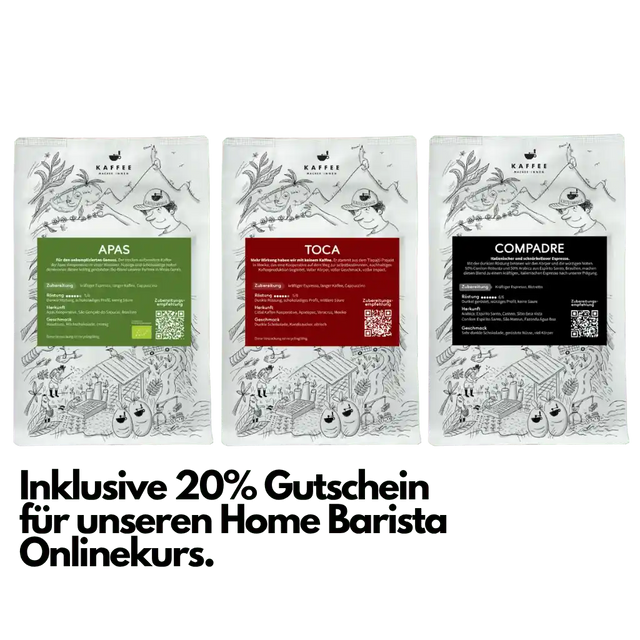
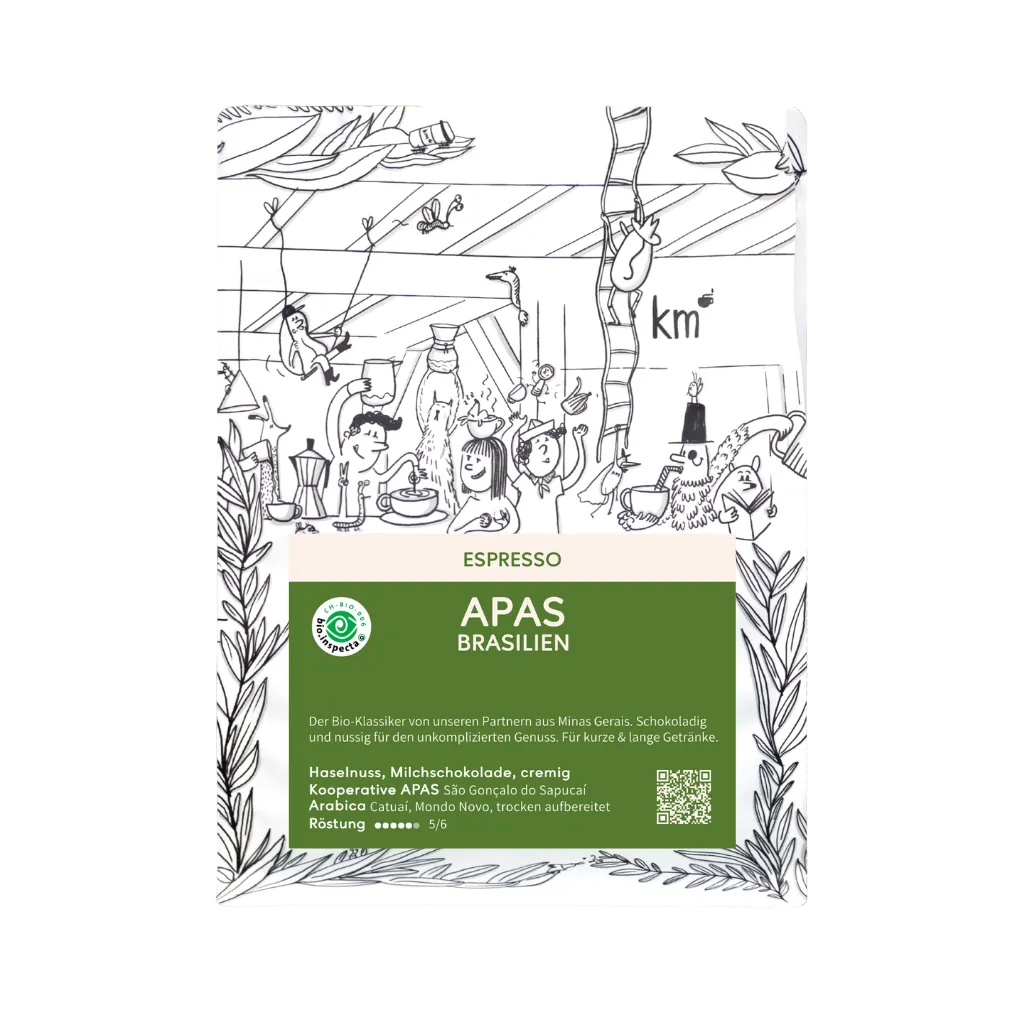
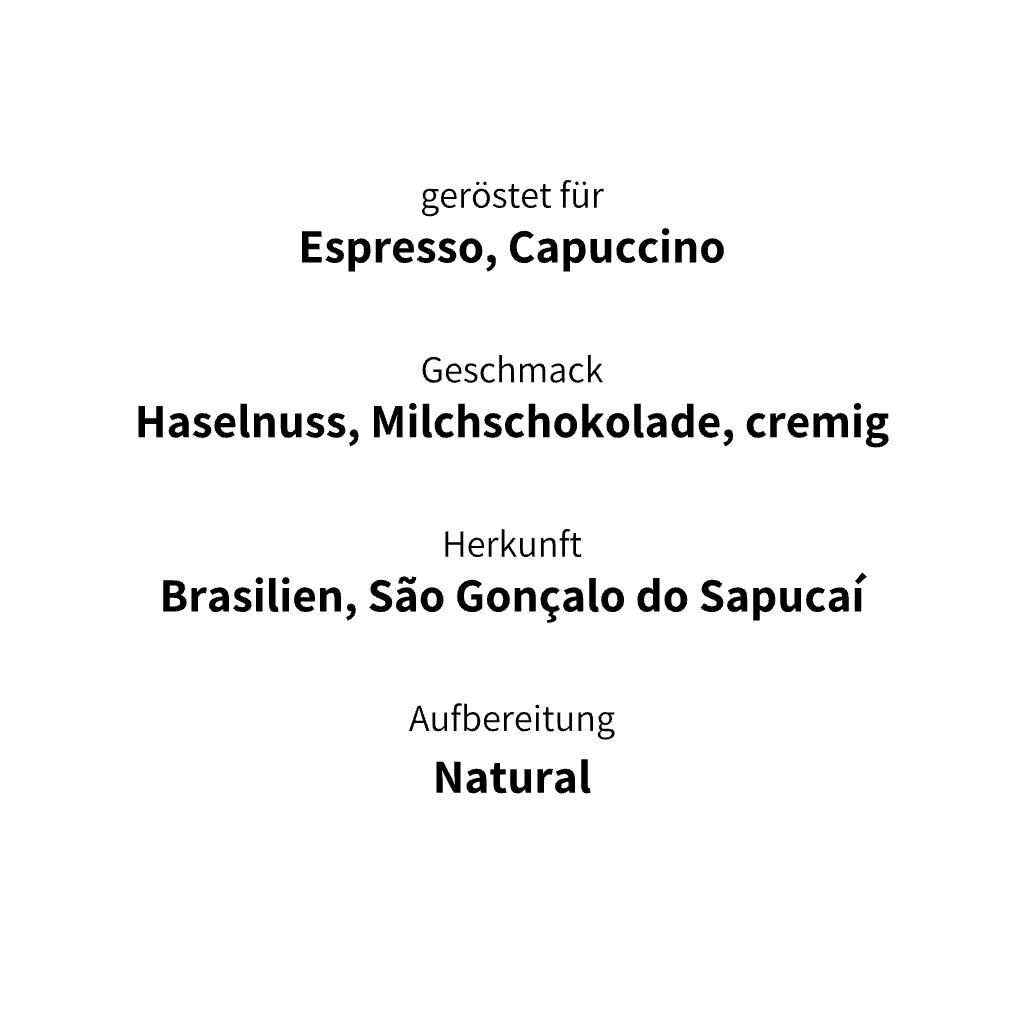
Roasted nuts, spicy, dark chocolate. Our tasting coffee in this test.
from CHF 9.90One more word about grind size reproducibility. We switch from espresso to ristretto, then to lungo and back to the espresso setting. The x50 value is then 267 µm instead of 248 µm, and the flow runs through in 17 to 18 seconds instead of 25. After resetting you have to readjust and sacrifice one or two shots. If you always stay on the same setting, you won't notice much. For frequently switching between recipes, the grinder is not well suited. You won't find the range reliably enough when switching back.
Tasting: Sweet, soft, creamy, not elegant
The recipe for the Compadre: 18.5 g in, 42 g out, grind size 66.
And then there's an espresso that surprised us. The same day we tested a grinder for 800 euros. Now an espresso from a grinder for around 250 francs, and it's good. Sweet, soft, creamy, the body is pleasant. The espresso is not convincing through elegance. But it's balanced and tastefully coherent.
In short: body-focused, strong, balanced. The dustiness from the fine peak is there, but it doesn't bother this coffee. You won't get a competition espresso or a finely resolved, light coffee with it. But the grinder doesn't promise that either.
Filter coffee, French press and moka pot
KitchenAid positions the Artisan as an all-rounder, so we also made filter coffee. For filter we actually wish for a narrower main peak so lots of clarity gets into the cup. But again the question is: what do you like to drink?
Our Amigo comes out of the Artisan just as we imagined. An everyday breakfast coffee, balanced, sweet, with body that brings its chocolatey and nutty notes to the cup. If you don't want to analyze a complex, fancy coffee, but just want a good coffee at breakfast, you get exactly that. It's not the clearest specialty filter coffee, but solid. The same goes for French press and moka pot.

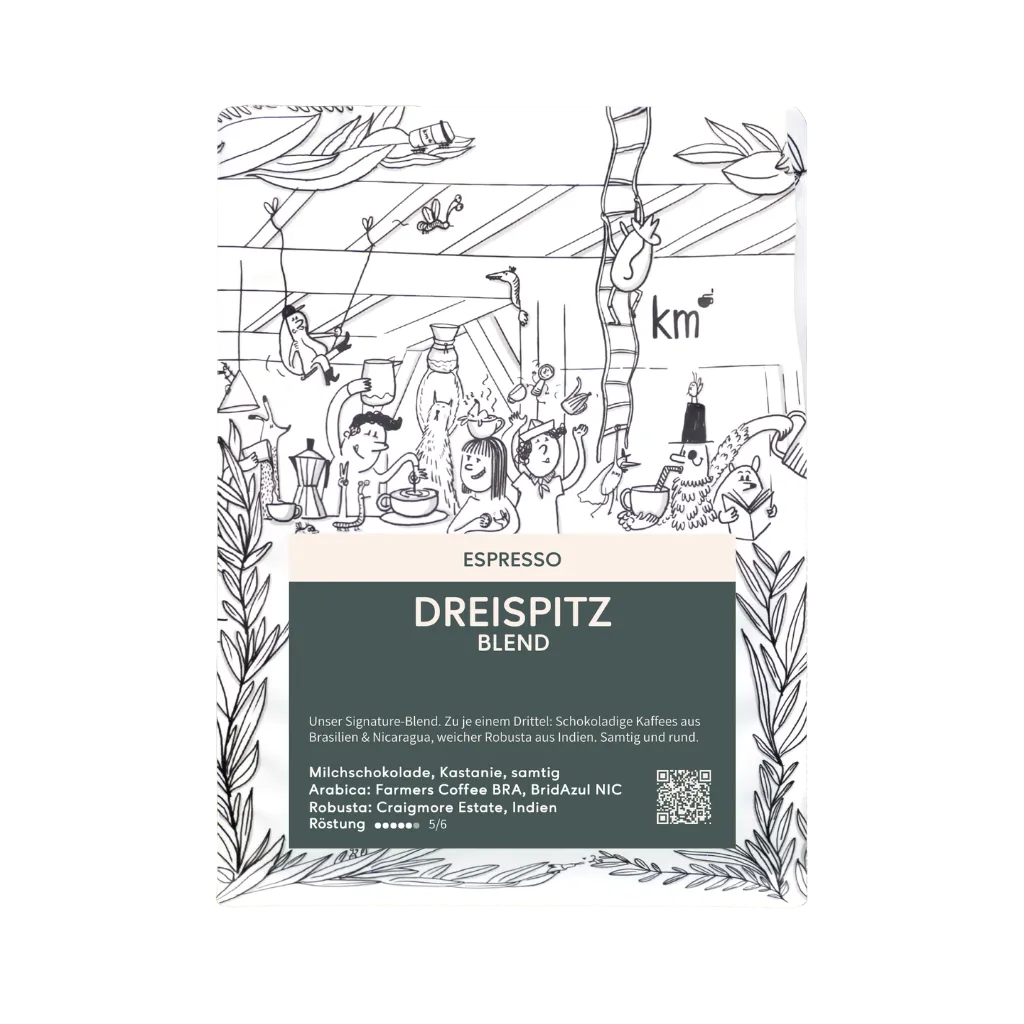
Chocolatey, caramel, balanced. From El Salvador, for filter, French press and moka pot.
CHF 10.50Operation and cleaning
Operation is intuitive: set time, hang in portafilter or place cup underneath, press button. The bottom container can be easily removed and replaced. For cleaning you can reach the inner cone, take it out and brush with the included brush. That's straightforward.
In the box you'll find, besides the grinder and brush, the portafilter holder with catch tray, a dosing cup with lid, a measuring spoon, and a holder for coffee pots.
Conclusion: Surprisingly much espresso for around 250 francs
The KitchenAid Artisan 5KCG8433 is a simple, inexpensive grinder that can do something many cheap grinders fail at: it grinds fine enough for espresso. And the espresso tastes good.
Strengths: Espresso-capable grind size, consistent dosing with 0.13 g standard deviation, quiet at 77.6 dB, minimal electrostatics, interchangeable bean hopper, easy cleaning.
Weaknesses: Grinding temperature rises to 38 °C after five grinds. Particle distribution with 318 µm main peak and 37 percent fine peak limits it to medium to dark roasts. Grind size cannot be reproduced after adjustment without readjusting. A 58mm portafilter doesn't fit in the holder.
For whom? For anyone starting out with espresso, with a small portafilter machine like the De'Longhi Dedica or the KitchenAid Artisan espresso machine. And for anyone who wants a grinder for filter, French press and moka pot that can also do espresso on the side.
Not for whom? Anyone who wants to drink complex, light roasted coffees and get everything in the cup that's in the bean. Anyone who regularly grinds for many people. Anyone who frequently switches between grind sizes.
Value for money: Around 256 francs in Switzerland, around 180 euros in Germany (as of November 2026). If you spend around 100 francs more, you can get single-dosing grinders from around 250 francs with more clarity in the cup, but then you have to weigh each portion beforehand. In its segment, among timed-dosing grinders, the Artisan is a strong option. It stays with us, we'll make a few more tutorials with it.
As always, we bought this grinder ourselves. This test was not requested by KitchenAid.
Test results: KitchenAid Artisan 5KCG8433
Evaluation per KM test protocol for espresso grinders. All measurements taken by ourselves. The temperature is the average of five grinds, the fifth was at 38.0 °C. Single-dosing performance is omitted because the Artisan is a timed-dosing hopper grinder. Particle distribution doesn't have its own row because it manifests itself in espresso potential. We rate this separately by roast level: potential is limited with dark roasts, particle distribution is insufficient for light roasts.
Technical specifications at a glance
| Property | Value |
|---|---|
| Price | approx. 256 francs (CH) / approx. 180 euros (DE), as of November 2026 |
| Burr type | Conical burr, stainless steel |
| Grind size adjustment | 70 steps (70 = finest) plus internal coarse adjustment |
| Operating mode | Hopper, timed dosing |
| Bean hopper | 340 g, removable with twist lock |
| Grinding speed | 13.5 g / 10 sec, 13.2 sec for 18 g |
| Volume | 77.6 dB(A) |
| Grinding temperature | 33.6 to 38.0 °C (first to fifth grind) |
| Absolute retention | 3.4 g (3.2 g temporary, 0.2 g permanent) |
| Consistency (Std. dev.) | 0.13 g |
| x50 (Espresso) | 248 µm |
| Fine peak | 36.8 % |
| Main peak | 318 µm |
| RPM control | No |
| Power | 150 W |
| Dimensions (W × D × H) | approx. 12.7 × 25.4 × 38.1 cm |
| Weight | 2.95 kg |
| Portafilter holder | suitable for KitchenAid and smaller portafilters (e.g. Dedica), not for 58mm |
Frequently asked questions about the KitchenAid coffee grinder
Is the KitchenAid coffee grinder suitable for espresso?
Yes. With the internal setting on the finest level and step 64 to 67 on the outside, the Artisan grinds fine enough for espresso. It works best with medium to dark roasts.
Is the KitchenAid's conical burr good?
For the price, yes. The main peak of 318 µm and fine peak of 37 percent result in a body-forward, balanced espresso. Light complex coffees lack the clarity.
Can I combine the Artisan with the De'Longhi Dedica?
Yes, the Dedica's portafilter fits in the holder. We can very much imagine the grinder next to a Dedica.
How do I set the dosing?
Once with the scale: set grinding time, weigh the result, adjust. For 18 g it was about 13 seconds for us. Check again after every grind size change.
Find more grinders from our test field in the large espresso grinder test. If you want the basics first: Which coffee grinder is right for your coffee?