



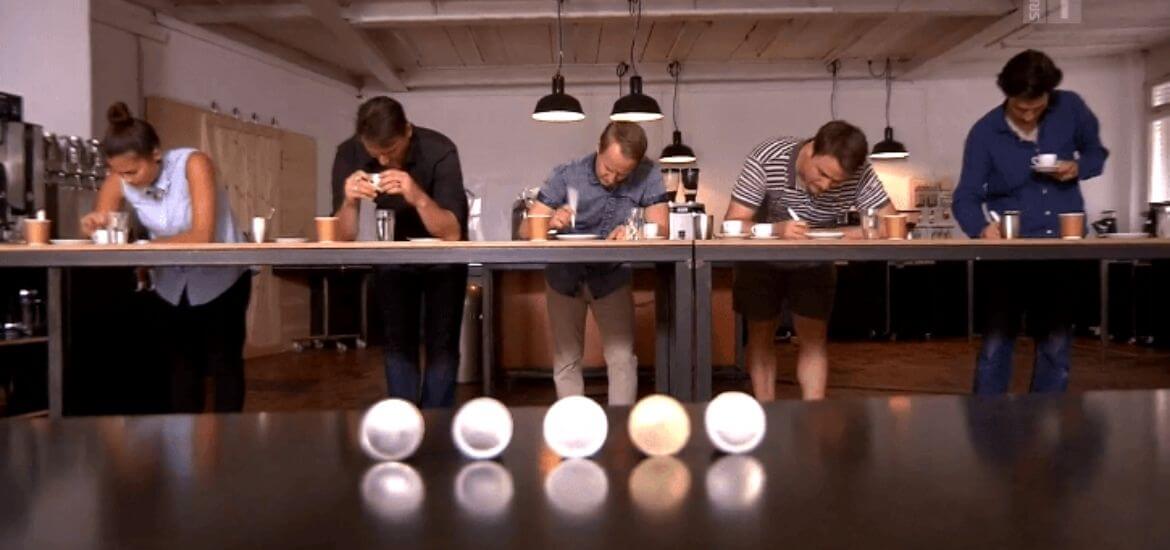

We hosted the Kassensturz broadcast on SRF aired on August 21, 2018 on the topic of capsule coffee. Together with Patrick Zbinden, we led the sensory panel and ensured the quality of the testing. It's always exciting to see what appears in a short segment after a long shooting day. From my perspective, however, some key messages came across well. The tasting was diverse (see test as pdf).
Capsule in the test
Coffee from the capsule can taste bad, good, and very good. In the test too, we tasted good coffee drinks. Nevertheless, it's important to note: strictly speaking, coffee from a capsule is not an espresso. The concentration of dissolved coffee particles makes capsule coffee more similar to a café crème than to an espresso.
In the test, we measure a TDS (Total Dissolved Solids) of 3.67% for capsule coffee using a refractometer. This is not surprising when you consider the use of "only" 5.5 grams of coffee. You simply cannot extract as much from 5.5 g as from 7–9 g in an espresso from a portafilter machine. If the coffee from the capsule is then pulled "long," as recommended on many packages (40 ml), the concentration can hardly be strong.
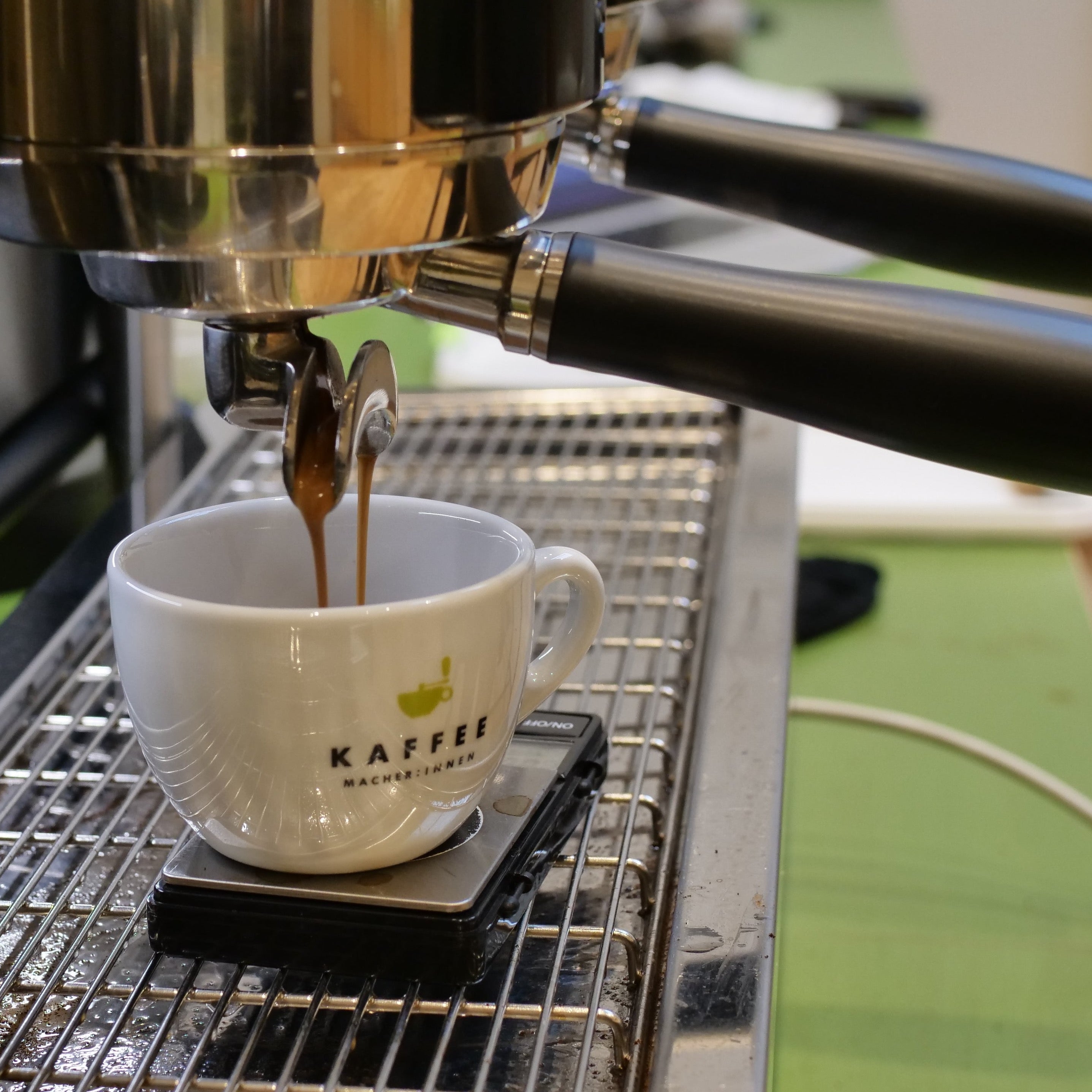
With espresso, we regularly measure results between 7 to 9.5 TDS. This naturally shows in the texture of the drink and the intensity of the flavors.

Strength as a difference
In my view, coffee drinks should first be classified based on the concentration of dissolved solids in relation to water.
Secondarily, one can then also consider what equipment the drink was brewed with. This perspective makes sense because espresso-like drinks can already be brewed today from both a portafilter machine and from a very good fully automatic piston machine.
In a filter coffee course, we brewed an espresso and then adjusted it to the strength of a filter coffee by adding water. After filtering out the solid particles that slip through the metal filter in the portafilter, the drink was very similar to filter coffee brewed with a hand filter.

For the record
The tasting was conducted blind. The participants did not know which capsules were available. I myself had no influence on the selection of coffees.
I would have found it interesting to taste more coffees as well, to also put the results in relation to international specialty capsules or also Beluga from Café Royal.
Without the waste issue
The environmental factor of capsules was not considered in the article. Of course, we view very critically any waste that arises in connection with brewing coffee. After all, you can make really great coffee quite simply yourself, from filter coffee to espresso.