



When you want to enjoy a delicious espresso, you don't immediately think about power consumption, kilowatt-hours, or standby mode. However, in the world of coffee, awareness of environmental issues has increased considerably in recent years, and many consumers are increasingly placing value on sustainable products.
We as coffee makers have been integrating power consumption into our machine tests for several years now. To further refine our tests, we have developed a more detailed power measurement protocol with Tobias, our Head of Sustainability.
In this blog, we want to explain to you in basic terms how we measure power consumption and how different espresso machine systems differ in terms of their consumption. We endeavor to use only absolutely necessary technical terms so that readers without electrical engineering background can follow along.
Why is machine power consumption important at all?
Of course, we don't want to constantly think about every little thing. When we enjoy an espresso, we want to do so with a clear conscience, without having to think about a nuclear power plant. Nevertheless, it makes sense to include power consumption in the pros and cons list when purchasing an espresso machine.
Every little bit counts. Let us conduct a brief thought experiment: In your household, you drink two cappuccinos each in the morning and afternoon. There are machines that require about 0.42 kWh for this. If you use your machine for a year, you will consume around 150 kWh.
If, on the other hand, your machine only uses 0.18 kWh to prepare the cappuccinos, your annual energy requirement drops to 65 kWh. This represents a saving of 85 kWh per year – quite simply. This corresponds roughly to the amount of electricity an LED TV uses when it runs all year. https://www.enbw.com/blog/wohnen/energie-sparen/was-man-mit-1-kwh-so-alles-machen-kann-2/
If we assume that it's not just you, but also many other passionate cappuccino lovers, the numbers increase significantly. The "Kaffee-Netz" forum has over 65,000 members. If each of them saved 90 kWh annually, that would come to a total of 4,225 megawatt-hours. This corresponds to the amount of electricity an offshore wind turbine can produce in half a year. And not every owner of a lever machine is active in Kaffee-Netz. So you can see that a machine's power consumption can make a significant difference.
What does our measurement protocol look like?
We use three professional power measurement devices, the Christ CLM1000 Professional Plus. Why three right away? If a value seems odd to us, we can verify the measurements with another device. These measuring devices have the advantage that they measure accurately to one tenth of a watt, i.e., to 0.0001 kWh – that is extremely precise!
We record all values in kWh. This unit is also displayed in your electrical panel, and you pay for your electricity based on consumption per kilowatt-hour (kWh).
In our power measurement, we also take into account the heat-up time. But how long does it actually take for a machine to be ready to operate? First, we measure how long it takes for the target temperature of 92 °C to be reached for the first brew in the portafilter. To avoid skewing the values, we always use a cold machine, that is, one that has been out of operation for at least ten hours. Additionally, the water filled always has a temperature of 20-24 °C. With thermoblock machines, for example, heating up takes only a few minutes, while dual boiler machines can take up to 40 minutes.
Once the machine reaches operating temperature, we perform a flush shot that heats up the portafilter.
Now we come to the "extraction measurement".
Espresso Extraction
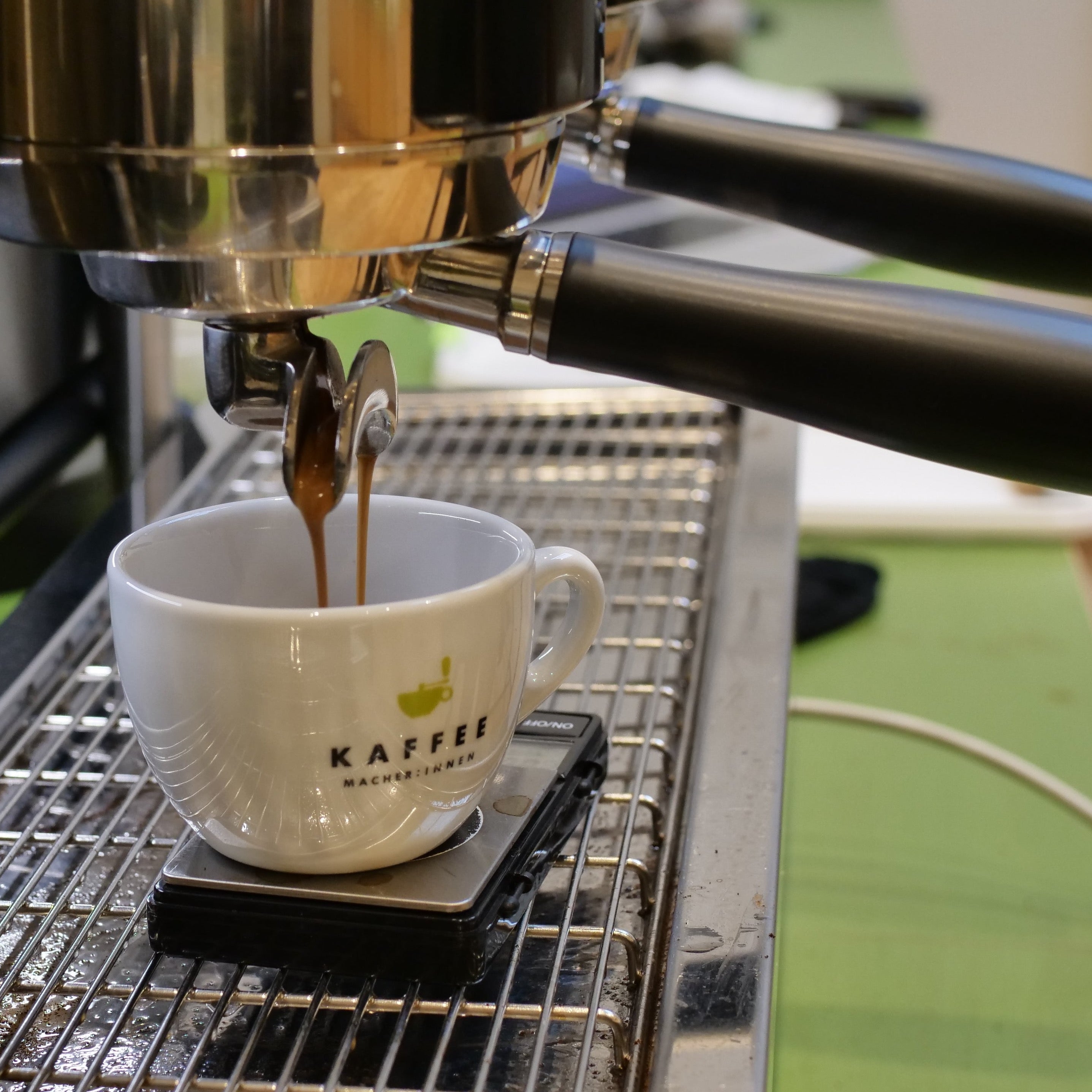
To simulate espresso extractions, we perform five extractions of 27 seconds each. Additionally, there is a so-called "flush" of 2 seconds, which simulates cleaning the brew group. Between each extraction, we pause for one minute to simulate grinding, tamping, and other steps.
If the machine offers the option to turn off the steam boiler, we perform the energy measurement for espresso twice: once with the steam boiler turned on and once with it disabled.
Americano
To simulate power consumption for an Americano, after each espresso extraction we drew 70 ml of hot water.
Cappuccino
To simulate the cappuccino extraction, after each espresso extraction we heated 300 grams of water from 6° C to 60° C using the steam wand. Here we simulate the frothing of milk foam that you need for a cappuccino.
Coffee Maker Protocol
In older videos, we frequently spoke about a "coffee maker protocol" to compare the energy consumption of different machines. This protocol included a warm-up phase of 25 minutes, regardless of machine type, followed by five espresso extractions with a one-minute pause between each. Since we did not determine the heat-up time for each machine with this outdated protocol, machines that heat up quickly were at a disadvantage. Even if they would be ready to operate after just 5 minutes, they still had to run for 25 minutes before the first extraction. This is one of the reasons why we developed a new protocol. However, to ensure comparability with the old videos, we also provide the values for new machines within the framework of the "coffee maker protocol" and show the electricity data in the article as in the following table.
Why are there such large differences in energy consumption?
The largest portion of energy consumed goes into heating water. Preparing an espresso requires a brew temperature of about 92 °C, which is handled by the espresso machine's heating system. For milk drink enthusiasts, water steam at approximately 120 °C is additionally required.
The way a machine heats the brew and steam water significantly affects energy consumption. A boiler machine works differently than a dual boiler or a thermoblock. In the following, we briefly explain the differences between the heating systems of the various machine types.
Boiler Machines
Boiler machines are often referred to as "single boiler machines" if they have a single heating circuit. Typical examples of this machine type include, for example, the Gaggia Classic and the Rancilio Silvia.
Single boiler machines have a small boiler in which water is heated to the desired temperature by electric heating elements. Depending on the size of the boiler, which is often between 0.3 and 0.5 liters, power consumption varies. If you want to prepare a cappuccino, after extracting the espresso you need to heat up the boiler to reach the required steam temperature. This process sometimes takes several minutes and requires additional energy.
In simple terms, a single boiler machine can be compared to an electric kettle
Dual Boiler Machines
As the name "dual boiler" already suggests, machines of this type have two separate boilers. The smaller boiler is responsible for brew water, while the larger one is responsible for steam generation. When both boilers are activated, they must first reach their target temperature before you can prepare espresso. During operation, the temperature in the boilers is kept constant by reheating. Depending on the size of the boilers, power consumption can be substantial. The La Marzocco GS3, for example, with its 1.5-liter brew boiler and 3.5-liter steam boiler requires a full 0.6 kWh in the first hour.
Dual boiler machines offer primarily temperature stability, often even under load, and high comfort, since steaming and espresso extraction can occur simultaneously and the temperature can be set precisely. However, in terms of energy efficiency, they are quite power-intensive. In simple terms, they are two electric kettles heating simultaneously at different temperatures (high and very high). The better the boilers are insulated, the less electricity is needed to reach and maintain the temperature.
Note: Retrofitting insulation is not an option, because without adjustments to the control electronics, temperature regulation no longer works reliably. While you can save some electricity, it comes at the cost of taste.
Two Circuit Machines
Two circuit machines have a single boiler, but it serves two separate water circuits. Many classical Italian espresso machines equipped with the Faema E61 brew group use this heating technology. The boiler is responsible for steam generation and is heated to temperatures between 120 and 130 °C. The brew water is routed from the tank through a pipe past the steam boiler. The heat of the steam boiler heats the water in the pipe similar to a heat exchanger. This brings the brew water from 20 °C in the water tank to the desired 92 °C in the brew group.
Although only one boiler needs to be brought to temperature, most two circuit machines still consume a lot of energy because the steam boiler must be constantly maintained at a very high temperature.
Thermoblock Machines and Thin Film Heaters
Thermoblock machines and thin film heaters represent interesting alternatives. Instead of bringing an entire boiler to a target temperature, an aluminum block or thin metal plate is heated. Water from the tank flows through pipes in the respective unit, which is directly heated. With a thin film heater, even less mass needs to be heated than with a thermoblock.
Since the water is only heated during extraction, the machine's heat-up time is significantly shorter than with the various boiler machines. The Zuriga E2, for example, is equipped with a thin film heater and is ready for use after just two minutes. That is extremely fast and also very energy-efficient. An Ascaso Steel Duo PID, which is equipped with a thermoblock, also reaches operating temperature in under ten minutes.
Depending on the machine's concept, the thermoblock or thin film heater must be heated to steam temperature. However, there are also models with two separate thermoblocks or thin film heaters, one for the brew and one for the steam temperature.
Multi-Heating Systems
There are espresso machines that combine different heating systems. For completeness, we want to mention this category of espresso machines, even though they are not very numerous.
The Ascaso Baby T, for example, has a steam boiler and a thermoblock for the brew temperature. Since many thermoblock machines do not offer the same steam performance as dual boiler or two circuit machines, Ascaso is pursuing a hybrid solution with the Baby T to combine energy efficiency and performance.
Conclusion: Should I throw my dual boiler in the trash?
In our detailed blog post on performance measurement, we continuously update a list with the power measurements of all our tested machines.
Anyone looking at the list will quickly recognize that thermoblock machines and especially thin film heaters are generally significantly more energy-efficient than boiler machines.
However, energy efficiency is by no means the only criterion for a good espresso machine. Factors such as temperature stability, programmability, steam power, user comfort, design, and many other aspects also play a crucial role in the decision to purchase a machine.
Have we therefore reached the end of the dual boiler or two circuit era, as we teased in our video? Yes, that could increasingly be the case in the coming years. Modern espresso machines are characterized by high temperature stability and can be adjusted extremely precisely. We are therefore curious about the developments that still lie ahead.
After all, energy efficiency is directly related to heat-up time. Who doesn't want a machine that is ready to use after just a few minutes, instead of having to wait three-quarters of an hour to prepare an espresso?
Should everyone now switch from their boiler machines to thermoblock machines? A resounding no! The manufacture of a machine and the raw materials required for it (stainless steel, cables, hoses, electronics) are far more energy-intensive than its operation. So if you own a two circuit machine that will function without major problems for at least another 10 years, you should definitely continue to use it!
After all, the rule is: 1. The less we buy new, the more resources are saved. 2. Durability and the repair of machines also contribute to resource conservation. However, if you are thinking about purchasing a new machine and value energy efficiency and sustainability, you should carefully review our performance measurements and factor them into your purchasing decision.