




























There is neither a rulebook nor an inspection authority for Direct Trade. There is also no definition that two roasters would have to agree on. Yet the term appears on thousands of coffee packages, and no one questions what direct trade actually means. It's more a feeling that conceals rather well. What we need is precision, because otherwise the good principles will be lost.
Direct Trade refers to the direct purchase of raw coffee from producers without anonymous intermediaries. The term originated in the early 2000s with some US roasteries as a response to a world market price of 41 US cents per pound. To date, there is no seal, certification body, or binding definition. Each roastery decides for itself what it means by this, but no one checks whether it's true.
«Is your coffee actually Direct Trade?»
The question came up in one of my roasting courses. «Your coffee is surely Direct Trade, isn't it?» I answered the way I have for years: nested, with asides, with lots of ifs and buts. My answer wasn't very satisfying for my conversation partner.
«Well,» I usually say, «there's no definition of how direct 'direct' actually is.»
Today, when you pick up a coffee package, you encounter terms like Relationship Coffee, Farm Direct, Ethical Sourcing, Direct Trade, fairer than Fairtrade, or all of them at once. Each of these terms sounds like it implies closeness, but none of them say anything as long as there's no number or concrete facts behind them. Relationship Coffee means little if no one takes a risk. Farm Direct obscures the fact that there are almost always multiple actors between farm and roastery; someone handles logistics, someone insurance, someone financing, someone warehousing. Ethical Sourcing remains a feeling without concrete, measurable criteria.
Ask a handful of roasteries what belongs to direct trade. The answers will be shorter or longer. But none will be the same.
Where Direct Trade comes from and what the term once meant
September 2001. The coffee price drops to 41 US cents per pound, the lowest real value in a hundred years. Small farmers can no longer service their loans, farms are being abandoned.
Into this situation, a few US roasteries argued that quality could be a way out. Intelligentsia, Counter Culture, Stumptown. They traveled to farms, donated cupping courses so producers could learn how their own coffee tasted, and tied the price to taste and quality instead of the exchange. Intelligentsia set itself a minimum: at least 25 percent above the Fairtrade minimum price, with complete transparency. Stumptown made it a rule that a coffee could only be called Direct Trade after three consecutive years.
Why there was never a rulebook for direct trade
There was no audit, no paperwork, and no certification body. The idea was self-regulation. Three companies defined for themselves what they meant, and talked to each other about it—that was all there was to it initially. Today, it's not just a handful of roasteries, but thousands worldwide. Self-regulation remained, but no one checks each other anymore.
Directly traded coffee is not the same as Direct Trade
Lennart Clerkx founded This Side Up in 2013 in the Netherlands. He wanted to organize dialogue between producers and roasters, but transportation proved to be a bottleneck, and so mediation became import. Today they buy themselves, take the risk, and finance roasteries upfront.
For Lennart, the central question is not who knows whom, but where the power lies. Whoever has the capital to execute the trade has the power. And the moment a middleman exists, dependence is created.
This leads to a distinction that hardly anyone in the industry makes.
What Lennart calls directwashing
When This Side Up buys coffee directly from a producer, that's Direct Trade. When a roastery then buys that coffee from This Side Up, they've purchased directly traded coffee. But they haven't conducted direct trade themselves. They're retelling someone else's relationship work as their own.
This isn't semantic hairsplitting. Either someone buys for me, or I do it myself. Lennart calls it the most common abuse he sees, and he explains why it bothers him: whoever passes off others' work as their own undercuts precisely those roasteries that do that work themselves.
Why we don't call ourselves Direct Trade, even though we could
We buy through algrano, This Side Up, Falcon, Plot Coffee, Ensambles and several others. We've pre-financed coffees. We've also imported directly ourselves, with export paperwork, even though we're not logistics experts. By common definitions, some of our coffees would qualify as Direct Trade. We just don't say so, because for most of our coffees we're hitchhikers: others organize the logistics, the warehousing, and we only pay when the raw coffee is called off.
Read where and how much coffee we buy in our transparency report.

Raw coffee is bagged for export in Ocotal, Nicaragua. Our bags have no label, but precise origin information.
Is there a Direct Trade seal?
No. There is no certification body, no logo, no audit standard, and from everything I hear, there won't be one.
Andreas Felsen, whom everyone calls Pingo, co-founded Quijote Coffee in Hamburg in 2010 and was among the German pioneers of direct trade. I asked him whether a Direct Trade certification body could ever come. His answer was a clear no, because, as Pingo says: roasteries that have lived this culture for years have already earned their credibility. A third-party seal wouldn't be a marketing tool for them, but rather a negative image transfer. For the same reason, Quijote consciously forgoes the organic and Fairtrade seals.
A common rulebook fails for him even earlier. The interests in the industry are too far apart, particularly in the use of the term itself.
Why many don't mind Fairtrade and don't mind Direct Trade either?
Fairtrade has doctoral theses written about it, consumer magazine articles, newspaper features, entire websites full of criticism. Rightly so—that belongs to a system that makes promises.
I asked Pingo if he knows a single consumer magazine that has critically examined Direct Trade. He knows none in Europe. He knows forums from the US, but apparently in Japan Direct Trade is questioned much more critically than it is here.
What's funny is that the explanation is quite simple; Fairtrade has a seal. A seal is a promise, a promise is verifiable, and something verifiable can be broken. Direct Trade makes no verifiable promise, and so there's nothing to break.
Whoever makes no promise cannot break their word.
That's the semantic black market we've made ourselves comfortable in. I can write that I trade ethically, and no one corrects me. I can write that this coffee is fairer than Fairtrade, and no one corrects me.
Are middlemen in coffee trade really the problem?
In almost every narrative about direct trade, the middleman is the figure to be eliminated. Often they're called coyotes, and those who are called that get no sympathy.
Some deserve it. Those who only hold out an empty hand, provide no added value, and create dependence—that's a bad deal we can do without.
Others master microeconomies. They handle local logistics, they pay cash when no one else buys. There are door closers, and there are door openers.
What that looks like, you see in Yulma Argueta. She didn't start growing coffee in Baja Verapaz, Guatemala until she was forty, and sold her first harvests locally without knowing how good her coffee actually was. We were able to export with her for the first time in 2025. So she wouldn't depend on us, we connected her with several exporters. Now she exports twice as much as last year.
Lennart said in our conversation that so much of how coffee trade is structured today is based on colonialism. If you want to learn more about coffee and colonialism, I recommend this podcast with Christian Cwik from the University of Graz.

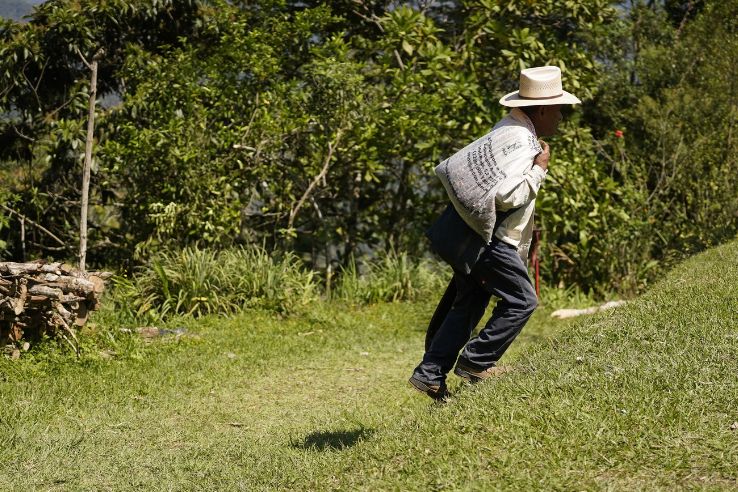
The coffee chain is long. By the time coffee reaches the cup, it passes through many hands. Here on a farm in the Sierra de Zongolica, Mexico.
How to recognize authentic Direct Trade: five questions for every roastery
Because there's no rulebook for direct coffee trade, I created one. Not an official one, but one that emerges from what people say when they mean it seriously. I'll give you five questions you should be able to answer on every website.
We applied the test to ourselves. So are the Kaffeemacher Direct Trade?
Question 1: partially passed. Although most of our coffees come through importers, the relationship is between us and producers. Often importers like algrano then take on pre-financing, logistics, and warehousing. But we also regularly buy coffees from importers who offer us coffee from producers we don't know.
Question 2: mixed results. Our average relationship duration is 4.52 years, which sounds solid. Only 37 percent of our partnerships have been running for three years or longer. By Stumptown's own rule, almost two-thirds of our coffees shouldn't be called «direct trade» since Stumptown only speaks of long-term relationships after three years.
Question 3: half passed. We ran Finca Santa Rita in Nicaragua ourselves from 2017 to 2025. With the Toca project in the Sierra de Zongolica, we became partners through a co-investment by buyers. With most other coffees, someone else bears the risk.
Question 4: passed. We've published our raw coffee prices since 2020. In 2025/26, our average FOB price was 5.76 USD per pound unweighted and 4.81 USD weighted, over 129,110 kilograms and 43 producers in 16 countries.
Question 5: failed. But: we create criteria case by case, because every coffee partnership is unique.
By this five-point test, we wouldn't be a Direct Trade roastery, and we don't say we are. But we do describe what we do, and if someone interprets that as direct trade, that's fine. How we work, what matters to us, how we build and maintain relationships, design visions together with producers—we describe that in our transparency report.
Does coffee become better through Direct Trade?
Not automatically. Pingo made a clear distinction. Where Quijote is really on site, in Honduras, where Stephi travels two or three times a year, and in Ecuador, where he is regularly, quality has developed together over the years. And in the two high-price years when many producers sold their coffee expensively anyway and weren't particularly loyal in delivery, Quijote got its usual qualities. That's not automatic though, he says himself. It takes engagement, constant exchange, and the roastery has to speak up if something doesn't work.
Behind this is a claim I think is the weakest in the whole field: that higher quality leads to higher income. Higher sales prices, yes. But high quality costs massively more work, and who actually says what good quality is?
For years there was a scoresheet that the world calibrated to. The world? Most producers to this day don't know how their coffee tastes. And this sheet comes across as neutral, but it's full of subjective judgments. When a final score decides whether a coffee gets bought, the argument doesn't hold up.

Very few producers know how their coffee tastes. We brought the Romão family in Castelo, Brazil, their roasted Compadre coffee back.
Direct Trade was an answer to 41 cents per pound of raw coffee. Today we're at many times that
That's where I see the blind spot in this whole debate. The founding logic of direct trade was an answer to a market at rock bottom. Because the exchange offered nothing, quality was supposed to be a second path, at least for the few producers who had the luck, social, or cultural capital to contact quality-oriented roasteries at all. Intelligentsia's 25 percent above the Fairtrade minimum price was formulated in a world where that minimum price mattered at all.
On February 12, 2025, Arabica stood at over 442 US cents per pound, an all-time high, more than five times the long-term average. In early June 2026, it was around 250. In eighteen months, the C-price fluctuated between 270 and 440.
In such a market, producers in Brazil, Mexico, India, and Indonesia prefer to sell domestically rather than for export, because cash flows quickly locally. They hold back coffee and influence prices with it. They've learned how speculation works.
What does a roaster who visits once a year accomplish then? I don't have a ready answer. I just think we're failing them as long as we keep justifying Direct Trade with arguments from 2001.
What that says about coffee trade
In all fairness: something has moved, at a place hardly anyone watches. Pingo tells of how the Transparent Trade network has developed a kind of definitional power within the industry. Roasteries approached importers and wanted to know how much of their money actually reaches producers. The demand for transparency increased significantly, though from roasteries rather than consumers.
As long as transparency is asked for from behind, it works. As soon as it's marketed forward, it becomes vague. Pingo calls it low-hanging fruit, and he's right: it takes little effort to know where your own coffee comes from.
What EUDR changes about it
When traceability becomes legally mandatory, a term that voluntarily promises it loses its value as a unique selling point. What then remains as a distinctive feature is the question of price and risk. But those are precisely the points that Direct Trade has never regulated bindingly.
Let's call directly what it deserves
Lennart is working to make himself superfluous. This Side Up no longer just guides roasteries toward direct trade, but also producers. An eight-year collaboration in Colombia with his local partner has evolved so that the partner now handles all sales himself. The next step is for him to build his own import company in the Netherlands. Lennart could keep this relationship, but he's spinning it out.
I find that as clever as it is admirable, and it shows where this could go.
We're currently looking at what role frameworks can play that producers give themselves. Participatory guarantee systems work from the bottom up, they adapt to local conditions, and they don't need a certification authority in Europe. Whether that holds remains to be seen.
Conclusion
There won't be a Direct Trade bible. The particular interests are too large. But there can be declarations of intent that cost something. And discussions that sharpen the concept instead of continuing to soften it.
Check a few roasteries that proclaim Direct Trade with the five suggested questions. That way we all get certainty about where more precision is needed and where the wheat separates from the chaff.
Frequently asked questions about Direct Trade coffee
What does Direct Trade mean for coffee?
The direct purchase of raw coffee from producers or cooperatives without anonymous intermediaries. The term originated in the early 2000s with US roasteries like Intelligentsia, Counter Culture, and Stumptown. No binding definition exists; each roastery decides for itself what it means by this.
Is there a Direct Trade seal?
No. There is no unified official Direct Trade logo, no certification body, and no audit standard for direct trade. Unlike Fairtrade or organic, no one checks whether the claim is true. Whoever uses the term defines the criteria themselves.
Is Direct Trade better than Fairtrade?
Fair coffee trade comes from the same reasoning as direct coffee trade—that the coffee price is repeatedly too low. But the two systems solve different problems. Fairtrade secures a minimum price floor and is externally audited. Direct Trade aims for quality, relationship, and higher prices, but is non-binding and not checked.
What does Direct Trade mean for taste?
Does coffee become better through direct trade? No, not automatically. Regular, honest exchange between roastery and producer can improve the quality and taste of directly traded coffee over years, if both sides invest. Direct purchase alone doesn't achieve that.
What is directwashing?
The term comes from Lennart Clerkx and describes roasteries that buy directly traded coffee from an importer and present its relationship work as their own. The coffee was directly traded, but the roastery itself hasn't done direct trade.
How do I recognize authentic Direct Trade?
By verifiable information: Who built the relationship, how long has it existed, who bears the financial risk, is an FOB price mentioned, and are the roastery's criteria publicly available somewhere?
Transcript of podcast episode 86 expand
DIRECT TRADE — WHO BENEFITS FROM DIRECT TRADE?
Kaffeemacher Podcast, edited transcript
======================================================================
› To follow along
This is the transcript of this podcast episode, edited and cleared of filler words. The spoken style is preserved. The English excerpts from Lennart Clerkx and César Marín are in the original.
I'm repeatedly asked whether our coffee is Direct Trade. My answer has always been complicated and multifaceted. And I notice that I somewhat dampen my conversation partner's enthusiasm. The way we communicate and present ourselves is already Direct Trade, right? Well, yes, I usually say, but there's no precise definition of exactly how direct Direct has to be.
That's when it becomes clear in such a conversation that this term has become highly charged and deeply imprecise, even misused. Ask a handful of roasteries and coffee drinkers what belongs to direct trade. The answers will be shorter or longer, but never the same. A common denominator would probably be that direct trade is based on familiarity between producers and roasteries. Okay, I'd say, but what is your familiarity? A shared photo on Instagram? A wave from afar, a handshake, herding pigs together, or even going through crises together?
Unfortunately, Direct Trade isn't quickly answered. Especially not when everyone has a different idea about it. So in this podcast, I'm searching for the original meaning, the rulebook, today's interpretation, the claims, and especially the question of who actually benefits from Direct Trade and who doesn't.
This is the Kaffeemacher Podcast. I'm Philipp Schallberger, welcome.
LET'S START WITH PRICE
------------------------
Direct Trade is ultimately also about whether the money you as consumers pay, and the money roasters pay, actually reaches where it's intended. So it's about money and prices. We need to start there.
The coffee price today, in April 2026, is around 280 to 300 cents per pound. It has been rising sharply for about a year and a half and has now fallen somewhat. But let's look back. In the 1980s, the coffee price was around 130 cents per pound. In September 2001, during what was called the Coffee Crisis, it fell to 41 US cents per pound. That was the lowest real value in a hundred years and the result of a price decline over four years.
What happened? Vietnam invested heavily and quickly in intensive Robusta production in the nineties. Brazil also made rapid advances in how much coffee could be harvested and processed. This resulted in around the turn of the century that prices dropped massively. 41 cents per pound. The price fell because oversupply was too large. Real production costs are not reflected in the exchange price, of course they're much higher. And so there were job losses, poverty, and rural exodus. Small farmers couldn't service their loans and had to abandon or sell farms.
This crisis led to intense debate about fair trade and the need for diversification in coffee growing. Fairtrade, which everyone knows today, set a minimum price in 1988, a safeguard from below. From 1988 to 2007, the Fairtrade minimum price was 176 cents per pound. So whoever could sell through Fairtrade channels during the coffee crisis had a floor. According to various studies, only 13 percent of Fairtrade-certified harvest actually sold under Fairtrade conditions. Demand collapsed because for many roasteries it was clear: if there's cheap coffee available, why pay for it? Just because it's Fairtrade?
THE BIRTH HOUR OF DIRECT TRADE
----------------------------------
That was the birth of Direct Trade. There were a few roasteries in the USA that wanted to buy and roast high-quality specialty coffees. The argument was that for the first time, there was reason to invest in quality. Because if prices are that low, then quality can be a path for producers who have the necessary social capital to address a different market.
Among these pioneering roasteries were Intelligentsia, Counter Culture, and Stumptown Coffee. These roasteries went personally to farms and built relationships. There were others who did this, and others who had done so before. But these three communicated loudly and clearly about their intentions.
There was no audit. There was no paperwork. There was no certification body. The roasteries argued that buying regularly creates a relationship. Stumptown has its own rule that a coffee can only be called Direct Trade after three consecutive years. You had to know each other. And so the pioneers of direct trade drove to coffee-producing countries. From the USA it's quick to get to Central America, so it's no surprise that the first Direct Trade relationships were all Central American producers.
So the basic idea was to link quality with direct contact. Cupping, the evaluation of quality through tasting, became the key to understanding quality. And so many Direct Trade pioneers donated cupping courses so producers could learn their coffee's quality. The price was tied to quality and no longer to the exchange. Intelligentsia early set its own benchmark saying it would buy at least 25 percent above the Fairtrade minimum price and report completely transparently about it.
You see: there was protection from below through Fairtrade, in response to the low exchange price. And then there was the idea that you should reward quality. That would be protection from above – in quotes. It's really more of an escape route, because not everyone could produce really good quality. I'll come back to that. But nothing was certified or monitored. The idea of self-regulation applied. These pioneers set their own standards.
When I look at the coffee world today, I see not just a handful of US roasteries anymore, but thousands worldwide who are dedicated to buying coffee with as few detours as possible – directly from the producer. Some say that makes it fairer and that the coffee becomes better that way. The problem: who can actually check that and what exactly can be checked?
To this day, there's no universally valid definition of what Direct Trade is. This leads to suddenly many doing Direct Trade even though they buy coffee very indirectly. So: what relevance does Direct Trade have today? What is true, what is copied, what is marketing – and who actually benefits from Direct Trade? Might it be in the end that roasteries profit from an undefined concept, while producers just hold the bag?
I'm trying to do justice to this topic as objectively as possible. But you can see: it's really multilayered. We ourselves roast coffee and we refrain from Direct Trade in our communication. Even though I'd say much of what we do would qualify as Direct Trade by common definitions.
THE VOCABULARY OF CLOSENESS
----------------------
Directly from the farm. Relationship Coffee. Fairer than Fairtrade. Whoever picks up a coffee package these days probably encounters one of these terms or all three at once. Direct trade is part of the basic vocabulary of the specialty industry. And that's exactly the problem. Because what is really communicated as direct today?
It's an incomplete list of terms that say much, but actually nothing if they're not backed by numbers. Relationship Coffee sounds human, but means nothing if there's no price and risk-taking behind it. Farm Direct obscures a bit that there are usually multiple actors between farm and roastery. Because someone has to do logistics. Someone has to do insurance and financing. And someone might even be a warehouse operator. Ethical Sourcing really sounds good, but without criteria it's not a concept, it's more of a feeling. Transparency, on the other hand, is a term very often used. That has weight only if backed by numbers and not just mentioned as a term.
You see the central pattern: it's about suggesting closeness. But often responsibility is simply avoided with transparent information.
WHO HAS THE POWER?
------------------
I spoke with Lennart Clerkx of This Side Up, a Dutch raw coffee importer. Lennart founded it in 2013. His idea was that direct dialogue between producers and roasters would improve coffee quality, create fair treatment, and ultimately deliver competitive products. He also saw the bottleneck: transport. It's expensive when you buy small amounts. And so This Side Up became an importer, even though that wasn't their original plan. They buy coffee themselves now, take the risk, and help finance roasteries. Whoever buys coffee from This Side Up is buying directly traded coffee, Lennart says.
› Lennart Clerkx, This Side Up (Amsterdam)
„The definition is hard. Whether somebody does the transport, or whether somebody owns the relationship – all of that, I think, is secondary to who has the power in the relationship. Any middleman, however much freedom and however much transparency they give: because they have the financial means to execute the trade, they hold the power in the end. So you create dependency the moment there is a middleman there. Direct trade is when that power is dispersed between the roaster and the grower equally, when they become dependent on each other for each other's success.
That is actually the reason I started This Side Up as a direct trade facilitator: being a development economist, power was the most interesting aspect I saw. That's the problem in the industry. We can talk about living income and fair trade and all this crap, but in the end – who is allowing more money to go to origin? Who, by the grace of their goodness and good deeds, is allowing a bit more money to go there? There is nobody willing to give up power in the industry, and that is why direct trade is so important."
So for Lennart it's about power distribution. Who has the power in the coffee chain? And he speaks of the middleman, a figure that many narratives try to exclude. But that's far too shortsighted and unfortunately isn't questioned. Often it's said: middlemen are bad, so you must work directly with producers. But who can really work directly with producers in a way that works for them too? And are middlemen always bad?
It's like this: if one link in the chain only holds out an empty hand, provides no added value, and creates dependence, then of course it's a bad deal. This kind of middleman can be dispensed with, if that's possible. But often these middlemen simply fill a gap, and they understand microeconomies. Maybe they handle local logistics or buy coffee in cash, so they give money when no one else would buy it. Or they can be harmful. These middlemen are often called coyotes – and by being named disparagingly, they can hardly receive sympathy. Sure, there are door closers. But others might be door openers. And there are roasteries that are glad when someone fills the gap somewhere in the chain.
Lennart says that at This Side Up they see themselves as "The Good Middleman" because they take risk and pre-finance roasters. So I asked him further what wouldn't qualify as Direct Trade in his eyes.
› Lennart Clerkx, This Side Up
„I have a kind of split opinion. The obvious answer would be: if there is any kind of middleman there. But what qualifies as a middleman can get quite grey, because the work that we do and the work a roaster does is very similar in its execution. When a farmer and a roaster completely own the relationship and have all the communication, agree all the prices together, and they rely on a third party to finance them and to execute the trade in an equal partnership – that is a healthy situation. But I'm not sure whether it's direct trade. In my very strictest definition, even that would not be direct trade, because of the dependency that the financial middleman creates.
So in an ideal world, direct trade would have a capital source to execute the trade that is regenerative, one where the power of the capital is shared between all the parties, between both ends of the value chain. And that hardly exists today. In my more easy-going definition I would say: if you do not own the relationship, if somebody else is doing the hard work of maintaining that relationship and you are basically just copy-pasting their work and saying 'this is direct trade' – that is the most common abuse that we see. That is also how a lot of people abuse the work of This Side Up. Because yes, we trade directly with them, and what we do together is something to be proud of. But then to use the term direct trade for it…"
So if a roastery buys directly traded coffee like from Lennart at six euros and then says "We as a roastery do Direct Trade", the term would be diluted. Yes, according to Lennart, the coffee is Direct Trade if This Side Up buys from producers. But if a roastery then buys that directly traded coffee further, it's a coffee that was directly traded before. The roastery bought directly traded coffee, but it hasn't done direct trade itself.
This isn't a trifle or semantic hairsplitting, but a completely different scenario. Here you're more of a hitchhiker. Not that that's good or bad. It's just different. Either someone buys for me or I do it all myself. From the perspective of the visionaries from the 2000s, a roastery buying coffee through This Side Up wouldn't be a Direct Trade roastery. But you know what so many say? That they do exactly that and are exactly that.
› Lennart Clerkx, This Side Up
„There are many people who show it as direct trade, which I disagree with, because basically they showcase the work that we do. Them being proud of buying that coffee because of all the work that is done in the partnership between This Side Up and the grower – that is fantastic, that makes everyone proud. But then to go one step ahead and call it direct trade means you are undercutting all the roasters who are doing that work. And that is what is so special about direct trade. That's also where we see the frustration of roasters who are doing this work and really involving themselves intimately in the reality of the producer, and then seeing that people are basically copy-pasting the good middleman's messages."
And that happens because there's no strict definition and no measurable comparisons, let alone a rulebook everyone could agree on.
I know some roasteries that really do Direct Trade the way Lennart would define it. There's Quijote in Hamburg. There's Muyu from Locarno, who imports coffee from Bolivia. There are brokers and others who do it all themselves: select the coffee themselves, import themselves, finance themselves, year after year. These roasteries are very close to the ideal communicated in the early 2000s. Other roasteries then buy from Direct Trade roasteries and adapt the model.
I asked Lennart whether Direct Trade is an advantage for him and for working with This Side Up.
› Lennart Clerkx, This Side Up
„There could be, if you look at it from a monetary perspective, because some larger companies might use us to direct-wash their coffees. But in the end it doesn't benefit us at all, because we exist to facilitate direct trade. Our top ten roasters, if you look at it year on year, they switch all the time, because we help people move towards direct trade. That's why we exist, that's the objective of our company. People showing our work and calling it direct trade – it might sell. It's a good question. I don't know whether it actually sells, or whether it's the pride that sells. So they should stay away from the term if it is not true. But then again, we have not been very vocal about what is and isn't direct trade. We just showcase what we do. We're not in the term-defining business, as it were."
Two things about this. First: I see myself there and I see us as Kaffeemacher. We refrain from using Direct Trade. But we describe what we do. There are cases where we pre-finance coffee early. We've also imported coffee ourselves, done all the export paperwork, even though we're not logistics experts. But usually we work with importers who do direct trade and we buy the directly traded coffee from them. That includes GEPA, Algrano, or Quijote and others. Because we're hitchhikers here, we at least refrain from saying we do Direct Trade ourselves.
Second: Lennart says he's not in the business of establishing definitions. And yet we're discussing this. Again for context: when everyone uses a term that's this vague but equally positively loaded and represents a sales and positioning argument, then we need to define it rather than continue to soften it. Because the more we soften it, the more the term loses its force.
WHAT THE PRODUCER SAYS
---------------------------
The discussion goes in circles if I only ask the processing side of the industry. So I asked a friend and coffee producer in Peru what he thinks about Direct Trade and what this approach brings him. Here's César Marín from Chacra de Dago in Peru.
› César Marín, Chacra de Dago (Villa Rica, Peru)
„Direct trade to me is not only about selling coffee without intermediaries, but about building a real relationship between producer and roasters. At the end of the day it's about speaking honestly about quality, price, climate, harvest, logistics and the many challenges that stay invisible behind the cup. In my case I travel often to Europe, because we believe the producer also needs to show a new face. We cannot only send the coffee and wait for feedback. We need to be present, explain our reality, understand the language of the roasters, have market knowledge and create trust and communication. In the end it is a relationship that we can build with time, transparency and mutual responsibility."
Beautiful, right? Honest exchange. Trust. Responsibility. Things that matter to him. I wonder: isn't that just a good approach to understanding and conducting trustworthy entrepreneurship? Being honest, trusting each other, and taking responsibility for the other person are pretty fundamental things. But apparently that's so far away that we need a name for it.
I then asked César whether Direct Trade is better than other systems – meaning the prevailing systems through which he would normally sell coffee.
› César Marín, Chacra de Dago
„I think it depends on an honest and serious relationship. A direct relationship can be beautiful if both sides are committed. But sometimes other partners also play an important role, especially when they help with financing and contracts and communication. For me it's not about saying direct trade is better than everything else. It's more about asking whether this business model creates more trust, more stability and more value for everyone involved. I think it's better, because it creates more of a human connection. When the relationship is strong, the roaster does not only buy big quantities, but they understand the process, they understand that the coffee they are buying is connected to the farm, to the family, to the territory and to decisions that started long before the coffee arrived at its destination. For producers, direct trade definitely helps us grow. It pushes us to improve quality, to understand the market, to communicate better and to show a more complete version of who we are."
So through exchange and visits we learn about each other's ideas and challenges. And that's really exciting. Honestly, I wish every roastery could earn the ability to work so closely with producers that everyone's wishes can be expressed at the same table and then discussed together as partners how to make it happen.
So we're dealing with a term that's been floating around for twenty years, really longer. This term can be more narrowly defined, like Lennart does, who even speaks of directwashing when someone buys his directly traded coffee, roasts it, and then communicates it as Direct Trade. And we've heard an understanding that's much broader: César sees Direct Trade as a different form of commerce, but especially of conduct – because for César, Direct Trade is based on trust, exchange, and honesty.
Maybe sometimes it would help if we spoke of direct conduct rather than direct trade. So get active and just do it, and play less with consumers' many ideas that direct is always better. It's really about bringing transparency into coffee trade and leveling power and knowledge asymmetries. The question is just: how do we get there? It will be difficult if we don't have a shared language, grammar, and vocabulary.
A DETOUR: WHY THERE'S NO DIRECT TRADE BIBLE
---------------------------------------------------
I'm taking a detour here. Warning, now comes a break. But trust me, I'll come back. Religion.
Religions with sacred books have solved a central problem: canonization. At some point an authority said: this is in here, this applies now. And deviations are then heresy. That's verifiable, it's nameable, it's sanctionable. Whoever quotes a sacred book quotes the same document as everyone else.
And that's something Direct Trade has never done so officially. There's no Direct Trade bible we can refer to. There are action intentions and visions. Some are more precise, others more convoluted to really meaningless. Some are more widely received because certain traders and roasteries have more trust in the industry. There are meetings and conferences, for example the Coretto in July 2025 in Hamburg, where roasteries like Quijote, Coffee Collective, Flying Roasters, and also GEPA were represented. In circles like these, it's clear what Direct Trade means because their philosophy has evolved so strongly into action: pre-financing, long-term partnerships, regular visits through thick and thin. They don't even need to discuss it, it's just part of it for them.
For most consumers though, Direct Trade simply sounds good because it suggests closeness and therefore doesn't seem to need precise expression. And that's why we have this semantic black market. Much is allowed because it's not sanctioned. I can say anything and won't be held accountable. I can say I trade totally ethically and no one corrects me. I can say this coffee is fairer than Fairtrade and no one corrects me.
IN CONVERSATION WITH PINGO FELSEN, QUIJOTE COFFEE
--------------------------------------------
So why is it so difficult to find a common rulebook? I asked one of the pioneers of direct coffee trade in Germany: Andreas "Pingo" Felsen from Quijote Coffee.
Pingo: It's especially difficult to find a common rulebook for Direct Trade when we have completely different interests in our industry and also completely different interests in using this term. That it's possible to find common content with which to fill this term, we've shown that, for example in our network, by agreeing on a common definition and sort of minimum standards so we can even talk about direct trade the way we imagine it together. But then of course there are completely different players in our industry who don't put coffee culture in the foreground, but have a profit interest. And of course terms are used accordingly so they have the greatest possible effect on public perception regarding coffee sales – no one is surprised by that.
Philipp: I did research on that and just looked back. So the early birds, the ones who really shaped these terms, early 2000s. I don't know how many of them today would say that what roasteries do now is really Direct Trade. I think very few would qualify that way in what they said. I mean, they all had their own approaches even then. There was no common rulebook even back then. They were just the first to say: we have an idea about this and we're saying what our company philosophy is. But even back then there really wasn't a single rulebook. There never was one.
Pingo: No, there never was a rulebook. Well, Counter Culture and Intelligentsia certainly defined it for themselves and talked to each other back then. I think Counter Culture still has very similar demands as it did back then. Even though they've become very big, they still uphold the old ideals. The same way we see it here in Europe with the Coffee Collective from Copenhagen, which is probably the pioneer in using the term Direct Trade in Europe. They really still conduct it as seriously in this coffee cultural sense as when they first used it.
Philipp: There were always events again. I think you organized some too, that was in Hamburg, about eight years ago. It was about the Transparent Coffee Guide, the gathering. That's like a flanking measure: it was about transparency, but with transparency also about steering toward more direct trade. How would you look at that today? Has transparency changed? Was there a development?
Pingo: We're quite happy with the development of transparency. Because many coffee roasteries, also many who don't do direct trade by our standards, approached importers and traditional intermediaries and said: look, there's a need we have. Transparency is really such a thing. We don't want to use transparency just as a marketing slogan in our roastery, we really want to know how much of the money we pay you actually reaches the producers. And that Transparent Trade network really gave good impetus because we were able to develop quite good impact, maybe even definitional power within the industry on the topic of transparency. Because really influential coffee roasteries on every continent were part of it and said: this is transparency. That had a real impact for a time, the demand for transparency really increased sharply. Not from coffee consumers, but from coffee roasteries who wanted to know: where does my coffee at least come from economically?
Philipp: And I find that so interesting. When roasteries want to know from importers how transparent a coffee is and what the chain behind it looks like, it works. I think then you have a common denominator. When it goes the other way, when it's a sales argument, it becomes a bit more vague. And so I'd say: transparency is actually low-hanging fruit. You really don't have to try very hard to know where your coffee comes from. But when it comes to Direct Trade, that's another story, and that's why I'm also not surprised there's so little agreement. I can tell my customers where my coffee comes from: I bought it at Aldi and relabeled it. And I can call that transparency too, right? Or I bought it from a large importer with years of experience. That too. And then I just write "transparent" on my website. And then it's just there. And the word transparent is enough. You don't even have to fill it with content, you don't have to justify it at all. You just write "transparent" on your package or "we guarantee complete transparency" and market the coffee. Is that really enough?
Pingo: Yes, it's not questioned. But Direct Trade isn't questioned either, except from within the industry itself.
Philipp: Do you know anyone who's examined it critically from the consumer angle, like a consumer magazine or something?
Pingo: No, I really don't know that across Europe. I know it from the US, from various forums, and I just heard that in Japan it's very critically examined. It apparently no one dares – at least according to travel reports from my colleague Matt who just got back – to use such terms and use them somewhat abusively because that apparently is questioned much more critically than in our consumer culture here in Europe.
Philipp: Do you think there will ever be a certification body for Direct Trade? That would be like the next step. But if there is, it needs a common rulebook first. Do you think something like that could ever exist?
Pingo: No, I don't think so. We see coffee roasteries that have been on the market for a while and go their own way with their procurement policy. I think all the pioneers of direct trade belong to that, and many who've been doing it for a while now too. They actually don't need this certification at all. It's just another term. All those who've been doing this for a while and really live this culture have already earned this credibility and don't need a third-party seal. That might actually devalue it. I'd see it similarly to the conscious choice we made to forego an organic seal or a Fairtrade seal: that the concern could well be justified that using such seals for roasteries like ours would mean a negative image transfer rather than being a marketing tool.
THE QUESTION OF QUALITY REMAINS
----------------------------------
What remains is really the question of quality. What Direct Trade can especially do is break through the anonymity of traditional trade. There are voices saying that quality in Direct Trade can be higher because you're in direct exchange with producers. Maybe. But very often there's no direct exchange at all, as we've heard.
Direct Trade must be compared to traditional anonymous trade. Only then do major cracks appear. There's no anonymity, there's direct exchange with each other. And especially there's no substitution of the coffee because suddenly a name is attached to the product.
But I see another fundamental criticism of the claim that higher quality would lead to higher income. First, it's true that sales prices can be higher, yes – but income doesn't rise because of that. Because high quality requires massively more work. And that's the crux of the matter.
Who actually says what good quality is? For years there was a scoresheet that the whole world calibrated to. The whole world? Most producers to this day don't know how their coffee tastes. And therefore the early Direct Traders were right to teach cupping skills so that sellers and buyers could talk about the same impressions. But what remains: this scoresheet, this familiar evaluation form that associates coffee quality with points, comes across as neutral but it's full of subjective judgments. When a final score decides whether a coffee gets bought or not, then the argument doesn't hold up that high quality would lead to better living conditions. Because it takes more than that.
Philipp: Is it really true when you look at it today that quality is better?
Pingo: That depends entirely on our engagement in the respective countries, what joint progress we've made – together with the coffee producers. We see that in the countries where we're really very active on site – that's primarily Honduras, where Steffi travels for us two, three times a year, and somewhat also Ecuador, where I travel regularly – that we can rely on qualities we've defined and developed together. In the countries where we're especially engaged, where we communicate especially well together and have taken joint quality development seriously, we've especially seen in the last two high-price years – where many producers could sell their coffees expensively anyway and weren't particularly loyal in delivery – that there was more stability in our raw coffee supply than with other roasteries. We felt happy and confirmed, especially in the last two years, that we got our usual qualities, sometimes even increasingly better qualities, and we didn't have to worry. So I'd sign onto that in the areas where we've really seriously taken care of ourselves.
Philipp: So the effect of direct exchange can lead to better quality. But it's not automatically given, it's not inherently linked.
Pingo: No, it's absolutely not automatic. We have to engage and we have to really try to lead this relationship on equal terms, exchange constantly about what's possible. And clearly: as a coffee roastery we also have to communicate our needs and take that seriously. If we're not satisfied with what we get, we have to say that. We just have to be honest with each other. And that's what direct trade is for: to build a real relationship, to learn to trust each other, and like it is in such a relationship, that we express things we expect and wish for. And then we have good chances of tending toward increasing quality.
Philipp: How long have you been doing Direct Trade as Quijote Coffee? Since the beginning?
Pingo: We committed to that from the start: to roast exclusively coffees that we buy directly in long-term relationships. We allow ourselves up to five percent of our annual sales for fun stuff we import from friendly coffee roasteries. But yes, we take Direct Trade seriously and handle it throughout so that all our coffees meet our self-defined criteria.
Philipp: How have these criteria you gave yourselves developed since – what did you say – sixteen, seventeen years? You founded in 2010. Have you been at Direct Trade 3.0 since then, or how far along are you?
Pingo: We've basically stayed with our old criteria. We haven't further developed them. But we have seen that this relationship in direct trade also really needs relationship maintenance. We've said goodbye to some sources where we noticed: either our trading partners don't meet our demands, or we simply can't manage to maintain this relationship in a way that meets our own demands. So things have changed here and there. I think we've learned to focus on the coffee origins that really matter to us and to limit ourselves to them too. We're a medium-sized roastery, we're seventeen people, we just can't travel around eight new countries one or two times a year and maintain real relationships. So what's changed is that we lead relationships a bit more seriously and a bit more deeply than before.
Philipp: If you look forward, ten years: Direct Trade won't fundamentally change. But do you think something new will come? Or is it really what it is, and people should just keep their word?
Pingo: We see that many players keep their word and that many roasteries that start in recent years do so for very sincere reasons and often engage very seriously with where their coffee comes from. I think there's already a bit of a renaissance of this coffee culture, that people don't just see coffee as a business model – somehow I want to open a nail salon or dog grooming salon, or maybe a coffee roastery, whatever makes the most profit. Maybe not a coffee roastery in these difficult years. But with the new startups we've observed in recent years, some things make me quite optimistic that direct trade isn't dead, but is evolving a bit more. And especially coffee roasteries that really focus on one or two origin countries have come increasingly to market. There are great qualities there, there are absolutely credible concepts.
Direct Trade is here to stay. Because sincerely meant direct trade changes the world in small ways and creates new room to maneuver. But only if we communicate precisely and don't appeal to consumers' diffuse feelings about coffee. Because that doesn't help anyone.
DIRECT TRADE 2.0
----------------
At the end, let's turn around the absence of a rulebook. I mean: that's great. If we don't have one, maybe one could come. Even if Pingo thinks not much is happening anymore. But what if there really could be a Direct Trade 2.0? There have already been many meetings about it. But who wants to have the courage in a world of so many roasteries and say: hey, this is now our new standard?
A supporting tool for this might be the Transparent Coffee Guide, where roasteries disclose their purchasing prices. That's an important step to even talk about prices. But Lennart thinks about Direct Trade quite a bit further. And maybe what he's saying now is Direct Trade 2.0.
› Lennart Clerkx, This Side Up
„This is evolving into a direct trade incubator. We have incubated a lot of roasting companies to become direct traders, but we have not really incubated producers to do the same. That is what we are working towards this year. We will start in Colombia. We have worked with a producer for the last eight years, and over time he has invited a lot of roasters to the field, they picked coffee together, they developed intimate relationships. Basically, when the coffee comes to Europe it is ninety percent sold, and he does all the selling himself. That's been going on for the last three, four years, and it kind of felt that our relationship was stagnating. So what do we do, what is the next step? That is what you see as the next step in our evolution: a kind of safe space for direct trade to develop, with the capital that we find together and in a community that we develop together.
So it is not necessarily independence – I think direct trade 2.0 is interdependent, where we do not own it, where we have the guts to share the power that we build. We have the relationship, and we gave it to Juan Pablo in Colombia. The next step is also letting the middleman function go: having him set up an actual import entity in the Netherlands, for example. Because in the end, the middleman function we have is a placeholder. If you zoom out, fair enough, we have this position in the middle because we stole it. Colonialism is the basis of all coffee trade, and that power belongs in the hands of the farmers. So yeah, direct trade should be one where the power sits comfortably with the roaster and also the growers."
So Lennart is working to build relationships so strong that he can then step out of them. He could say he keeps everything in the company, but he's spinning out the relationships he built. And I find that as brilliant as it is admirable.
CONCLUSION
-----
The whole debate about Direct Trade is more important than ever. Because if we stop questioning exactly what we mean, we end up in a cacophony that really doesn't help anyone and through which the meaning is lost.
I also don't think there will be a universal Direct Trade bible. The differences and particular interests of all roasteries are too great. Declarations of intent from certain groups of roasters and importers exist and will exist more. And that's good. Because every discussion that takes place sharpens the picture of Direct Trade and helps roasteries and importers handle such a heavily charged term more cautiously – a term that's existed for about 25 years and has been interpreted so diversely that I really find it amazing that it still exists.
But because it does, we all have to care for it and really call direct what deserves to be called direct.
Talk to you soon.

