




























Four processes, one goal: the caffeine must come out of the bean, everything else should stay in. How well this succeeds determines the taste, the price, and whether measurable solvent residues end up in the cup. We spoke with decaffeinator CR3 in Bremen, reviewed patents and limit values, and found an error that appears in almost every article on the subject.

Decaffeination always happens to raw coffee, never to roasted coffee. Four extraction agents are in use: dichloromethane, ethyl acetate, water, and CO₂. The difference between them lies in selectivity, not in the marketing name. And decaffeinated does not mean caffeine-free: a decaffeinated espresso contains 3 to 15.8 milligrams of caffeine.
What all processes have in common during production
Decaffeination always happens to raw coffee, the green bean before roasting. There is no industrial process that decaffeinates roasted coffee.
Meike Holtmann works at ANKA, the research and innovation subsidiary of CR3, on these exact processes. She describes four steps that run the same in all processes:
The difference between processes lies in the second step, specifically in three factors: temperature, pressure, and time. Holtmann calls it "the operating mode of the entire process".
Selectivity means: how specifically an extraction agent targets caffeine and leaves everything else alone. A less selective agent also pulls out fats, acids, and aromatic compounds. This is the real reason why some decafs taste flat.
Dichloromethane: nine hours and the best price-to-performance ratio
Dichloromethane, or DCM for short or methylene chloride, is the most common process worldwide. The reason is simple: it works better than anything else. Holtmann calls DCM "the most efficient extraction agent for caffeine".
Pressure, temperature, and target value based on the original patent by Procter & Gamble from 1971. The beans are pre-moistened to 41 to 50 percent by weight of water, the solvent-to-bean ratio is 3:1 to 5:1.
Short process time means low energy consumption, which directly impacts the price. Holtmann: "The price-to-performance ratio is right."
What many find surprising: DCM is not the most aggressive, but rather a gentler agent.
"It is relatively selective for caffeine. Not that many co-extracts come out with it."
If you start with good raw coffee quality, you retain a lot of aroma. But we have yet to taste a specialty coffee from the DCM process. This likely has to do with the fact that it is a chemical process and market acceptance is limited.
In the indirect DCM process, the solvent never touches the bean. The coffee is soaked in hot water, the caffeine goes into the water, and only this water is treated with DCM. Afterward, the aromatic compounds return to the bean with the water. We found no documented numbers for temperatures and times of this variant.
How much dichloromethane remains in the coffee? 34 products tested
A working group tested 2024 34 commercially available decaffeinated roasted coffees from EU trade using headspace-GC-MS. The results:
| Measurement | Value |
|---|---|
| Range in roasted coffee | 5.7 to 816.6 µg/kg |
| Mean value | 127 µg/kg (0.127 mg/kg) |
| Median | 59.5 µg/kg (0.060 mg/kg) |
| Legal maximum Switzerland and EU | 2 mg/kg (2,000 µg/kg) |
| Legal maximum USA | 10 mg/kg (10 ppm) |
| Transfer to beverage, filter coffee | Median 26.8 percent |
| Transfer to beverage, French press | Median 43.1 percent |
Fabian, Süsse-Herrmann, McGaffin & Hielscher (2024), Proceedings 109(1), 33. Limit values: Swiss VTVV Annex 1, EU Directive 2009/32/EG Annex Part II, 21 CFR 173.255.
Three things are clear. First: DCM is detectable in finished coffee, the statement "nothing remains after roasting" is too broad. Second: the highest measured individual value is about 41 percent of the limit, the median about 3 percent. Third, one quarter to just over two fifths of the residue ends up in the cup, and the French press transfers significantly more than the paper filter.
Holtmann says about the residues: "The prescribed maximum amounts are undercut by a factor of a hundred." The median of the study is a factor of about 34, the mean value about 16. That fits in terms of magnitude, though individual values scatter considerably.

Pure caffeine at Descamex, Córdoba, Mexico
Why the subject is concerning again, once more
The International Agency for Research on Cancer (IARC) has classified dichloromethane since 2017 in Group 2A, as "probably carcinogenic to humans". In the USA, since November 2023, there has been a petition from several environmental and health organizations to strike methylene chloride from food approval. The FDA reopened the comment period on May 28, 2026, and closed it on June 29, 2026; a decision has not been reached to date. We found no comparable initiative in the EU, nor in Switzerland.
Ethyl acetate, the sugarcane process
Ethyl acetate goes by two names. The technical one is ethyl acetate, the nicer one is Sugarcane Process. Both refer to the same molecule.
"Industrially it is used in synthetic form. But it is also present in traces naturally in sugarcane, in sugar beets, or also in fruit and can also be produced from natural ingredients. And that's why it also carries this name Sugarcane Processing."
Technically, ethyl acetate behaves similarly to DCM, with one difference: "It is not quite as selective for caffeine as dichloromethane. So the process times are slightly longer." At Descafecol in Manizales, the decaffeination plant in Colombia, the solvent cycles run for approximately eight hours according to the process diagram, after a half-hour of steaming.
Cycles and steaming time based on the process diagram from Descafecol, Manizales. The residue specification of 20 ppm is a voluntary statement from Descafecol; Cafe Imports states a maximum of 10 ppm in their process diagram.
The legal situation is the real difference. Unlike dichloromethane, there is no numerical maximum limit for ethyl acetate. It is listed in Part I of the Annex to Directive 2009/32/EG, among the solvents that are permitted for all purposes under good manufacturing practice. The Swiss VTVV follows this system.
The most interesting set of numbers for this process comes from a 1999 review and shows what decaffeination costs:
| Condition | Duration | Caffeine removed | Loss of soluble solids |
|---|---|---|---|
| Room temperature, 27 degrees | 8 h | 37 to 39 % | 9 to 10 % |
| Room temperature, 27 degrees | 14 h | 42 to 44 % | 14 to 15 % |
| With hot water circulation | 8 h | 62 to 64 % | 34 to 36 % |
| With hot water circulation | 16 h | 78 to 80 % | 40 to 42 % |
Ramalakshmi & Raghavan (1999), Critical Reviews in Food Science and Nutrition 39(5), Table 5. Laboratory conditions, not industrial parameters.
Water processes: why water alone doesn't work
The most obvious idea is also the wrong one. If you put coffee beans in hot water, caffeine dissolves, but so does everything else. You end up with a cup of coffee and a flavorless bean.
Water processes solve this with a trick. Holtmann: "The coffee bean is extracted with hot water or with hot caffeine-free green coffee extract." This extract is saturated with all soluble coffee components, just without caffeine. So essentially only caffeine can migrate out of the bean, everything else stays in because the solution is already saturated.
The caffeine-laden extract then runs through absorber filters. "From these absorber filters comes a caffeine-free but aroma-rich extract back out." The cycle starts again.
"We have found that the filters we use there also have a lower affinity for co-extracts, which has a very positive effect on the aroma of the decaffeinated coffee, because we have fewer losses there."
Two suppliers carry water processes in their names. Swiss Water in Delta, British Columbia, works with green coffee extract and charcoal filters. Descamex in Córdoba, Veracruz, calls its process Mountain Water Process.
Values from a 1980 patent for the water process with adsorption. Swiss Water and Descamex do not publish their own process data.
"99.9% caffeine-free" - well, sort of
Neither Swiss Water nor Descamex publish temperatures, pressures, process times, or a decaffeination rate. The common claim "99.9 percent caffeine-free" for the Swiss Water Process could not be traced to any primary source; it comes from a teaching material that itself refers to a blog. We therefore do not cite it as fact.
The coffee we started with comes from such a process. Our Sueño from Mexico is decaffeinated at Descamex with water, the coffee comes from Rancho San Felipe.

Supercritical CO₂: from 31 degrees and 73.8 bar
Carbon dioxide is known as a gas and as dry ice. Above approximately 31 degrees and 73.8 bar, it becomes something third: supercritical. It then has the density of a liquid and the diffusion behavior of a gas, and in this state, it dissolves caffeine.
Kurt Zosel invented this in Oberhausen; the patent was filed on February 5, 1970. It specifies 40 to 80 degrees, 120 to 180 atmospheres, a water content of the beans of 15 to 30 percent, 5 to 15 hours of decaffeination, and residual caffeine below 0.01 percent. The core of the patent is a subtlety: it is precisely the moisture that makes supercritical CO₂ a medium that takes up caffeine.
At today's industrial scale, the values are higher. Holtmann mentions "extremely high pressures of 250 to 300 bar and high temperatures of 60 to 80 degrees". A 2017 life cycle assessment study documents a facility with 250 bar and 90 degrees, five hours of steaming, then 11.5 hours of extraction for Arabica and 22 hours for Robusta, with 97 percent caffeine removal.
According to the Max Planck Society, approximately 100,000 tons of raw coffee per year are processed worldwide using the supercritical process. That is about one percent of the global harvest.
Subcritical CO₂: liquid at 70 bar, seven days process time
If you lower the pressure and temperature below the critical point, you get liquid CO₂. This is slower and more expensive, and for exactly that reason interesting, especially sensorially.
CR3 calls this process Carbonic Natural. Holtmann describes it like this: "The CO₂ is in a liquid state and flows through the pretreated beans and is incredibly selective." After extraction, the pressure is released, it drops from 70 bar to ambient pressure, and the caffeine precipitates out of the CO₂. It is absorbed in a water stream, the CO₂ goes back caffeine-free to the next batch.
Pressure, temperature, and residual caffeine from a documented plant visit by Belco. There, 97 to 99 percent of the caffeine goes out in the liquid CO₂ phase.
Sebastian Gabriel, Marketing and Sales at CR3, explained it to us like this: CO₂ is "a lazy solvent".
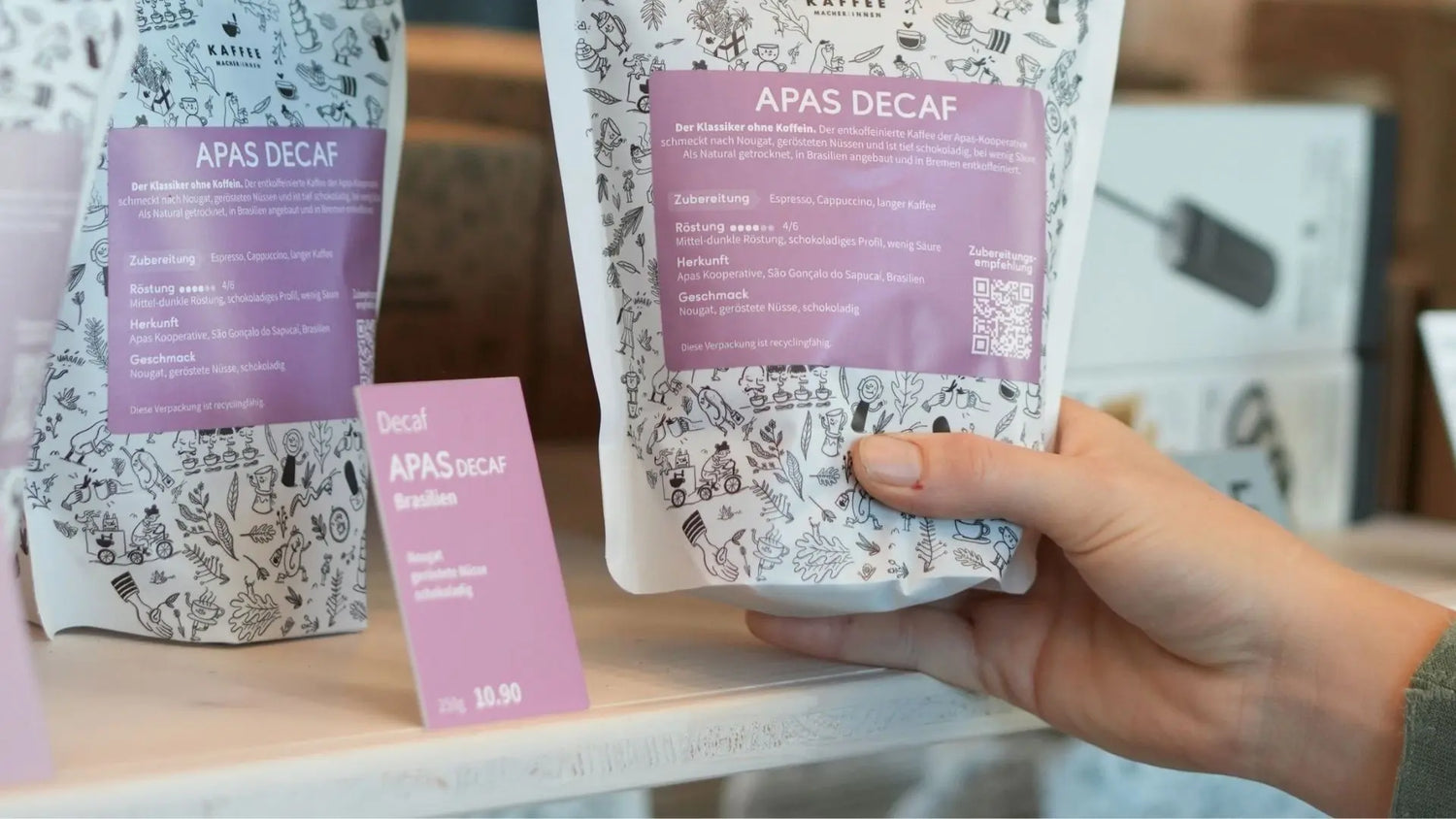
Two points that matter in everyday use. The CO₂ comes from natural spring carbonation, so the process is bio-certifiable. And: our Apas Decaf from Brazil is decaffeinated this way, as is our Dipilto Decaf from Nicaragua.

The triglyceride process: much claimed, little proven
Many articles mention a fifth process: beans bathe in hot coffee oil, the triglycerides in the oil draw out the caffeine.
We found no primary source for this. No patent, no peer-reviewed study, no manufacturer information provides temperature, duration, oil-to-bean ratio, or decaffeination rate. We checked and ruled out three relevant patents that are regularly cited in the literature for this and actually describe other processes.
The four processes in direct comparison
CO₂ appears twice in the table because it runs in two operating modes. The extraction agent remains the same.
| Process | Extraction agent | Duration | Pressure / Temperature | Selectivity | Cost |
|---|---|---|---|---|---|
| Dichloromethane (DCM) | Dichloromethane | approx. 9 h | 2–14 bar / 60–99 °C | high | low |
| Ethyl acetate (Sugarcane) | Ethyl acetate | approx. 8 h cycles | not published | medium | low to medium |
| Water (Swiss Water, Mountain Water) | Green coffee extract plus absorber filter | not published | 50–100 °C (Patent 1980) | high, filter-dependent | high |
| CO₂, supercritical | Supercritical CO₂ | 11.5–22 h | 250–300 bar / 60–90 °C | high | high |
| CO₂, subcritical (Carbonic Natural) | Liquid CO₂ | 6–7 days | 70–80 bar / 23 °C | very high | high |
"Not published" means: the value is not published by any manufacturer and in no primary source.
What "decaffeinated" legally means, and why "limit value 0.1 percent for the EU" is wrong
Precision is crucial: statements like "in the EU, decaffeinated coffee may contain up to 0.1 percent caffeine" appear on every other page on the subject. This is not quite accurate as stated.
The EU regulates exclusively coffee extracts with Directive 1999/4/EG, that is, instant coffee. The limit there is 0.3 percent caffeine water-free on a dry matter basis. For roasted coffee, we found no harmonized EU numerical value.
The 0.1 percent comes from national law:
| Jurisdiction | Roasted coffee | Instant coffee | Legal basis |
|---|---|---|---|
| Switzerland | max. 0.1 percent by mass, based on dry matter | max. 0.3 percent by mass | Federal Department of Home Affairs Food Beverage Ordinance |
| Germany | max. 1 g caffeine per kg coffee dry matter, i.e., 0.1 % | max. 3 g/kg, i.e., 0.3 % | Coffee Ordinance, § 2 Abs. 3 |
| EU | no harmonized value found | 0.3 % | Directive 1999/4/EG |
Practically speaking, this changes nothing for you as a drinker: the same value of 0.1 percent applies in Switzerland and Germany.
What actually ends up in your cup
The limit value says nothing about how much caffeine you actually drink. For that, we need measurements of the beverage.
The reference study for this is from 2006. Ten filter coffee decafs from nine chains and local cafes ranged from 8.6 to 13.9 mg of caffeine per 473 ml. Decaffeinated espresso came in at 3 to 15.8 mg per shot.
To put it in perspective: raw coffee contains about one percent caffeine for Arabica and about two percent for Canephora, depending on the species. A 2020 study gives ranges of 0.8 to 1.4 percent for Arabica and 1.7 to 4.0 percent for Robusta. Roasting changes this hardly at all because caffeine is heat-stable.
What this residual caffeine does in your body is a separate question. How long caffeine lasts, how quickly it is broken down, and when it starts to disturb sleep, we have written separately.
Bremen as the caffeine capital
"Decaffeination was invented in Bremen. Many people don't know that. And you could say Bremen is still the world capital of decaffeination to this day."
Both are true, with a clarification. The patent "Preparation of coffee" was filed on May 4, 1906, and granted on September 1, 1908. It lists three names: Johann Friedrich Meyer Jr., Ludwig Roselius, and Karl Heinrich Wimmer. Roselius is almost always listed as the sole inventor, but that is not the case.
And the solvent was indeed benzol, literally in the patent: "We have found that benzene (also called benzol) is eminently suitable for this purpose." Kaffee HAG was founded that same year, 1906. The widespread anecdote that a coffee shipment damaged by seawater gave Roselius the idea sounds adventurous, but perhaps a bit too adventurous. I could not find a reliable source for it so far.
As for the world capital: in Bremen, Coffein Compagnie processes approximately 120,000 tons of raw coffee per year in five plants according to its own information and calls itself the global market leader. Additionally, CR3 is also based in Bremen. There is no independent global capacity ranking because Descamex, Descafecol, Demus, and Swiss Water do not publish their capacities.
Which process makes the best coffee?
Stacey Linden from Swiss Water told me something to this effect in a conversation for the main article:
The decaffeination process leaves a sensory footprint, more or less depending on the process. We find the question interesting of whether this sensory change is a flaw or whether it can add a new quality.
Fast and cheap processes like DCM leave what we perceive as a soy-like character. Water processes can leave a malty flavor in flatter coffees. Ethyl acetate can increase acidity, while the subcritical CO₂ process can mute the coffee somewhat.
If you know that as an importer or roaster, then you look for the right raw coffee for the right process, and that way a new, sensorically interesting product can be created.
Decaffeination as quality improvement of poor raw coffee?
We asked Meike Holtmann whether it's true that in the past mainly poor qualities were decaffeinated. Her answer: "I don't perceive that here on our company grounds anymore today. A large part of the coffees we sell here as raw material have good, sometimes even very good sensory quality." The low qualities, affectionately called "birdseed or muesli coffees" in-house, are extremely rare.
Her observation on the effect is interesting: "With unclean qualities, the decaffeination process is sometimes actually perceived as an upgrade." Less so with good qualities. The process smooths things out, which helps poor raw coffee and costs good coffee something.
To judge decaf, you need to know both: the raw coffee quality and the process used. More on taste, faster aging, and why decaf extracts differently is in the main article on caffeine-free coffee.
To listen to
Conclusion
Four processes, and none is universally the best. Dichloromethane is fast, cheap, and more selective than its reputation suggests, but leaves measurable residues and is under regulatory scrutiny. Ethyl acetate is similarly fast, slightly less selective, and legally more loosely regulated. The water processes avoid solvents entirely but publish hardly any process data. CO₂ in the subcritical mode is the slowest and most expensive process and, according to CR3, the most selective.
You'll find our decaffeinated coffees in the decaf collection, each with the process specified.
Sources
Conversations
Meike Holtmann, Research and Innovation, ANKA (Research and Innovation subsidiary of CR3), Bremen.
Sebastian Gabriel, Marketing and Sales, CR3 Coffee Refinement, Bremen.
Stacey Linden, Swiss Water, Delta, British Columbia.
Studies and Reviews
Fabian, Süsse-Herrmann, McGaffin & Hielscher (2024): Residues of dichloromethane in decaffeinated roasted coffees, Proceedings 109(1), 33.
Ramalakshmi & Raghavan (1999): Critical Reviews in Food Science and Nutrition 39(5), Table 5.
Study from 2006 on caffeine content in decaffeinated beverages. McCusker, Fuehrlein, Goldberger, Gold & Cone (2006): Caffeine Content of Decaffeinated Coffee, Journal of Analytical Toxicology 30(8)
2020 study on caffeine content in Arabica and Robusta. Gaibor, Morales & Carrillo (2020): Determination of Caffeine Content in Robusta Roasted Coffee (Coffea canephora) by RP-UHPLC-PDA, Asian Journal of Crop Science 12(2)
Life cycle assessment study from 2017 on a supercritical CO₂ facility. De Marco, Riemma & Iannone (2017): Supercritical Carbon Dioxide Decaffeination Process, a Life Cycle Assessment Study, Chemical Engineering Transactions 57
Patents
Meyer Jr., Roselius & Wimmer: "Preparation of coffee", filed May 4, 1906, granted September 1, 1908.
Zosel: Process for decaffeination with supercritical CO₂, filed February 5, 1970.
Procter & Gamble: Decaffeination with dichloromethane, 1971.
Water process with adsorption, 1980.
Law
Federal Department of Home Affairs Food Beverage Ordinance (Switzerland).
Regulation on Technical Requirements for Food, VTVV, Annex 1 (Switzerland).
Directive 2009/32/EG on Extraction Solvents, Annex Part I and Part II.
Directive 1999/4/EG on Coffee Extracts.
Coffee Ordinance, § 2 Abs. 3 (Germany).
21 CFR 173.255 (USA).
Further Information
IARC Monographs: Classification of dichloromethane in Group 2A, 2017.
FDA, Procedure to strike methylene chloride from food approval, ongoing since November 2023.
Max Planck Society, information on the supercritical CO₂ process.
Process diagrams Descafecol (Manizales) and Cafe Imports.
Documented plant visit by Belco at CR3.
Coffein Compagnie, Bremen, own statements on processing volume.

