













Chocolate and Coffee. Similarities and Differences. A Podcast with Christoph Inauen from Choba Choba
For many, chocolate and coffee simply go together – as a luxury product. But the similarities and challenges of the two products already begin in cultivation. The shift towards a better chocolate future for producers requires a different approach – Choba Choba presents a revolutionary alternative for this.
Often a "Schöggeli" is served with coffee because for many it simply pairs so well together. Coffee itself is often described as chocolatey, and both products also look good together visually. It seems as if chocolate and coffee were siblings.
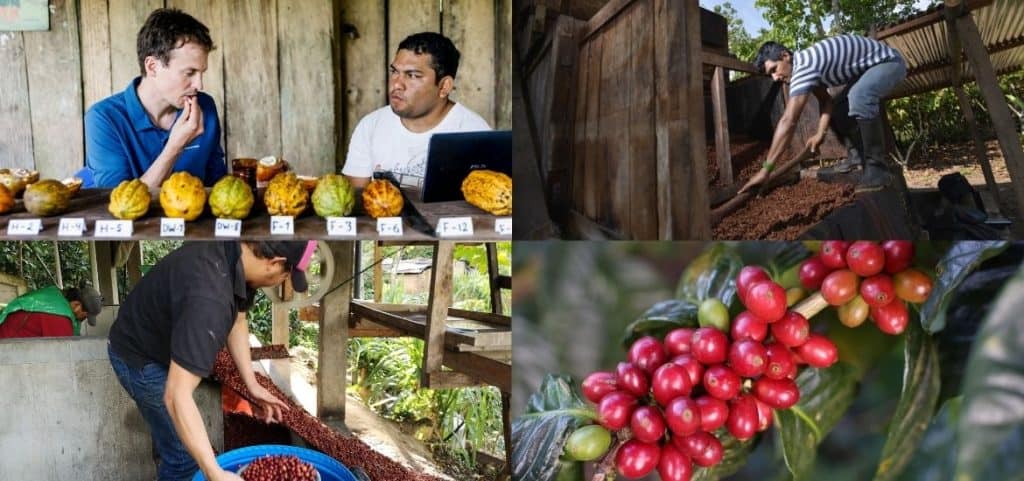
There are also many similarities on the production side – cacao trees also grow in the subtropics, like sun but not too much heat, like shade, and differ in four original varieties.
"The distinction between Criollo and Trinitario is too simplistic," says Christoph Inauen and explains that they have established a varieties garden in Peru to cultivate rare, old, forgotten, and rediscovered varieties. They – meaning Inauen's company Choba Choba, which is legally based in Switzerland, operates as a company in Peru, and whose producers in Peru are themselves shareholders.
The mentioned varieties garden reminds me strongly of our initiative „1000 Variedades" in Nicaragua – an experimental plot slightly above our Finca Santa Rita farm, where we plant various varieties and want to observe their behavior.
 Christoph Inauen, co-founder of Choba Choba. Image: ZVG Choba Choba
The Choba Choba Model
Christoph Inauen knows the cacao and chocolate world very well. At age 26, he built sustainable supply chains for one of Switzerland's largest chocolate companies – supply chains that still exist today.
Shortly thereafter, he joined the management – an impressive fact that a company made sustainability a core concern as early as 2007. "Yes," says Inauen, "I don't know many other companies that started so early with this."
Inauen traveled extensively to cacao regions and established new partnerships. When a producer who had since become a friend approached him after several years to say that despite the new situation, the certifications, and all the marketing, not much had changed for the producers, Inauen was shocked.
"Of course, this was initially a shock, but later it became a motivation to choose a new approach." And so Inauen founded Choba Choba with his business partner Eric Garnier and launched the "Chocolate Revolution."
Choba Choba is a joint stock company where 30% of the shares are owned by the producers themselves. This means they participate directly in the company's profits. Choba Choba thus produces cacao itself, which is then further processed in Switzerland by Felchlin.
For Inauen, it is particularly impressive to see how the self-image of many producers has changed.
Previously, a producer would say: Hello, my name is Oswaldo, I am a cacao producer. Today he says: Hello, my name is Oswaldo, I work in international cacao trading.
Christoph Inauen, Choba Choba
Choba Choba pays producers 2.5 to 3 times more for cacao than they would receive if they sold their products on the world market. The chocolate is therefore also sold at a higher price in Switzerland – from previously 8.50 CHF, thanks to efficiency improvements, prices dropped to just under 5 CHF.
For us, it was always clear that chocolate cannot cost 1 or 2 francs. That simply doesn't make sense.
Christoph Inauen, Choba Choba
Chocolate Quality as a Door Opener
The message of Choba Choba is actually simple to understand. But because it breaks with everything that characterizes the chocolate industry, it seems almost exotic. Getting the story to the shelf would be complex, because the product should primarily live through quality.
Excellent raw materials, no additives, and precise processing make Choba Choba a premium chocolate. On the shelf, quality should be front and center – the message for a new approach in the cacao business should be communicated through other channels.
High Price as a Stumbling Block
Initially, a 90g chocolate bar was sold for 8.50 CHF. The price caused a stir. Can chocolate be that good? The story had to be recognized first. And criticism of Choba Choba grew louder – that while they want to reach poor producers, the end product is only accessible to the wealthy.
Through efficiency improvements, Choba Choba was able to lower the price and today sells chocolate at Coop for just under 5 CHF – which is still a lot for a supermarket. So Choba Choba stands out simply because of the higher price.
Do Small Companies Have to Grow Large?
In the podcast with Christoph Inauen, I also discuss whether small companies always have to scale – that is, whether they must be set up to grow continuously.
Most investors see this as a basic requirement. However, and here Choba Choba and we coffee makers share the same vision: Ideas must be scalable. We need imitators – those who copy or even improve upon the model.
Inauen says in the podcast that Choba Choba never wants to reach 100,000 producers, but rather wants to involve the community.
We don't need to focus on a few investors earning more. The investors should be the community. That is, producers and consumers.
Christoph Inauen, Choba Choba
Are Chocolate and Coffee Similar?
Yes, definitely. And not just as a luxury product, but also what lies behind it. The supply chain is similar, the situation of the producers, the consolidated market, and the challenges of the future – climate change, the aging of producers, and soil quality.
Exchanges beyond one's own field are always worthwhile and help everyone. In this podcast, I often had the feeling that Christof was talking about coffee – so similar are some of the stories. As coffee makers, we learn a lot from this – and want to learn even more. We'll see if we eventually produce cacao ourselves.