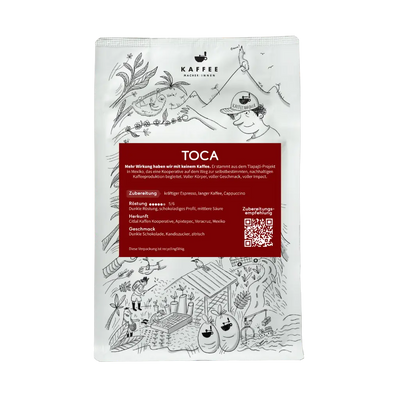













Nano. These are coffees that keep showing us why we make coffee in the first place. We want to share these coffees with you and invite you on a sensory journey.
We regularly taste coffees that surprise us. Often these are coffees available only in small quantities. Those that are rare because they were produced with incredible effort, or because they come from producers who themselves own very little land.
We wanted to create a new line in our assortment for these coffees. Nano. Nano stands for exactly these coffees that are severely limited. Coffees that are so beautiful we want to dive into them. Coffees that keep showing us why we actually make coffee.
Why do some coffees taste so different?
Good coffee is no accident. Names don't help make a coffee better – it's solely about focusing on details, about the relentless drive to work as precisely as possible, to understand all influencing factors and to use them deliberately.


Good coffee therefore requires, besides time, a great deal of attention. Not every coffee can be monitored so closely, as this would hardly be economically feasible. A growing minority of producers who manage to keep refining beyond their main production are devoting ever more attention to these special preparations.
So for a coffee to be much better than others, it takes:
- coffee cherries equipped with all necessary nutrients
- a uniform ripeness level of the cherries
- precise separation of the cherries into floaters (defective or damaged) and sinkers (intact and ripe)
- clean separation of fruit pulp and seed when pulped
- an extremely precise drying protocol when dry processed
- a meticulously clean environment when the cherries are further processed in a closed environment (bag, barrel, tank, etc.)
- control over shade-sun ratio during drying, pH levels, air/no air, etc.
- slow, even and controlled drying of the parchment
- cool, dry, stable storage of the parchment


We choose the roasting approach at the end based on what the coffee is like. We generally roast washed coffees with more energy, dry processed ones with somewhat less energy, especially toward the end of the roast.
With roasting we only bring out what's already in the coffee. Roasting these coffees is of course fun, but there's also a lot of adrenaline involved – because the work that went into each bean is enormous.
Which coffees make it into the Nano line?
These are coffees that convince us both sensorily and stand for change. We have no preferences about where these coffees must come from, we're completely open about it.
Regularity
We don't set when a new Nano coffee comes into our assortment. It happens when we discover a coffee that won't let us go.
Rarities
The coffees are available only in limited quantities. First come, first served, or as they say – the quicker you are, the quicker you get it.