
















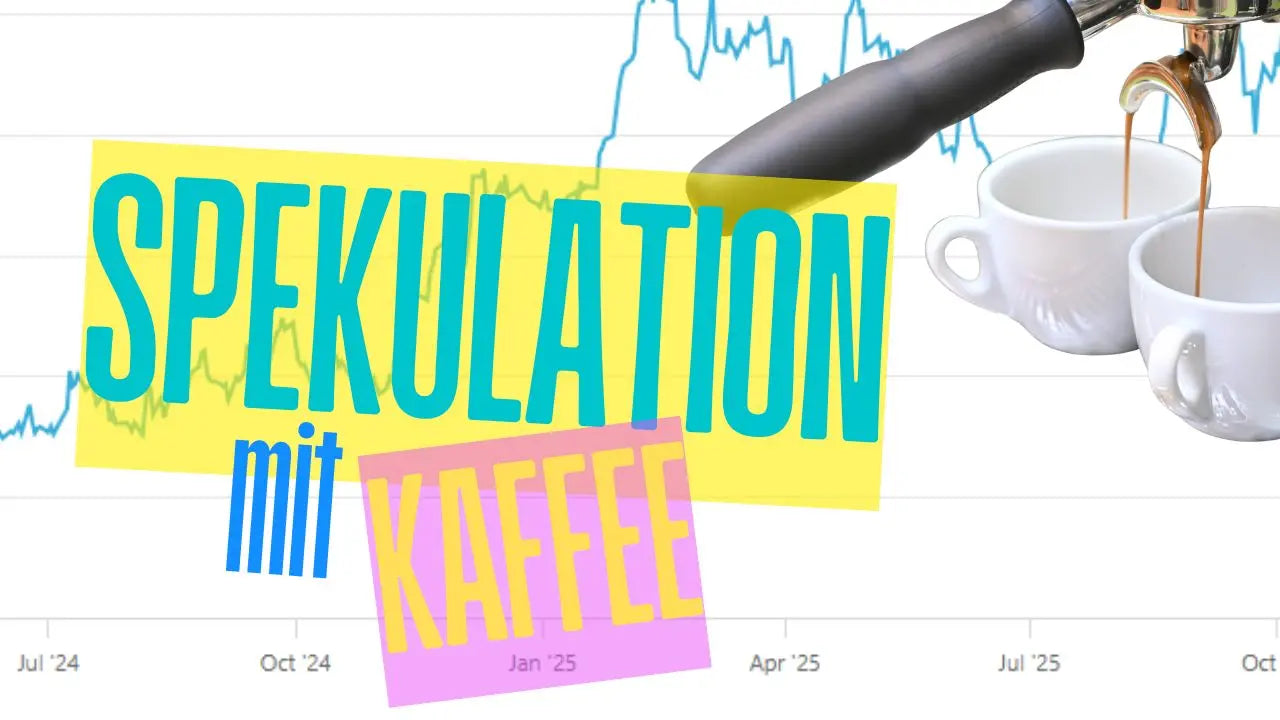

In fall 2024, coffee prices skyrocketed to record highs and remained as high as never before throughout 2025. But why? I made two videos about it and identified the origin in Brazil's poor harvest, only then in excessive speculation. (Video from January 2025) and an update in November 2025.
In between, I repeatedly read and heard that this unprecedented rise was the direct product of commodity speculation and that many of the sharp fluctuations couldn't be explained rationally.
Attributing all these movements to "speculation" wasn't convincing enough for me and, above all, not precise. Until then, I felt the word more than I understood it. So I wanted to know more and embarked on an intensive learning journey.
At the beginning of this learning journey, I actually had just one question:
- Who sets the coffee price?
- And why does it sometimes move so sharply up or down, and even within a single day?
I wanted to know if it's really true, what you keep hearing: That speculation distorts prices. That investors drive the market. That speculation is the catalyst for upward or downward movements.
And I also wanted to know whether we're making life harder for ourselves than it needs to be. Whether the idea that "the speculators" are to blame is correct. Or whether with this idea we're just dodging the need to understand a more complicated system.
"Speculation is to blame!"
Since the price increase of green coffee on the exchange (the so-called C-Market) in November 2024, I've engaged with the topic more intensively than ever in my coffee career. First, I wanted to understand exactly what was happening, how we as a coffee roastery could orient ourselves, what it meant for producers, and how we could develop a vision together.
And at some point, I heard more and more that this was all the work of "the speculators." When the Lavazza CEO said in summer 2025 that 80% of the movement came from hedge funds, I nodded at first, but then became skeptical — and above all curious. "Speculation" doesn't really explain anything in the first place; it rather stirs up emotions.
"Many people use speculation as an explanation when there's a lack of explanations."
So I sat down, listened, and asked questions. With people who trade coffee. With people who produce coffee. And with analysts who have been observing commodity markets for decades.
The deeper I went, the clearer it became: There's no simple story. But there are many layers.
What is speculation? About futures, shorts, and longs
I wanted to understand the mechanics behind coffee price formation and speculation on coffee. So I talked with Heinz Zimmermann, professor emeritus of financial market theory in Basel. He said a sentence that would stay with me later on:
"Speculation is not the problem. Excessive speculation is the problem."

Because: Speculation serves a function. It's part of the counterparty for producers who sell futures to hedge their prices against lower prices (to hedge against price declines).
An example:
If twelve producers want to hedge their harvest and sell futures (a future is a contract that stipulates that someone must buy or sell a specific amount of coffee at a specific price in the future), but only three roasters want to buy, then an imbalance arises. Speculators fill this gap. Or as Heinz Zimmermann puts it: "Producers want to get rid of risk. Speculators take on risk."
When producers hedge a lot (protect themselves against falling prices) and sell futures, more open positions are created. And these must be bought. These can be so-called commercial actors, that is, traders or roasters. But if they don't buy, then speculators step in. In stock market terminology, they now go long, while the hedging producers go short.
For balance to exist here, for the market to function at all, offers must be covered by demand. And speculators then take on these open positions.
How do speculators make money?
The interest of speculators is purely monetary in nature. For them, it's not about the physical product coffee, but about making financial gains.
This gain occurs when there are changes in the coffee market. Whether prices go up or down is secondary: the profit results from the change in price.
If you buy at a lower price and sell higher, you make a profit, just like someone who expects falling prices. Then speculators go short, selling a future at a high price that they don't even own yet.
If the price falls later, they buy the future back cheaper. Here too, the difference is the profit.
This movement, or volatility, is the magnet for speculators. But too much volatility isn't attractive for them either, Judy Ganes told me.
When speculation becomes too much: excessive speculation
I wanted to ask Judy Ganes who actually speculates here? Judy Ganes worked on Wall Street for a longer time, has been following commodity markets for decades, and says:
"Speculators are the scapegoat. Always."

She doesn't believe the thesis that private investment funds are destroying the market. She says speculators amplify movements, but they don't create them. Everything begins in the cash market, in physical reality.
Aside: the cash market: Here, actual, physically available green coffee is traded. In contrast to the futures market, the cash market deals with immediate delivery and actual demand today, not in the future.
Judy explains further that speculation can be an amplification of already existing trends. And at the same time, I see with Heinz Zimmermann's glasses: Amplification is not harmless. Amplification can cause more damage than the trigger itself.
If a frost threatens, that's what's called a fundamental factor. But if billions flow into the market within minutes because algorithms recognize a correlation, then the market hasn't just reacted, it has overreacted.
Heinz puts it soberly: "Volatility is higher than what would be fundamentally necessary." And that's the point at which speculation becomes excessive speculation.
How volatility feels at the coffee origin

Volatility, the constantly changing state, is interesting to a certain extent for speculators on one side. Roasteries become hesitant with purchases, because a small price shift can have a large impact on awarding an order to a customer. For producers, on the other hand, volatility is a nerve-wracking ordeal.
The coffee will soon be or has just been harvested. But at what price do I sell the coffee as a producer now? Or rather: When do I sell it if the price is constantly changing? And who buys it when?
Many producers in recent months were ready to sell coffee, but buyers didn't want to buy. So, César Marin reports in the podcast, producers ended up holding two harvests and waiting for someone to buy their coffee.
César also says that the coffee price determines whether a producer in Peru can finance their harvest. It determines whether a cooperative loses loyal members or whether an entire region gets new buyers who show up with cash that nobody expected.

Miguel Guevara
High volatility is difficult for all participants in the coffee chain because it doesn't allow for long-term planning without a lot of risk.
Miguel Guevara from our partners at Ensambles in Mexico assesses the situation for smallholder producers like this:
"La gente de cereza se la pasa revisando diario la bolsa."
The producers who sell coffee in cherries check the New York coffee price every day. "Every day." Producers who sell their coffee in parchment/pergamino live in a different time frame. There, prices are adjusted more slowly, volatility arrives muffled. "But it always comes."

Excessive speculation and the resulting volatility thus not only changes the macro level and the C-price rapidly, it changes the pace at which people on the ground make decisions. But above all, it creates uncertainty: whether producers sell today or tomorrow and whether they stay loyal to a cooperative or not.
And that's a stark contrast:
On one side, we have market participants making short-term decisions at their screens, but their effects are felt thousands of kilometers away in coffee-producing countries. What's striking is that a decision at the screen is made quickly, but agriculture is slow. It takes three years for a coffee tree to even bear fruit. So two completely different worlds stand opposite each other, but are connected through the coffee market.
"Coffee doesn't wait"
One of the sentences that stuck with me on this journey came from producer and friend César Marin from Peru. He said: "El café no espera." Coffee doesn't wait.
When I heard that, I didn't yet know how central this sentence would become. But it suddenly stood as a symbol for everything that can happen in the coffee market when prices rise or fall in the shortest time.
César told me how it was in his region around Villa Rica in 2025. The harvest was there, the coffee cherries were ripe, but nobody wanted to buy.
"There was coffee," he says. "But nobody bought coffee."
Producers had picked and processed coffee, but there were no buyers because collection points in the region were closed. And so there was this stalemate: The sellers (the producers) wanted to sell coffee because prices were high. The buyers (e.g., the collection points) didn't want to buy coffee because the price was too high for them.
At the same time, new buyers suddenly appeared, and nobody knew who they represented. Collection points that paid 450 to 470 cts/lb per pound of parchment — prices never seen before. César says: "I believe these were companies from Colombia, Honduras, and Brazil." Companies, that is, that couldn't buy enough coffee from their own markets and therefore came to Peru to cover their demand.
Why the industry can't just watch
I also spoke with people who buy coffee in large quantities: the purchasing manager of a large European retailer, as well as the green coffee buyer for one of Europe's largest roasteries. When it comes to volumes, the lever up and down is bigger.
"Volatility can destroy your accounting," says the purchasing manager.
"If you buy 20,000 tons of coffee and the price fluctuates by twenty or thirty cents in a short time, that's millions of dollars." The green coffee buyer confirms this statement:
"There are always winners and losers. But the problem isn't the price. The problem is the speed."
He gave me this example: If competitor A makes a contract for green coffee at $4.25/lb (approx. $9.37/kg) and competitor B buys at $4.10/lb and the competitor at $4.00/lb (approx. $9.04/kg), then that decides competitiveness and thus the awarding of contracts.
The industry tries to adapt. Purchasing now sits much closer with sales and the finance department. And the customer themselves is included in the planning.
The sharp fluctuations and high prices have resulted in more money in the market than ever before. Traders too are reaching their limits, as they first buy and then sell coffee in their commercial function. They too borrow the money for this. Money volumes have increased massively since November 2024. David Neumann also comments on this in this podcast episode.
Why speculation is necessary — but remains dangerous at the same time
After this long journey, I don't stand here and say: Speculation is the problem. But I do say: Excessive speculation is a problem. And a serious one at that.
Speculation is necessary so that producers can hedge their prices. Without speculators, there would be no functioning futures market. But when capital inflows become too large, when models blindly amplify trends, when liquidity doesn't stabilize but accelerates, then producers, traders, cooperatives, and also roasters become extras in a market that moves faster than any real decision.
It's often said that the market is always right. I would say: The market always produces a result. But whether it's right shows itself only later.
And that "later" is often the next harvest.